
The Public Service Commission of Wisconsin (PSC) recently released two documents that provide useful insights into the past, present, and future of renewable energy development for our state. The PSC’s 2025 Renewable Portfolio Standard (RPS) memo provides statistics regarding utility-scale renewable energy that serves Wisconsin’s electricity needs, including projects located in Wisconsin and in neighboring states. The 2026-2032 Draft Strategic Energy Assessment (SEA) provides many insights, and most pertinent to the renewable industry, the SEA outlines utility plans for additional renewable energy development.
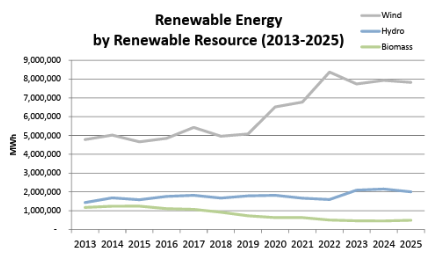
In short, the RPS memo tells a high-level tale of how Wisconsin got to where we are today with renewable energy. It shows that while wind-generating facilities have historically met most of Wisconsin’s renewable energy needs, production from new Wisconsin-based solar projects has increased the total amount of renewable energy that we use. As of 2025, about 20% of all the electricity we use in Wisconsin comes from renewable energy.
Separately, the draft SEA paints a picture of what the future could hold for Wisconsin. According to utility plans, the growth of Wisconsin-based solar will continue through 2030, as will battery energy storage systems (BESS) that support clean energy integration. Starting in 2030, utilities are planning for new Wisconsin-based wind projects to come online and add to Wisconsin’s renewable energy portfolio. This begs the question: Is Wisconsin on track to add enough renewable resources to serve our future needs? Due to policy uncertainty and speculative data center growth, the crystal ball is much too murky to answer that question with much confidence.
The 2025 RPS Memo
Let’s begin with a look back at Wisconsin’s historical renewable energy development. This figure from the RPS memo shows the growth of wind energy serving Wisconsin’s needs compared to baseline hydroelectric and biogas/biomass resources over the last decade plus:
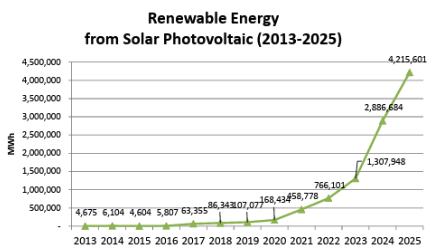
And this PSC figure below presents utility-scale solar production over that same time span separately, as solar production was relatively flat until about 2020:
While the RPS memo does not provide detailed historical stats, based on RENEW’s participation in PSC cases and observation of renewable energy trends, we can provide insight into renewable energy development. This includes development that occurred before 2013 and new trends shown in the RPS memo figures.
Between 2008 and 2013, renewable energy growth in Wisconsin was mostly driven by wind projects. According to the 2012 RPS memo, at that time, wind projects located in neighboring states contributed about 43% (2.8 million Megawatt-hours, or MWh) to Wisconsin’s renewable energy portfolio. Wisconsin-based wind projects contributed another 20% (1.3 million MWh). Altogether, wind production made up about two-thirds of Wisconsin’s renewable portfolio, with baseline hydroelectric and landfill gas making up most of the rest. The addition of these wind facilities after 2008 helped Wisconsin reach the 10% statewide renewable energy goal for the first time in 2013.
While growth in all renewable energy serving Wisconsin fell flat between 2013 and 2019, in 2020, wind energy production began to increase again, thanks to new projects. A new trend began here as well. For the first time, utility-scale solar projects located in Wisconsin came online and started to significantly contribute to our renewable energy portfolio.
The 2025 RPS memo pie chart below presents a snapshot of what renewable resources serve Wisconsin’s electricity needs today. This is Wisconsin’s current renewable energy portfolio:
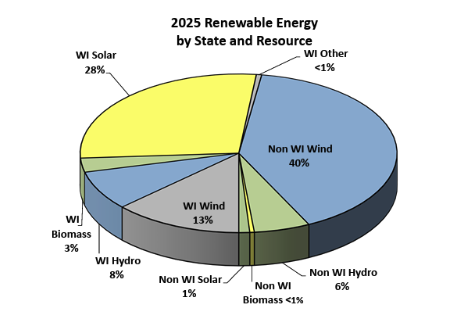
While non-Wisconsin-based wind projects used to occupy about two-thirds of this pie in the mid-2010s, that percentage has shrunk – not due to a reduction in wind production, but due to the growth of Wisconsin-based solar. In fact, while non-Wisconsin wind production increased from 2.8 million MWh in 2012 to 5.9 million in 2025, Wisconsin solar production grew astronomically over that same period – from a mere 5,000 MWh in 2012 to 4.2 million MWh in 2025.
The PSC only counts renewable energy production from facilities certified by the PSC as renewable resources, either owned by Wisconsin utilities or contracted by them to serve Wisconsin’s electricity needs. Each year, the PSC calculates the RPS percentage as total renewable energy production from these facilities divided by total retail sales of electricity to Wisconsin customers.
The main takeaway from the 2025 RPS memo is that renewable energy now serves about 20% of Wisconsin’s electricity needs. This includes a doubling in percentage from 10% in 2013, when Wisconsin first met its statewide goal, and a noticeable uptick from 2024, when 18.5% of our electricity came from renewables. To see where Wisconsin is headed, we will now have to look at the draft SEA.
The Strategic Energy Assessment (SEA) 2026-2032
The SEA is a forward-looking document that attempts to project future needs and future supply within Wisconsin’s electricity industry. Wisconsin does not have an Integrated Resource Plan (IRP), as many utility-regulated states do. To somewhat fill that IRP gap, the SEA serves as an information-gathering and reporting process that the PSC is required to do by state law. The PSC released a draft that covers the 2026-2032 period and is now seeking public comments through September 28 to inform updates and edits made to its final revised report.
The first takeaway from the draft SEA is the projected rise of data centers in Wisconsin. Over the 2026-2032 period, collective utility forecasts project a 40% increase in statewide summer peak. The SEA also states that 72% of this projected increase is due to new data centers and their electricity needs.
While this blog will focus on renewable energy insights provided by the SEA, we must also note that bullish utility projections of new data centers in Wisconsin are highly uncertain, and that the SEA does not provide a rigorous vetting of utility forecasts that would be included within IRP proceedings.
Before we delve further into the SEA outlook for renewable development, let us reference one important SEA statistic that the RPS memo misses. That statistic is the installed capacity of customer-owned solar, which can also help us understand a fuller picture of Wisconsin’s renewable energy production. The SEA states that in 2025, Wisconsin residents and businesses owned 318 Megawatts (MW) of rooftop solar. If we assume a 13% average capacity factor for rooftop solar, this equates to about 362,000 MWh of electricity produced by these customer-owned solar systems in 2025.
Since utilities do not register these customer-owned solar systems for RPS compliance, the RPS memo does not capture Wisconsinites’ direct contribution to Wisconsin’s renewable portfolio. But if you insert the Wisconsin rooftop solar production estimate into the calculation of that 20% RPS statistic mentioned above, Wisconsin’s 2025 statewide renewable energy percentage increases to about 21.4%.
As we turn to the SEA’s 2032 renewable projections, it is important to note Wisconsin’s current installed capacity of renewable resources. Wisconsin currently has 2,189 MW of utility-scale solar generating capacity, 827 MW of wind generating capacity, and 510 MW of BESS storage capacity in service.
From this understanding of Wisconsin’s current generation portfolio, we can better contextualize the planned build-out coming over the next several years. The table below is informed by SEA-collected statistics and reflects utility-planned additions:
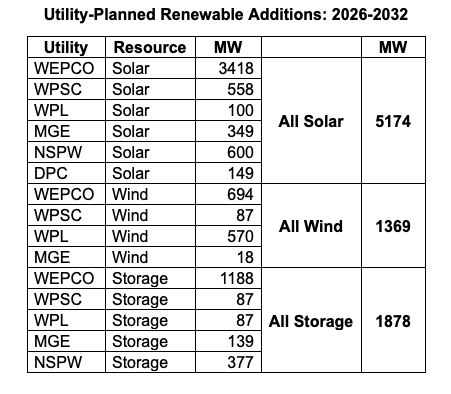
If these plans fully come to fruition, by 2032, Wisconsin will nearly triple its in-state solar and wind generating capacity and more than quadruple its current capacity to store electricity.
Based on other information within the SEA, a bit more insight can be shared with regard to the start-up timing of these resources. The start of operations for these solar and BESS resources will mostly occur between 2026 and 2030. Many of these solar and battery projects have already been approved by, or have applications pending before, the PSC. Applications for Wisconsin wind additions are just now beginning to be presented to the PSC. Those wind projects would likely start operating between 2030 and 2032.
Later this summer, RENEW plans to follow up on this blog to compare the SEA 2032 clean energy projection to the 2050 modeling results for what Wisconsin will need according to our Wisconsin Zero Carbon Study.