by jboullion | Sep 23, 2011 | Uncategorized
From an article on ControlDesign.com:
It was like the Egyptian obelisk going up in “The 10 Commandments,” only it was a lot faster, and the slaves were replaced by portable hydraulics. Oh, and there was a 32 ft diameter fan at the top.
This was the scene on a sunny, early-September afternoon as Wago installed a 100 ft tall wind turbine next to its U.S. headquarters in Germantown, Wis. And, as if the gleaming white tower wasn’t impressive enough, it was “tipped up” in an amazing 8-10 minutes by a portable hydraulic unit hooked up right next to the tower. After that, it took only another 15 minutes to bolt down the tower, hook up its electronics, and get it spinning in the breeze of Wisconsin’s famous “dairy air.”
Capable of generating 20 kW for Wago’s multi-function facility, the small-scale, commercial-grade VP-20 turbine was built by Renewegy in nearby Oshkosh, Wis. The turbine employs Wago’s 787 Series power supplies, 756 Series cables/connectors, 288 Series fuse blocks and backup capacitor module.
The wind turbine’s initial cost was $80,000, but state and federal incentives allow Wago to reduce its bill by about $35,000. Other VP-20s have been installed at SCA Tissue in Neenah, Wis., and at the North Texas Job Corp Center in McKinney, Texas. Renewegy reports that it can install single 20 kW units on farms, 40 kW dual units to serve schools, and 100 kW five-unit systems for small wind farms and commercial applications.
by jboullion | Sep 22, 2011 | Uncategorized
From a news release by Dairyland Power:
Methane digester located in Eau Claire Energy Cooperative’s service territory
LA CROSSE, WI— Dairyland Power Cooperative has signed an agreement with Bush Brothers & Co. to purchase the renewable energy and capacity from a new anaerobic wastewater system located in Augusta, Wis. The system will be served by Eau Claire Energy Cooperative, a Dairyland member.
Construction on the renewable energy facility is nearing completion, and commercial operation is expected in early 2012.
“It is a significant milestone when three entities work together to create yet another renewable energy facility for the benefit of the communities we all serve. Renewable energy facilities, including the new one at the Bush Brothers facility at Augusta, have added a positive element to the way we provide electricity for our co-op members,” said Eau Claire Energy Cooperative CEO and President Lynn Thompson.
The digester plant at the industrial wastewater facility is designed to process biogas produced in a covered lagoon to power a 635 kW generator. This is projected to produce enough renewable energy to power nearly 500 homes in the Dairyland system.
“The anaerobic digester represents a responsible method for handling plant waste and we are glad to have it as a part of our manufacturing process,” said Joe Breid, Director of Operations for the Bush Brothers plant in Augusta.
Once operational, the Bush Brothers facility will represent the seventh methane digester within the Dairyland system, and the first industrial use. The first six digester f if acilities are “cow power” plants, utilizing dairy cow manure as the source from which methane gas is derived to fuel the generators and create renewable energy. . . .
About Bush Brothers
Founded in 1908, Bush Brothers & Company is a privately owned food processor headquartered in Knoxville, Tenn. Best known for their baked beans, Bush’s also offers more than 30 varieties of canned beans including kidney, pinto and black. Bush Brothers & Company is still family owned and operated, working for the same ideals that were set forth by A.J. Bush more than 100 years ago – ensuring the highest quality and best taste can be found in all their products. Bush’s sells one-third of all canned beans in the U.S., making it the top bean brand in the country. Its signature commercials of Jay Bush and his Golden Retriever, Duke, have made Bush’s Beans a familiar household name. For more information, visit www.bushbeans.com.
by jboullion | Sep 20, 2011 | Uncategorized
We are having a “Lake Country Moving to Solar” bash at Lake Country Unitarian Universalist Church, W299N5595 Grace Drive in Hartland from noon to 4 this Saturday, celebrating our 19.68 kW solar PV system which came on-line last month. We are having speakers INCLUCING MICHAEL VICKERMAN, musicians, tours of the solar installation and community garden on the premises, solar tea and other snacks, informational tables including a petition to Obama, Kohl, and Johnson to Move Away from Fossil Fuels, and children’s activities. We will have preferred parking for bikes and hi-mpg vehicles!
Hope you all can make it to this. Call me (Gerry Flakas) at 262-646-2703 if you have any questions.
by jboullion | Sep 15, 2011 | Uncategorized
From an article by Tom Held and Thomas Content in the Milwaukee Journal Sentinel:
A project to build a wind turbine adjacent to the Port of Milwaukee’s administration building will move forward after a contractor agreed to increase its use of businesses owned by minorities or women.
The Board of Harbor Commissioners gave the project a go-ahead at a meeting Wednesday morning. The board had delayed action on the contract last month because of concerns about participation levels of minority and female-owned businesses.
“We’re excited to see this project move forward and we’re glad that the issues the board raised were able to be resolved successfully,” said Matt Howard, the city’s environmental sustainability director.
The low bidder on the project, Kettle View Renewable Energy of Random Lake, offered to boost minority hiring on the project in order to keep the project on track. The vote to approve the $520,922 contract was unanimous.
Construction of a foundation is expected to start in the coming weeks, with the tower and turbine to be installed in the spring.
The 154-foot turbine would be located just north of the port administration building on South Lincoln Memorial Drive, west of the Lake Express ferry terminal.
Kettle View was the low bidder among five firms that submitted proposals for the project.
As proposed, a combination of $400,000 in federal renewable-energy stimulus money and grants of up to $100,000 each from the state Focus on Energy Program and We Energies would pay for the wind turbine.
The turbine for the project would be made in Vermont by Northern Power Systems. Kettle View is considering a Wisconsin contractor for the turbine tower, said Erick Shambarger of the city’s environmental sustainability office.
The project aims to demonstrate the city’s commitment to clean energy and provide more than enough electricity to meet the needs of the port administration building.
The wind turbine that the city selected is less than half the height of a utility-scale wind turbine, such as those erected in Fond du Lac County in recent years.
It’s shorter than the Bay View Terrace condominium tower along the lake, but taller than the small turbines that are outside the Discovery World museum.
It would generate enough electricity over a year’s time to power up to 15 typical homes.
The city is forecasting savings on utilities plus energy-related revenues totaling $14,000 to $20,000 a year.
The turbine that’s planned for the site is the same model as those built in recent years around the state, at Wausau East High School, the Fort Atkinson campus of Madison Area Technical College and the Village of Cascade in Sheboygan County.
by jboullion | Sep 14, 2011 | Uncategorized
The University of Wisconsin Milwaukee was awarded 1.5 million dollars from the DOE (Department of Energy) in order to continue to train under-graduate and graduate level engineering students to become future leaders in industrial energy efficiency. The award is part of a larger 30 million dollar DOE grant given to 24 universities across the county, who currently are leaders in this field. The money will be used to set up an assessment center where students will be able to learn, though working with larger corporations and smaller businesses, how to reduce energy waste and save money through energy efficiency. The money will be given to UW Milwaukee in installments over the next 5 years. Energy Secretary Steven Chu thinks this will open the door to new jobs in this ever growing industry.
Other universities receiving the grant
by jboullion | Sep 12, 2011 | Uncategorized
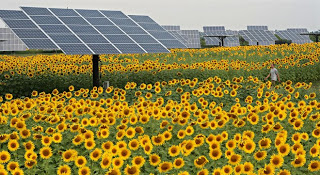
Delavan – Welcome to the field where sun power and the sunflower meet.
Well, not just one sunflower. More like thousands. And not just one solar panel, either. Thousands there, too.
Convergence Energy of Lake Geneva is building one of the largest solar projects in the state, and the first that allows individual investors to buy a stake in the project.
The Convergence Energy Solar Farm began construction last year on 14 acres near Dan Osborn’s wholesale nursery.
The idea, said Steve Johnson, vice president of business development, is to provide a green-power investment opportunity for people who live in a condo or have too much shade to make solar power workable on their own home’s roof.
By the time it’s finished this year, it will be the second-largest solar project in Wisconsin, after Epic Systems’ corporate campus solar project in Verona.
But instead of being developed by one large company, this project is being built, piece by piece, as investors take a stake in the project.
“It’s a way for a small investor to have a part in it all,” said investor Dave Smith of Libertyville, Ill. “When you live in a town home like I do, there’s nothing you can really do.”
Smith bought one of the Convergence systems at a time when the economy and stock market were in rough shape.
“I thought, why should I invest in anonymous equities and bonds when I can invest in a local company that I can keep an eye on, that’s doing something good and will probably pay returns?” he said. “So I was very excited about it.”
Johnson said, “We call it networked solar. It allows people whose homes aren’t oriented toward the sun properly to take part. They might be in the woods. Or some may not like the aesthetics of the panels on the roof.”
The project allows those people to still have a stake in something they believe in, Johnson said.
Convergence developed the project, obtaining funding from the state’s Focus on Energy program as well as a U.S. Treasury Department financing program authorized by the federal stimulus package.
Now, the company offers investors a stake in the project by investing at least $16,000 for a system, which amounts to 80 or so panels erected across three tracking towers. Each system of three towers generates up to 20 kilowatts of electricity, and dozens of the towers stretch across the land.
One advantage, compared with conventional rooftop solar systems, is that these panels are erected on dual-axis trackers, so they rotate during the day to follow the sun. That generates about 30% more power than a fixed solar system, Johnson said.
Convergence leased the land from Osborn, who opted to grow sunflowers this summer in between the rows of panels. He wants to press the sunflower seeds into oil that could be used in biodiesel.
Osborn’s business has been running a tractor on biodiesel for years, so this just made sense, he said. Osborn estimates he could end up with 600 gallons of fuel from the sunflowers that are now in full bloom and face toward the sun each morning.
Osborn has invested in several of the tracking systems and says he did it to offset the power used by his business, his home and the homes of his children, who live nearby.
“This is my little part, you know. It’s clean and it’s the sun, and it’s what we should all be doing,” he said.
Power produced by the project is sold to We Energies, with Convergence in turn passing that income on to its investors.
“It wasn’t all about the money,” Smith said. “I wanted to paint my own corporation’s name on the pole and say, ‘Look, we’ve invested in solar.’ We’re offsetting our carbon footprint.”
We Energies has been a strong supporter of the project, Johnson said.
Ryan Logterman is proud to be a part of the project, which helped create jobs for his firm, Logterman Heating and Cooling, more than doubling its workforce in the past few years.
Logterman also is an investor in the project.
“We’re all in. We are all investing in this ourselves. I’ve got the end of the second row,” he said, gesturing across the field. “I’m on System No. 10.”
Logterman’s heating, ventilating and air conditioning business employed three people five years ago when he began work in the industry as a solar thermal installer.
Today, Logterman’s business has 10 employees, one crew working exclusively digging trenches, building foundations and wiring Convergence Energy’s solar panels.
“It’s a good feeling. We’re doing something positive. We’re generating renewable power, and I’m hiring more people and helping the local economy,” Logterman said. “We try to buy as much material as we can from local wholesalers.”
Convergence is keeping it local, too, buying panels from the Helios Solar Works factory that opened this year in Milwaukee’s Menomonee Valley. Convergence was Helios’ first customer, and that firm has been adding more workers as it builds its customer base.
Customers and investors alike appreciate the made-in-Wisconsin flavor of the project, Johnson said, adding that Helios panels were selected because they’re more efficient than the typical photovoltaic panel.
“The whole thing about renewables is about local economies. We’re really striving to build local economies,” Johnson said. “It’s providing an opportunity for people who want to invest in solar and put a little more clean energy on the grid.”
This article was written by Thomas Content of the Journal Sentinel
by jboullion | Aug 29, 2011 | Uncategorized
From an article by Bill Berry in The Capital Times:
STEVENS POINT – As long as various groups are seeking relief from onerous and burdensome taxes, why don’t we have a tax break for bicycle commuters?
Many of us in this category have commuted to and from work for decades. OK, let’s be honest. We feel sorry for the poor souls trapped in motor vehicles. They look so forlorn and detached from the world around them. Bicycle commuters, on the other hand, have no choice but to be attuned and aware, with 2,000-pound monsters all around us.
Frankly, biking to and from work is the best part of the job. In a city like this one, a brisk morning ride through residential neighborhoods is a gift not to be underrated. There are birds and gardens and tidy lawns along the way. The bustling rail yards that bisect the city are full of sights and sounds. . . .
On second thought, forget it. We get enough benefits anyway. We’re not a bunch of fat-cat beggars looking to skirt our civic responsibilities. We’re doing our part, and we already know we’re getting a better deal by hopping on a two-wheeler. We already save money by biking. We arrive at work fit, awake and ready for the day’s tasks.
We don’t need no stinkin’ tax breaks. . . .
by jboullion | Aug 26, 2011 | Uncategorized
From an article by Claudia Broman in the Ashland Current:
A commitment by the state to support a clean economy could result in Wisconsin residents having lower utility bills, more jobs and cleaner air, according to two separate studies released earlier this summer.
“Unfortunately, Wisconsin’s clean economy is in danger of losing a good deal of its steam as a result of policy rollbacks and funding cutbacks in the renewable energy arena,” said Michael Vickerman, executive director of RENEW Wisconsin, a statewide organization advocating for public policies and private initiatives that advance renewable energy. “The short-sighted attacks we’ve seen in 2011 could throw the state’s clean economy into reverse next year.”
So far this year, RENEW says the state’s Legislature has reduced funding for Focus on Energy, suspended the statewide rule regulating the permitting of wind turbines, and weakened the state’s renewable energy standard by allowing utilities to count Canadian hydropower toward their requirements.
by jboullion | Aug 26, 2011 | Uncategorized
From an article by Kathleen Foody in the Stevens Point Journal:
ROTHSCHILD — Village residents and commuters on Business Highway 51 can expect traffic snarls as about 150 trucks hauling construction materials pour in and out of the Domtar paper mill today.
Rothschild Police Chief Dean Albrecht said Boldt Construction, the Appleton firm overseeing construction of a $255 million biomass power plant on Domtar’s site, asked his department to help control traffic during today’s work.
Officers will be at the intersection of Business Highway 51 and Weston Avenue from 5 a.m. until about 2 p.m. to help out, Albrecht said.
“We think traffic will go pretty smoothly; maybe some congestion during rush hour between 6 and 8 (a.m.),” he said.
We Energies spokesman Brian Manthey said crews will spend today pouring the foundation for the large boiler that will burn material at the plant, requiring the procession of trucks carrying materials.
Manthey said the traffic will be spaced out, with two or three trucks carrying material from County Materials plant locations in Wausau, Weston and Merrill entering or exiting the construction site at a time.
Once complete, the plant will burn about 500,000 tons of the tops and limbs of trees to generate energy for sale by We Energies and steam for Domtar’s paper-making process at the existing Rothschild mill. The plant is intended to help We Energies comply with state regulations requiring at least 8 percent of utilities’ sales to come from renewable energy sources by 2015.
To qualify for federal tax credits, the facility must be operational by the end of 2013.
by jboullion | Aug 25, 2011 | Uncategorized
Immediate release
August 25, 2011
More information
Michael Vickerman
Executive Director
608.255.4044
mvickerman@renewwisconsin.org
Wind Farm Productivity Comparable to Iowa’s
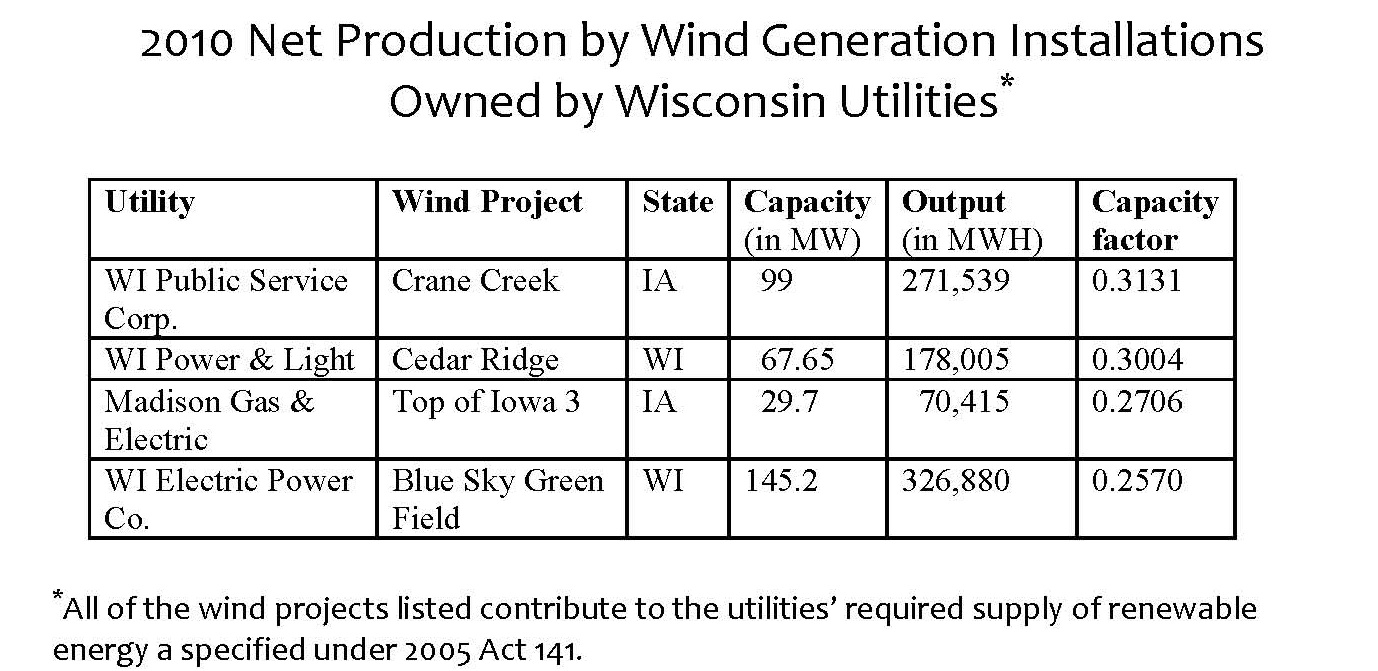
Production figures from wind energy projects owned by Wisconsin utilities reveal that there is no significant difference between wind farms in Iowa and the Badger State, according to an analysis of utility annual reports performed by RENEW Wisconsin, a statewide organization advocating for public policies and private initiatives that advance renewable energy.
The most productive wind project last year was Wisconsin Public Service’s Crane Creek project in Howard County, Iowa, followed closely by Wisconsin Power and Light’s Cedar Ridge project in Fond du Lac County. (See table below.) The output from both projects in 2010 exceeded 30 percent of their rated capacity. Capacity factor is a measure of actual output relative to potential output if the turbine ran 100 percent of the time at full capacity.
“These figures suggest that the winds in Wisconsin can deliver significant quantities of clean energy to nearby users,” said Michael Vickerman, executive director of RENEW. “This is especially true of the newer turbines with taller towers and longer blades.”
“Clearly Wisconsin ratepayers are getting their money’s worth from Wisconsin’s newest wind projects,” Vickerman said. “Moreover, the host communities reap considerable economic benefits in the form of payments to local governments and landowners.”
Differences in output between wind projects in the same region can be attributable to causes other than the wind resource itself. These can include shutdowns caused by grid congestion and operating restrictions aimed at minimizing impacts on wildlife and project neighbors.
“The evidence suggests that Cedar Ridge is a standout performer among Wisconsin wind projects, and every bit as productive as the projects in Iowa owned by Wisconsin utilities,” said Vickerman.
Click table to enlarge.