by jboullion | Oct 11, 2010 | Uncategorized
From a report published by the Wisconsin Sustainable Business Council, The Green Tier Porgram at the Wisconsin Department of Natural Resources, and the Wisconsin School of Business:
By 2007, 68,203 businesses in the United States had generated more than 770,000 jobs in the green economy (Pew Charitable Trust, 2009). Every state has a piece of America’s green economy. The leading states include Oregon, Maine,California, Colorado, Massachusetts and Minnesota. Wisconsin is not currently among the leading states:
SOURCE: PEW Charitable Trusts, 2009, based on the National Establishment Time Series 2007 Database; analysis by Pew Center on the Statesand Collaborative Economics
Green job growth in Wisconsin through the 2001 recession (where WI lost 100,000 manufacturing jobs that were never recovered) was anemic. Wisconsin has lost an additional 70,000 manufacturing jobs (through July, 2010) because of the recession of 2008 (Center on Wisconsin Strategy, 2010).
While Wisconsin ranks either first or second in the nation in manufacturing jobs per capita, there is still a great deal of idle capacity in Wisconsin.
In 2007, jobs associated with the green economy accounted for 0.49 percent of all jobs nationally. WI was slightly below the national average with 3,150,000 total jobs and 0.48 percent of them being green.
A closer look at the data reveals that Wisconsin ranks as a top ten state in energy efficiency jobs. Energy efficiency is one of the five types of green jobs identified in the Pew report. Wisconisn ranked sixth in energy efficiency with 2,801 jobs. Midwestern states generally did well in all sectors, with Minnesota, Michigan, and Illinois appearing among the top 10 states in multiple sectors.
In 2007, jobs associated with the green economy accounted for 0.49 percent of all jobs nationally. WI was slightly below the national average with 3,150,000 total jobs and 0.48 percent of them being green.
A closer look at the data reveals that Wisconsin ranks as a 2,801 jobs. Midwestern states generally did well in all sectors, with Minnesota, Michigan, and Illinois appearing amongthe top 10 states in multiple sectors.
The report concludes:
The United States, and Wisconsin, will be focused on job creation over the next five to ten years. Creating green jobs has to be a part of the future if we hope to maintain our roleas a manufacturing state. Green jobs will gravitate towards states that are the most attractive, or to states that actively increase their attractiveness relative to competing states. The states that actively recruit green businesses will prosper in the longer run.
Wisconsin has a long history of manufacturing strength, and we are increasingly attracting manufacturing companies that are creating green jobs. But we can do more. We have only to look at our neighboring states of Iowa or Minnesota to see the benefit of establsihing Wisconsin as a hotbed of green expertise.
New green businesses can create jobs, generate revenues, and help Wisconsin re-emerge as a bell-weather state in the heartland of America.
by jboullion | Oct 11, 2010 | Uncategorized
From a report published by the Wisconsin Sustainable Business Council, The Green Tier Porgram at the Wisconsin Department of Natural Resources, and the Wisconsin School of Business:
By 2007, 68,203 businesses in the United States had generated more than 770,000 jobs in the green economy (Pew Charitable Trust, 2009). Every state has a piece of America’s green economy. The leading states include Oregon, Maine,California, Colorado, Massachusetts and Minnesota. Wisconsin is not currently among the leading states:
SOURCE: PEW Charitable Trusts, 2009, based on the National Establishment Time Series 2007 Database; analysis by Pew Center on the Statesand Collaborative Economics
Green job growth in Wisconsin through the 2001 recession (where WI lost 100,000 manufacturing jobs that were never recovered) was anemic. Wisconsin has lost an additional 70,000 manufacturing jobs (through July, 2010) because of the recession of 2008 (Center on Wisconsin Strategy, 2010).
While Wisconsin ranks either first or second in the nation in manufacturing jobs per capita, there is still a great deal of idle capacity in Wisconsin.
In 2007, jobs associated with the green economy accounted for 0.49 percent of all jobs nationally. WI was slightly below the national average with 3,150,000 total jobs and 0.48 percent of them being green.
A closer look at the data reveals that Wisconsin ranks as a top ten state in energy efficiency jobs. Energy efficiency is one of the five types of green jobs identified in the Pew report. Wisconisn ranked sixth in energy efficiency with 2,801 jobs. Midwestern states generally did well in all sectors, with Minnesota, Michigan, and Illinois appearing among the top 10 states in multiple sectors.
In 2007, jobs associated with the green economy accounted for 0.49 percent of all jobs nationally. WI was slightly below the national average with 3,150,000 total jobs and 0.48 percent of them being green.
A closer look at the data reveals that Wisconsin ranks as a 2,801 jobs. Midwestern states generally did well in all sectors, with Minnesota, Michigan, and Illinois appearing amongthe top 10 states in multiple sectors.
The report concludes:
The United States, and Wisconsin, will be focused on job creation over the next five to ten years. Creating green jobs has to be a part of the future if we hope to maintain our roleas a manufacturing state. Green jobs will gravitate towards states that are the most attractive, or to states that actively increase their attractiveness relative to competing states. The states that actively recruit green businesses will prosper in the longer run.
Wisconsin has a long history of manufacturing strength, and we are increasingly attracting manufacturing companies that are creating green jobs. But we can do more. We have only to look at our neighboring states of Iowa or Minnesota to see the benefit of establsihing Wisconsin as a hotbed of green expertise.
New green businesses can create jobs, generate revenues, and help Wisconsin re-emerge as a bell-weather state in the heartland of America.
by jboullion | Oct 11, 2010 | Uncategorized

From a news release issued by Governor Jim Doyle:
Company to Install Anaerobic Digester and Create 13 Jobs
MADISON – Governor Jim Doyle today announced a $550,000 loan for Betin Incorporated from the State Energy Program (SEP). Department of Commerce Secretary Aaron Olver and Department of Agriculture, Trade and Consumer Protection Secretary Randy Romanski made the announcement today in Belmont on behalf of the Governor.
“In Wisconsin, we are taking the lead to not only address environmental challenges, but also to find opportunities for innovation and growth,” Governor Doyle said. “I’m pleased that we could help Betin, Inc. install technology to use renewable energy and cut costs.”
“We are grateful to operate in a state where our Governor and Department of Commerce recognize the need to encourage and support private projects like ours that build environmentally-sound solutions to manufacturing,” said company President Arnaud Solandt. “The loan will allow us to expand further and create new jobs within the community.”
The SEP loan is funded by the American Recovery and Reinvestment Act. Betin, Inc. is one of the nation’s largest goat-cheese manufacturers using the trade name Montchevre. It will install an anaerobic digester to process whey and waste water. The resulting methane will be used to help meet up to 80 percent of the company’s energy needs. The project will create 13 jobs and represent total investment of $3.5 million.
by jboullion | Oct 8, 2010 | Uncategorized
From an article by Tom Content in the Milwaukee Journal Sentinel:
The Wisconsin Sustainable Business Council has published a 2010 Green Jobs Report focusing on areas of opportunity and investment for the state to focus on to build jobs in the clean-tech sector.
The report sees opportunities in jobs linked to energy efficiency, green building, renewable energy and mass transit.
“Green jobs are a critical part of the state’s recovery from the recession,” said Tom Eggert, executive director of the business council and co-director of the business, environment and social responsibility program at the University of Wisconsin School of Business.
The aim of the report was to look at green jobs in Wisconsin at a time when other Midwest states have moved to capitalize and promote the attractiveness of their states for clean-tech companies, Eggert said.
“We can do more,” the report concludes. “We have only to look at our neighboring states of Iowa or Minnesota to see the benefit of establishing Wisconsin as a hotbed of green expertise.”
Strengths that the state can build on include its manufacturing tradition and the experience of its workforce in manufacturing technology, Eggert said.
“Green jobs will gravitate toward states that are the most attractive, or to states that actively increase their attractiveness relative to competing states,” the report says.
Wisconsin has invested heavily in energy efficiency initiatives and in research linked to cellulosic ethanol and biofuels. Cellulosic ethanol is a biofuel produced from wood, grasses, or the nonedible parts of plants.
But Eggert sees an opportunity by increasing the state’s renewable portfolio standard as a way to send a message to companies that may want to locate here that the state is committed to renewable energy. A renewable portfolio standard is a regulation that requires increased production of energy from renewable energy sources, such as wind, solar, biomass and geothermal.
by jboullion | Oct 8, 2010 | Uncategorized
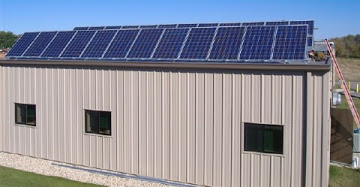
This week, New Glarus Utilities, a member of WPPI Energy, completed a new 5 kW solar project at their wastewater treatment plant located in the village. The energy produced will offset usage at the office building on-site.
by jboullion | Oct 7, 2010 | Uncategorized
From an Associated Press article by Dina Cappiello in the Milwaukee Journal Sentinel:
WASHINGTON (AP) — Solar power is coming to President Barack Obama’s house.
The most famous residence in America, which has already boosted its green credentials by planting a garden, plans to install solar panels atop the White House’s living quarters. The solar panels are to be installed by spring 2011, and will heat water for the first family and supply some electricity.
Energy Secretary Steven Chu announced the plans Tuesday in Washington at a conference of local, state, academic and nonprofit leaders aimed at identifying how the federal government can improve its environmental performance.
Former Presidents Jimmy Carter and George W. Bush both tapped the sun during their days in the White House. Carter in the late 1970s spent $30,000 on a solar water-heating system for West Wing offices. Bush’s solar systems powered a maintenance building and some of the mansion, and heated water for the pool.
Obama, who has championed renewable energy, has been under increasing pressure by the solar industry and environmental activists to lead by example by installing solar at 1600 Pennsylvania Avenue, something White House officials said has been under consideration since he first took office.
The decision perhaps has more import now after legislation to reduce global warming pollution died in the Senate, despite the White House’s support. Obama has vowed to try again on a smaller scale.
Last month, global warming activists with 350.org carried one of Carter’s solar panels – which were removed in 1986 – from Unity College in Maine to Washington to urge Obama to put solar panels on his roof. It was part of a global campaign to persuade world leaders to install solar on their homes. After a meeting with White House officials, they left Washington without a commitment.
Bill McKibben, the founder of the 350.org group, said Tuesday the administration did the right thing.
by jboullion | Oct 7, 2010 | Uncategorized
From an article by Jessica Larsen in the Tomah Journal:
Area residents got their chance on Tuesday to learn about a possible new 150-mile electric transmission line running from La Crosse to Madison.
American Transmission Company announced in July its plans for the 345-kilovolt line after a two-year study. Now the company is making its way to eight cities to host open houses for people to voice their opinions and learn more about the project, which it is calling the Badger Coulee Transmission Line Project. In Tomah, 143 people attended.
According to ATC, the line will improve system reliability, economic savings for utilites and energy consumers and access to additional renewable energy. It will improve electric system reliabilty in western Wisconsin by providing increased regional electric transfer capability into the state and alleviating stabilty issues in the upper Midwest, according to ATC reports. The company’s studies show that building a more efficient high-voltage line offsets the need for about $140 million in lower-voltage ugprades in western Wisconsin.
The route for the line is not set. Per state law, ATC will first look at existing transmission and other electric lines and pipelines. Next, it will turn to state and federal highways and railroads. After that, it will turn to receational trails and lastly will establish new corridors using section lines or property boundries when feasable.
At the open house, residents watched a seven-minute video about the project and then walked around to different stations to talk with ATC staff. People got a chance to leave comments and to give input on where they do not want the lines. Most popular was farm land and near schools.
“We are seeing a lot of curiosity,” said ATC local relations manager Sarah Justus. “We want input, and people appreciate the opportunity to have a stake in it. … We don’t know everything there is to know.”
by jboullion | Oct 6, 2010 | Uncategorized
From a news release issued by Focus on Energy:
Boost the bottom line while strategically managing energy use
Madison, Wis. (October 6, 2010)—In honor of Energy Awareness Month this October, businesses around the country are taking steps to reduce energy use by making cost-effective building improvements and getting staff involved to find smart solutions.
With cold weather on its way now is a great time for organizations to make sure they are well positioned to keep energy costs in check and save money this season, and year round. In fact, Focus on Energy, Wisconsin’s statewide program for energy efficiency and renewable energy, has already helped Wisconsin businesses save more than $212 million in annual energy costs since 2001.
If organizations are unsure how to get started, Focus offers these free and low-cost best practices to help businesses get ahead this season.
1. Start an energy management team. One cost-effective way to keep tabs on energy costs is to establish an energy team within the organization. Visit focusonenergy.com/energyteam for a free toolkit to help create a team and start implementing high-ROI, low-risk projects.
2. Install (and use!) a programmable thermostat. Businesses can save 1 percent on heating costs for each degree they lower the thermostat. Instead of adjusting the thermostat manually, make sure to install a system that will automatically manage the building’s temperature. Already have a system in place? Program it to achieve maximum savings, and don’t forget to adjust it with the shift from Daylight Saving Time, if necessary.
3. Weatherization can yield big savings. Weather-strip and caulk cracks in walls, jams, and floors. Check for worn-out weather-stripping and replace it.
4. Measure the facility for proper attic insulation. Consider upgrading with spray-foam or batt insulation. Additional insulation can be blown into walls, and there are options for insulating flat roofs, crawl spaces, and floors.
5. Maintain heating, ventilation, and air-conditioning equipment regularly. Facilities can reduce the energy use of heating and cooling systems by up to 6 percent simply by having them serviced regularly and changing air filters monthly. Don’t forget to keep the space around the system clean and clear to prevent debris from being pulled into the burners and filters.
6. Purchase energy-efficient equipment and lighting. When it comes time to replace equipment, look for the ENERGY STAR® label—an assurance of quality and energy efficiency. For lighting, install compact fluorescent bulbs for task lighting and high-performance T8 or pulse-start metal-halide systems for larger or high-bay applications. Lighting-control systems such as occupancy sensors and daylight sensors can help save even more.
7. Talk to the experts at Focus on Energy. We’re a one-stop resource for free technical expertise and financial incentives. Call us today at 800.762.7077 or visit focusonenergy.com.
by jboullion | Oct 6, 2010 | Uncategorized
From a story on WXOW-TV, La Crosse:
LA CROSSE, Wisconsin (WXOW)- Opponents of the use of coal to heat classrooms and dormitories at the UW-La Crosse held a rally to push for a transition to cleaner forms of energy.
Speakers at the rally emphasized damage to the environment and public health as reasons to stop using coal as an energy source. The rally also criticized what they call destructive methods used to mine the coal used to power the campus.
Representatives for the No Coal Coalition say that the transition to cleaner energy should not be complicated. The coal plant at UW-La Crosse is able to run on natural gas, which would be used as a transitional fuel until renewable sources of energy such as biomass can be used. The No Coal Coalition also mentioned that a new facility will not have to be built; only changes to the infrastructure will be needed.
by jboullion | Oct 5, 2010 | Uncategorized
By Michael Vickerman
September 30, 2010
On September 23, Alex DePillis and I hopped on board a tour bus filled with natural resource professionals and gave an overview of wind development in Wisconsin as we headed to the 54 MW Butler Ridge Wind Facility. The project is located in the Town of Herman in southeast Dodge County, a few miles west of State Highway 175. Most of the project’s 36 turbines are located south of State Highway 33.
The project was developed by Midwest Wind, which also developed the Cedar Ridge project owned by Alliant Energy. The project was sold to Babcock & Brown’s U.S. division, which then constructed the facility. The general contractor for that project was RES Americas. Butler Ridge was placed in commercial operation in March 2009. Right now, it is the newest utility-scale wind project in Wisconsin, but that distinction will only late this year, when Shirley Wind comes on-line.
In December 2009, NextEra Energy (formerly FPL Energy) bought Butler Ridge from Babcock and Brown. NextEra is also the owner of the Montfort project in Iowa County.
It turned out to be an excellent day to see wind generation in action. Thanks to a strengthening low pressure system to the west, there was a steady southerly air flow sweeping over southern Wisconsin that morning. Every flag we saw that morning was stiff as could be and pointing due north. Wind speeds at hub height ranged between 20 and 25 mph. The GE turbines were producing at about 75% of their rated capacity.
We stopped at Butler Ridge’s operations and maintenance center on Illinois Road. From the vantage point of the facility, we could see wind turbines in every direction. The closest turbine, at about 1,100 feet away, was audible but barely so.
Full article here.