by jboullion | Feb 4, 2010 | Uncategorized
From a story on WSAW-TV (Wausau):
Governor Jim Doyle is pushing for a clean energy bill to pass, and making his case in North Central Wisconsin.
He spoke at the Wausau business incubator today.
“This is where Wisconsin is going — and when you invest in green energy – this is the kind of new energy you should be investing in,” says Governor Jim Doyle.
Governor Doyle supports the ‘Clean Energy Jobs Act,” to make sure local clean energy businesses will be first in line to succeed.
“China is currently making greater investments in green energy than all of the United States and all of Europe. The world is moving rapidly in this direction and Wisconsin can’t just sit back watch it happen,” says the Governor.
The Governor says the energy bill would require the state to use renewable sources for 20 percent of its energy by 2020 and 25 percent by 2025.
He says this will reduce our need to rely on other states for things like coal and oil.
And he hopes it will add about 15,000 jobs to the Badger State.
by jboullion | Feb 3, 2010 | Uncategorized
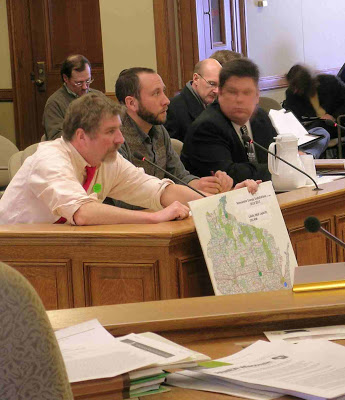
Michael Vickerman (left), Josh Stolzenburg (center), owner of North Wind Renewable Energy, LLC, Stevens Point, and Dave Miller, Wave Wind, LLC, Sun Prairie, testify in support of the Clean Energy Jobs Act bill before the Special Assembly Committee on Climate Change. Vickerman leans forward to show the committee members a map of renewable energy installations.
From a summary of Michael Vickerman’s (RENEW Wisconsin)
testimony before the Assembly Special Committee on Clean Energy, February 2, 2010:
RENEW Wisconsin strongly supports the provisions in SB450/AB649 to expand the state’s Renewable Energy Standard to 25% by 2025, which includes a 10% in-state renewable energy set-aside. RENEW has evaluated the availability of specific resources to reach that standard and has concluded that meeting such a target is technically feasible. If adopted, the in-state set-aside will become the most powerful engine for job development and capital investment over the next 15 years.
We expect such a requirement to be achieved through a combination of utility-scale power plants and smaller-scale generating units dispersed throughout Wisconsin. With respect to distributed renewable generation, we note the following:
1. The vast majority of the distributed renewable generating units installed in Wisconsin serve schools, dairy farms and other small businesses, churches and local governments.
2. Utilities are not in the business of installing these systems themselves.
3. In many cases the renewable energy installation went forward because there was a special buyback rate available to accelerate the recovery of the original investment made by the customer. Last week, I gave the example of the Dane County community anaerobic digester project that, once operational, will treat manure taken from several nearby dairy farms in the Waunakee area and produce two megawatts of electricity with it. The electricity will be purchased by Alliant Energy through a voluntary biogas tariff worth 9.3 cents/kWh. Unfortunately, Alliant’s biogas program is fully subscribed and is no longer available to other dairy farmers, food processing companies and wastewater treatment facilities served by Alliant.
4. Companies that install solar, wind and biogas energy systems are quintessentially small businesses, many of them family-owned. Renewable energy contractors and affiliated service providers constitute one of the few market sectors where young adults who have acquired the necessary skills to do the job well can find meaningful work at decent pay.
5. By its very nature, distributed renewable energy delivers nearly 100% of its economic punch to the local economy.
by jboullion | Feb 3, 2010 | Uncategorized
From a question-and-answer summary of the Low Carbon Fuels Standard included in the Clean Energy Jobs Act bill written by Peter Taglia, Staff Scientist, for Clean Wisconsin:
The Clean Energy Jobs Act (SB 450 and AB 649), announced recently by Governor Doyle, has been introduced by both houses of the Wisconsin legislature. The bill incorporates many of the recommendations made by the governor’s Climate Change Task Force. The Clean Energy Jobs Act, if adopted, will increase Wisconsin’s use of renewable energy, energy efficiency, cleaner fuels and cleaner cars. The Low Carbon Fuel Standard (LCFS) in the bill would be established based on recommendations currently under development by a broad stakeholder group of the Midwestern Governors Association (MGA).
Below are a series of answers to frequently asked question about how an LCFS will impact biofuels and oil sands (compiled by Pete Taglia of Clean Wisconsin and member of the Midwestern Governors Association’s Low Carbon Fuel Standard Advisory Group). If you have questions about the LCFS you can contact Pete Taglia at ptaglia@cleanwisconsin.org.
Question: What is a Low Carbon Fuel Standard (LCFS)?
A LCFS is a fuel policy that will help break our dependence on foreign sources of oil and promote energy independence by gradually moving Wisconsin toward the cleanest and most efficient sources of transportation fuels. A LCFS rates different types of transportation fuels by their efficiency and carbon footprint and allows fuel providers to choose what mix of fuels will be used to meet the requirement.
Question: What types of fuels qualify for an LCFS?
An LCFS policy is unique in that all transportation fuels are able to compete in the fuel market, including the following resources:
• Ethanol: Alcohol fuel made from corn or cellulose (wood, plant stalks, harvest residues, etc.). Wisconsin has 8 corn ethanol plants producing almost 500 million gallons per year.
• Biodiesel: A diesel substitute (mono alkl ester) made from vegetable and animal oils that is then mixed with petroleum diesel (e.g., B20 is 20% biodiesel). Wisconsin has 8 biodiesel plants that use soybean oil, waste animal fats, and waste grease feedstocks.
• Renewable diesel: A fuel chemically similar to petroleum diesel (a hydrocarbon fuel) but made with renewable resources such as wood waste. Flambeau River Biofuels in Park Falls and New Page in Wisconsin Rapids both received Department of Energy grants to produce renewable diesel from wood waste.
• Compressed Natural Gas (CNG): Wisconsin has approximately 20 CNG fueling stations and two school district bus systems that use natural gas. ANGI Energy Systems of Milton is a leading manufacturer of CNG fueling systems and Wisconsin leads the nation in the production of biogas from dairy manure and food wastes.
• Electricity: Wisconsin has numerous electric vehicles and plug-in hybrid vehicles as part of state, utility and private car fleets. Wisconsin’s largest corporation, Johnson Controls, is a leading battery manufacturer that won a recent contract to supply batteries to Ford’s new electric van and Columbia Parcar of Reedsburg manufacturers a line of electric utility vehicles in WI.
by jboullion | Feb 3, 2010 | Uncategorized
From Madison Gas and Electric’s Greenview site:
AC_FL_RunContent( ‘codebase’, ‘http://download.macromedia.com/pub/shockwave/cabs/flash/swflash.cab#version=8,0,0,0’, ‘width’, ‘440’, ‘height’, ‘195’ , ‘src’, ‘http://storybridge.tv/sites/all/themes/storybridge/swfs/sbplay_seg02c’, ‘quality’, ‘high’, ‘pluginspage’, ‘http://www.macromedia.com/go/getflashplayer’, ‘align’, ‘middle’, ‘play’, ‘true’, ‘loop’, ‘true’, ‘scale’, ‘showall’, ‘wmode’, ‘transparent’, ‘devicefont’, ‘false’, ‘id’, ‘sbplay_seg02c’, ‘bgcolor’, ‘#000000’, ‘name’, ‘sbplay_seg02c’, ‘menu’, ‘true’, ‘allowFullScreen’, ‘true’, ‘allowScriptAccess’, ‘always’, ‘movie’, ‘http://storybridge.tv/sites/all/themes/storybridge/swfs/sbplay_seg02c’, ‘salign’, ‘tl’, ‘FlashVars’, ‘pathPrefix=http://storybridge.tv&segList=%2Ffiles%2Fep100mainB_poster.swf%2C0%0D%0A%2Ffiles%2Ffieldtrip_0.swf%2C5%0D%0A%2Ffiles%2Fep99main_1.swf%2C79%2Chttp%3A%2F%2Fstorybridge.tv%2Fpostcard%2F77%3Fpmode%3Dshare%26message%3Dhttp%3A%2F%2Fwww.storybridge.tv%2Fgreenview%2Ffieldtrip&lc0=Z&lc1=X&lc2=X&lc3=X&lc4=X&autoplay=false&pingPath=http://storybridge.tv/files/ping.txt&myTitleIn=LARGER+THAN+LIFE&mp4_path=/files/LargerThanLife.mp4&selfURL=http://www.storybridge.tv/greenview/fieldtrip&nextNode=http://storybridge.tv/greenview/solarsystems&nextNodeTitle=SOLAR+SYSTEMS&nextNodeTease=Solar+is+hot+right+now%21++There%27s+a+lot+of+curiousity+and+for+years%2C+MGE+engineers+have+been+preparing+themselves+to+answer+those+questions.%0D%0A%0D%0AIn+an+attempt+to+learn+all+about+solar%2C+MGE+has+spent+the+last+10+years+building+solar+demonstrations+projects+in+all+shapes+and+sizes.++%0D%0A%0D%0AIn+this+story%2C+get+up+close+to+some+unique+solar+systems+and+find+out+what+engineers+have+learned+by+testing+ideas+in+the+real+world.%0D%0A%0D%0Awindow.onload%3Dfunction+%28%29+%7B+document.getElementById%28%22liHome%22%29.className+%3D+%22off%22%3B+document.getElementById%28%22liAskBob%22%29.className+%3D+%22off%22%3B+document.getElementById%28%22liGenerationGreen%22%29.className+%3D+%22off%22%3B+document.getElementById%28%22liWindEnergy%22%29.className+%3D+%22off%22%3B+document.getElementById%28%22liSolarEnergy%22%29.className+%3D+%22on%22%3B+document.getElementById%28%22liArchive%22%29.className+%3D+%22off%22%3B%7D+&nextNodeImg=http://storybridge.tv/files/ep83thumb_poster.jpg’);
This farm field trip has nothing to do with cows or horses. Each year, Kewaunee County students visit a very different kind of farm… the Rosiere Wind Farm.
In this story, see how students react to the giant structures and hear why teachers think the visit is full of important lessons.
by jboullion | Feb 3, 2010 | Uncategorized
From an article by Richard Mial in the La Crosse Tribune:
Minnesota could be a major factor in deciding whether a high-speed rail route between Chicago and the Twin Cities goes through La Crosse or Eau Claire, Gov. Jim Doyle said Tuesday.
Doyle told the Tribune Editorial Board he believes Minnesota is not nearly as organized on its rail plans as Wisconsin.
If Minnesota “is not a very strong participant,” most of the high-speed line likely would go through Wisconsin, improving Eau Claire’s chances of landing the route, Doyle said.
But from an economic point of view, Doyle added, “we’re better off having it to go La Crosse and up the Minnesota side, because then Minnesota is paying the operating costs of the whole trip from La Crosse up to the Twin Cities.”
The state and federal governments last week announced that Wisconsin will receive $823 million in American Recovery and Reinvestment Act funds to help establish high-speed passenger rail service.
The money primarily will be used to upgrade service between Chicago to Milwaukee and extend it to Madison, using an existing Amtrak line.
Included in the $823 million is $1 million to study extending the line to the Minneapolis-St. Paul area, Doyle said.
by jboullion | Feb 3, 2010 | Uncategorized
From an article by Tom Content in the Milwaukee Journal Sentinel:
Trash would be converted into electricity at Project Apollo, a renewable energy project proposed for Milwaukee’s north side, developers said Tuesday.
Alliance Federated Energy announced plans to develop a $225 million renewable energy plant that would create 250 construction jobs and 45 full-time jobs. The first phase of the project is expected to be running by 2013.
The plant would use technology developed by Westinghouse Plasma Corp. of Madison, Pa., to convert the waste at high heat into a synthetic gas, or syngas. That, in turn, could be used as a fuel to generate power.
The first phase of the renewable energy facility is expected to process about 1,200 tons of municipal and industrial waste per day. That would generate 25 megawatts of electricity, or enough to power roughly 20,000 typical homes, according to Alliance Federated Energy. A second phase is envisioned that would generate another 25 megawatts of power, company spokesman Josh Morby said.
Alliance is a Milwaukee-based company that focuses on developing and financing renewable energy projects. The company was founded in 2005, and Apollo is its first announced project.
The location of the project hasn’t been announced, but the developer is planning to locate in Milwaukee.
by jboullion | Feb 2, 2010 | Uncategorized
From a question-and-answer summary of the Low Carbon Fuels Standard included in the Clean Energy Jobs Act bill written by Peter Taglia, Staff Scientist, for Clean Wisconsin:
The Clean Energy Jobs Act (SB 450 and AB 649), announced recently by Governor Doyle, has been introduced by both houses of the Wisconsin legislature. The bill incorporates many of the recommendations made by the governor’s Climate Change Task Force. The Clean Energy Jobs Act, if adopted, will increase Wisconsin’s use of renewable energy, energy efficiency, cleaner fuels and cleaner cars. The Low Carbon Fuel Standard (LCFS) in the bill would be established based on recommendations currently under development by a broad stakeholder group of the Midwestern Governors Association (MGA).
Below are a series of answers to frequently asked question about how an LCFS will impact biofuels and oil sands (compiled by Pete Taglia of Clean Wisconsin and member of the Midwestern Governors Association’s Low Carbon Fuel Standard Advisory Group). If you have questions about the LCFS you can contact Pete Taglia at ptaglia@cleanwisconsin.org.
Question: What is a Low Carbon Fuel Standard (LCFS)?
A LCFS is a fuel policy that will help break our dependence on foreign sources of oil and promote energy independence by gradually moving Wisconsin toward the cleanest and most efficient sources of transportation fuels. A LCFS rates different types of transportation fuels by their efficiency and carbon footprint and allows fuel providers to choose what mix of fuels will be used to meet the requirement.
Question: What types of fuels qualify for an LCFS?
An LCFS policy is unique in that all transportation fuels are able to compete in the fuel market, including the following resources:
• Ethanol: Alcohol fuel made from corn or cellulose (wood, plant stalks, harvest residues, etc.). Wisconsin has 8 corn ethanol plants producing almost 500 million gallons per year.
• Biodiesel: A diesel substitute (mono alkl ester) made from vegetable and animal oils that is then mixed with petroleum diesel (e.g., B20 is 20% biodiesel). Wisconsin has 8 biodiesel plants that use soybean oil, waste animal fats, and waste grease feedstocks.
• Renewable diesel: A fuel chemically similar to petroleum diesel (a hydrocarbon fuel) but made with renewable resources such as wood waste. Flambeau River Biofuels in Park Falls and New Page in Wisconsin Rapids both received Department of Energy grants to produce renewable diesel from wood waste.
• Compressed Natural Gas (CNG): Wisconsin has approximately 20 CNG fueling stations and two school district bus systems that use natural gas. ANGI Energy Systems of Milton is a leading manufacturer of CNG fueling systems and Wisconsin leads the nation in the production of biogas from dairy manure and food wastes.
• Electricity: Wisconsin has numerous electric vehicles and plug-in hybrid vehicles as part of state, utility and private car fleets. Wisconsin’s largest corporation, Johnson Controls, is a leading battery manufacturer that won a recent contract to supply batteries to Ford’s new electric van and Columbia Parcar of Reedsburg manufacturers a line of electric utility vehicles in WI.
by jboullion | Feb 2, 2010 | Uncategorized
From a question-and-answer summary of the Low Carbon Fuels Standard included in the Clean Energy Jobs Act bill written by Peter Taglia, Staff Scientist, for Clean Wisconsin:
The Clean Energy Jobs Act (SB 450 and AB 649), announced recently by Governor Doyle, has been introduced by both houses of the Wisconsin legislature. The bill incorporates many of the recommendations made by the governor’s Climate Change Task Force. The Clean Energy Jobs Act, if adopted, will increase Wisconsin’s use of renewable energy, energy efficiency, cleaner fuels and cleaner cars. The Low Carbon Fuel Standard (LCFS) in the bill would be established based on recommendations currently under development by a broad stakeholder group of the Midwestern Governors Association (MGA).
Below are a series of answers to frequently asked question about how an LCFS will impact biofuels and oil sands (compiled by Pete Taglia of Clean Wisconsin and member of the Midwestern Governors Association’s Low Carbon Fuel Standard Advisory Group). If you have questions about the LCFS you can contact Pete Taglia at ptaglia@cleanwisconsin.org.
Question: What is a Low Carbon Fuel Standard (LCFS)?
A LCFS is a fuel policy that will help break our dependence on foreign sources of oil and promote energy independence by gradually moving Wisconsin toward the cleanest and most efficient sources of transportation fuels. A LCFS rates different types of transportation fuels by their efficiency and carbon footprint and allows fuel providers to choose what mix of fuels will be used to meet the requirement.
Question: What types of fuels qualify for an LCFS?
An LCFS policy is unique in that all transportation fuels are able to compete in the fuel market, including the following resources:
• Ethanol: Alcohol fuel made from corn or cellulose (wood, plant stalks, harvest residues, etc.). Wisconsin has 8 corn ethanol plants producing almost 500 million gallons per year.
• Biodiesel: A diesel substitute (mono alkl ester) made from vegetable and animal oils that is then mixed with petroleum diesel (e.g., B20 is 20% biodiesel). Wisconsin has 8 biodiesel plants that use soybean oil, waste animal fats, and waste grease feedstocks.
• Renewable diesel: A fuel chemically similar to petroleum diesel (a hydrocarbon fuel) but made with renewable resources such as wood waste. Flambeau River Biofuels in Park Falls and New Page in Wisconsin Rapids both received Department of Energy grants to produce renewable diesel from wood waste.
• Compressed Natural Gas (CNG): Wisconsin has approximately 20 CNG fueling stations and two school district bus systems that use natural gas. ANGI Energy Systems of Milton is a leading manufacturer of CNG fueling systems and Wisconsin leads the nation in the production of biogas from dairy manure and food wastes.
• Electricity: Wisconsin has numerous electric vehicles and plug-in hybrid vehicles as part of state, utility and private car fleets. Wisconsin’s largest corporation, Johnson Controls, is a leading battery manufacturer that won a recent contract to supply batteries to Ford’s new electric van and Columbia Parcar of Reedsburg manufacturers a line of electric utility vehicles in WI.
by jboullion | Feb 2, 2010 | Uncategorized
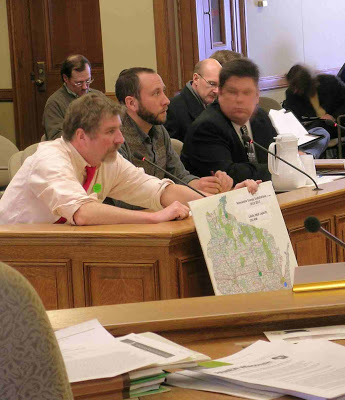
Josh Stolzenburg (center), owner of North Wind Renewable Energy, LLC, Stevens Point, joined Michael Vickerman (left) and Dave Miller, Wave Wind, LLC, Sun Prairie, in testifying in support of the Clean Energy Jobs Act bill before the Special Assembly Committee on Climate Change. Vickerman leans forward to show the committee members a map of renewable energy installations.
From a summary of Michael Vickerman’s (RENEW Wisconsin)
testimony before the Assembly Special Committee on Clean Energy
February 2, 2010:
RENEW Wisconsin strongly supports the provisions in SB450/AB649 to expand the state’s Renewable Energy Standard to 25% by 2025, which includes a 10% in-state renewable energy set-aside. RENEW has evaluated the availability of specific resources to reach that standard and has concluded that meeting such a target is technically feasible. If adopted, the in-state set-aside will become the most powerful engine for job development and capital investment over the next 15 years.
We expect such a requirement to be achieved through a combination of utility-scale power plants and smaller-scale generating units dispersed throughout Wisconsin. With respect to distributed renewable generation, we note the following:
1. The vast majority of the distributed renewable generating units installed in Wisconsin serve schools, dairy farms and other small businesses, churches and local governments.
2. Utilities are not in the business of installing these systems themselves.
3. In many cases the renewable energy installation went forward because there was a special buyback rate available to accelerate the recovery of the original investment made by the customer. Last week, I gave the example of the Dane County community anaerobic digester project that, once operational, will treat manure taken from several nearby dairy farms in the Waunakee area and produce two megawatts of electricity with it. The electricity will be purchased by Alliant Energy through a voluntary biogas tariff worth 9.3 cents/kWh. Unfortunately, Alliant’s biogas program is fully subscribed and is no longer available to other dairy farmers, food processing companies and wastewater treatment facilities served by Alliant.
4. Companies that install solar, wind and biogas energy systems are quintessentially small businesses, many of them family-owned. Renewable energy contractors and affiliated service providers constitute one of the few market sectors where young adults who have acquired the necessary skills to do the job well can find meaningful work at decent pay.
5. By its very nature, distributed renewable energy delivers nearly 100% of its economic punch to the local economy.
by jboullion | Feb 2, 2010 | Uncategorized
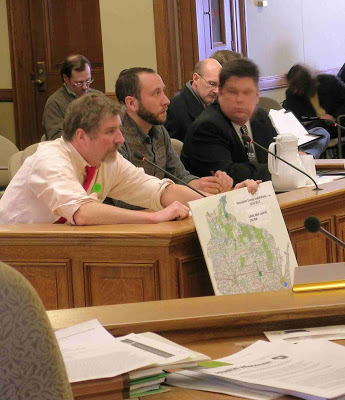
Michael Vickerman, Josh Stolzenburg (center), owner of North Wind Renewable Energy, LLC, Stevens Point, and a spokesman for Wave Wind, LLC, Sun Prairie, testify in support of the Clean Energy Jobs Act bill before the Special Assembly Committee on Climate Change. Vickerman leans forward to show the committee members a map of renewable energy installations.
From a summary of Michael Vickerman’s (RENEW Wisconsin)
testimony before the Assembly Special Committee on Clean Energy
February 2, 2010:
RENEW Wisconsin strongly supports the provisions in SB450/AB649 to expand the state’s Renewable Energy Standard to 25% by 2025, which includes a 10% in-state renewable energy set-aside. RENEW has evaluated the availability of specific resources to reach that standard and has concluded that meeting such a target is technically feasible. If adopted, the in-state set-aside will become the most powerful engine for job development and capital investment over the next 15 years.
We expect such a requirement to be achieved through a combination of utility-scale power plants and smaller-scale generating units dispersed throughout Wisconsin. With respect to distributed renewable generation, we note the following:
1. The vast majority of the distributed renewable generating units installed in Wisconsin serve schools, dairy farms and other small businesses, churches and local governments.
2. Utilities are not in the business of installing these systems themselves.
3. In many cases the renewable energy installation went forward because there was a special buyback rate available to accelerate the recovery of the original investment made by the customer. Last week, I gave the example of the Dane County community anaerobic digester project that, once operational, will treat manure taken from several nearby dairy farms in the Waunakee area and produce two megawatts of electricity with it. The electricity will be purchased by Alliant Energy through a voluntary biogas tariff worth 9.3 cents/kWh. Unfortunately, Alliant’s biogas program is fully subscribed and is no longer available to other dairy farmers, food processing companies and wastewater treatment facilities served by Alliant.
4. Companies that install solar, wind and biogas energy systems are quintessentially small businesses, many of them family-owned. Renewable energy contractors and affiliated service providers constitute one of the few market sectors where young adults who have acquired the necessary skills to do the job well can find meaningful work at decent pay.
5. By its very nature, distributed renewable energy delivers nearly 100% of its economic punch to the local economy.