by jboullion | Oct 14, 2009 | Uncategorized
From an article by Shelly Birkelo in the Jansville Gazette:
JANESVILLE — Have you broken down and turned on your furnace yet?
It’s natural to wait as long as possible in an effort to keep your winter heating costs down.
There are, however, other ways to spend less money and save energy starting with an annual furnace inspection.
“It will probably cost between $50 and $100, but it is important to make sure your furnace is running correctly and efficiently,” said Steven Schultz, Alliant Energy communications program manager.
A checkup also will clean out dust or dirt, he said.
“Dust and dirt can clog vital parts, making your furnace run harder and eventually break down,” Schultz said.
It’s also the best prevention against deadly carbon monoxide poisoning, according to Alliant’s monthly Natural Gas update newsletter.
To find an energy-smart heating contractor in your area, visit alliantenergy.com/ dealerlocator.
A home energy evaluation also can help consumers understand where their energy is going, Schultz said.
“It can show you where heat is escaping during the winter, for example, and will provide you with a blueprint for weatherizing your home,” he said.
For details about how you can do a home energy audit, visit www.alliantenergy.com/utilityservices/foryourhome/easyenergysavers/014671, Schultz said.
Focus on Energy, Wisconsin’s statewide energy-efficiency and renewable energy initiative, also is a good source for energy and money-savings tips, Schultz said.
It is funded by all of the state’s utilities and can be accessed by visiting www.focusonenergy.com or calling 1-800-762-7077, he said.
by jboullion | Oct 14, 2009 | Uncategorized
From a news release issued by Focus on Energy:
Focus on Energy provides $99,000 to boost energy saving efforts
Madison, Wis. – Since being acquired in 2001, Cortec Coated Products in Eau Claire, Wis. has prided itself on finding smart business solutions. The manufacturer has built on its knowledge and experience to become a global supplier and forerunner in the coated paper and film industry. With the help of Focus on Energy, Wisconsin’s energy efficiency and renewable energy initiative, Cortec Coated Products has also been able to build on Focus’ knowledge and experience tobecome a leader in energy efficiency.
Cortec Coated Products received $99,000 in financial incentives from Focus on Energy after installing an innovative heat-recovery system and plant-wide lighting and steam
trap upgrades. These improvements will save the company more than 223,000
kilowatt-hours of electricity and 175,000 therms of natural gas annually – enough
energy to power 200 Wisconsin homes for a year. The company will also benefit
from $210,000 in savings on its energy bills each year.
The biggest energy saver is a unique heat-recovery system installed last [June] that provides extraordinary energy savings. The system captures “waste” heat from the facility’s oven exhaust system and instead of venting that hot air outside of the facility; the system extracts heat from the outgoing air and returns it to the oven inlet to start the process again. Reusing this heat enables the manufacturer to significantly reduce its natural gas use and saves $170,000 a year. Focus on Energy awarded $82,000 to help get the project off the ground and also provided $2,400 prior to install so a feasibility study could be completed to assure significant energy savings.
by jboullion | Oct 14, 2009 | Uncategorized
From an editorial in the Dubuque Telegraph Herald:
Whether you’re talking about hog confinement lots or wind farms, the message is the same: Uniform regulation throughout a state trumps local control.
The arguments over the siting of wind projects in Wisconsin during the past year sound much like the discussions several years ago about hog lots in Iowa. In both cases, having consistent guidelines makes sense. Iowa was operating under 99 sets of rules, with every county deciding its parameters for hog lots. Counties argued for local control. But the need for consistency made the stronger case. Eventually, a bipartisan state committee hammered out one set of rules. That made sense.
Wisconsin Gov. Jim Doyle is looking to do the same thing. He signed a law ordering the Public Service Commission to establish uniform standards regulating the construction and operation of wind energy systems. Not only is the approach more fair, it could save individual townships and counties lots of headaches.
Without uniform siting, communities were left to make these tough decisions on their own — with strong constituent opinions Advertisement
on either side. In the face of public concern, trustees in southwest Wisconsin’s Smelser Township passed moratoriums banning all wind projects. They apparently violated state open meetings law in the process, making decisions without properly notifying the public. Trustees say the moratorium was in response to citizens’ concern that wind turbines pose a health risk.
by jboullion | Oct 14, 2009 | Uncategorized
2012
April 2012
+ Siting rule survives challenge, takes effect
+ Community wind sweeps into western Wisconsin
+ St. Croix County Wind Project seeks PSC approval
2011
June 2011
+ State’s Hostility Toward Renewables Escalates
+ “Leaders” Lag Citizenry on Wind Support
April 2011
+ Siting Rule Suspension Rocks Wind Industry
+ Glenmore Wind Survives Raucous Opposition
February 2011
+ Walker, Legislature Open Fire on Siting Rule
+ Site Puts WI Wind Facts at Your Fingertips
2010
September 2010
+ Stringent Siting Rule Heads to Legislature (summary of proposed rule’s provisions)
May 2010
+ PSC Sets Hearings for Turbine Siting Rules
+ Tall Turbines Set to Breeze into Green Bay Area
+ Schools Roll Out Northwind 100 Turbines
February 2010
+ PSC Gives Go-Ahead to Glacier Hills Project
+ From PSC’s Order on Glacier Hills
+ Milwaukee Reels in 270 Jobs With New Wind Generator Manufacturing
2009
December 2009
+ Decision Nears on Glacier Hills Wind Park
+ Excerpts from WEPCO Witnesses on “Wind Turbine Syndrome”
October 2009
+ Wind Permitting Bill Becomes Law of the Land
+ Final Environmental Impact Statement Released for Glacier Hills Wind Park, including “Glacier Hills at a Glance” and a list of parties to the technical hearing.
by jboullion | Oct 14, 2009 | Uncategorized
From an announcement by the Waukesha County Environmental Action League:
Water is on its way to becoming the oil of the 21st century. World water shortages brought about by increasing demand of growing populations and the results of mis-use and overuse of water, in conjunction with globalization, and the privatization of government roles and responsibilities, are adding up to what may be a world water crisis. While improved technology and new and alternate sources may provide answers to the energy crunch, no scientists have discovered how to make more water yet.
Two award-winning documentary films begin to address this issue: “Thirst” and “FLOW” (For Love of Water). Beginning on Sept. 23, WEAL (Waukesha County Environmental Action League) will show these films around the County.
Think of it as the “No Excuses Film Fest”:
Seven showings (“Thirst” — 4 showings. “FLOW” — 3 showings.)
On different nights of the week
From Sept 23 to Oct 22, 2009
At locations all around the County
Free parking at easily accessible Public Libraries**
Free admission
Light refreshments
Discussion to follow
by jboullion | Oct 13, 2009 | Uncategorized
The Public Service Commission issued the final environmental impact statement on the Glacier Hills Wind Park, and it includes these items:
Medical Impacts (page 68)
UW Med Flight is the responding air ambulance service closest to the Glacier Hills project area. UW Med Flight and the other reswponding agencies plan to develop safe landing sites or locations within the project area to which medical helicopters could be dispatched. Establishing alternative landing zones in an area is a common tool employed by medical helicopter services where terrain, vegetation, or
structures restrict landing sites….
In some instances, alternate landing sites may not be required; a medical helicopter can land in proximity to a wind turbine if it is safe and prudent to do so. There do not seem to be any UW Med Flight rulers or policies that would preclude landing within a project area if it is safe to do so. The decision about where to land is the pilot’s and is based on a variety of site factcors that present themselves upon arrival at an emergency scene. For example, closer landins to a turbine might be possible if the winds are calm and the wind turbine rotors are not rotating.
Sound Impacts (Page 82)
The studies done to date suggest that there is a wide variability in how peopole react to wind turbine noise and that many people do no appear to be affected. The studies do, however, support the concern that some people do react negatively to wind turbine noise, primarily through annoyance and sleep disturbance. It is widely accepted that disruption of sleep can lead to other physiological and psychological problems.
Dr. Nina Pierpont has hypothesized that in addition to annoyance and disturbance, wind turbine noise can result in direct activation of the vestibular and autonomic system leading to other health problems. The validity of this suggestion has been questioned. The Minnesota Department of Health concluded that “evidence is scant” for this hypothesis.
In summary, it is important to recognize that turbine noise can be problematic for some people. Although specific sound levels or distances from turbines cannot be directly correlated with these disturbance or annoyance problems, project design and siting should take potential impactcs of turbine noise into account.
Property Values (page 84)
A more recent study of two recently completed Wisconsin wind farms was completed by Appraisal Group One. This study contained similar problems of small sample size and weak statistical analyses. While the study was limited to residential vacany land sales, other potential factors that might influence sales prices were not analyzed. The study did not verify that all properties sold within the wind farm areas actually had views of wind turbines, whether the properties were sold prior to the proposal of a wind facility versus after the facilities were constructed and operating, and it did not differentiate between vacant lots with infrastructure potential such as streets, sewer, and water as opposed to farmland with no infrastructure.
by jboullion | Oct 13, 2009 | Uncategorized
From an article by Shelly Birkelo in the Jansville Gazette:
JANESVILLE — Have you broken down and turned on your furnace yet?
It’s natural to wait as long as possible in an effort to keep your winter heating costs down.
There are, however, other ways to spend less money and save energy starting with an annual furnace inspection.
“It will probably cost between $50 and $100, but it is important to make sure your furnace is running correctly and efficiently,” said Steven Schultz, Alliant Energy communications program manager.
A checkup also will clean out dust or dirt, he said.
“Dust and dirt can clog vital parts, making your furnace run harder and eventually break down,” Schultz said.
It’s also the best prevention against deadly carbon monoxide poisoning, according to Alliant’s monthly Natural Gas update newsletter.
To find an energy-smart heating contractor in your area, visit alliantenergy.com/ dealerlocator.
A home energy evaluation also can help consumers understand where their energy is going, Schultz said.
“It can show you where heat is escaping during the winter, for example, and will provide you with a blueprint for weatherizing your home,” he said.
For details about how you can do a home energy audit, visit www.alliantenergy.com/utilityservices/foryourhome/easyenergysavers/014671, Schultz said.
Focus on Energy, Wisconsin’s statewide energy-efficiency and renewable energy initiative, also is a good source for energy and money-savings tips, Schultz said.
It is funded by all of the state’s utilities and can be accessed by visiting www.focusonenergy.com or calling 1-800-762-7077, he said.
by jboullion | Oct 13, 2009 | Uncategorized
From an article by Shelly Birkelo in the Jansville Gazette:
JANESVILLE — Have you broken down and turned on your furnace yet?
It’s natural to wait as long as possible in an effort to keep your winter heating costs down.
There are, however, other ways to spend less money and save energy starting with an annual furnace inspection.
“It will probably cost between $50 and $100, but it is important to make sure your furnace is running correctly and efficiently,” said Steven Schultz, Alliant Energy communications program manager.
A checkup also will clean out dust or dirt, he said.
“Dust and dirt can clog vital parts, making your furnace run harder and eventually break down,” Schultz said.
It’s also the best prevention against deadly carbon monoxide poisoning, according to Alliant’s monthly Natural Gas update newsletter.
To find an energy-smart heating contractor in your area, visit alliantenergy.com/ dealerlocator.
A home energy evaluation also can help consumers understand where their energy is going, Schultz said.
“It can show you where heat is escaping during the winter, for example, and will provide you with a blueprint for weatherizing your home,” he said.
For details about how you can do a home energy audit, visit www.alliantenergy.com/utilityservices/foryourhome/easyenergysavers/014671, Schultz said.
Focus on Energy, Wisconsin’s statewide energy-efficiency and renewable energy initiative, also is a good source for energy and money-savings tips, Schultz said.
It is funded by all of the state’s utilities and can be accessed by visiting www.focusonenergy.com or calling 1-800-762-7077, he said.
by jboullion | Oct 13, 2009 | Uncategorized
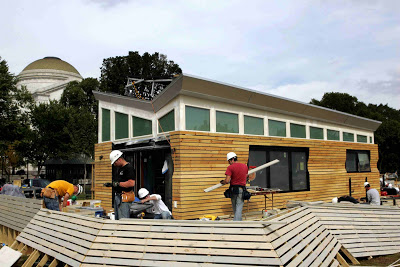
Students from the University of Wisconsin-Milwaukee assemble their solar-powered house in preparation for the start of the U.S. Department of Energy Solar Decathlon 2009 on the National Mall in Washington, D.C., Tuesday, Oct. 06, 2009.
From an article by Tom Content in the Milwaukee Journal Sentinel:
University of Wisconsin-Milwaukee architecture and engineering students have erected one of 20 buildings in a solar village that has risen on the National Mall in Washington, D.C.
Over the past two years, the students designed a small, energy-efficient solar home on campus, as part of the Solar Decathlon competition sponsored by the U.S. Department of Energy.
After being built on campus, the home was taken down in pieces and shipped to Washington, where it was put back together over the past week.
UWM is one of 20 teams selected to compete in the Solar Decathlon and is the first entrant in the competition from Wisconsin.
“We’re excited about it,” said Greg Thomson, assistant professor of architecture. “We’re happy to be there. There’s a big chunk of the Big Ten, and also teams that are made up of multiple universities.”
The competition is international – with teams funded in part by the governments of Germany and Spain.
The UWM home – named Meltwater – features 28 solar panels producing electricity and two solar panels powering a hot water system. The name was chosen because its design was inspired by the power of the sun to melt the glaciers and create the Great Lakes.
The students and faculty involved in the project designed a home that would be comfortable in Wisconsin’s climate.
The walls are extra thick and injected with more than twice the insulation of a typical Wisconsin home, Thomson said.
Photo by Stefano Paltera/U.S. Department of Energy Solar Decathlon
by jboullion | Oct 12, 2009 | Uncategorized
From an announcement made by the U.S. Department of Energy:
The Solar Installer Instructor Training network promotes high-quality training in the installation of solar technologies. Nine regional resource and training providers support the professional development of trainers and instructors of solar photovoltaic (PV) and solar heating and cooling (SHC) technologies across the country. . . .
The nine winners were announced on October 8, 2009. The award amounts listed reflect the maximum possible amounts in total funding for each awardee, not only Recovery Act funds:
Midwest Renewable Energy Association, Inc. ($3,307,709)
The Midwest Renewable Energy Association will provide instructor development opportunities and organize a network of instructors, installers, engineers, administrators, and other industry stakeholders to create and share instructional resources. The program will use team learning methods and collaborative technologies to create instructional resources.
Other grants were made to:
+ The Pennsylvania State University ($3,500,000)
+ North Carolina State University ($3,008,826)
+ Kennebec Valley Community College ($2,886,782)
+ Hudson Valley Community College ($3,497,595)
+ Salt Lake Community College ($3,110,140)
+ Houston Community College ($3,566,058)
+ University of Central Florida ($2,800,000)
+ California Community Colleges Board of Governors ($3,499,828)