by jboullion | Jun 26, 2009 | Uncategorized
From Habitat for Humanity of Grant County:
Feb. 2009 Heating Bill-$66.00!
Learn About Energy Saving Options & Programs Available to the public which made a $66.00 heating bill possible [for a Habitat for Humanity home in Benton, WI].
Location: Work Site, 177 White Street, Benton WI
Date: Saturday, June 27th
Time: 9am—3 Sessions, attend one or more
Program
Welcome and Introductions—9:00-9:30am
• President of Habitat for Humanity
• Senator Dale Schultz
• Partner Families
• Presenters
Session I—9:30-10:00 Building for Efficiency, Gary Kramer Using Insulated Concrete Forms, In- floor Heating Systems, and Structural Home Options
Session II—10:00-10:30 Solar Hot Water Heating Systems—Todd Timmerman of Timmerman’s Talents and Habitat for Humanity
Break 10:30-11:00 – Cookies & Conversation
Session III— 11:00-11:45 Home Energy Audits and Blower Door Testing—Mark Henning, 7th Power Solutions
Co-sponsors
Focus on Energy SW Community Action Program
USDA Workforce Development
Habitat for Humanity Contact Information
Phone: 608-348-9119
Mailing Address: PO Box 617 Platteville, WI 53818
Office: 135 S Hickory Street Platteville
Email: grantcountyhabitat@yahoo.com
Web Site: www.grantcountyhabitat.com
by jboullion | Jun 25, 2009 | Uncategorized
From a fact sheet published by Focus on Energy:
Rooftop wind turbines are one of the most talked about trends in renewable energy. City dwellers and suburbanites, inspired by the spread of large turbines and intrigued by the idea of producing their own energy, are today inquiring about rooftop wind systems in record numbers.
But just how viable are these systems? Can small rooftop wind turbines ever produce enough electricity to make the investment worthwhile? Find out the answers to these and other commonly asked questions below. . . .
Will a small rooftop turbine power my whole house?
No. Small turbines can only produce small quantities of electricity due to their small rotors.
Rooftops are ill-suited to harness the wind regardless of their location due to the trees and buildings surrounding a home. Rooftops in the city are particularly difficult places to harness the breeze. Not only are cities less windy than the countryside, but the air is turbulent because of trees and the variation in heights of buildings. Turbulence can wear out a turbine and reduce its life expectancy.
One analysis showed that a common type of rooftop turbine (being tested by Madison Gas Electric) “had generated about 45 kWh in about eight months (in a year about 65 kWh). The average single family WI home uses 10,000 kWh/year. Are you ready to live on 65 kWh/year?”
by jboullion | Jun 25, 2009 | Uncategorized
From a fact sheet published by Focus on Energy:
Rooftop wind turbines are one of the most talked about trends in renewable energy. City dwellers and suburbanites, inspired by the spread of large turbines and intrigued by the idea of producing their own energy, are today inquiring about rooftop wind systems in record numbers.
But just how viable are these systems? Can small rooftop wind turbines ever produce enough electricity to make the investment worthwhile? Find out the answers to these and other commonly asked questions below. . . .
Will a small rooftop turbine power my whole house?
No. Small turbines can only produce small quantities of electricity due to their small rotors.
Rooftops are ill-suited to harness the wind regardless of their location due to the trees and buildings surrounding a home. Rooftops in the city are particularly difficult places to harness the breeze. Not only are cities less windy than the countryside, but the air is turbulent because of trees and the variation in heights of buildings. Turbulence can wear out a turbine and reduce its life expectancy.
One analysis showed that a common type of rooftop turbine (being tested by Madison Gas Electric) “had generated about 45 kWh in about eight months (in a year about 65 kWh). The average single family WI home uses 10,000 kWh/year. Are you ready to live on 65 kWh/year?”
by jboullion | Jun 25, 2009 | Uncategorized
From a fact sheet published by Focus on Energy:
Rooftop wind turbines are one of the most talked about trends in renewable energy. City dwellers and suburbanites, inspired by the spread of large turbines and intrigued by the idea of producing their own energy, are today inquiring about rooftop wind systems in record numbers.
But just how viable are these systems? Can small rooftop wind turbines ever produce enough electricity to make the investment worthwhile? Find out the answers to these and other commonly asked questions below. . . .
Will a small rooftop turbine power my whole house?
No. Small turbines can only produce small quantities of electricity due to their small rotors.
Rooftops are ill-suited to harness the wind regardless of their location due to the trees and buildings surrounding a home. Rooftops in the city are particularly difficult places to harness the breeze. Not only are cities less windy than the countryside, but the air is turbulent because of trees and the variation in heights of buildings. Turbulence can wear out a turbine and reduce its life expectancy.
One analysis showed that a common type of rooftop turbine (being tested by Madison Gas Electric) “had generated about 45 kWh in about eight months (in a year about 65 kWh). The average single family WI home uses 10,000 kWh/year. Are you ready to live on 65 kWh/year?”
by jboullion | Jun 25, 2009 | Uncategorized
From a fact sheet published by Focus on Energy:
Rooftop wind turbines are one of the most talked about trends in renewable energy. City dwellers and suburbanites, inspired by the spread of large turbines and intrigued by the idea of producing their own energy, are today inquiring about rooftop wind systems in record numbers.
But just how viable are these systems? Can small rooftop wind turbines ever produce enough electricity to make the investment worthwhile? Find out the answers to these and other commonly asked questions below. . . .
Will a small rooftop turbine power my whole house?
No. Small turbines can only produce small quantities of electricity due to their small rotors.
Rooftops are ill-suited to harness the wind regardless of their location due to the trees and buildings surrounding a home. Rooftops in the city are particularly difficult places to harness the breeze. Not only are cities less windy than the countryside, but the air is turbulent because of trees and the variation in heights of buildings. Turbulence can wear out a turbine and reduce its life expectancy.
One analysis showed that a common type of rooftop turbine (being tested by Madison Gas Electric) “had generated about 45 kWh in about eight months (in a year about 65 kWh). The average single family WI home uses 10,000 kWh/year. Are you ready to live on 65 kWh/year?”
by jboullion | Jun 24, 2009 | Uncategorized
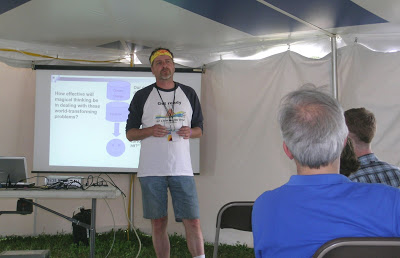
From a presentation by RENEW’s Michael Vickerman (above) at the Energy Fair of the Midwest Renewable Energy Association:
Energy Policy Must Recognize Energy Realities
+ Supplies of liquid fuels peaked in 2008
+ Capital is disappearing before our very eyes
+ Energy and food are the original currencies
+ The shift from stores to flows is inevitable
+ Current economy is highly energy-intensive
+ Energy return on energy invested (EROEI) must inform decision-making
+ We can’t afford to prop up existing energy sinks or engage in wealth-draining military adventures
Three paths to choose
+ Business as usual
+ Clean green technology
+ Curtailment and community
by jboullion | Jun 24, 2009 | Uncategorized
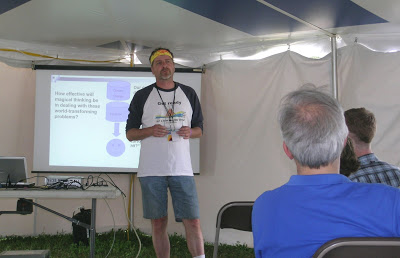
From a presentation by RENEW’s Michael Vickerman (above) at the Energy Fair of the Midwest Renewable Energy Association:
Energy Policy Must Recognize Energy Realities
+ Supplies of liquid fuels peaked in 2008
+ Capital is disappearing before our very eyes
+ Energy and food are the original currencies
+ The shift from stores to flows is inevitable
+ Current economy is highly energy-intensive
+ Energy return on energy invested (EROEI) must inform decision-making
+ We can’t afford to prop up existing energy sinks or engage in wealth-draining military adventures
Three paths to choose
+ Business as usual
+ Clean green technology
+ Curtailment and community
by jboullion | Jun 24, 2009 | Uncategorized
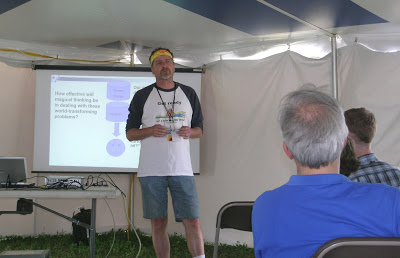
From a presentation by RENEW’s Michael Vickerman (above) at the Energy Fair of the Midwest Renewable Energy Association:
Energy Policy Must Recognize Energy Realities
+ Supplies of liquid fuels peaked in 2008
+ Capital is disappearing before our very eyes
+ Energy and food are the original currencies
+ The shift from stores to flows is inevitable
+ Current economy is highly energy-intensive
+ Energy return on energy invested (EROEI) must inform decision-making
+ We can’t afford to prop up existing energy sinks or engage in wealth-draining military adventures
Three paths to choose
+ Business as usual
+ Clean green technology
+ Curtailment and community
by jboullion | Jun 24, 2009 | Uncategorized
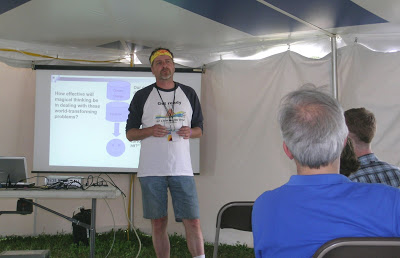
From a presentation by RENEW’s Michael Vickerman at the Energy Fair of the Midwest Renewable Energy Association:
Energy Policy Must Recognize Energy Realities
+ Supplies of liquid fuels peaked in 2008
+ Capital is disappearing before our very eyes
+ Energy and food are the original currencies
+ The shift from stores to flows is inevitable
+ Current economy is highly energy-intensive
+ Energy return on energy invested (EROEI) must inform decision-making
+ We can’t afford to prop up existing energy sinks or engage in wealth-draining military adventures
Three paths to choose
+ Business as usual
+ Clean green technology
+ Curtailment and community
by jboullion | Jun 23, 2009 | Uncategorized
From the presentation by RENEW’s Michael Vickerman on June 21, 2009, at the Energy Fair of the Midwest Renewable Energy Association, Custer, WI:
Energy Policy Must Recognize Energy Realities
+ Supplies of liquid fuels peaked in 2008
+ Capital is disappearing before our very eyes
+ Energy and food are the original currencies
+ The shift from stores to flows is inevitable
+ Current economy is highly energy-intensive
+ Energy return on energy invested (EROEI) must inform decision-making
+ We can’t afford to prop up existing energy sinks or engage in wealth-draining military adventures
Three paths to choose
+ Business as usual
+ Clean green technology
+ Curtailment and community