by jboullion | Jan 7, 2009 | Uncategorized
From a media release issued by Northland College and posted on BusinessNorth.com:
ASHLAND, Wis. – Northland College is taking another step to reduce its environmental impact by no longer offering trays in its cafeteria.
In the fall semester, the College began Tray-less Tuesdays, an initiative that saved 138 gallons of water each Tuesday by not offering trays to students. Now, Northland is extending the policy for the other six days of the week.
“We estimate we ran 828 fewer trays through the dish machine on Tuesdays” said Jeff Spangenberg, the director of food service at Northland. Because a tray takes twice as much space in the dishwashing machines as a plate, eliminating them is a simple but effective way to reduce the environmental impact of food service.
In addition to saving water, energy, dish soap and time, the policy also will cut down on food waste. By only using a plate, and going back to the buffet for seconds if necessary, students are less likely to over-estimate their appetites and take food they won’t eat. When Viterbo University went tray-less in 2007, they eliminated nearly three tons of food waste in two semesters. While Northland has fewer mouths to feed, the results are still expected to be significant.
by jboullion | Jan 7, 2009 | Uncategorized
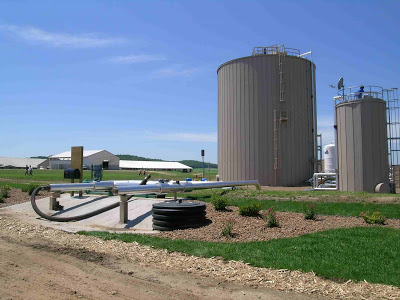
The larger of the two tanks digests the manure at the Five Star Dairy near Eau Claire. Photo by Ed Blume, RENEW Wisconsin
From an article in the Daily Pioneer (Platteville):
PLATTEVILLE – Tim Zauche, associate professor of chemistry and engineering physics at the University of Wisconsin-Platteville, wants manure from area dairy farms. But he just wants to borrow it.
Zauche and Christopher Baxter, UWP associate professor of agriculture, met with about 25 Grant and Lafayette county dairy farmers on Monday, Jan. 5, to discuss the feasibility of building an anaerobic digester in the region. The digester would collect methane gas from cow manure. The methane could be converted into a variety of useable energy sources.
“The university is interested in anaerobic digesters because we’re striving to become more sustainable,” Zauche said. “We’re looking to become more independent of our energy needs from other places.”
The project is just in the exploratory stage. Details of the project – including who would own the digester, where it would be located, what would be expected of participating farmers and a number of more technical details – need to be worked out, Zauche said.
Zauche said that the digester would need to process manure from at least 500 cows to be economically feasible. That could be reduced somewhat if the digester also processes production waste from several area cheese factories. Baxter said that the UWP Pioneer Farm plans to increase its herd to 300 cows, which includes dairy cows and a planned expansion of its beef herd.
by jboullion | Jan 6, 2009 | Uncategorized
From the Wisconsin League of Conservation Voters:
Join Us For CONSERVATION LOBBY DAY 2009!
Wednesday, February 25, 2009 – RSVP here!
*RSVP Required—RSVP DEADLINE is February 13!
Since the first Conservation Lobby Day in 2005, it has grown from just over 100 citizens to over 500! Each year these citizens from across Wisconsin descend on the Capitol to share their conservation values with their Legislators. As we head into the 5th annual Conservation Lobby Day, there is one thing we can guarantee-when citizens come together to make their conservation values known, legislators listen, and conservation victories soon follow!
The reauthorization of the Knowles-Nelson Stewardship Fund and the passage of the Strong Great Lakes Compact are two great examples of how citizen lobbying resulted in ground-breaking conservation laws.
The participation of local groups and citizens like YOU is incredibly important to the success of Conservation Lobby Day. Every day throughout the state, countless citizens work tirelessly to protect the local land, water, and wildlife.
Conservation Lobby Day is a unique opportunity to share your conservation stories and experiences with legislators and have a huge impact on conservation policies affecting all of Wisconsin.
In 2009-2010, the conservation community will be fighting to:
Preserve Groundwater: Wisconsin’s Buried Treasure: manage Wisconsin’s groundwater resources to preserve drinking water supplies, lakes, streams, and wetlands.
Stop Global Warming in Wisconsin: address the threats of global warming in Wisconsin through clean, renewable energy jobs and energy conservation.
Restore Conservation Integrity: return Wisconsin to an Independent DNR Secretary and a timely appointment of Natural Resource Board members.
Protect Wisconsin’s Drinking Water: protect Wisconsin’s drinking water supplies by making sure we safely spread agricultural, municipal, and industrial waste.
For a 1-page brief on each of these issues, click on their title above.
by jboullion | Jan 6, 2009 | Uncategorized
From the Wisconsin League of Conservation Voters:
Join Us For CONSERVATION LOBBY DAY 2009!
Wednesday, February 25, 2009 – RSVP here!
*RSVP Required—RSVP DEADLINE is February 13!
Since the first Conservation Lobby Day in 2005, it has grown from just over 100 citizens to over 500! Each year these citizens from across Wisconsin descend on the Capitol to share their conservation values with their Legislators. As we head into the 5th annual Conservation Lobby Day, there is one thing we can guarantee-when citizens come together to make their conservation values known, legislators listen, and conservation victories soon follow!
The reauthorization of the Knowles-Nelson Stewardship Fund and the passage of the Strong Great Lakes Compact are two great examples of how citizen lobbying resulted in ground-breaking conservation laws.
The participation of local groups and citizens like YOU is incredibly important to the success of Conservation Lobby Day. Every day throughout the state, countless citizens work tirelessly to protect the local land, water, and wildlife.
Conservation Lobby Day is a unique opportunity to share your conservation stories and experiences with legislators and have a huge impact on conservation policies affecting all of Wisconsin.
In 2009-2010, the conservation community will be fighting to:
Preserve Groundwater: Wisconsin’s Buried Treasure: manage Wisconsin’s groundwater resources to preserve drinking water supplies, lakes, streams, and wetlands.
Stop Global Warming in Wisconsin: address the threats of global warming in Wisconsin through clean, renewable energy jobs and energy conservation.
Restore Conservation Integrity: return Wisconsin to an Independent DNR Secretary and a timely appointment of Natural Resource Board members.
Protect Wisconsin’s Drinking Water: protect Wisconsin’s drinking water supplies by making sure we safely spread agricultural, municipal, and industrial waste.
For a 1-page brief on each of these issues, click on their title above.
by jboullion | Jan 6, 2009 | Uncategorized
From a media release issued by Focus on Energy:
(January 6, 2009) – (January 6, 2009) – Focus on Energy, Wisconsin’s energy efficiency and renewable energy initiative, announced today that Pierce Pepin Cooperative Services officially became a program member beginning January 1, 2009. The utility, located in Ellsworth, Wis., serves approximately 6,500 electric members throughout most of Pierce County and portions of Pepin, St. Croix and Buffalo counties.
“I welcome Pierce Pepin Cooperative Services into Focus on Energy and am delighted its customers will be able to benefit from the services the program offers,” said Eric Callisto, Chairperson of the Public Service Commission of Wisconsin, the agency that manages the state’s Focus on Energy Program. “Pierce Pepin Cooperative Services’ decision to participate in Focus on Energy will result in a healthier environment for Wisconsin and will provide options for its customers to make sound energy decisions.”
Pierce Pepin Cooperative Services will participate in the Business, Residential and Renewable Energy offerings under the Focus on Energy umbrella. The benefits of participating include:
Business Programs that help manufacturers, commercial businesses, farmers, schools and local governments reduce operating costs, increase their bottom line and improve productivity and employee and customer comfort. The programs offer technical expertise, training and financial incentives to help implement innovative energy management projects.
Wisconsin ENERGY STAR Homes, Home Performance with ENERGY STAR and Apartment & Condo Efficiency Services Programs that encompass new and existing homes, multi-family construction and remodeling projects for all types of residential dwellings. These programs help homeowners and landlords integrate energy improvements into their remodeling projects, as well as deliver newly-built homes, apartments and condominiums that are comfortable, safe, durable and energy efficient.
Lighting and appliance programs that increase the availability of ENERGY STAR qualified products ranging from compact fluorescent light bulbs to heating and cooling equipment. These efforts deliver lower energy bills for residents and businesses and increased sales for retailers and contractors.
Renewable Energy Programs that help residents and businesses harness energy from sunlight, wind and organic materials.
Targeted Home Performance that reduces energy bills while increasing comfort and safety for income-qualified participants.
by jboullion | Jan 6, 2009 | Uncategorized
From a media release issued by Focus on Energy:
(January 6, 2009) – Focus on Energy, Wisconsin’s energy efficiency and renewable energy initiative, announced today that Vernon Electric Cooperative officially became a program member beginning January 1, 2009. The utility serves approximately 10,000 members throughout Vernon County and portions of La Crosse, Monroe, Juneau, Sauk, Richland and Crawford counties.
“I welcome Vernon Electric Cooperative into Focus on Energy and am delighted its customers will be able to benefit from the services the program offers,” said Eric Callisto, Chairperson of the Public Service Commission of Wisconsin, the agency that manages the state’s Focus on Energy Program. “Vernon Electric Cooperative’s decision to participate in Focus on Energy will result in a healthier environment for Wisconsin and will provide options for its customers to make sound energy decisions.”
Vernon Electric Cooperative will participate in the Business, Residential and Renewable Energy offerings under the Focus on Energy umbrella. The benefits of participating include:
Business Programs that help manufacturers, commercial businesses, farmers, schools and local governments reduce operating costs, increase their bottom line and improve productivity and employee and customer comfort. The programs offer technical expertise, training and financial incentives to help implement innovative energy management projects.
Wisconsin ENERGY STAR Homes, Home Performance with ENERGY STAR and Apartment & Condo Efficiency Services Programs that encompass new and existing homes, multi-family construction and remodeling projects for all types of residential dwellings. These programs help homeowners and landlords integrate energy improvements into their remodeling projects, as well as deliver newly-built homes, apartments and condominiums that are comfortable, safe, durable and energy efficient.
Lighting and appliance programs that increase the availability of ENERGY STAR qualified products ranging from compact fluorescent light bulbs to heating and cooling equipment. These efforts deliver lower energy bills for residents and businesses and increased sales for retailers and contractors.
Renewable Energy Programs that help residents and businesses harness energy from sunlight, wind and organic materials.
Targeted Home Performance that reduces energy bills while increasing comfort and safety for income-qualified participants.
by jboullion | Jan 5, 2009 | Uncategorized
From an announcement on the Web site of the The Wisconsin Department of Transportation:
The Wisconsin Department of Transportation(WisDOT) is seeking public comments on its draft long-range transportation plan, Connections 2030. A public meeting will be held in La Crosse, WI at the UW-La Crosse Cartwright Center, on Thursday, Jan. 8, from 5 to 8 p.m. La Crosse area residents are invited to attend to learn about the plan, ask questions, and submit comments.
WisDOT also welcomes comments and questions via phone at (608) 266-8108, or on the Connections 2030 Web site at: www.wiconnections2030.gov. Comments will be received until Feb. 27, 2009.
Connections 2030 is a statewide, multimodal transportation plan that provides a vision for highways, local roads, air, water, rail, bicycle, pedestrian, and transit through the year 2030. Its policies and recommendations direct WisDOT’s activities in areas such as preserving transportation infrastructure and services, promoting transportation safety, and supporting economic growth.
The plan will guide transportation decisions over the next 20 years. It focuses on the transportation system’s ability to support the preservation of transportation services and infrastructure, safe travel on all modes, mobility for all citizens, security and efficiency in all areas of operation, and economic growth throughout Wisconsin.
by jboullion | Jan 5, 2009 | Uncategorized
From an article by Tom Kertscher in the Milwaukee Journal Sentinel:
Mequon – The largest wind turbine on a technical college campus in Wisconsin has been erected at Milwaukee Area Technical College in Mequon, where officials hope that what’s been dubbed “Blades of Freedom” will reduce campus energy costs and help train students for sustainable energy jobs of the future.
The turbine, which at 160 feet high and 56 feet wide easily is visible from Highland Road, also is aimed at raising awareness among the public about renewable sources of energy, said Michael Townsend, vice president of the Mequon campus.
Questions about the turbine’s appearance, noise and other issues initially caused City of Mequon officials to pause when they took up MATC’s request in April 2006. But four months later, after hiring a consultant, the city gave the turbine a green light.
The school purchased a reconditioned 90-kilowatt, V-17 turbine from Vestas, a company in Denmark.
The original cost to MATC was pegged at $150,000, but it has since climbed to $188,000. With $67,000 in grants from We Energies and the state’s Focus on Energy program, the total cost is about $255,000.
The MATC portion rose because a vendor that the school originally intended to use withdrew from the deal, said MATC spokeswoman Kathleen Hohl. And after the turbine was purchased, it sustained damage while being stored on the Mequon campus as the school waited for approvals from the city, she said.
MATC expects to recoup its investment because the turbine will generate about 8% of the Mequon campus’ electricity. . . .
by jboullion | Jan 2, 2009 | Uncategorized
A column by Mike Nichols in the Milwaukee Journal Sentinel seems to present an either/or dicotomy between wind-generated electricity and digester-generated electricity. Nichols wrote:
This is something to ponder as we head into a new year – and a new era. We are developing huge wind farms in Wisconsin. People are talking about setting turbines out on our Great Lakes. Breaking wind could be the key to the future. The only question now is “What kind?”
Do we harness our skies or our pies?
The Journal Sentinel published the following response from RENEW’s executive director Michael Vickerman:
The statement that Wisconsin can generate more electricity from manure than from windpower is not supported by the numbers.
To make biogas from manure, a dairy farm operator has to keep the cows inside and under a roof at all times. Only in a confined setting is it possible to collect cow manure and break it down in an oxygen-free digester that results in methane. Of Wisconsin’s 1.3 million dairy cows, only one-eighth of them live in confined animal operations. The average dairy cow here is part of a small herd and spends a considerable amount of time in pasture.
As stated in the column, Wisconsin is well ahead of other states in capturing energy from dairy cow manure and generating electricity with it, and there is certainly room for growth. Bear in mind, however, that takes more than 2,000 dairy cows to produce enough methane to equal the output from one commercial wind turbine. Yes, Wisconsin now boasts about two dozen biogas generation systems attached to dairy farms. But compared with the output from the 251 wind turbines installed this year at four different projects, their electrical production is quite modest.
Though other locally available resources–solar, small hydro, woody fuels and biomethane—will certainly play a larger part in contributing to Wisconsin’s electricity mix, wind energy will remain the renewable energy workhorse for the foreseeable future.
Finally, the Governor’s Global Warming Task Force recommended a raft of policies to achieve a renewable energy goal of 25% by 2025, no small undertaking I can assure you. If we are serious about achieving that goal, we must accept expanded contributions from all eligible resources. We do not have the luxury of playing favorites.
by jboullion | Jan 2, 2009 | Uncategorized
From a the first of two articles by Adam Wise in the Wisconsin Rapids Daily Tribune:
Note: This is the first of a two-part report on how the Wisconsin Rapids School District is spending money that residents approved in a 2006 referendum. The second story will appear Friday.
Wisconsin Rapids School District leaders plan to cope with rising utility costs by increasing energy efficiency with money approved through the referendum process.
A little more than two years ago, residents in the district approved a four-question, approximately $10 million referendum for building, technology and curriculum upgrades.
With most of the money — about $8.3 million — slated for district facilities, Buildings and Grounds Director Tom Helgestad and staff members developed a three-year plan to conduct a majority of the work during the district’s summer breaks.
As an example of the upgrades, Helgestad said the district achieved an almost 45 percent decrease in natural gas usage at Grove Elementary School after replacing the old heating system.
“Because of the age of the equipment, our infrastructure and heating systems were between 50 and 60 years old,” said Helgestad, specifically referring to Howe, Mead, and Grove elementary schools. “They were at the end of their life; parts were unavailable. We had to retrofit to keep things going.”
Wisconsin Rapids School Board members have been receiving periodic updates from Helgestad regarding the progress of the three-year plan.
“We’re actually going to be able to save even though the prices have gone up,” board member Mary Rayome said.