by jboullion | Jan 6, 2010 | Uncategorized
From an article by Chris Detjen and Maia Dedrick on MinnPost.com:
On Saturday, Dec. 12, Aurora Conley, a 25-year-old Ojibwe native of Bad River, Wis., walked at the leading edge of a 100,000-person march through the streets of Copenhagen — the largest climate mobilization in history, by many estimates — carrying with other indigenous people a banner that said “The World Wants a Real Deal.” The following Wednesday, she spoke at a press briefing on behalf of the International Forum of Indigenous Peoples on Climate Change.
“It was really imperative that we were at the front lines of the march, and that we’re at the front lines of the climate movement,” Conley said. “Indigenous peoples are the ones most impacted by climate change and the practices causing it. Our cultures and traditions are the ones that are dying first.” When asked for examples of these impacts, she spoke of close native friends who have developed cancer due to suspected exposure to toxic oil sand mining residues.
A local leader, Conley is studying to become a solar panel installation trainer for other Native Americans, and has worked with Winona LaDuke through the environmental organization Honor the Earth. At the 2009 United Nations Climate Change Conference in Copenhagen, she took her leadership global.
Conley was in Copenhagen as one of 12 Midwestern young people attending the conference through Expedition Copenhagen, a partnership between the Will Steger Foundation and Stonyfield Farm. Like all of us on the Expedition, Conley used her time there to connect people in her community back home with this year’s historic deliberations in Copenhagen.
Midwest contributes 20% of U.S. greenhouse emissions
Expedition delegates hailed from seven states in the Upper Midwest: Michigan, Illinois, Wisconsin, Minnesota, Iowa, North Dakota and South Dakota. Our region’s voice matters greatly on climate change. The Midwest contributes 20 percent of greenhouse gas emissions produced in the United States each year, largely because of its dependence on coal-fired electricity.
by jboullion | Jan 5, 2010 | Uncategorized
From a news release issued by the Public Service Commission of Wisconsin:
MADISON – The Public Service Commission of Wisconsin (PSC) today [December 18, 2009] announced that all 118 Wisconsin electric providers have met their renewable portfolio standards (RPS) for 2008, and 112 providers exceeded the requirements for the year, creating excess renewable resource credits that can be banked and used for compliance in future years. Wisconsin utilities are well on their way to meeting the increase in renewable energy that will be required by 2015.
Our current RPS law requires Wisconsin retail electric providers to produce 10 percent of their electricity from renewable resources by the year 2015. For the years leading to 2015, Wisconsin utilities are required to report their progress in meeting the renewable milestones to the PSC. Wisconsin electric providers continue to take steps towards achieving their renewable energy goals. In 2008, Wisconsin utilities increased the amount of renewable electricity provided by nearly one percent over what was provided in 2007.
From the newsletter of Customers First!:
With a nationwide renewable portfolio standard (RPS) likelier than any other energy policy choice to be included in federal climate legislation, a newspaper survey has found many states—not including Wisconsin—failing to meet their own RPS goals.
In October, USA Today reported that it found nine states where efforts to boost reliance on renewable energy were not making the grade. Thirty-five states have adopted some form of RPS. Some states, the story noted, require utilities that don’t produce or purchase enough renewable energy to pay fees to finance renewable projects. That system allows utilities to comply with program requirements without necessarily adding renewable generation capacity.
States that have already missed or are expected to miss all or part of their mandated targets include Arizona, California, Delaware, Maryland, Massachusetts, New Jersey, New Hampshire, New York, and Ohio. In aggregate, Wisconsin utilities currently obtain roughly 4 percent of their power from renewable sources, against a current-law target of 10 percent by 2015.
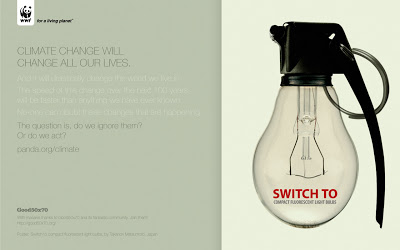
by jboullion | Jan 5, 2010 | Uncategorized
One of serveral posters from WWF. Click on picture to enlarge.
by jboullion | Jan 5, 2010 | Uncategorized
From an article by Nick Paulson in the Wisconsin Rapids Tribune:
For some time, Tom Klismith has followed the federal incentives to install renewable energy systems at his certified public accounting firm.
He liked the idea of installing solar panels at Klismith Accounting, but as a numbers man, the incentives — which cover 30 percent of the installation costs — just didn’t add up.
“When you did the tax return, the alternative minimum tax was negating the impact” of the federal incentives, Klismith said.
But when that tax law was changed as part of the American Recovery and Reinvestment Act of 2009, Klismith pounced. He had 112 solar panels installed at Klismith Accounting. In the two months since he installed the panels, Klismith has saved $425, but he expects that number to rise as the days grow longer and there is more sun. During the course of the year, he expects to save at least $6,000.
At that rate, the system should pay for itself in less than 10 years. That means big savings for the company because the equipment will last 20 to 25 years.
by jboullion | Jan 5, 2010 | Uncategorized
An article from the Telegraph Herald (Dubuque, IA):
The University of Wisconsin-Platteville’s new sustainable and renewable energy systems major recently received $5,000 from Wind Capital Group, a wind-energy firm in Missouri, for its renewable-energy program to help promote and further the program.
Besides equipment and field trips, Wind Capital Group’s commitment also will help fund student and faculty collaborative research and projects, scholarships within the program, and student and faculty conference trips.
Wind Capital has a number of projects, including a proposed wind farm in Smelser Township (and parts of two other Grant County townships), that the company is pursuing. The goal is to develop more wind-generated electricity in Wisconsin. The project is on hold pending state regulators’ efforts to come up with statewide rules for wind farms.
by jboullion | Jan 4, 2010 | Uncategorized
From the workshop page on the site of the Midwest Renewable Energy Association:
MREA is a national leader in providing high quality education and training programs for consumers, businesses, and renewable energy system installers. For more than 18 years we have offered workshops, seminars, and conferences that demonstrate that renewable energy is practical, reliable, and ready for mainstream use.
When you attend a MREA training you will:
•learn from experts with years of practical experience,
•receive curriculum that is based on nationally recognized standards,
•meet other people with similar interests and values, and
•have a great time.
MREA Workshop Offerings:
MREA offers workshops that cover a variety of topics in renewable energy.
Come learn from experts in the field about subjects including:
•Photovoltaics or PV (solar electric)
•Residential Wind systems
•Solar Domestic Hot Water/Solar Thermal Systems
•Site Assessor Training & Certification
•Installer Training
•Renewable Energy Business
•Alternative Construction
Don’t delay in registering. The classes fill up quickly.