
Clean Energy Works is RENEW Wisconsin’s initiative to get into the field with our business members and learn directly from those doing the work each day. By shadowing installers, technicians, and staff across the clean energy industry, we gain a deeper understanding of what goes into the work. These experiences directly inform how RENEW supports and advocates for the people and companies driving clean energy forward.
When it comes to clean energy home improvements, the first project is rarely the last. In Westby, Wisconsin, one homeowner’s decision to go solar became the foundation for batteries, a smart panel, a heat pump, and future expansion.
To see what that looks like in practice, I joined Erik Amodt, Project Manager, and Tomas Herrera, Customer Experience Integrator, at a home where solar opened up the door to so much more.
Meet the Crew
Ethos Green Power Cooperative was established in Viroqua in 2013 and has grown into a 24-person electric cooperative serving southwest Wisconsin. Getting their start in solar installations, Ethos has expanded into battery storage, integrated electrical systems, and mini-split heat pumps as customer needs evolved.
Erik’s own path into clean energy started in agriculture. He spent years farming before transitioning into solar, bringing with him a practical mindset shaped by mechanical work and problem-solving.
“I grew up up north in Blair,” Erik said. “I did a lot of mechanical work and electrical work on the farm. I went to engineering school for three years, did a lot of math-type stuff, and then I just learned on the job. It worked out just fine.”
“Farmers are good at figuring it out,” he said. “It’s kind of fun to learn, to understand code better and see how all that stuff works.”
Erik is now a co-owner in the cooperative. He and Tomas work closely with homeowners as projects evolve. They’ve seen how often one installation leads to another.
“Electrification doesn’t happen all at once,” Tomas said. “It’s usually a journey.”
A recent customer, Paul, has a home that reflects that progression.
About the Technology
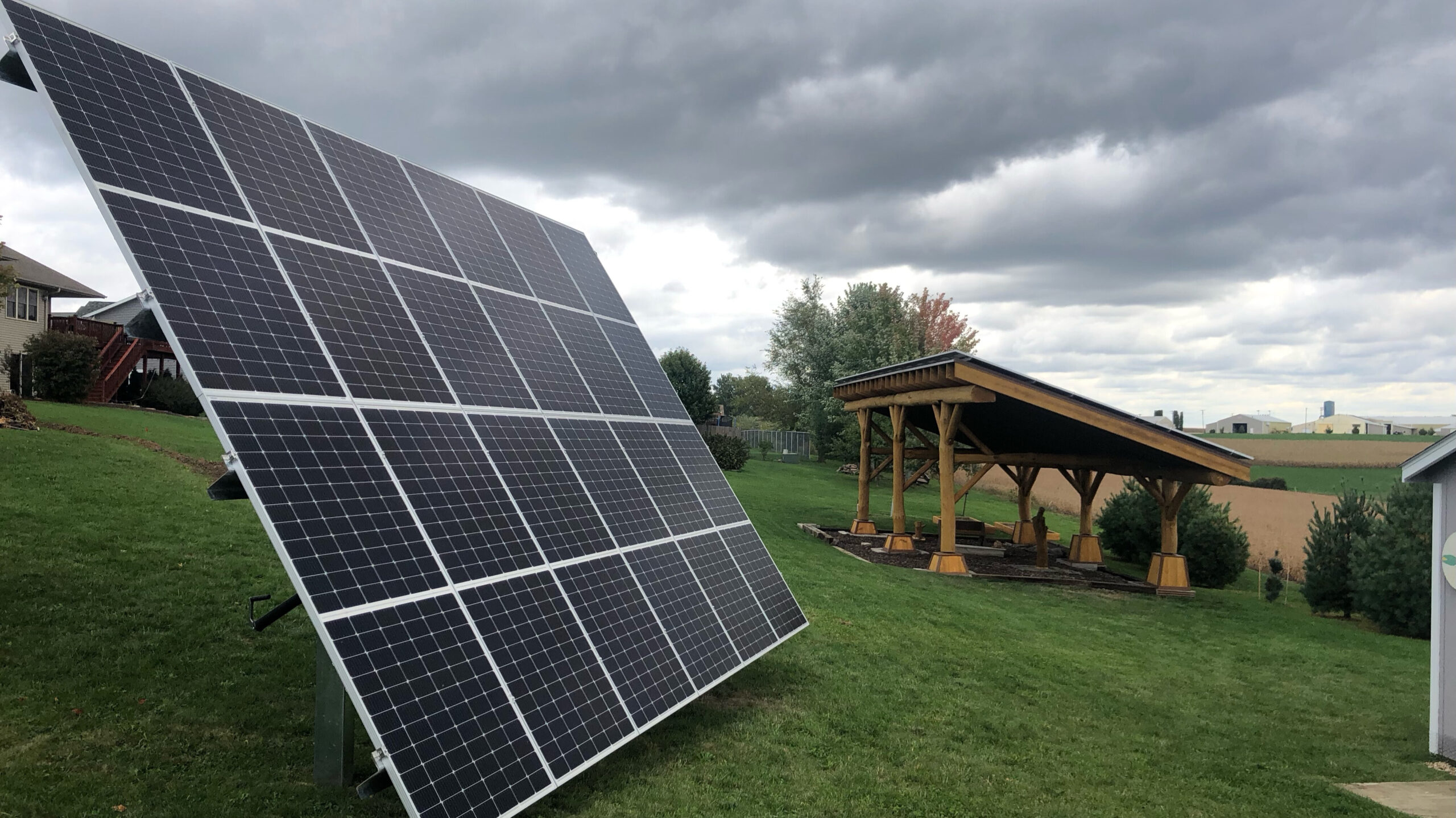
Paul began with solar and then expanded with a solar canopy. A local contractor built a beautiful timber frame structure, and Ethos installed solar on top. What started as an energy project also became a permanent and aesthetic feature on the property.
He later added a tiltable ground-mounted array to improve solar energy production in the winter and is now considering an additional ground mount behind his second array. Along the way, he added battery storage, a Span smart panel, and most recently, a heat pump.
The system integrates solar production with three batteries totaling 15 kilowatt-hours of storage, which offers him about 15 hours of emergency power. The Span panel provides circuit-level usage monitoring and prioritizes essentials like lights and refrigerators during outages.
Erik walked through the system controller first, explaining how power flows from the meter into the Enphase controller before distributing through the Span panel and three batteries.
“Span really shines when you start to have battery backup,” Erik said. “They can just work so seamlessly together.”
For Paul, storage was not just about cost savings. Living in a rural area, outages are periodic and often unpredictable. They can happen even on days when there is not a cloud in the sky. That uncertainty became a concern in his woodworking shop, where losing power mid-operation can create real physical risk.
“One initial concern of mine also was safety of my woodworking machines,” Paul said. “Not losing power during a critical operation.”
It wasn’t just about protecting equipment. It was about protecting himself as well. An abrupt outage, followed by power returning without warning, could create a dangerous situation while operating machinery.
“So we did switch one circuit on that critical machine over to here, to the Span panel, so that it can continue on if there is an outage,” he said.
With battery backup and the Span smart panel managing loads, the system provides a smooth transition between grid power and stored energy. Storage and backup became a way to protect his home, his physical health, and his workspace from unpredictable interruptions that are commonplace in rural areas.
Even the municipal utility came out to observe the installation, given how new the technology was to the area.
“They were thrilled to be able to come down and see this,” Paul said. “They were snapping pictures.”
Why It Matters
Paul’s home reflects a pattern that is increasingly common across Wisconsin. Solar becomes the entry point. Once installed, homeowners begin to understand their energy usage. From there, many build outward: adding storage, integrating mini-split heat pumps, and planning for electric vehicles.
This progression differs from how the industry often frames electrification. The common advice is to optimize the building envelope and electrify everything first, then add solar. In practice, many homeowners start with solar and expand over time.
Repeat customers are not simply a sales metric. They are a reflection of quality work and long-term trust. When systems perform well and installers remain engaged, homeowners return.
Looking Ahead
Paul is not done. He is increasingly interested in the possibility of using his electric vehicle as a battery for his home. Vehicle-to-home integration is already in use across the country and has been used to power homes during power outages caused by severe weather.
For Ethos Green Power Cooperative, repeat customers will likely become even more important as the market evolves.
“At the end of the day, we’re just trying to build good systems and do right by our customers,” Erik said.
In Westby, what began as a single solar installation has grown into a fully integrated energy system. It also reinforces an important lesson for the industry: build it right the first time, and customers will come back when they are ready for the next step.
If you are part of this work and would be willing to share your story, I would love to join you for a day. Feel free to reach out to me at ben@renewwisconsin.org.