
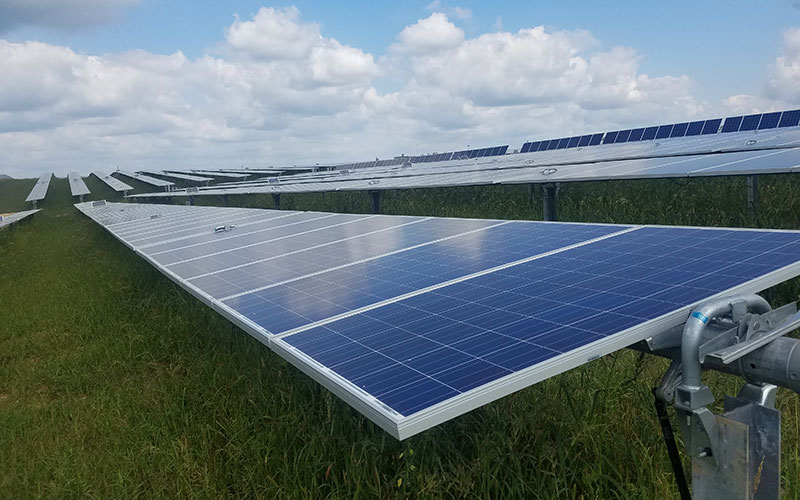
When a utility-scale solar project is proposed — often in a rural, agricultural setting — nearby residents often have real concerns. Renewable developers often prefer farmland because it offers large, open, and flat pieces of land suitable for solar projects.
It’s true that the development of a large-scale solar facility brings changes, including a period of construction and the introduction of photovoltaic (PV) panels to the agricultural landscape, which reduces the amount of usable cropland.
At the same time, solar projects also offer a wide range of community benefits, including construction jobs and economic development, tax and financial aid from project developers, and steady, long-term lease payments to local landowners — enabling them to keep their land in the family and weather periods of financial stress.
That last point is particularly important, and it was recently highlighted by leaders in New York, who wrote a letter to the Trump Administration in response to its inaccurate claims that solar power was eating up vast amounts of farmland.
Citing largely inflated or misinformed concerns over the loss of agricultural land, the USDA has backed away from helping farmers develop solar on their farmland.
That is unfortunate news, and it’s important to note the fact that across the country, just .07 percent of farmland hosts solar projects. Building a cleaner, healthier, and more affordable renewable energy future will require more solar projects, plain and simple.
Another important statistic: to meet the Department of Energy’s ambitious goal of supplying 40 to 45 percent of U.S. electricity with solar by 2050, solar would require just 1.15 percent of America’s nearly 900 million acres of farmland. Growing corn for ethanol requires more than 4 percent of U.S. farmland, and is far less energy efficient than solar.
Countering Misinformation
Unfortunately, there’s a slew of online misinformation highlighting exaggerated and false narratives about wind and solar projects, making it difficult to have productive discourse around renewables. It is important for renewable energy advocates to counter these narratives with the facts, while recognizing and addressing legitimate community concerns.
First, no one is forced to lease their land for solar development. Private landowners, oftentimes farmers, make these decisions when they consider the economic security that solar projects can offer. These solar contracts typically last around 20 or 30 years — the life of the panels.
When the leases are up, landowners can choose to re-up their contract or to decommission the project and return the land to farming, removing the solar panels and the related infrastructure, which are often recycled for their valuable components. Allowing the land to “rest” without growing crops can restore the soil’s health, making it more productive when farming resumes.
Additional provisions about decommissioning the project can be put into solar leases or joint development agreements (JDAs, essentially voluntary contracts that communities and developers can enter that contain additional project terms).
Fostering Economic Resilience
For many farmers, the decision to lease land to solar developers boils down to dollars and cents. The regular payments that solar leases offer are welcome at a time when farmers are under heavy financial stress, as rising prices for fuel and other agricultural inputs combine with falling crop prices. Over the last two years, profit margins for American corn and soybeans have been in the red.
Increasingly extreme and unpredictable weather driven by climate change, combined with unpredictable tariffs, has made farming financially volatile. This can put family farms at risk of losing land they have held for generations.
Solar and wind leases can offer sorely needed financial relief and stability in a time of increasing uncertainty.
A study of landowners in New York State found that three times as many farmers intend to use large-scale solar leases to continue farming rather than exit the profession. The idea that solar panels always completely displace farming is also inaccurate. Some farmers continue to farm the land around the solar panels, grazing animals like goats and sheep.
Other projects and farms practicing agrivoltaics demonstrate the feasibility of growing crops like hay, soybeans, and alfalfa, as well as tomatoes, amidst solar panels. While agrivoltaics are not currently the norm, the dual-use model of agriculture co-existing with solar development is likely to become more popular.
Some project developers also plant native wildflowers to stabilize and regenerate soils, reduce erosion, and attract pollinators. These provisions can also be written into a JDA.
And it’s not just the involved landowners who benefit: Wisconsin communities can also reap the rewards of utility aid payments. Instead of property taxes, large-scale renewable projects (over 50 megawatts, or MW) pay $5,000 per MW of power produced each year, which is then divided up between the towns or cities and the counties hosting the project.
A report from Clean Wisconsin highlighted that the average payment to local governments is nearly $180,000. That money comes with no strings attached, and usually significantly exceeds local property taxes. These annual payments can be used to maintain roads, invest in local fire departments, and even decrease taxes or cancel proposed tax hikes.
As mentioned above, communities commonly enter into JDAs with solar developers that can provide additional assurances about setbacks, construction, maintenance, environmental impacts, and decommissioning, providing peace of mind for communities.
Coexisting with Solar
Thankfully, we do not have to choose between protecting Wisconsin’s farming heritage and building the renewable energy we need for an affordable, healthy energy future, because solar projects offer a wide array of projects for farmers and their surrounding communities.
As advocates of renewable energy, RENEW Wisconsin is working to counter the misinformation and make sure that the renewable energy future is a win-win proposition, strengthening Wisconsin’s economy and protecting our state’s farming tradition while addressing the twin crises of energy affordability and climate change.

Brian Wagenaar, a Twin Cities native, is one of RENEW’s 2026 summer law clerks. He is currently a student at the University of Wisconsin Law School and starts his second year in the program this fall. Prior to his time at UW’s Law School, Brian earned his bachelor’s in environmental policy from UW-Green Bay.