by jboullion | Dec 7, 2009 | Uncategorized


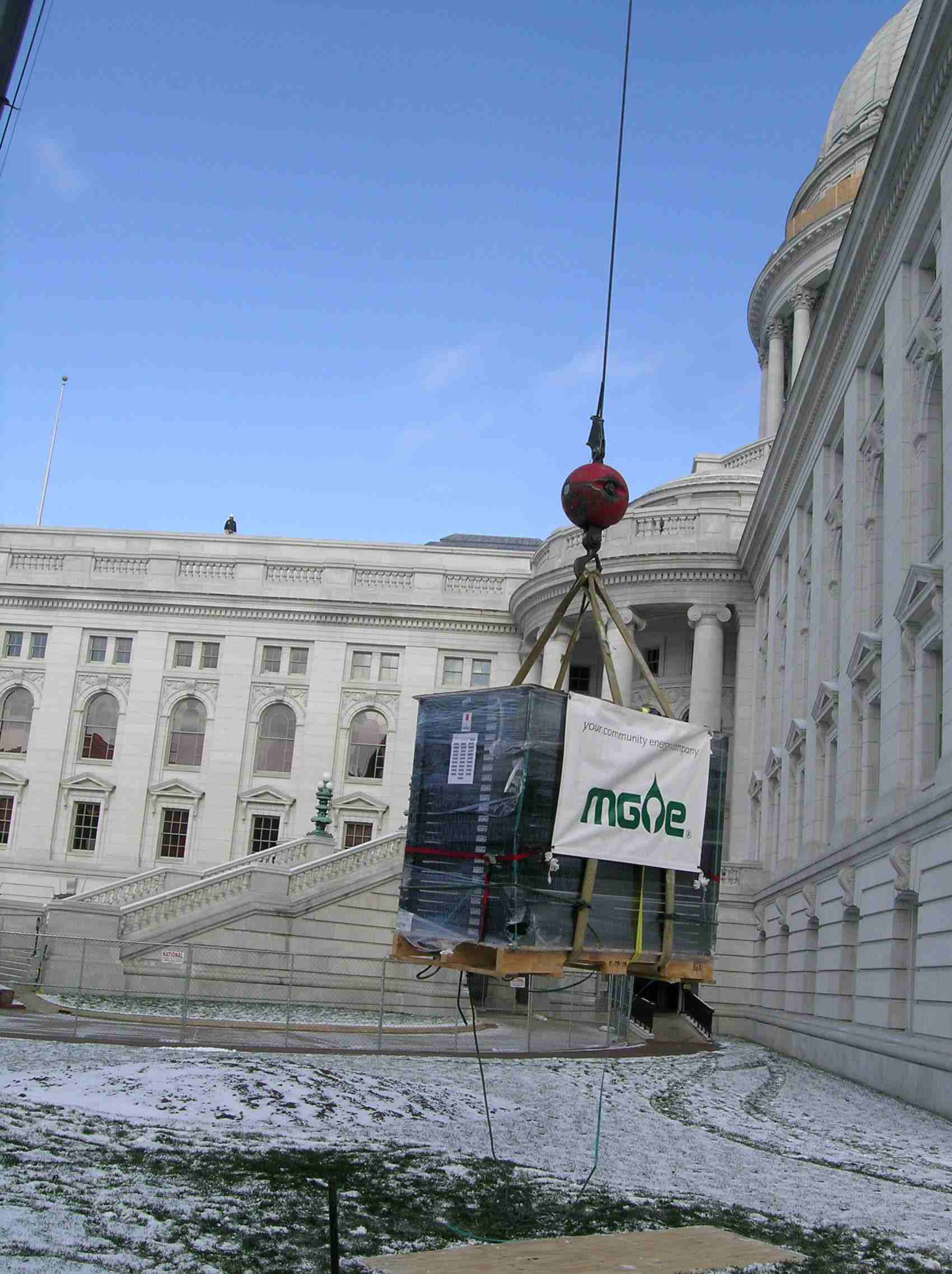
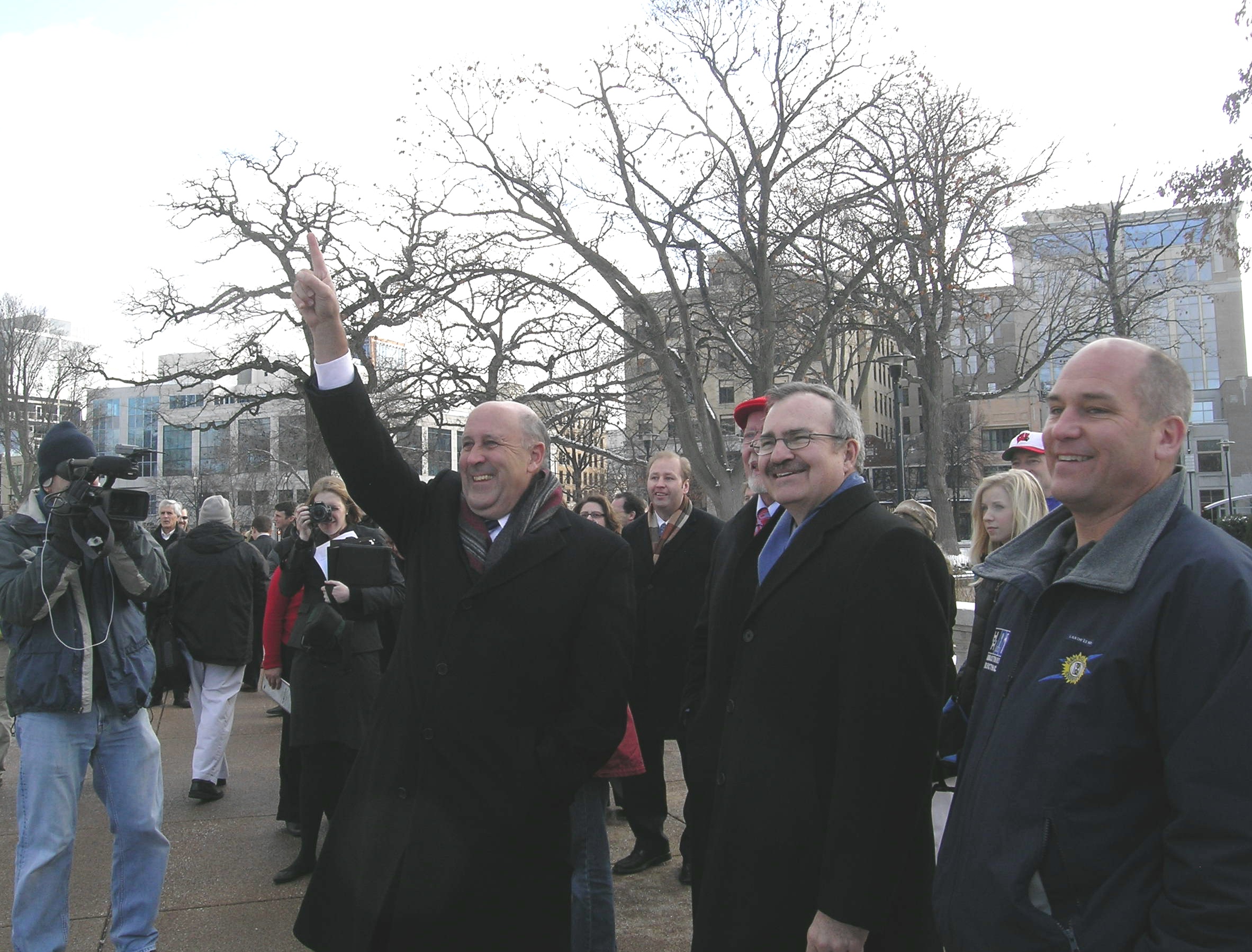
Governor Jim Doyle signals a crane operator to lift the first pallet of solar panels (left) for installation on the West Wing of the State Capitol. Madison Gas and Electric (MGE) President Gary (middle) and Chris Collins (right), a representative of the installer H&H Solar, joined in the liftoff.
The 48 solar panels in the final installation will cover 9,600 square feet on the Capitol roof and produce about 11,700 kilowatt hours of electricity a year, slightly more than a typical Wisconsin home would use annually.The system will be owned and maintained by MGE, which is fully funding the $78,000 project.
by jboullion | Dec 3, 2009 | Uncategorized
From an article by Raghav Mehta on The Minnesota Daily:
As policymakers and environmentalists search for new sources of renewable energy, researchers at the University of Minnesota are working on turning leaves and branches into energy.
University researchers are currently exploring the viability of using forest-based biomass as an alternative energy source. Last month they received a $2.7 million federal grant to expand the footprint of their research to cover 50 million acres of forestland in Minnesota, Wisconsin and Michigan.
Forest resources professor Anthony D’Amato will lead the study in collaboration with scientists and researchers from the U.S. Forest Service and the University of Wisconsin.
Researchers will gather branches, leaves and shrubs to analyze the economic and ecological costs and benefits of harvesting the woody biomass over the next four years.
D’Amato said forest-based biomass gives another option in the search for a more environmentally friendly source of energy.
by jboullion | Dec 2, 2009 | Uncategorized
From the newly released handbook on “Community Wind Financing,” published by the Environmental Law & Policy Center:
. . . community wind [i]s any project up to 20 MW which was “initiated and (at least partially) owned locally.”
Community wind power projects represent a relatively small, but growing, share of the wind energy market. As of July 2008, community wind projects accounted for at least 736 MW of the total installed wind energy projects in the United States, primarily in the Midwest, and more have been developed in the last year. These projects are largely owned by farmers and other local investors, schools, tribes and municipal utilities and rural electric cooperatives. Such local ownership generates powerful economic and social benefits for rural areas. . . .
This updated Handbook provides the latest information on financing community wind projects, including ownership structures, roles of financial intermediaries, and sources of federal and state financial support. Although building these projects has become easier over time as landowners have benefited from the experiences of the community wind pioneers, understanding and accessing financing opportunities remains perhaps the most important requirement for a successful project.
by jboullion | Dec 1, 2009 | Uncategorized
From an article by Heidi Clausen in The County Today:
TURTLE LAKE – An anaerobic cogeneration facility being proposed in Turtle Lake could help solve a growing problem for area dairy processing plants.
GreenWhey Energy, a privately held company spearheaded by Lake Country Dairy founder and project manager Tom Ludy, would recycle about 330,000 gallons of high-strength wastewater daily.
Initially, the waste would come from at least five northwestern Wisconsin processing plants within about 60 miles of Turtle Lake.
Eventually, it could be feasible to expand the facility so it could take in wastewater from as many as 11 regional plants, Ludy said.
The project would generate enough electricity to power about 1,500 homes along the Xcel Energy grid and create 242 million BTUs of heat a day. Underground pipes would transfer the heat to businesses and other buildings throughout the village.
GreenWhey plans to donate a free heat supply to the Turtle Lake School District and provide nutrient-rich solids that could be sold as fertilizer to farmers.
After the digestion process, an aerobic digestion system would clean the water so it could be discharged above ground.
Plans are to have the digester project up and running by next November on property near Lake Country Dairy in Turtle Lake, Ludy said .
by jboullion | Nov 30, 2009 | Uncategorized
From an article by Joe Knight in the Eau Claire Leader-Telegram:
“This is the age of oil, but the age of oil is about to end,” said Lori Snyder of UW-Eau Claire’s geology department.
In 1950, the U.S. did not import any oil. Today, we still like our cars, and we have to import 60 percent of the oil we use to support our driving habit, she said.
Vehicles may have gotten a smaller and more fuel efficient since the 1950s, but our appetite for energy – the majority of it coming from fossil fuels – is huge. Today the average American uses three times the amount of energy we used in 1950, Snyder said.
Snyder and J. Brian Mahoney, also of the geology department, discussed the future of fossil fuels and energy Tuesday night for an “Ask A Scientist” program at UW-Eau Claire.
An audience of mixed ages attended, and many asked questions of the scientists, but the answers they received painted a less-than-reassuring picture of our energy future.
Fossil fuel basically is solar energy trapped by plants and bugs – sometimes millions of years ago – that never completely decomposed. We have extracted the fuels and used it to power our cars, heat our homes and generate our electricity, but supplies are becoming scarce, the geologists said.
Oil supplies in the U.S. peaked in the 1970s, Mahoney said. World supplies of oil that is readily accessible are peaking now, he said.
There are some alternative sources of oil, such as sand tars in Alberta, Canada, which are being mined, but they require a substantial amount of energy to extract and are costly to the environment, Mahoney said.
We still have an abundance of coal in the U.S. – enough to meet our electrical needs for 200 to 250 years, Snyder said. Unfortunately, coal is the dirtiest fossil fuel for emissions. We’re already altering the composition of the atmosphere, and continuing at the current rate or increasing emissions brings about more questions about climate change and what life on Earth might be like in 100 years, Mahoney said.
“It’s taking us to a place we don’t really understand,” he said.