
All the Good We’re Doing, Together
In the nonprofit world, we spend a lot of our time planning how we will continue to fund our mission—similar to how many people spend much of their time planning how they will make ends meet.
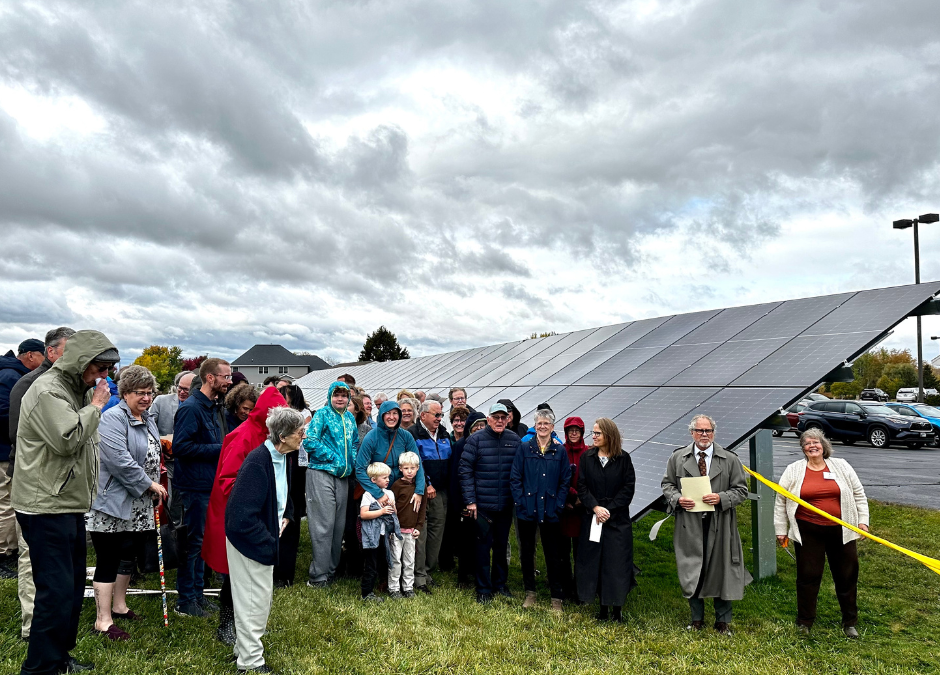
In some cases, for those who can’t make ends meet on their own, there are nonprofits to help. They feed, house, educate, and even protect us. Through RENEW’s Solar for Good program, we have the unique opportunity to help other nonprofits, as well as schools and houses of worship.
The formula is fairly simple—we make it easier for these organizations to access solar power, reducing their energy bills and, in turn, their operating budgets. The hope is that this help allows each and every one of them to spend more of their money and time where it matters: their mission.
Ultimately, every panel that goes up on a food pantry or affordable housing development means one more person who gets to reap the benefits of renewable energy.
Hunger Task Force
In 2025, Hunger Task Force completed a 465-panel array on their new headquarters in Milwaukee. Solar for Good helped the project come to fruition with a $48,237 grant, which covered about 13% of the project cost. Thanks to a wide mix of grants, donations, and government funding, Hunger Task Force covered most of the costs of this project.
Based on projected energy savings of $29,160 per year, Hunger Task Force will pay back its out-of-pocket expenses through avoided energy costs. Each year after that, another nearly $30,000 can go toward providing healthy food to those in need in and around Milwaukee. For every dollar spent on this project, Hunger Task Force will see $1.79 come back to it over the expected life of a typical solar array.
The dollars and cents are a huge motivating factor, but for a nonprofit focused on healthy meals and stewardship, we see additional benefits that are well aligned with the core mission of Hunger Task Force. By reducing emissions, this array helps lower air pollution and mitigate the effects of climate change, both of which lead to better health outcomes for our communities.
Learn more about Hunger Task Force’s Mission to end hunger in Milwaukee and Wisconsin.
West Central Wisconsin Community Action Agency
In 2023, the West Central Wisconsin Community Action Agency (West CAP) completed a 29-kilowatt solar array at one of their low-income housing projects to reduce energy bills for families. Solar for Good provided 27 panels through our grant program, about a third of the panels needed for the array. At the time of its completion, it was projected that the array would fully meet the energy needs of the families who would live in the low-income housing project.
Since 1965, West Cap has worked to promote the self-sufficiency of low-income families in the rural communities of west central Wisconsin. Solar panel technology has become a relatively new tool in efforts like this, as it can be used to completely or nearly eliminate energy bills for families that need a hand making life more affordable.
As Peter H. Kilde, former West CAP Executive Director, put it, “Through our poverty-fighting programs, we want to help prepare families for a world less dependent on fossil-fueled energy. This funding will not only allow us to reduce carbon emissions and help our planet, but it will also ease the energy burden for low-income families so they can afford their housing for the long term.”
Learn more about West CAP’s mission to take action against poverty.
Sauk Prairie School District
In 2025, the Sauk Prairie School District completed its second of two solar arrays for a total of 350-kilowatts of power. Their goal was to reduce their energy costs and, therefore, their overall operating budget. The savings will be placed in a fund to replace the roofs of each building across the district, as well as the solar panels. Solar for Schools, now part of Solar for Good, donated 179 panels, just over 20% of the total project.
It’s expected that the array at the elementary school will produce half of the building’s energy needs. As of July 2025, the smaller installation at the high school had already saved the district $15,000 in energy bills, just 10 months into operation.
The project serves as an educational tool for students and the community, with real-time data on energy generation and savings available online.
Learn more about the Sauk Prairie School District’s arrays.
Looking Ahead
As we see electricity bills rise and fossil fuel resources impacted by global conflict, the power of a solar array is becoming greater each day. And though this work has already touched so many, there are even more organizations out there that have yet to realize the benefits of this energy source.
To keep this work moving forward, we need people like you to support this effort. Together, we can help the nonprofits and schools of Wisconsin manage their energy bills so that they can focus their resources and time on what matters most: helping our communities.