by jboullion | Apr 28, 2011 | Uncategorized
From a story by Martha Boehm on WEAU-TV, Eau Claire:
LA CROSSE, WI (WEAU)–Some students at UW-La Crosse want the state-run heating plant, that’s been on campus for decades, to stop burning coal. The No Coal Coalition wants the state to consider other fuel options.
“It may take a while, but what we really want is a definitive statement from them for a day and a year that they will be able to transfer our campuses off of coal,” said UW-La Crosse senior Jennifer Dausey.
Dausey has been working with the No Coal Coalition and Environmental Council for about a year. About a dozen students and faculty members want the Wisconsin Department of Administration, which owns the heating plant at UW-L, to stop burning coal to heat campus buildings.
“We always say that we should have been off coal yesterday,” Dausey said. “There’s no reason we need to keep burning this dirty energy. It’s not only destroying families in the mining process, but it’s also destroying our health and our lungs. It causes so much asthma it’s ridiculous.”
Dausey says the coalition not only wants the plant to stop using coal, but to cut back on its natural gas emission, which is the second way it produces energy.
“It’d be easiest to switch to burning biomass, which is like wood pellets and it’s going to become a bigger economy here in Wisconsin with our natural resources,” Dausey said.
by jboullion | Apr 28, 2011 | Uncategorized
From an article by Brian E. Clark on WisBusiness.com:
Citing what they described as high costs, members of the three-person Public Service Commission said We Energies and the Domtar Corp. paper company will have to bear more costs for a proposed biomass plant in Rothschild that would produce both electricity and steam.
The $250 million plant will use waste wood and sawdust to produce 50 megawatts of electricity, as well as steam for Domtar’s papermaking operations.
Phil Montgomery, the new PSC chairman, said at Thursday’s PSC meeting that the state currently has adequate power supply reserves, but that We Energies needs to build the plant to meet state mandates that 10 percent of its power be produced from renewable resources by 2015.
Montgomery, a former legislator who chaired the Assembly Committee on Energy and Utilities, said he continues to support the renewable standard.
“But I don’t think anyone in the Legislature thought we would be experiencing this economic downturn we’re in now,” he added, noting that he hopes We Energies and Domtar can reduce costs to electricity ratepayers.
Commissioner Eric Callisto said he has trouble with the overall economics of the plan and how it has been structured between We Energies and Domtar.
Callisto said he is concerned with everything from the financing and operating costs to the rates that consumers will have to pay for the power generated by the plant. . . .
Commissioner Lauren Azar said she believes biomass may become Wisconsin’s best energy resource, but she said the Rothschild plant construction cost is approaching $5,800 per kilowatt hour, which she called “unacceptably high” and almost on par with the price tag for building a nuclear power facility.
Wind turbine construction costs are about half that figure, she said. But recent actions by the Legislature and governor over wind farm-siting rules have caused at least two companies to abandon projects because of regulatory uncertainty, she said.
by jboullion | Apr 27, 2011 | Uncategorized
From an article in the Chicago Tribune:
MADISON, Wis.— A poll of Wisconsin residents finds strong support for increasing the use of wind energy, even if doing so would raise electricity bills several dollars per month.
The Wisconsin Public Radio poll was released Friday. It shows that 77 percent of respondents want to see the state invest more in wind energy. Reasons included decreasing the nation’s reliance on foreign oil and helping the environment.
A majority, 69 percent, wouldn’t mind eight to 10 wind-energy machines being placed closed to where they live, and 79 percent favor placing the machines offshore in Lake Michigan.
Click here for poll results.
by jboullion | Apr 27, 2011 | Uncategorized
From an article article by Casandra Colson in the Jackson County Chronicle:
Living “green” always has been a way of life for Brambleberry Bed and Breakfast owners Chris and Sherry Hardie.
“That type of lifestyle was automatic,” Sherry said. “It wasn’t anything we strived for — it was the way we were raised.”
The Hardies, who each grew up on a dairy farm, now make sure Brambleberry Bed and Breakfast guests get a taste of what it’s like to live sustainable lifestyles during their stays at the couple’s rural Taylor getaway destination.
Brambleberry was named one of Wisconsin’s Eco-Elegant B&Bs by the Wisconsin Department of Tourism last year, and it’s also one of the state’s certified Travel Green destinations since 2008.
Travel Green Wisconsin businesses need to score at least 30 points in the certification process to receive the designation. Branbleberry scored 71.
“That’s a really good score and shows their support for sustainability,” said Shelly Allness, Travel Green Wisconsin program manager.
The Hardies were chosen to have the fifth-top eco-elegant inn, largely because of their commitment to growing and using homegrown produce for guest meals. They make homemade blackberry wine, use fresh herbs, serve homegrown pork and eggs and also make and serve homemade maple syrup.
by jboullion | Apr 27, 2011 | Uncategorized
From an article by Dan Piller in the Des Moines (Iowa) Register:
Beginning next month, motorists on Iowa highways will notice more of those huge trucks – which can be as long as 180 feet and weigh almost 400,000 pounds – hauling turbine parts as Iowa’s wind industry goes through another growth spurt.
MidAmerican Energy of Des Moines will begin construction of a 593-megawatt wind farm, which will include 193 turbines in Adair County alone.
“Wind turbine units can have up to nine loads apiece,” said Phoumine Baccum, who administers oversize truck permits for the Iowa Department of Transportation. “The blades come in three pieces, each a separate load, the towers are usually three separate loads, and there are separate loads for the hub and the nacelle and for other equipment.”
Brad Kohlwes’ family trucking company in Des Moines hauls for wind farms. “This is a real boost for the trucking industry and for Iowa’s economy,” he said. “I just wish we didn’t have to pay more than $4 for diesel like we do.”
Trucks loaded with turbine parts get about 4 miles per gallon, he said.
by jboullion | Apr 27, 2011 | Uncategorized
From a commentary by Steve Hiniker, executive director of 1000 Friends of Wisconsin, in the Milwaukee Journal Sentinel:
Gov. Scott Walker’s proposed budget has more than enough pain to go around. Schools get hit with more than $800 million in cuts over the next two years. Recycling programs are not funded. Health care for seniors and the poor are slashed. Local road aids are cut. Some transit systems may not survive the proposed reductions. State revenue sharing is going down, putting more pressure at the local level to cover the costs of cuts to state aids – and without raising property taxes.
It’s called austerity.
Unless you happen to be a road builder.
Then this budget is called a bonanza.
While other programs are cut, highway expansion projects totaling more than $400 million get the green light. Highway expansion raids the general fund of more than $140 million, crushing any arguments that “highway users pay for the costs of roads.” In fact, the general fund and property taxes will pay about half of roadway costs in the future. So-called user fees are soon to be eclipsed by decidedly nonuser fees.
When you look at the increase in highway spending, it is also important to pay attention to where the money goes. Local road aids are cut, meaning that even though there is more money going for major highway expansion, there is less money for local units of government to fix those bone-jarring potholes that crop up every spring. Maintenance dollars for highways are down as well.
Walker has said that the highway expansion is needed for our economic recovery. The governor is putting a lot of faith – and capital – in having superhighways be the cornerstone of the state’s economic recovery. After all, he could have put the money in building better communities with better schools as a basis of economic development.
All of this seems bizarre when you consider that we are driving less than ever. We are in the fifth year of a steady decline in miles driven by each Wisconsin resident. The numbers of miles driven will likely decline even more as the cost of gas continues to climb above $4 a gallon. In fact, it is because we are driving less that the governor is proposing to raid the general fund for highways.
As people drive fewer miles with more fuel-efficient vehicles, they use less gas and the amount collected in gas taxes decreases. So in order to expand highways, non-transportation fund dollars need to be raised. This is why Walker is pushing transit aids out of the transportation fund and is raiding everything from general fund dollars to the environmental fund to pay for bigger roads.
But if people are driving less, why expand highways?
by jboullion | Apr 26, 2011 | Uncategorized
From a story on WEAU-TV, Eau Claire:
RED WING, Minn. (AP) — Under the forested bluffs of southeastern Minnesota lies an increasingly sought-after resource. It’s called “frac sand.” And it’s prized by the energy industry, which uses it to extract gas and oil from underground rock in a process called hydraulic fracturing, or fracking.
Minnesota Public Radio reports an increasing number of companies are eying Minnesota for the sand, prized for its perfectly round, hard and chemically inert grains. One energy company recently purchased land near Red Wing for sand mining, sparking opposition from residents and environmentalists.
From an article in the Star Tribune, Minneapolis-St. Paul:
The fracking process pumps a mixture of frac sand, water and chemicals into underground rock formations to break up the stone and release oil and natural gas. It allows affordable access to fossil fuel supplies that once were too expensive to tap.
But it’s been a contentious issue in some states that have fracking operations. Critics argue that chemicals used in fracking may be contaminating water supplies.
by jboullion | Apr 26, 2011 | Uncategorized
Frm an article by Ron Seely in the Wisconsin State Journal:
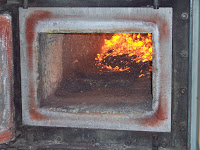
A small wood burner helps fire the boiler
to heat the Barron, Wiscosnin schools.
From smoking piles of wood chips in the countryside to dust on kitchen counters in Cassville, the difficulties posed by the conversion of the E.J. Stoneman Electrical Station in Grant County to burn wood instead of coal have challenged both village residents and plant engineers.
But the adventures and misadventures of the conversion stand as an informative and cautionary tale of what may lie ahead as Wisconsin and the rest of the country struggle to find alternative renewable fuels to help wean us from dirtier, nonrenewable combustibles such as coal.
Even so, Rich Nelson, plant manager, is more convinced than ever that the plant, one of just a few in the country that burn only wood, represents a future that will see much less dependence on nonrenewable fuels. After all, he said, it makes perfect sense to be turning demolished buildings in Milwaukee into power for more than 28,000 homes in the Cassville area.
“If we weren’t here,” Nelson said, “then all that construction material would be going into a landfill.”
The 60-year-old power plant, which rises next to the Mississippi River, was converted last year by Michigan’s DTE Energies, which has owned the plant since 2008. Its two boilers are now heated by wood rather than coal, a process known in the trade as “repowering.”
The transition has had its rough spots. Nearby residents have complained about problems such as ash on their window sills and kitchen counters, and wood chip piles stored in quarries that spontaneously combust and fill scenic valleys with blue haze.
“It’s frustrating sometimes,” Nelson said. “I think the expectation was that we’d push a button and then everybody’s feet would be up on their desks and we’d be making power.”
by jboullion | Apr 26, 2011 | Uncategorized
From an article by Laurel Walker in the Milwaukee journal Sentinel:
Waukesha – GE Healthcare is seeking city permission to install 10 wind turbines up to 155 feet tall on its 662-acre Waukesha campus on county Highway T north of I-94.
The project, if approved, would be built next year or later, said Annette Busateri, public relations manager. It is part of the company’s 2015 goal of reducing electrical usage by 15% and improving building energy efficiency by at least 10%, she said.
The Waukesha Plan Commission is scheduled to consider a conditional use permit for the project at its 6 p.m. meeting Wednesday. The city has no wind turbines, planner Michael Hoeft said.
City planner Jennifer Andrews said the company has lined up letters indicating state and federal agencies likely have no objections.
“They seem to have all their ducks in a row,” she said.
Although the proposed turbines are about a mile from the runways of Waukesha County’s airport, Crites Field, their height would be below the limit set by the county’s zoning ordinance that protects airspace around the airport from encroaching structures.
The plan calls for turbines on towers ranging from 135 to 155 feet tall. Three would be behind the former headquarters building, now an assembly building for medical imaging equipment that’s the farthest north of three buildings. The other seven would be between the two other buildings farther south.
Waukesha County Parks and Land Use Director Dale Shaver said there are no commercial wind turbines in the county. Not only would this project be the first, but they would be near a high-traffic, very visible interchange.
by jboullion | Apr 25, 2011 | Uncategorized
From an article by Tom Content in the Milwaukee Journal Sentinel:
Rising gasoline prices will pack a punch to pocketbooks this year, leaving consumers less inclined to buy big-ticket items, economists say.
But a Milwaukee group wants to help consumers keep from overspending on fuel.
Consider:
• A report by the Energy Information Administration said that, on average, a typical American household driving about 20,000 miles a year will see gas prices surge about $825 this year, based on the recent run-up in fuel prices to near record levels.
• A similar consumer hit is forecast for Canadian consumers in a recent economic forecast from CIBC World Markets, which found that the run-up in prices means that a greater share of household income is being spent on filling gas tanks than at any time except 2008. That will have consequences for sales of everything from big-ticket items like cars to every day items such as groceries, CIBC economists say.
“The rise in food and gasoline prices since the start of the year has effectively offset most of the benefit to (U.S.) consumers from the recent tax stimulus,” said CIBC economist Peter Buchanan in a recent report.
That’s where Drive Smart America, a business with a passion for getting great gas mileage, comes in.
Drive Smart America has trained drivers at Veolia Water Services, the Milwaukee Department of Public Works and other local fleets on smart-driving techniques that result in less wasted fuel. The business is led by Bradlee Fons of Pewaukee but includes experienced hybrid drivers who have been able to top the gas mileage charts.
Fons routinely gets more than 80 mpg in his Honda Insight hybrid – and has hit 100 in summer driving. On a recent drive in a minivan to see his son in La Crosse, Fons managed 33 mpg in a vehicle rated to get 24 on the highway.
The initiative is part passion, part business. The 6-year old Milwaukee Hybrid Group is changing its name to Drive Smart Wisconsin and hopes to stage more events like a tire pressure checkup held last year in Waukesha County. Fully inflated tires can be an important factor in improved gas mileage.