by jboullion | Sep 20, 2010 | Uncategorized
From an article by Kevin Murphy in the Wausau Daily Herald:
MADISON — The Citizens Utility Board wants the Wisconsin Public Service Commission to take a harder look at the environmental impact a power plant planned for Rothschild might have.
CUB asked the PSC last week to reconsider its preliminary decision not to conduct an environmental impact statement for the 50 megawatt, biomass-fueled generating plant We Energies wants to build on the south side of the Domtar paper mill.
PSC staff has conducted a preliminary environmental assessment, or EA, of the project that found it would pose no significant threat to the quality of the human environment. CUB said, however, that that conclusion is contrary to PSC staff’s own preliminary determination that the plant will have significant impacts unless mitigation measures are implemented.
by jboullion | Sep 20, 2010 | Uncategorized
From a news release issued by Energy Composites Corporation:
WISCONSIN RAPIDS, Wis. September 17, 2010 — Energy Composites Corporation (“ECC”)
(NASDAQ OTC:ENCC) a leading provider of composites-based solutions to the clean-tech sector, today announced that it has entered into an agreement with SSP Technology A/S of Kirkeby, Denmark (“SSP”), with the purpose of entering into a strategic partnership and to establish a joint venture. This strategic alliance will support both companies’ efforts to supply competitive blades to wind turbine generators for North American customers.
With its base in Wisconsin Rapids, the joint venture will be well-situated in the midst of the upcoming Great Lakes/Midwest wind turbine market. In the coming years this region will set new demands and lead the market for turbine performance, blade size and manufacturing technologies.
SSP will offer customers the complete aerodynamic and structural design for blades and moulds, production of prototype blades, and ramp-up of blade production based on the partnership with ECC. ECC will manufacture blades for all customers based either on the customer’s own design or a blade design developed via the partnership with SSP. The joint venture will manufacture moulds and prefabricated root segments for both companies and their customers.
by jboullion | Sep 17, 2010 | Uncategorized
From an announcement issued by the Energy Center of Wisconsin:
Free live webinar
Wednesday, September 29, 2010
1:00pm – 2:00pm CDT
Presented by Peter Taglia, Staff Scientist, Clean Wisconsin
The Midwest contains the world’s largest concentration of productive agriculture and food processing, and produces enormous amounts of animal and food waste. The Midwest is also rich in woody biomass and other forestry resources that can be sustainably harvested.
However, only a tiny portion of these wastes is converted to biogas, a renewable substitute for natural gas that reduces fossil fuel use and greenhouse gas pollution. For agricultural waste alone, the Midwest’s 55 anaerobic digesters pale in comparison to Germany’s, which exceed 4,000 despite its significantly smaller agricultural output.
This webinar explores the potential for this renewable energy resource to grow by examining biogas sources, conversion technologies, and outputs together with energy policies needed to support them. With appropriate policy and deployment, biogas can become a substantial source of energy in the Midwest.
by jboullion | Sep 17, 2010 | Uncategorized
See more video here.
From a news release about the ribbon cutting issued by MATC:
MILWAUKEE (Sept. 15, 2010) – Milwaukee Area Technical College hosted a ribbon-cutting ceremony at its 32-acre, 540 kW Photovoltaic Educational Laboratory on Wednesday, Sept. 15. The PV Lab is located at 810 E. Capitol Dr., Milwaukee.
MATC and Johnson Controls, the global leader in delivering products, services and solutions that increase energy efficiency in buildings, collaborated on the project, the largest operating photovoltaic facility in Wisconsin and is believed to be the first entirely portable photovoltaic facility in the United States. The project was unanimously approved by the Wisconsin Technical College System State Board on Sept. 30, 2009, and ground was broken on May 5, 2010.
“The Photovoltaic Educational Laboratory showcases several outstanding attributes of MATC: innovation and creativity at work; partnering with local businesses to provide new educational opportunities; advancing the world of technology to heights we have not seen before; and becoming a leader for other educational institutions and businesses to follow,” said MATC President Dr. Michael L. Burke. “This physical location has changed dramatically in just over four months. It started as a non-descript, unwanted, unmarketable tract of land that had stumped experts for decades on what exactly to do with it. Now, it represents what can really be called a new American dream.”
. . . The site features:
• 2,590 PV panels;
• two training centers for technicians, designers, site assessors, electricians, sales personnel and other professionals in renewable energy fields;
• over-parking and over-road array placement;
• data collection capabilities; and
• the first public television transmitter in the country that will approximate energy grid neutrality.
by jboullion | Sep 17, 2010 | Uncategorized
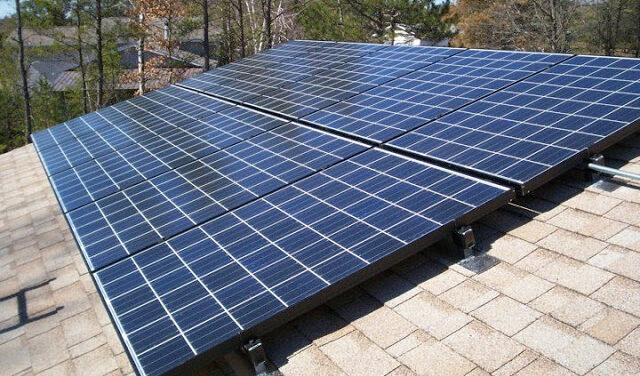
North Wind Renewable Energy installed this flush-mounted solar electric system on a home near Wisconsin Rapids.
by jboullion | Sep 17, 2010 | Uncategorized
From a blog post by Tom Content of the Milwaukee Journal Sentinel:
The Sierra Club on Thursday [September 9, 2010] filed suit in federal court claiming that two major coal-fired power plants operated by Wisconsin Power & Light Co. were upgraded over the years without installing modern pollution controls required by the Clean Air Act.
The suit charges the Madison utility made modifications to its Nelson Dewey power plant in Cassville in southwestern Wisconsin and its Columbia power plant near Portage without adding pollution controls. WP&L is a subsidiary of Alliant Energy Corp., Madison.
The suit is the latest in a series of Sierra Club suits targeting pollution from coal-fired power plants across Wisconsin.
Another suit by the environmental group and Clean Wisconsin has targeted air pollution from the We Energies Valley power plant in Milwaukee’s Menomonee Valley. Sierra Club has also filed suit over pollution by coal plants operated by Dairyland Power Cooperative of La Crosse and Wisconsin Public Service Corp. of Green Bay.
“The pattern here is that our aging fleet of coal plants can’t even meet current standards, so it sets us up for making a choice about whether we should be throwing good money after bad” to retrofit coal plants to meet emerging, stricter standards, said Jennifer Feyerherm of the Sierra Club’s Beyond Coal campaign.
WP&L has proposed adding pollution controls at the Columbia power plant, in an investment projected to cost $627 million. The state Public Service Commission has yet to rule on that proposal, and the Sierra Club is challenging that the controls proposed don’t go far enough to reduce air emissions from Columbia.
“We’re disappointed that the Sierra Club has opted for this approach,” utility spokesman Scott Reigstad said of Sierra Club’s suit. “We disagree with the claims the Sierra Club is making in its complaint. We intend to vigorously defend against the action.”
The court actions come as the state Public Service Commission is studying whether to shut down aging coal-fired power plants in Wisconsin because of the state’s power glut, and as the U.S. Environmental Protection Agency is commencing regulation of coal plants to curb emissions of carbon dioxide as well as a series of other pollutants.
by jboullion | Sep 16, 2010 | Uncategorized
FOR IMMEDIATE RELEASE
September 16, 2010
MORE INFORMATION
RENEW Wisconsin
Michael Vickerman
608.255.4044
mvickerman@renewwisconsin.org
MGE Rate Filing Rewards Fossil Fuel Use, Penalizes Renewable Energy
RENEW Wisconsin, a statewide renewable energy advocacy organization, today called on Madison Gas and Electric (MGE) to scrap its pending request to substantially increase the cost of participation in its voluntary renewable energy subscription program.
RENEW contends that MGE does not need a higher renewable rate because the cost of energy supplying its award-winning Green Power Tomorrow program have not changed over the last 18 months and will not for the foreseeable future. The utility is seeking permission from the Public Service Commission (PSC) to increase the renewable energy rate from 1.25 cents to 2 cents per kilowatt-hour (kWh), a 60% increase.
If approved, the voluntary premium that MGE customers will pay for sponsoring more wind and solar electricity production will be significantly higher than what other Wisconsin utilities charge. In contrast, Milwaukee-Based We Energies charges a 1.38 cents/kWh premium to participate in its Energy for Tomorrow program. That rate, which received a slight upward adjustment in 2009, will remain in effect through 2011.
“Nothing about this price hike makes any sense,” said Michael Vickerman, Executive Director of RENEW Wisconsin. “Program costs haven’t changed. Wind and solar energy is no more costly this year than it was in 2009, and next year it will be more of the same. Therefore, Green Power Tomorrow’s premium should remain where it is today.”
As part of the upcoming hearings on this proposal, RENEW Wisconsin will introduce a new approach to setting the purchase price of renewable energy, one that would insulate customers from the whiplash of fluctuating fossil energy prices. RENEW Wisconsin’s proposal is supported by the City of Madison, a large purchaser of renewable energy and a party in the PSC proceeding.
Vickerman pointed out that a price increase of this magnitude is certain to drive down customer participation levels, which MGE itself has acknowledged in its filings. In fact, MGE anticipates little to no increase in program revenues even if the 60% increase is approved.
In testimony filed at the PSC, Vickerman stated that Green Power Tomorrow expanded rapidly in 2008 and 2009 after reducing its premium from more than 2.6 cents to 1 cent/kWh. In that period, the customer participation rate climbed to nearly 10%, the third-highest ranking among all U.S. utilities, according to the National Renewable Energy Laboratory. In 2009, the pool of voluntary renewable energy serving program subscribers was nearly as large as the supply of renewable energy required under Wisconsin’s Renewable Energy Standard, Vickerman said.
“Through their purchases, Green Power Tomorrow subscribers eliminated in 2009 the production of about 95,000 tons of carbon dioxide from fossil energy sources at no cost to nonparticipating ratepayers,” Vickerman said.
“Up until now, Green Power Tomorrow has been a relatively inexpensive way for customers to lower greenhouse gas emissions that come from burning coal,” Vickerman said. “But by doubling the cost of renewable energy in less than two years, MGE will effectively encourage customers to drop out of the program, and take possession of the unsold renewable energy credits for its own use. This is bound to alienate customers who wish to support renewable energy generation and reduce their own greenhouse gas emissions.”
The proposal to raise the renewable energy subscription rate, submitted as part of MGE’s application to raise overall retail rates by nearly 10%, will be the subject of hearings later in September. If approved, a typical customer subscribing at the 100% level in Green Power Tomorrow would pay $3.75 more a month beginning January 1, 2011.
–END–
RENEW Wisconsin is an independent, nonprofit 501(c)(3) organization that acts as a catalyst to advance a sustainable energy future through public policy and private sector initiatives. More information on RENEW’s Web site at www.renewwisconsin.org.
by jboullion | Sep 15, 2010 | Uncategorized
THINK GREEN PICNIC
…FOR PEOPLE WORKING TO SAVE THE PLANET
Join other GREEN people, for your monthly dose of what’s going on in the “green scene” – the picnic will feature many representatives from environmental groups.
Brats, hot dogs, veggie option, potato salad, chips, condiments, cookies, water and pop are provided. You are welcome to bring your own beer, wine or other drinks.
TUESDAY, SEPTEMBER 28, 2010
Pine Pavilion, Carson Park
4:30-7:00 PM No rain date
Be kind to the earth:
Please bring your own reusable plate, cup, napkin and utensils
***Payment and RSVP MUST BE MADE IN ADVANCE***
$3 Individual $5 Couple $7 Family
Send to Think Green, 3013 Putnam Glen Place, Eau Claire, WI
Sponsored by Green Drinks Eau Claire.
by jboullion | Sep 15, 2010 | Uncategorized
FOR IMMEDIATE RELEASE
Contact:
Amy Heart
MREA Milwaukee Director
414-431-0758
amy@the-mrea.org
CITY ADDS SOLAR TO FIRE STATIONS AND TRAINS WORKFORCE
Milwaukee, WI – Milwaukee’s solar program is bringing solar hot water to two local fire stations, while training the local solar workforce. The City of Milwaukee’s Solar America City program, Milwaukee Shines, organized this one-of-a-kind opportunity through a partnership with Midwest Renewable Energy Association, Caleffi North America and Milwaukee Solar.
Milwaukee’s Fire Station #13, located at 2901 N 30th Street, and Fire Station #23, located at 2130 W Oklahoma Ave, will both receive solar hot water systems this October, as part of training workshops lead by the Midwest Renewable Energy Association (MREA).
The MREA, a non-profit organization, is a national leader in providing high quality training programs for renewable energy professionals. These install workshops will provide specialized training for individuals who would like to learn how to install solar hot water systems.
Matt Howard, Director of Milwaukee Office of Environmental Sustainability, said this installation is a perfect fit. “Solar hot water on fire stations is an excellent and efficient application of this technology,” said Howard. “The City of Milwaukee is excited to showcase a good use of the technology and off-set some of our energy use as well.”
Amy Heart, MREA’s Milwaukee Director, said this is a unique opportunity to not only save money for the City of Milwaukee, but also provide hands-on training for future solar installers. “By training local installers, we are working to expand the local solar market, reduce costs for consumers, and ensure quality installations that can demonstrate how solar works for Wisconsin,” said Heart.
Caleffi North America, headquartered in Milwaukee’s Menomonee Valley, donated the solar hot water systems for the installation workshops. Dean Wolff of Milwaukee Solar, will serve as the installer and instructor on the project.
Milwaukee was selected as a Solar America City in 2008 by the U.S. Department of Energy. Milwaukee Shines, the city’s solar program, works to increase solar electric and solar hot water installations through education, awareness and financial assistance. For details on the City of Milwaukee’s solar program visit www.MilwaukeeShines.com or call 414-286-5593
Pre-registration for the workshops is required, and pre-requisites must be met. To get more information on the MREA fire station install workshops visit www.the-mrea.org or call 414-431-0758.
Installation Schedule
Fire Station #13 Solar Hot Water Installation
Monday, October 4 – Thursday, October 7
City of Milwaukee Fire House #13
2901 N 30th Street
Milwaukee, WI 53210
Fire Station #23 Solar Hot Water Installation
Monday, October 25 – Thursday, October 28
City of Milwaukee Fire House #23
2130 W Oklahoma Ave
Milwaukee, WI 53215
# # #

by jboullion | Sep 13, 2010 | Uncategorized
FOR IMMEDIATE RELEASE:
Contact:
Gina Sinisi, Communications Coordinator
Midwest Renewable Energy Association
715-592-6595 ext: 113
gina@the-mrea.org
MREA ELECTS NEW BOARD PRESIDENT
CUSTER, WI – Thomas Brown was recently elected as the Board President of the Midwest Renewable Energy Association (MREA). Tom is an architect and LEED-Accredited Professional specializing in environmentally-responsive green design. He teaches environmental design courses at UW-Stevens Point and frequently presents at regional and national conferences. Tom has been a MREA member from its beginning, and is also a founding member of both the Energy and Environmental Building Alliance (EEBA), a national organization devoted to high-performance buildings, and the Wisconsin Green Building Alliance (WGBA). He is also a member of the U.S. Green Building Council (USGBC) and the Sustainable Buildings Industry Council (SBIC).
As an Architect, Tom’s projects have received numerous awards and been recognized nationally. His Mead Wildlife Area Education & Visitor Center was the first publicly-owned project in Wisconsin to achieve LEED Platinum Certification. Another project, the Sullivan Residence, was selected by the National Association of Home Builders Research Center as the most Innovative/Advanced Custom Home in a cold climate region in the country.
Tom lives in Stevens Point with his spouse, Jo Seiser. Jo is Executive director of the North Central Conservancy Trust (NCCT), a 7-county regional land trust for central Wisconsin. They have two children, Anders & Ivy.
Brown said that “as a founder and friend of the Energy Fair for over 20 years, I am pleased that I can help further the goals of the MREA as we continue to grow and expand our training opportunities and offer our considerable renewable energy expertise to our partners and others throughout the Great Lakes region of the Midwest.”
The MREA welcomes Tom at his new role as President.