by jboullion | Jan 21, 2010 | Uncategorized
IMMEDIATE RELEASE
January 21, 2010
MORE INFORMATION
Michael Vickerman
RENEW Wisconsin
608.255.4044
mvickerman@renewwisconsin.org
RENEW denounces WMC’s “fact-free flip-flop” in radio ad on energy bill
RENEW Wisconsin’s Executive Director Michael Vickerman assailed the credibility of a new radio ad launched by Wisconsin Manufacturers and Commerce (WMC) that characterizes the Clean Energy Jobs Act bill as an unaffordable extravagance.
“WMC executed an astonishing fact-free flip-flop with its claim that the legislation (AB 649/SB 450) would raise an average family’s electricity bill by more than $1,000 a year. What’s astonishing about it that WMC is conveniently forgetting existing ratepayer protections, which it endorsed – and claimed credit for — when similar legislation passed in 2006,” Vickerman said.
When the state’s current renewable portfolio standard (RPS) was passed (which directed utilities to source 10 percent of their electricity from renewable generation by 2015), WMC ran an article on its website with the headline “’Energy Efficiency and Renewables Act’ Will Protect Ratepayer Dollars.” That article can be accessed at http://www.wmc.org/display.cfm?ID=1256.
The article says that WMC was instrumental in ensuring that “ratepayer groups will have a clear opportunity to seek delays in the implementation of new renewable portfolio standards, should they have an unreasonable effect on electric rates.”
The Clean Energy Job Act bill would continue those ratepayer protections enacted in 2005 Act 141. So far no utility or energy advocacy group has requested an implementation delay under the current renewable energy standard.
In order for an average family’s bill to increase $1,000 a year, according to Vickerman, electric rates would have to double.
“That will never happen because groups like WMC, Citizens Utility Board, and the Wisconsin Industrial Energy Group would intervene aggressively on behalf of their member using the existing ratepayer protections,” Vickerman stated.
Since the adoption of Act 141’s renewable energy requirements, Madison Gas and Electric’s residential ratepayers have seen annual increases of only 0.8 percent through 2009, even though the utility is already in compliance with the 2015 standard, added Vickerman.
“This outrageous claim is just another example of WMC’s decision to lob grenades instead of working constructively to forge a responsible partnership with all parties to create family-supporting jobs in the clean energy sector,” Vickerman said.
“It’s clear that WMC made up its mind to oppose the Clean Energy Jobs Act bill long before its contents were even known to the public,” Vickerman stated.
“There is no more obvious proof of this than WMC’s sponsorship of a so-called study by the Wisconsin Pubic Research Institute (WPRI) that claims that the bill’s provisions to expand renewable energy supplies would cost utilities $16 billion.”
RENEW previously critiqued the WPRI report in a report titled “Think Tank Flunks Renewable Energy Analysis.” (https://www.renewwisconsin.org/2009/12/think-tank-flunks-renewable-energy_22.html)
“WPRI’s assertions demonstrate yet again that if you torture your economic models long enough, they will confess to anything,” Vickerman said.
END
RENEW Wisconsin is an independent, nonprofit 501(c)(3) organization that acts as a catalyst to advance a sustainable energy future through public policy and private sector initiatives.
by jboullion | Jan 21, 2010 | Uncategorized
From a blog post on by Andrew Weiland in the BizTimes Milwaukee:
Some of southeastern Wisconsin’s key business leaders said today that the creation of a regional transit authority to upgrade Milwaukee County’s bus system and create a Kenosha-Racine-Milwaukee (KRM) commuter rail is essential for the economic vitality of the region.
Backed by some of area’s most prominent business executives, Gov. Jim Doyle announced today new legislation to create a Southeastern Regional Transit Authority (SERTA).
The plan includes a 0.5 percent sales tax increase in Milwaukee County to provide a dedicated funding source for the county’s financially troubled bus system.
Business leaders said mass transit is needed to help people get to work and is a key amenity to attracting talented workers to southeastern Wisconsin.
“This is not a want, this is an absolute need for the community,” said Tim Sullivan, president and chief executive officer of South Milwaukee-based Bucyrus International Inc. The announcement about the RTA legislation was held at the Bucyrus headquarters.
“It’s critical that this legislation pass during the spring 2010 session,” said Robert Mariano, chairman and CEO of Milwaukee-based Roundy’s Supermarkets Inc. “It is foolish to ignore, this is an economic development issue. Transit builds the economy.”
“For the vitality of southeastern Wisconsin, getting this bill through the legislature is critical,” said Scott VanderSanden, president of AT&T Wisconsin.
“We believe regional transit and the KRM is an important investment in the future of our region,” said J. Fisk Johnson, chairman and CEO of Racine-based S.C. Johnson & Son Inc. “More efficient and more affordable public transit can help make a city an even more attractive place for business and can help the vibrancy of a community. The lack of accessibility to Milwaukee and Chicago is a big reason it is more challenging to attract key people to our company.”
“It’s really frustrating to see the constant deterioration of public transit,” said Ed Zore, CEO of Milwaukee-based Northwestern Mutual Life Insurance Co. “It’s really important for business to have a good public transit system.”
About 700 of his company’s employees use public transit, Zore said.
by jboullion | Jan 20, 2010 | Uncategorized
From an article by Dee Hall in the La Crosse Tribune:
MADISON — The Wisconsin Department of Natural Resources is dragging its heels in addressing charges that four University of Wisconsin System coal-fired plants are violating the federal Clean Air Act, an environmental group says.
The Sierra Club alleged in comments last summer that the heating plants at the La Crosse, Eau Claire, Stevens Point and Stout campuses have undergone millions of dollars worth of upgrades that should trigger additional pollution controls.
A consultant’s report commissioned by the state Department of Admini-stration disagreed, concluding that the $16.8 million in changes at the four facilities don’t qualify as “major modifications.“
Officials at the DNR, which issues operating permits for the four plants, say they’re still evaluating the comments.
Jeff Johnson, environmental engineering supervisor for the air-management program at the DNR’s regional office in Eau Claire, said the permit reviews are “complicated” and it will take time to evaluate the written comments filed by the Sierra Club and others expected from the U.S. Environ-mental Protection Agency.
“I do not have all the information on how the comments from Sierra Club and EPA will be handled, but do know we have a small task force working on resolving these issues,” Johnson said.
Charges that state-owned power plants are violating the federal clean-air law come at an awkward time for Gov. Jim Doyle, who late last year unveiled his Clean Energy Jobs Act. It calls for 25 percent of the state’s energy to come from wind, solar, biomass or other renewable sources by 2025. At the end of 2008, the state was at nearly 5 percent.
Wisconsin currently relies heavily on coal, which is a major source of greenhouse gases that contribute to global climate change.
‘We can only move so fast’
While the overwhelming majority of that coal is burned by private utilities, the state owns 15 coal-fired plants that serve UW campuses, state treatment facilities and prisons and state-owned buildings in Madison including the Capitol. The plants provide steam to heat the buildings, and some generate electricity and chilled water for cooling.
“Clearly one of the first and best steps he (Doyle) could take is to clean up the state of Wisconsin facilities,” said Jennifer Feyerherm, director of the Sierra Club’s Wisconsin Clean Energy Campaign. “It seems like the first logical step for someone who wants to take the lead on global warming.”
by jboullion | Jan 20, 2010 | Uncategorized
An Associated Press story on WXOW-TV La Crosse:
MADISON, Wis. (AP) – The developers of a sweeping renewable energy bill say the measure positions Wisconsin well if the federal government restricts coal use.
Roy Thilly was co-chairman of Gov. Jim Doyle’s Global Warming Task Force, which developed recommendations that have become the basis for the bill. He tells lawmakers during a hearing the task force wanted to help the state to survive if carbon regulations come down from Washington. Wisconsin currently relies heavily on coal, a major source of greenhouse gases.
Thilly says the bill will eventually reduce utility bills because renewable sources will negate the need to build expensive new power plants.
Opponents say the bill will cost the state billions of dollars and thousands of jobs. Environmentalists have denied those claims.
by jboullion | Jan 20, 2010 | Uncategorized
An article from the Sheherd Express:
Over the next three months, the Wisconsin Legislature and governor will try to enact the Clean Energy Jobs Act aimed at creating new jobs and improving the air we breathe through a clean energy economic strategy. It is important for policy-makers to get multiple points of view on the table and all of the facts honestly presented to develop the optimal public policy for Wisconsin’s future. So it is unfortunate that the Wisconsin Policy Research Institute (WPRI), the child of the right-wing Bradley Foundation, put out a terribly flawed report two months ago—in fact, it was so bad that many thought it would be discarded immediately. Instead, this report, which, of course, came up with the results the business community desired, has been cited over and over by well-funded special interests that oppose clean energy technology.
Among the many obvious errors made in the study, the report failed to factor in economic and related benefits that would result from the legislation. This includes reduced energy costs for businesses and individuals, avoiding the costs of building new power plants, fewer transmission lines, various health benefits resulting in less absenteeism from work and school, more certainty for businesses by avoiding the fluctuations in fossil fuel prices, and greater revenues for farmers resulting from the increased use of biofuels. We just hope that legislators are intellectually honest enough to see through such biased analysis.
by jboullion | Jan 20, 2010 | Uncategorized
Green Drinks Tonight!
5PM @ Dooley’s
Eau Claire Green Drinks
5:00-7:00PM
The Backroom of Dooley’s Pub (Corner of 5th and Water St)
Come relax with friends and make some new ones as we get together and discuss environmental issues that are important to YOU at Eau Claire’s Green Drinks. Green Drinks is an opportunity for folks interested in “green” environmental issues to come together over drinks and conversations to find out what interesting things are going on in the Chippewa Valley. Green Drinks is unique because there is no agenda, there are no dues, there’s no board of directors – it’s just a social opportunity for people to come together and talk with other like-minded environmentalists about ideas, events, and issues going on around our community.
A common sentiment often heard in the local environmental community is that there is no clearinghouse of information regarding environmental issues. Green Drinks has already successfully served Wisconsin communities as a place to share ideas in La Crosse, Madison, and Green Bay – it’s time to add Eau Claire to that list!
by jboullion | Jan 20, 2010 | Uncategorized
From an article by Larry Sandler of the Milwaukee Journal Sentinel:
South Milwaukee – Milwaukee County could create its own transit authority, funded by a sales tax of up to a half-cent, to take over the county’s cash-strapped bus system, under proposed legislation unveiled Tuesday.
The full 0.5% sales tax would bring in about $60 million a year, or roughly $20 million more than the Milwaukee County Transit System would need to end property tax support and meet its funding needs, bus system spokeswoman Jacqueline Janz said. The new transit authority would be required to use the additional money to restore bus routes cut since 2001, to increase service or to reduce fares.
Planners have warned the bus system would face a major service cut without new state or local funding to replace property taxes.
After months of behind-the-scenes negotiations, Gov. Jim Doyle announced the plan at a news conference at Bucyrus International corporate headquarters. He was backed by the chief executive officers of some of the region’s largest corporations, who said the southeastern Wisconsin economy depends on reliable transit that isn’t funded by property taxes.
The Milwaukee County authority would be one of several temporary local transit authorities that eventually could merge into the existing Southeastern Regional Transit Authority, which oversees the planned KRM Commuter Link rail line. Like Milwaukee County, other county or municipal governments that run bus systems could form temporary transit authorities in Kenosha, Racine, Ozaukee, Washington and Waukesha counties, which would sunset if not merged into the regional agency.
Outside Milwaukee County, the local transit authorities could be funded by local vehicle registration fees, hotel taxes or property taxes contributed by local governments, but they could not impose sales taxes without voter approval in a referendum.
From an article by Stephanie Jones in the Journal Times (Racine):
[Racine Mayor John] Dickert stood with the governor Tuesday in supporting new transit legislation.
“If we as elected officials are going to rebuild our cities, we must start with a solid foundation,” Dickert said. “That foundation can begin with a regional transit system.”
by jboullion | Jan 19, 2010 | Uncategorized
From a news release issued by the Forest County Potawatomi Community:
Crandon, Wis. – The Forest County Potawatomi Community began an advertising campaign Monday in support of the Clean Energy Jobs Act, state legislation that economists predict will create a minimum of 15,000 new jobs in Wisconsin and end up lowering electric bills in the state.
“Protecting Mother Earth and the resources She provides is a cornerstone of the Potawatomi people,” said Jeff Crawford, Forest County Potawatomi Attorney General. “Wisconsin needs to seize this opportunity to reduce the carbon pollution that threatens Wisconsin for the worse while also creating thousands of jobs for Wisconsin families.”
Crawford added, “The Potawatomi support the Clean Energy Jobs Act and will aggressively work to ensure passage. The bill will be a real boost to Wisconsin’s economy.”
The Clean Energy Jobs Act is based on recommendations from the Global Warming Task Force. The Task Force was formed to investigate ways the Wisconsin could reduce its greenhouse gas emissions while simultaneously creating jobs and growing the state’s economy. Representatives from Wisconsin businesses, environmental groups, utilities and other interested stakeholders voted in favor of a final report containing roughly 60 recommendations. The Forest County Potawatomi was a member of the Global Warming Task Force.
Among the major recommendations from the Task Force is the proposal that 25% of Wisconsin’s electricity come from renewable sources by 2025.
Public opinion research has found that a majority of Wisconsin voters favor action by the State to reduce carbon pollution and believe state action will grow clean energy jobs.
by jboullion | Jan 19, 2010 | Uncategorized
From a post on the Web site of Bubbling Spirngs Solar:
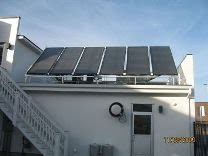
Café 27 in Steven’s Point has just finished the installation of a six-panel array of Bubbling Springs Solar’s collectors, performed by Bob’s Plumbing. Using solar thermal technology in the foodservice industry is highly economical; the sun heats or preheats the water for dishwashing and cooking, cutting down on conventional energy bills. Café 27 is setting an excellent example and we hope to see more solar thermal in the foodservice industry. Check out Café 27 at 945 Clark St. in Stevens Point, WI or call 715-544-4730.
by jboullion | Jan 19, 2010 | Uncategorized
From a news release issued by the Wisconsin Department of Workforce Development:
State Labor Secretary says UW-Platteville on track with new clean energy degree
PLATTEVILLE – Department of Workforce Development (DWD) Secretary Roberta Gassman said today Governor Doyle’s Clean Energy Jobs Act will create 15,000 jobs by 2025, including career opportunities for graduates of a new clean energy degree program at the University of Wisconsin-Platteville.
“Governor Doyle’s comprehensive clean energy package will create thousands of good, family-supporting jobs, grow our economy and help Wisconsin gain its energy independence,” Secretary Gassman said. “His plan will mean career opportunities for our workers of tomorrow, including UW-Platteville students pursuing the new bachelor’s degree in renewable energy.”
Governor Doyle’s Clean Energy Jobs Act implements recommendations of his Global Warming Task Force to address climate change and grow the state’s green economy. The comprehensive package would:
Require use of renewable energy sources for 20 percent of Wisconsin’s needs by 2020and 25 percent by 2025. This will ensure more energy dollars remain in the state. Wisconsin currently spends $16 billion per year on imported energy to heat homes and fuel cars and trucks.
Increase energy efficiency and energy conservation efforts with graduated statewide electricity savings goals, leading to a 2 percent reduction in energy use by 2015 and annual reductions thereafter.
Create jobs, more than 1,800 in the first year, many of them construction jobs, according to new industry-recognized research. Economists and policy analysts estimate the package will create 800 to 1,800 new construction jobs per year through 2025 and more than 2,000 manufacturing jobs once the energy act provisions are fully implemented.
Secretary Gassman addressed students and faculty in the new on the first day of the spring semester. She applauded the university’s decision to offer a four-year degree in renewable and sustainable energy. The decision was prompted by the popularity of a minor degree in renewable energy that the College of Engineering, Mathematics and Science offered to students in all fields of study.