by jboullion | Oct 21, 2009 | Uncategorized
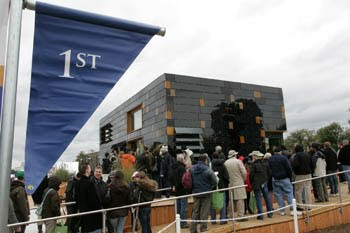
Visitors stand in line to learn about Team Germany’s solar-powered house, which won the U.S. Department of Energy Solar Decathlon on the National Mall in Washington, D.C., Sunday, Oct. 18, 2009. (Photo by Stefano Paltera/U.S. Department of Energy Solar Decathlon)
From a news release issued by the U.S. Department of Energy:
WASHINGTON, DC – U.S. Department of Energy Deputy Secretary Daniel Poneman today announced the winners of the 2009 Department of Energy Solar Competition on the National Mall in Washington, D.C. Team Germany, the student team from Darmstadt, Germany, won top honors by designing, building, and operating the most attractive and efficient solar-powered home. The University of Illinois at Urbana-Champaign took second place followed by Team California in third place.
The active competition lasted for a week, with the prototype home designs open to the public through Sunday. Team Germany’s winning “Cube House” design produced a surplus of power even during three days of rain. This is the team’s second-straight Solar Decathlon victory, after winning the previous competition in 2007. . . .
Over the past two weeks, the 2009 Solar Decathlon challenged 20 university-led teams from the United States and as far away as Spain, Germany, and Canada to compete in 10 contests, ranging from subjective elements such as architecture, market viability, communications, lighting design, and engineering, to technical measurements of how well the homes provided energy for space heating and cooling, hot water, home entertainment, appliances, and net metering.
New to this year’s competition, the Net Metering Contest was worth 150 points towards the final results and was the most heavily weighted contest. It challenged teams to generate surplus energy, above and beyond the power needed to run a house, which they fed into a power grid.
Team Germany earned 908.29 points out of a possible 1,000 to win the competition, followed by the University of Illinois at Urbana-Champaign with 897.30 points, and Team California with 863.08 points.
The UW-Milwaukee team brought up the rear with 524.074 points, largely due to delays in getting the home to Washington. The University of Minnesota Team finished fifth with 838.544 point.
by jboullion | Oct 20, 2009 | Uncategorized
From a news release issued by Alliant Energy:
CEDAR RAPIDS, Iowa – October 20, 2009 – October is Energy Awareness Month and Alliant Energy has three easy ways consumers can save energy, and best of all, they require little to no investment. Homeowners can lower their energy bills in three simple steps – turn down the thermostat, trade out traditional light bulbs for compact fluorescent lights (CFLs), and complete an energy audit.
“A cleaner environment and more sustainable future are important to many homeowners, and Energy Awareness Month is just another reminder that each of us can contribute to a global energy solution by using energy more efficiently,” said Linda Mattes, Director of Energy Efficiency and Renewables at Alliant Energy. “An added benefit is the money homeowners can save on their energy bill.”
Consumers can save approximately ten percent on their annual heating costs by taking the “10 Degree Challenge.” Simply turn the thermostat down by ten degrees for eight hours each day – and save money while working or sleeping.
After turning the thermostat down a few degrees, another easy and effective place to start saving is with lighting. Lighting accounts for 20 percent of the average home’s electric bill. Using just one ENERGY STAR® qualified CFL can save an average of $30 or more in electricity costs over its lifetime and prevent more than 450 pounds of greenhouse gas emissions.
CFLs save money by using 75 percent less energy and last up to 10 times longer than their old-fashioned counterparts. Because they produce more light than the traditional incandescent light bulbs, customers should purchase a CFL with a lower wattage to get the same amount of light.
Once a homeowner has looked at their thermostat settings and lighting, they can address the rest of the home with an energy audit. My Home Comfort Check Up, a free online audit, helps customers identify where their energy dollars are going. Homeowners can complete the online survey by visiting www.alliantenergy.com/mhcc.
by jboullion | Oct 20, 2009 | Uncategorized
From Tom Stolp:
Quick reminder: Green Drinks is on Wednesday at Dooley’s Pub! Join us for a quick presentation and then discussion about upcoming issues and events. Green Drinks Eau Claire. Dooley’s Pub on Water St., 6:30-8:00PM
by jboullion | Oct 20, 2009 | Uncategorized
From a news release issued by Focus on Energy:
MADISON, Wis. (October 19, 2009) – Focus on Energy, Wisconsin’s statewide resource for energy efficiency and renewable energy, announced competitive grants today to help industrial businesses and manufacturers throughout the state to complete energy efficiency projects.
“In today’s economy, many companies are severely capital constrained,” said Ken Williams, Focus on Energy’s business programs director. “Focus on Energy is committed to providing the financial incentives needed to get large projects off the shelf and on the table.”
These grants will fund up to $500,000 or 50 percent of project costs per company for large energy efficiency projects that have been stalled due to lack of available internal capital. Applicants must document a need for funding to overcome the financial barrier to be selected. Approved projects must be completed December 15, 2010 and offer savings of 200,000 kilowatt-hours of electricity or 20,000 therms of natural gas annually.
“Focus offered a similar program in 2007 that was very popular,” Williams explained. “We are pleased to offer an expanded version of the program for 2010 and give companies the opportunity to complete stalled projects.”
Interested businesses should visit focusonenergy.com/competitive_incentives for more information. Applications must include a list of potential projects as funding is based on the energy savings from those projects and is paid when projects are completed. Applications must be received by December 4, 2009. For more information about large industrial grants call Craig Schepp at (608) 277-2948
by jboullion | Oct 20, 2009 | Uncategorized
A news release from the Public Service Commission:
MADISON – The Public Service Commission of Wisconsin (PSC) has rescheduled a 2nd public hearing for Wednesday, October 21 in Milwaukee on We Energies’ (Wisconsin Electric Power Company (WEPCO) and Wisconsin Gas, LLC) request to adjust electric, steam and natural gas rates.
Administrative Law Judge Michael Newmark will be present to receive comments from the public at the hearing site in Serb Hall, Wisconsin South Hall, 5101 West Oklahoma Avenue in Milwaukee beginning at 3 p.m. and 6 p.m.
When a utility requests a change in rates, the PSC conducts a thorough audit of the utility’s expenses and revenues. The agency will look at the amount We Energies needs to provide a reliable source of energy to customers, which includes costs of fuel, maintenance, new construction and environmental protection.
Public comments on We Energies’ application will be included in the record the Commission will review to make a decision. The PSC has the authority to approve, deny or modify the application.
Citizens are encouraged to attend. The hearing location is accessible to people in wheelchairs. Anyone requiring accommodations to participate should contact the PSC at 608-266-5481.
Documents associated with We Energies’ application can be viewed on the PSC’s Electronic Regulatory Filing System at http://psc.wi.gov. Type case numbers 5-UR-104in the boxes provided on the PSC homepage, or click on the Electronic Regulatory Filing System button.
by jboullion | Oct 20, 2009 | Uncategorized
From an article by in the Dunn County News:
A company-wide commitment to environmental stewardship from the shop floor to top management has led Phillips Plastics Corporation — with facilities in Phillips, Eau Claire, Hudson, New Richmond, Medford, Men-omonie and Prescott — to save more than $750,000 on its energy bills each year. This will not only help the manufacturer save money, but protect the environment and keep jobs in Wisconsin.
Phillips Plastics Corporation received $400,000 in financial incentives from Focus on Energy, Wisconsin’s statewide resource for energy efficiency and renewable energy, to complete energy saving projects that will save more than 8.5 million kilowatt-hours of electricity and 78,000 therms of natural gas annually-enough energy to power 940 Wisconsin homes for a year.
Multiple projects
Since 2002, Phillips Plastics has completed energy assessments at all 15 of its buildings to find cost-effective ways to save energy including traditional applications, innovative technologies, energy management plans and high-performance equipment upgrades.
Major projects include:
• Numerous plant-wide lighting upgrades, including advanced controls where appropriate
• Adding variable speed drives on heating, cooling and ventilation equipment at multiple sites
• Installing energy efficient compressed air equipment
• Upgrading ventilation equipment in multiple sites
• Installing cutting edge chilled water technology at two sites
• Completing numerous feasibility studies to determine which projects to pursue
by jboullion | Oct 20, 2009 | Uncategorized
From an article by Dave Alexander in the Meskegon Chronicle:
Grand Valley State University’s wind turbine testing project for Muskegon Lake is shifting in a new direction.
Instead of a wind turbine at the east end of Muskegon Lake, GVSU’s Michigan Alternative and Renewable Energy Center now is planning to move a wind test platform to Lake Michigan, where data can be collected on the pros and cons of turbines on a major lake.
The university has received $1.4 million in an “earmark” from U.S. Rep. Pete Hoekstra, R-Holland, to advance wind turbine generation on the Great Lakes.
The idea of testing a turbine on Muskegon Lake is cost prohibitive with the federal dollars available, according to Arn Boezaart, interim director of the Muskegon-based MAREC. Efforts to partner with L-3 Communications in Muskegon have not been successful.
Discussions with officials from the U.S. Department of Energy and those interested in advancing a Great Lakes wind industry in West Michigan led to the idea of a floating, data-collection platform in Lake Michigan.
The platform would hold a anemometer that gauges wind speed. . . .
A data-collection platform established from 6-10 miles off the Muskegon shoreline would be left on the lake for two or three years. It would provide year-round wind data.
The floating platform also could test anchoring systems and show how Lake Michigan ice movements in the winter would affect an eventual lake-based turbine installation, Boezaart said.
by jboullion | Oct 19, 2009 | Uncategorized
AC_FL_RunContent( ‘codebase’, ‘http://download.macromedia.com/pub/shockwave/cabs/flash/swflash.cab#version=8,0,0,0’, ‘width’, ‘505’, ‘height’, ‘227’ , ‘src’, ‘http://storybridge.tv/sites/all/themes/storybridge/swfs/sbplay_seg02c’, ‘quality’, ‘high’, ‘pluginspage’, ‘http://www.macromedia.com/go/getflashplayer’, ‘align’, ‘middle’, ‘play’, ‘true’, ‘loop’, ‘true’, ‘scale’, ‘showall’, ‘wmode’, ‘transparent’, ‘devicefont’, ‘false’, ‘id’, ‘sbplay_seg02c’, ‘bgcolor’, ‘#000000’, ‘name’, ‘sbplay_seg02c’, ‘menu’, ‘true’, ‘allowFullScreen’, ‘true’, ‘allowScriptAccess’, ‘always’, ‘movie’, ‘http://storybridge.tv/sites/all/themes/storybridge/swfs/sbplay_seg02c’, ‘salign’, ‘tl’, ‘FlashVars’, ‘pathPrefix=http://storybridge.tv&segList=%2Ffiles%2Fep107main_poster.swf%2C0%0D%0A%2Ffiles%2Faskbob5_0.swf%2C3%0D%0A%2Ffiles%2Fep107main_1.swf%2C44%0D%0A%2Ffiles%2Fep107main_2.swf%2C90%0D%0A%2Ffiles%2Fep107main_3.swf%2C22%2Chttp%3A%2F%2Fwww.storybridge.tv%2Fnode%2F863%3Fcmode%3Dcomment%23comment-form%0D%0A%2Ffiles%2Fep107main_4.swf%2C126%2Chttps%3A%2F%2Fwww.mge.com%2Fmy_mge%2FServiceForms%2FWindPowerRes.htm%0D%0A%2Ffiles%2Fep107main_5.swf%2C15%2Chttp%3A%2F%2Fwww.storybridge.tv%2Fnode%2F866%0D%0A%2Ffiles%2Fep107main_6.swf%2C31%2Chttp%3A%2F%2Fstorybridge.tv%2Fpostcard%2F77%3Fpmode%3Dshare%26message%3Dhttp%3A%2F%2Fwww.storybridge.tv%2Fgreenview&lc0=Z&lc1=X&lc2=X&lc3=X&lc4=X&autoplay=false&pingPath=http://storybridge.tv/files/ping.txt&myTitleIn=ASK+BOB+-+EPISODE+5&mp4_path=/files/AskBob5.mp4&selfURL=http://www.storybridge.tv/greenview&nextNode=/node/Object&nextNodeTitle=GREEN+VIEW%3A++SOLAR+SYSTEMS&nextNodeTease=Solar+is+hot+right+now%21++There%27s+a+lot+of+curiousity+and+for+years%2C+MGE+engineers+have+been+preparing+themselves+to+answer+those+questions.%0D%0A%0D%0AIn+an+attempt+to+learn+all+about+solar%2C+MGE+has+spent+the+last+10+years+building+solar+demonstrations+projects+in+all+shapes+and+sizes.++%0D%0A%0D%0AIn+this+story%2C+get+up+close+to+some+unique+solar+systems+and+find+out+what+engineers+have+learned+by+testing+ideas+in+the+real+world.&nextNodeImg=http://storybridge.tv/files/ep83thumb_poster.jpg’);
From Ask Bob, a feature on the Web site of Madison Gas and Electric.
by jboullion | Oct 19, 2009 | Uncategorized
The Public Service Commission issued the final environmental impact statement (EIS) on the Glacier Hills Wind Park, and it includes these items:
Medical Impacts (page 68)
UW Med Flight is the responding air ambulance service closest to the Glacier Hills project area. UW Med Flight and the other reswponding agencies plan to develop safe landing sites or locations within the project area to which medical helicopters could be dispatched. Establishing alternative landing zones in an area is a common tool employed by medical helicopter services where terrain, vegetation, or
structures restrict landing sites….
In some instances, alternate landing sites may not be required; a medical helicopter can land in proximity to a wind turbine if it is safe and prudent to do so. There do not seem to be any UW Med Flight rulers or policies that would preclude landing within a project area if it is safe to do so. The decision about where to land is the pilot’s and is based on a variety of site factcors that present themselves upon arrival at an emergency scene. For example, closer landins to a turbine might be possible if the winds are calm and the wind turbine rotors are not rotating.
Sound Impacts (Page 82)
The studies done to date suggest that there is a wide variability in how peopole react to wind turbine noise and that many people do no appear to be affected. The studies do, however, support the concern that some people do react negatively to wind turbine noise, primarily through annoyance and sleep disturbance. It is widely accepted that disruption of sleep can lead to other physiological and psychological problems.
Dr. Nina Pierpont has hypothesized that in addition to annoyance and disturbance, wind turbine noise can result in direct activation of the vestibular and autonomic system leading to other health problems. The validity of this suggestion has been questioned. The Minnesota Department of Health concluded that “evidence is scant” for this hypothesis.
In summary, it is important to recognize that turbine noise can be problematic for some people. Although specific sound levels or distances from turbines cannot be directly correlated with these disturbance or annoyance problems, project design and siting should take potential impactcs of turbine noise into account.
Property Values (page 84)
A more recent study of two recently completed Wisconsin wind farms was completed by Appraisal Group One. This study contained similar problems of small sample size and weak statistical analyses. While the study was limited to residential vacany land sales, other potential factors that might influence sales prices were not analyzed. The study did not verify that all properties sold within the wind farm areas actually had views of wind turbines, whether the properties were sold prior to the proposal of a wind facility versus after the facilities were constructed and operating, and it did not differentiate between vacant lots with infrastructure potential such as streets, sewer, and water as opposed to farmland with no infrastructure.
by jboullion | Oct 19, 2009 | Uncategorized
From an article by Rick Barrett in the Milwaukee Journal Sentinel:
A group of local businessmen have proposed using a waste treatment facility at the former Maple Leaf Farms in Yorkville to process food waste into electricity.
Maple Leaf was one of the nation’s largest duck farms. It closed in 2008, resulting in the shutdown of its manure-to-energy methane digester.
DF-1 Associates is a group of Racine-area businessmen involved in restaurant grease recycling. They’re hoping to reopen the methane digester and fuel it with restaurant garbage and waste from food-processing plants. The company would make money by hauling away the waste from restaurants and food processors and selling electricity generated from the digester.

 Visitors stand in line to learn about Team Germany’s solar-powered house, which won the U.S. Department of Energy Solar Decathlon on the National Mall in Washington, D.C., Sunday, Oct. 18, 2009. (Photo by Stefano Paltera/U.S. Department of Energy Solar Decathlon)