by jboullion | Feb 17, 2009 | Uncategorized
From an article by Chris Hubbuch in the La Crosse Tribune:
With his yellow rain slicker, reflective vest and helmet-mounted headlight, it’s hard to miss Kurt Oettel as he pedals to work.
“There’s no doubt I’m a bike commuter,” he said. “I look like a geek.”
Oettel, 44, rides about 21/2 miles each way from his home on 24th Street to Gundersen Lutheran, where he works as an oncologist.
He rarely misses a day.
“I took off those three days when there was a 35 below wind chill,” he admitted.
For Oettel, who with his wife has three kids, one car and 11 bicycles, biking to work started as a necessity but continues out of a passion for biking and for conserving energy.
A new law that took effect Jan. 1 provides a monetary benefit for commuters like him and an incentive for others to get on their bikes.
According to the law, commuters can collect $20 a month for bike-related expenses; employers can deduct the expense from their taxes.
The credit, which extends benefits already available to parking and public transit users, was included in last fall’s controversial $700 billion financial industry bailout.
Ironically, the measure’s sponsor, Rep. Earl Blumenauer, voted against it. The Oregon Democrat, who wears a bicycle lapel pin and spent years pushing for the credit, opposed the rescue bill, calling it too expensive and ineffective.
Exactly how the law will be applied — how often do you have to ride to work to be a bicycle commuter? — isn’t clear. The IRS has not issued specific guidance on the rule, said spokesman Christopher Miller.
“A lot of things are not completely explained yet,” said Meghan Cahill, communications director for the League of American Bicyclists, which applauds the law.
Employees will have to produce receipts to document they spent money — on a bike, accessories or repairs — said Mary Jo Werner, a CPA with Wipfli LLP in La Crosse.
It’s not clear from the law whether it’s mandatory for employers to offer the benefit.
“I don’t know why an employer wouldn’t want to do it,” Werner said. “You’re giving an employee a benefit and it doesn’t cost anything. Plus it kind of breeds good will.”
Carl Johnson, owner of Smith Cycling and Fitness, hasn’t figured out how it will work but plans on offering the credit. He has about 10 employees who could qualify as bike commuters.
by jboullion | Feb 17, 2009 | Uncategorized
From the solicitation announcement from We Energies:
We Energies offers grants under its Renewable Energy Research and Development (R&D) Grant Program to its business and not-for-profit electric customers as well as to organizations teamed with We Energies business and not-for-profit electric customers. This program offers financial assistance in the form of a grant to conduct research on renewable energy technologies, or to help demonstrate a renewable energy product or technology. Areas of research that will receive the highest funding priority include work in the following areas:
1. Improving existing renewable energy technologies such as wind, solar, and biomass.
2. Expanding renewable distributed-generation technologies and related technologies, such as energy storage and smart grid technologies that directly benefit the integration and distribution of renewable energy onto the grid.
3. Developing renewable energy technologies, products and services that provide more affordable electricity and improved reliability.
4. Conducting longer-term research on advanced renewable technologies that will help meet tomorrow’s electricity needs and contribute positively to the renewable energy industry.
A proposed research project must be located within We Energies electric service territory, or if not located within the service territory it must clearly provide local benefits to the electric service territory. Grants are not intended to offset the cost of purchasing small renewable systems such as a residential photovoltaic installations and/or a small wind turbine on a farm, but rather are intended for research and development endeavors that will clearly advance a technology or product, and will clearly contribute positively to the renewable energy industry. . . .
We Energies offers grant funds up to a maximum grant of $200,000 per project. Although matching funds are not required for this grant program, any additional funding that can be added to the proposal is considered a favorable element of the project and increases the chances for a successful grant. In addition, as noted above, We Energies grant funds may potentially be used as matching funds toward a larger state or federal grant program, provided project activities meet this program’s requirements and intent. Only one R&D grant will be awarded per applicant per program year. Exceptions will be made for Universities and similar type organizations where separate project applications may be received from different departments within the organization in one calendar year. In those cases, only one successful grant will be awarded to a specific department in a calendar year. . . .
How do I apply for a grant?
Complete and submit the application. The application requires a scope of work that describes the goals of your study, the tasks or deliverables that will be accomplished, a timeline and budget for each task/deliverable, and your qualifications (and those of your team, if applicable). If a consultant or outside entity will perform all or a portion of the work, a scope of work and associated materials must be received on their letterhead and signed by the person(s) committing to complete the study. If you’re an organization teaming with a We Energies electric customer, a letter of commitment from all parties, describing the
relationship and roles of each party, also must be included in your application. . . .
More information:
Amy Flom
amy.flom@we-energies.com
262-893-6162
by jboullion | Feb 16, 2009 | Uncategorized
From the Web site of the Midwest Renewable Energy Association (MREA):
The ReNew the Earth Institute is a place where people of all ages can learn about renewable energy, energy efficiency, sustainable living, and other environmental issues. The Institute has working renewable energy systems, hands-on educational displays, demonstration gardens, a resource library, and a workshop/conference room. . . .
Located at 7558 Deer Road in Custer, WI., we’ve got many projects on the way for this spring, and we can always use an extra pair of hands. Call Mike at 715-592-6595 ext.105 if you are interested in helping for a couple hours or even for a couple of days
by jboullion | Feb 16, 2009 | Uncategorized
From an article by Tom Content on JSOnline.com:
About 175 people gathered this morning in the auditorium at the Schlitz Audubon Nature Center to talk about ways to green their company’s environmental footprint and save some money at the same time.
Companies are looking to reduce their energy and water bill costs by taking steps to make their processes more efficient.
It’s all about applying the quality-improvement techniques that companies are by now long familiar with – lean manufacturing, Six Sigma – and adapting them to their use of resources such as energy and water, said Joseph Jacobsen, associate dean at Milwaukee Area Technical College.
What’s causing the shift to thinking green? Business owners can sense that carbon regulations are coming and want to get ready, while others are realizing that saving energy and water helps save — or stem the rise – in utility bills.
“Green is not just environmental sustainability. Green is business sustainability too,” said Jon Dommissee, director of new product development and marketing at Bradley Corp.
Bradley, a local maker of plumbing fixtures, and the state Focus on Energy were sponsors of this morning’s Green Manufacturing Summit, and the Journal Sentinel was media sponsor.
by jboullion | Feb 16, 2009 | Uncategorized
From an article by Chris Hubbuch in the La Crosse Tribune:
With his yellow rain slicker, reflective vest and helmet-mounted headlight, it’s hard to miss Kurt Oettel as he pedals to work.
“There’s no doubt I’m a bike commuter,” he said. “I look like a geek.”
Oettel, 44, rides about 21/2 miles each way from his home on 24th Street to Gundersen Lutheran, where he works as an oncologist.
He rarely misses a day.
“I took off those three days when there was a 35 below wind chill,” he admitted.
For Oettel, who with his wife has three kids, one car and 11 bicycles, biking to work started as a necessity but continues out of a passion for biking and for conserving energy.
A new law that took effect Jan. 1 provides a monetary benefit for commuters like him and an incentive for others to get on their bikes.
According to the law, commuters can collect $20 a month for bike-related expenses; employers can deduct the expense from their taxes.
The credit, which extends benefits already available to parking and public transit users, was included in last fall’s controversial $700 billion financial industry bailout.
Ironically, the measure’s sponsor, Rep. Earl Blumenauer, voted against it. The Oregon Democrat, who wears a bicycle lapel pin and spent years pushing for the credit, opposed the rescue bill, calling it too expensive and ineffective.
Exactly how the law will be applied — how often do you have to ride to work to be a bicycle commuter? — isn’t clear. The IRS has not issued specific guidance on the rule, said spokesman Christopher Miller.
“A lot of things are not completely explained yet,” said Meghan Cahill, communications director for the League of American Bicyclists, which applauds the law.
Employees will have to produce receipts to document they spent money — on a bike, accessories or repairs — said Mary Jo Werner, a CPA with Wipfli LLP in La Crosse.
It’s not clear from the law whether it’s mandatory for employers to offer the benefit.
“I don’t know why an employer wouldn’t want to do it,” Werner said. “You’re giving an employee a benefit and it doesn’t cost anything. Plus it kind of breeds good will.”
Carl Johnson, owner of Smith Cycling and Fitness, hasn’t figured out how it will work but plans on offering the credit. He has about 10 employees who could qualify as bike commuters.
by jboullion | Feb 13, 2009 | Uncategorized
From WE Energies and the Wisconsin Green Building Alliance:
Coming to Milwaukee!
Friday, March 13, 2009, 8 a.m. – 5 p.m.
ZERO ENERGY BUILDING – THE CONVERGENCE OF SOLAR POWER AND ENERGY EFFICIENCY
Lessons For Architects, Builders, Designers, Engineers, Developers, and Owners
Presenters:
Steven J. Strong, President, Solar Design Associates
Lew W. Pratsch, U.S. Department of Energy
LOCATION:
We Energies
Public Service Building – Auditorium
231 W. Michigan St.
Milwaukee, WI 53203
Sponsored by We Energies and the Wisconsin Green Building Alliance
TO REGISTER AND FOR MORE INFO, GO TO: http://www.wgba.org/zeb.html
AGENDA:
Friday, March 13, 2009
8:00am – 8:30am Registration and Continental Breakfast
8:30am – 8:45am Welcome and Introductions
8:45am – 9:15am PV Cell and Module Technology
9:15am – 10:15am Overview of PV Systems Options & Applications: Intro to basic systems and components with application examples
10:15am – 10:30am Morning Break
10:45am – 12:00pm Moving Toward Zero Energy Homes
12:00pm – 1:00pm Lunch Break
1:00pm – 2:00pm BIPV: Options, Materials and Methods
2:00pm – 2:45pm BIPV: A World View
2:45pm – 3:00pm Afternoon Break
3:00pm – 4:00pm BIPV – Detailed Case Studies
4:00pm – 4:30pm Codes, Economics and Incentives
4:30pm – 5:00pm Wrap Up with Questions and Discussion
by jboullion | Feb 13, 2009 | Uncategorized
From an article by Tom Content in the Milwaukee Journal Sentinel:
More companies are looking to reduce their energy and water utility bills by taking steps to make their processes more efficient.
It’s all about adapting the quality-improvement techniques that many companies are already using, said Joseph Jacobsen, associate dean at Milwaukee Area Technical College.
What’s making people turn to green? Businesses know that carbon regulations are coming and want to get ready, and they are realizing that saving energy and water helps save – or stem the rise – in utility bills.
“Green is not just environmental sustainability. Green is business sustainability too,” said Jon Dommissee, director of new product development and marketing at Bradley Corp.
Jacobsen and Dommissee spoke during a Green Manufacturing Summit held Thursday at the Schlitz Audubon Nature Center in Bayside. Bradley, a local maker of plumbing fixtures, and the state Focus on Energy sponsored the event, along with the Journal Sentinel.
Despite the slowing economy, companies continue to seek grants from Focus on Energy to help them pay for energy-saving projects, said Nate Altfeather of Focus.
Focus provides grants that help shorten the payback time on projects that boost energy efficiency. With companies holding the line on spending, the types of incentives sought from Focus may shift.
“We’re going to see a lot more interest in low and no-cost maintenance incentives,” Altfeather said. “People aren’t going to be able to cut checks for $100,000 for new equipment.”
Focus is developing new incentives designed to help companies with energy-saving upgrades that have a payback of one year or less. The Focus program, funded through charges on utility bills, will pay nearly 100% of an energy audit for those firms, Altfeather said.
by jboullion | Feb 13, 2009 | Uncategorized
From a new release posted on WQOW-TV, Eau Claire:
Eau Claire (News Release) – With the Wisconsin Department of Transportation in Eau Claire today to receive public comment on its “Connections 2030” long-range transportation plan, the West Central Wisconsin Rail Coalition is seeking changes to the plan that would include the region in WisDOT’s plans for a high speed rail network.
Members of the coalition applaud much of the philosophy of the draft Connections 2030 plan, which includes a major state policy goal to provide Wisconsin citizens with more transportation choice by improving passenger train service and other non-automobile travel options. In the draft plan, WisDOT says it “envisions a 21st century intercity passenger rail system that links the Midwest region’s major economic centers.”
Unfortunately, West Central Wisconsin is not included in that network, which would be built in three phases with routes serving Chicago-Milwaukee-Madison-La Crosse-St. Paul and Milwaukee-Green Bay. The plan only promises to “consider” service to area once the entire network is completed more than a decade from now.
The Coalition points out that West Central Wisconsin – which encompasses the Chippewa Valley and St. Croix Valley areas from Eau Claire/Chippewa Falls through Menomonie and Hudson/River Falls – is one of the fastest growing population areas in the state, growth that could be stunted if the area is left out of the network.
by jboullion | Feb 12, 2009 | Uncategorized
From an article by Craig Reberth in the Telegraph Herald (Dubuque):
CASSVILLE, Wis. — Pending a state Department of Natural Resources air-quality hearing next week and the ensuing public comment period, work should start on converting a Cassville power plant from coal to 100 percent renewable fuel.
In May, DTE Energy Services, of Ann Arbor, Mich., announced it was purchasing the E. J. Stoneman power plant. DTE said it planned to convert the coal-fired plant to burn wood waste, a renewable fuel.
The Stoneman facility was built in 1950. Integrys Energy Services bought the 53-megawatt capacity plant in 1996 from Dairyland Power Cooperative and operated it as a merchant power plant, selling power in the open market. This is DTE Energy’s initial foray into Wisconsin.
Once the air permit is issued, the project will move forward, DTE officials say. The plant probably will be pulled off-line by the end of this month, with demolition and construction to take place during the summer. The plant could be back online as early as June 2010.
Work includes converting the boilers from burning pulverized coal to a stoker technology and conversion of the material handling process. It is estimated the project will use 40 people at the peak of the effort.
by jboullion | Feb 12, 2009 | Uncategorized
From the Web site of Energy Concepts, located in Hudson, Wisconsin:
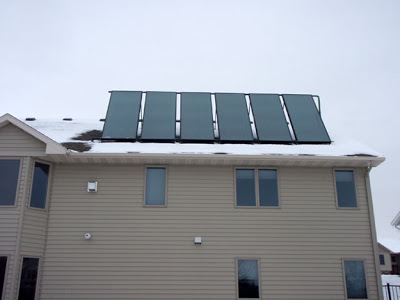
One hurdle on this project was convincing the sub-division association that the solar panels would not take away from the development’s overall aesthetics and that it complied with existing covenants, which it did.
This is a custom-designed combination domestic hot water and in-floor space heating system.
The homeowners received $2,500 for the project from a Focus on Energy Hot Water Grant and another $3,500 from the Solar Space Heaitng Progam, a program of utility members of WPPI Energy.
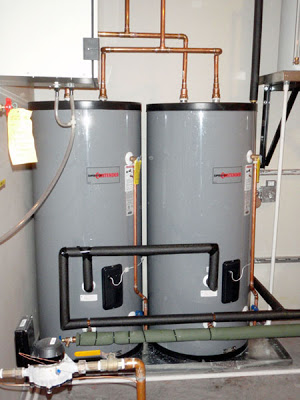
Two 119-gallon tanks (below) hold the solar heated water until it circulates under the floors to heat the house.