
Webinars: Building Communities Educational Series

From the UW-Extension Center for Community and Economic Development:

Today’s society is complex and challenging. There are myriad social, environmental and economic opportunities and challenges facing communities and businesses of all types and sizes. How do we engage each other in ways that benefit more than just a few special interests? How do we proceed so that we can achieve important objectives, but not do so at the expense of other ones that we also value? Is there a way of balancing a healthy economy, a healthy ecosystem and a healthy community? If we find that balance, can we sustain it?

This year’s Building Communities Webinar Series tackles these important questions. We address global, regional and local issues and challenge ourselves as both a community and as individuals. Join us in discovering some of our constraints and uncovering the limitless potential we possess to overcome them. If you care deeply about the economy and the viability of our businesses … if you care deeply about the ecological health of our planet … if you care deeply about the quality of life of our community – this webinar series is for you. Join us to be enlightened, to be informed, to be challenged, and to be called to action!

Who Should Attend:
Extension educators along with local elected and appointed officials working with communities on economic development and quality of life issues, including local business leaders, economic development professionals, and environmentalists.

Co-sponsors:
University of Wisconsin-Extension Center for Community and Economic Development and Sustainability and Energy Teams. . . .

The registration fee is $40 per program/$275 for the series per site (You can invite as many people as you would like to participate at your site).

Programs will be held on the third Tuesday of the month from 11:30 A.M. – 12:30 P.M. (Central Time) from October 2008 – June 2009.

This year, the series will focus on Sustainability:

October 21, 2008, 11:30 – 12:30 P.M., C.T.
Setting the Stage: Sustainability and Sustainable Community Development

November 18, 2008, 11:30 – 12:30 P.M., C.T.
Energy Efficiency

December 16, 2008, 11:30 – 12:30 P.M., C.T.
Renewable Energy

January 20, 2009, 11:30 – 12:30 P.M., C.T.
Sustainability and Comprehensive Planning

February 17, 2009, 11:30 – 12:30 P.M., C.T.
Sustainable Business Practices and Strategies

March 17, 2009, 11:30 – 12:30 P.M., C.T.
Green Collar Jobs: Sustainable Work in a Low Carbon World

April 21, 2009, 11:30 – 12:30 P.M., C.T.
Local Food Networks: Food Localization as a Sustainability Strategy

May 19, 2009, 11:30 – 12:30 P.M., C.T.
Sustainability Indicators and Measurement

June 16, 2009, 11:30 – 12:30 P.M., C.T.
Community Organizing for Sustainability
Northcentral Home Energy Conservation Workshop slated

From an article in the Wisconsin Ag Connection:

Homeowners, renters, and people who are contemplating building a new home can learn about ways to save energy in the home by attending the second annual Northcentral Home Energy Conservation Workshop on October 11 at the Rib Lake High School. The program will cover alternative home heating systems, solar energy applications, energy saving ideas for new and existing homes, home energy audits, renewable electricity and alternative home construction methods. The workshop will cover the costs and payback potential of the various types of systems and practices as well as tax credits and cash incentives for various energy saving applications. Speakers will discuss practical, feasible ways to save money and energy and provide information that can be used to choose energy-saving practices.

The program includes 15 breakout sessions and includes a lunch featuring locally grown foods from the Price and Taylor County areas. In the afternoon, participants can choose from two options: a tour of two nearby homes demonstrating a variety of energy-saving practices, or a workshop on designing and building window quilts. The Price and Taylor County UW-Extension Offices and Land Conservation Departments, the Upper Chippewa River Basin Program, and Pri-Ru-Ta Resource Conservation and Development Council are sponsoring the program in partnership with Price Electric Cooperative, Taylor Electric Cooperative, Clark Electric Cooperative, Xcel Energy, Medford Electric Utility, Wisconsin Focus on Energy, and the Midwest Renewable Energy Association, with major funding through a grant from the Wisconsin Environmental Education Board. . . .

For more information or a brochure, contact the Price County UW-Extension Office at 715-339-2555, or Taylor County UW-Extension at 715-748-3327.

Cuba City gains jobs from Wausaukee Composites' wind energy foray

From an article by Craig D. Weber in the Dubuque, Iowa, Telegraph Herald:

CUBA CITY, Wis. — Operating in what was once the Cuba City Machine building, now known as the Wausaukee Composites building, the burgeoning wind energy industry sounds a clarion call in the city of 2,000.

“Wausaukee Composites is excited to play a contributing role in the rapidly developing wind energy industry in North America,” said David Lisle, president and CEO of Wausaukee Composites Inc. “We have been actively developing new manufacturing opportunities in this emerging market segment for more than two years.”

That opportunity includes Cuba City. Wind turbine nacelle cover assemblies are being manufactured in the 42,000-square-foot facility located on the city’s south end. Production began on Feb. 18 with about 12 employees.

“The Cuba City plant will be a dedicated facility to the wind energy industry,” Lisle said, explaining the facility has the capacity to produce up to 800 wind turbine nacelles a year.

Kettle Foods gets it

From the Green Racine blog:

Salem, Ore.-based Kettle Foods says that it has yielded environmental and economic benefits by adopting measures that include offsetting all of the electricity used to operate both its Salem and Beloit factories with wind power. Additionally, the Beloit plant is home to 18 rooftop wind turbines.

“When we decided to go for green – or in this case, gold – with LEED certification of our new factory, we knew it was the right thing to do,” says Tim Fallon, president of Kettle Foods’ North American division.

The company also recycles of 2,300 gallons of waste oil with conversion to biodiesel used to power a company fleet of diesel-engine cars called BioBeetles, and reduces more than three million pounds of carbon dioxide emissions annually resulting from the elimination of shipping lines between Oregon and the Midwest.

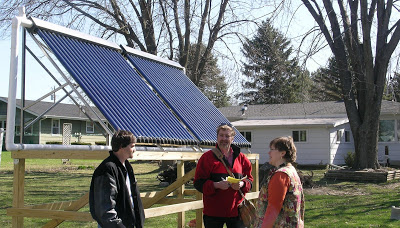
Solar hot water from a Platteville garden

Solar hot water from a Platteville garden

From left to right: Todd Timmerman, solar installer;
Michael Vickerman, RENEW Wisconsin; and Nancy Collins.

From an article in the newsletter of RENEW Wisconsin:

Ben and Nancy Collins weren’t only thinking about energy savings when they installed a solar hot water system at their Platteville residence to serve their family of six. They also wanted to influence their children’s attitudes toward renewable energy use.

Says Nancy Collins: “We want our children to grow up thinking that it’s normal for families to harvest solar energy.”

”It’s not space age or futuristic technology,” she adds. “I was surprised at the simplicity of the system and the efficiency of the heat exchange. It is a sound investment for energy savings. Gas prices have gone up but our bills have stayed the same.”

But there are aspects of the Collins’ solar hot water system that are decidedly not normal. For example, due to heavy shading from nearby trees, the solar collectors could not be placed on the rooftop of the Collins’ home. Instead, the installer, Todd Timmerman of Timmerman’s Talents, Platteville, went searching for the least-shaded section of their yard, which turned out to be their garden.

But such is the Collins’ commitment to harvesting solar energy that they decided to move the garden, and situate the collectors in its place, amidst the cilantro, basil and strawberries. On that space now stands a four-foot-tall wooden structure, housing two collector panels facing the sun at a 45º angle. Since its completion in September 2007, the ground-mounted system has become a neighborhood fixture, a few feet from where neighborhood children congregate and play in the Collins’ yard.

The array installed by Timmerman captures radiant solar energy through a series of vacuum-sealed tubes (also called evacuated tubes). Inside each tube is a copper heat pipe. Sunlight striking each of the 40 tubes heats a liquid inside each heat pipe, which quickly turns into a vapor. The gas travels upwards and releases heat into a larger pipe running along the top of the array. At that point the heat is transferred to a glycol solution that is then pumped into the house to where it heats the water inside.

Commentaries

2012
12.04.12 PSCW Decisions “Tax” Renewable Energy
11.08.12 The Real Meaning of Kewaunee’s Demise
08.16.12 Natural Gas: Wrestling with Reality

2011
07.11.11 Wisconsin’s Widening War on Renewables

2010
11.10.10 Shirley Wind: An Auspicious Debut for Emerging Energies
09.30.10 Meet Butler Ridge, Wisconsin’s Newest Wind Project
09.27.10 Touring This Year’s Renewable Energy Crop
07.12.10 The Oil Spill and You
05.05.10 Impressions of Wind Siting Council’s Tour of Wind Development in Fond du Lac County
05.04.10 A Cruel Month for Renewable Energy
04.15.10 Legislators Fire Blanks at Clean Energy Jobs Act
04.07.10 Costs of Coal Plants Keep Going Up
02.22.10 Of Molehills and Renewable Energy Purchases
02.17.10 Clearing Up Wisconsin’s Lakes With Clean Energy
02.12.10 Letter to Sen. Miller & Rep. Black on rate impacts of ARTs

2009
12.22.09 Think Tank Flunks Renewable Energy Analysis
11.20.09 Fact sheet: Renewable energy buyback rates
10.19.09 Educating Schools on Solar Air Heating
10.10.09 Plain English explanation of wind siting reform law
09.25.09 CWESt’s Report Adds Noise to Wind Debate
08.11.09 Pursuing Sustainability Through Economic Adversity
07.10.09 It’s Time to Bring Renewable Energy Home
06.02.09 Windpower – A Stabilizing Force in an Economic Downdraft
04.07.08 The Importance of Doing the Math
01.27.09 Response to anti-wind comments of State Rep. Bob Ziegelbauer

2008
12.05.08 Q&A on higher buyback rates on electricity from renewables
10.07.08 Palin’s Folly
07.24.08 Sock maker steps up to solar hot water
07.10.08 An Open Letter to Congress: Extend Renewable Energy Tax Incentives
05.19.08 Fossil Fuel Watch: Gas Tax Pain
03.31.08 Oppositon to Windpower Pollutes Climate Policy
01.04.08 Walling Out Wind

2007
07.27.07 A Federal Energy Policy: Can It Happen Here?
03.20.07 Fossil Fuel Watch: Solar, The No-risk Path to Wealth Creation

2006
12.28.06 Fossil Fuel Watch: Meet My Solar Clothes Dryer
11.16.06 Mid-Term Elections: Renewable Energy Cleans Up
11.02.06 Draining Canada First

2005
10.06.05 Fossil Fuel Watch: Stirrings in the Land of What-Me-Worry?
09.21.05 Fossil Fuel Watch: The Eye Between the Storms

Holmen schools join Energy Star challenge

From a story on WKBT.com:

The Holmen School District is undertaking an energy challenge.

Tuesday Lietenant Governor Barbara Lawton announced Holmen will participate in her Energy Star School Challenge.

The challenge means the school district makes a committment to reducing its energy consumption by 10 percent.

La Crosse is already participating in the challenge by doing things like turning off lights and computers when they’re not in use, to cut down on energy consumption.

“Becoming more efficient in the use of energy remains an important and necessary goal for the School District of Holmen,” said Holmen School District Superintendent Dale Carlson. “We look forward to partnering with Lt. Governor Lawton and her Energy Star Challenge as we commit to continually improving our energy performance.”

Lawton issued her Energy Star School Challenge in April as part of her Green Economy Agenda. Lawton said that her goal for the challenge is to commit at least 100 new school districts, nearly 25 percent of all Wisconsin school districts, to reduce their energy costs by at least 10 percent.

Milwaukee gets high marks for sustainability, energy, water

From an article by Jeff Sherman posted on OnMilwaukee.com:

According to a story today from sustainlane.com, Milwaukee is the 12th most sustainable city in the country. It is first in a ranking of “water supply” and second in one of “natural disaster risk.”

The health and sustainable living Web site says, “America’s 50 biggest cities are thinking green and the 2008 SustainLane U.S. City Rankings-topped by Portland, Ore.-reveal which cities are increasingly self-sufficient, prepared for the unexpected and taking steps toward preserving and enhancing their quality of life.”

Sustainlane.com said this about Milwaukee, “Since Milwaukee inaugurated its first office of sustainability in 2006, green momentum in the Midwestern city has picked up steam. Located on the western shore of Lake Michigan, Milwaukee has invested in New Urbanist redevelopment, consciously folding sustainability into it’s planning and design (one green public housing development nabbed a Sierra Club honor in 2005). It has also taken great care to manage storm water and reduce runoff into the lake and area rivers. And that’s not all: In 2006, five percent of its fleet vehicles ran on alternative energy. A year later, more than 40 percent of the city’s fleet are powered by alternative fuel. A 2006 energy audit of the City Hall complex led to power-saving measures that reduced energy use there by nine percent and saved the city $35,000 in one year. The city also has public outreach campaigns for recycling, composting, and water conservation. The city’s updated bike plan may help get the near-75 percent of car commuters heading out to work…riding their bikes instead!”

Twin Ports gets wind shipments

From a story on the Web site of WQOW, Eau Claire:

SUPERIOR, Wis. (AP) – Seven shiploads of wind turbine components are being unloaded at the Duluth-Superior port for transport to wind farms across the Midwest and beyond.

The components are being stored on nearly 50 acres at the Twin Ports before they’re trucked to Illinois, Iowa, North Dakota and even as far as Montana.

100-ton-capacity cranes lift and load generators, blades and hubs onto specially built trucks designed to hold the weight. About 2,000 wind turbine components have come through the Twin Ports so far this year.

The Duluth-Superior port set a record in 2007 when 310,000 freight tons of wind cargo passed through.