by jboullion | Nov 12, 2012 | Uncategorized
More information
Michael Vickerman
mvickerman@renewwisconsin.org
608.255.4044, ext. 2
State’s Renewable Standard Delivers Positive Results
Most utilities already meeting 2015 targets
Most Wisconsin electricity providers have already acquired all the renewable energy supplies they need to meet the state’s 10% target in 2015, according to the Public Service Commission (PSCW). The agency’s annual compliance review showed that nearly 9% of electricity sold by in-state electricity providers in 2011 originated from such renewable energy resources as sunlight, biogas, hydro, landfill gas and wind, compared with 3% in 2006.
“By any measure, the state’s Renewable Energy Standard (RES) has been an unqualified success,” said Michael Vickerman, program and policy director for RENEW Wisconsin. “From the standpoint of job creation, resource diversity, price stability, environmental protection and revenue generation, the RES has delivered exceptional value to a state that is very dependent on imported fossil fuels for electricity generation.”
Passed in 2006, the RES has been the most powerful policy for driving growth in renewable electricity sales. Yet with so many electricity providers already in compliance with their 2015 requirements, the prospects for new investments in home-grown energy sources are uncertain.
“Right now, we don’t have a policy in place for directing investments into clean energy after 2015,” Vickerman said. “If we want to reap the economic and environmental benefits that come with renewables, state lawmakers will have to extend the Renewable Energy Standard or adopt a successor policy.”
“Investments in renewable resources not only supply Wisconsin utility customers with clean energy, they also generate work opportunities for local manufacturers and businesses, additional revenue for local governments, and income for farmers,” said Vickerman.
“Renewable energy should be the cornerstone of an economic development strategy that aims to increase the state’s workforce and expand investment opportunities,” Vickerman said. “We look forward to working with the Governor and the next Legislature to put in place a realistic, low-cost policy framework that maintains the momentum building from the current RES.”
END
RENEW Wisconsin is an independent, nonprofit 501(c)(3) that leads and represents businesses, and individuals who seek more clean, renewable energy in Wisconsin. More information on RENEW’s Web site at www.renewwisconsin.org.
by Ed Blume | Nov 12, 2012 | Uncategorized
More
information
Michael Vickerman
mvickerman@renewwisconsin.org
608.255.4044, ext. 2
State’s Renewable Standard Delivers Positive
Results
Most utilities already meeting 2015 targets
Most Wisconsin electricity
providers have already acquired all the renewable energy supplies they need to
meet the state’s 10% target in 2015, according to the Public Service Commission
(PSCW). The agency’s annual compliance review showed that nearly 9% of
electricity sold by in-state electricity providers in 2011 originated from such
renewable energy resources as sunlight, biogas, hydro, landfill gas and wind,
compared with 3% in 2006.
“By any measure, the
state’s Renewable Energy Standard (RES) has been an unqualified success,” said
Michael Vickerman, program and policy director for RENEW Wisconsin. “From the
standpoint of job creation, resource diversity, price stability, environmental
protection and revenue generation, the RES has delivered exceptional value to a state that is very
dependent on imported fossil fuels for electricity generation.”
Passed in 2006, the RES has
been the most powerful policy for driving growth in renewable electricity
sales. Yet with so many electricity providers already in compliance with their
2015 requirements, the prospects for new investments in home-grown energy
sources are uncertain.
“Right now, we don’t have a
policy in place for directing investments into clean energy after 2015,”
Vickerman said. “If we want to reap the economic and environmental benefits
that come with renewables, state lawmakers will have to extend the Renewable
Energy Standard or adopt a successor policy.”
“Investments in renewable
resources not only supply Wisconsin utility customers with clean energy, they
also generate work opportunities for local manufacturers and businesses,
additional revenue for local governments, and income for farmers,” said
Vickerman.
“Renewable energy should be
the cornerstone of an economic development strategy that aims to increase the
state’s workforce and expand investment opportunities,” Vickerman said. “We
look forward to working with the Governor and the next Legislature to put in
place a realistic, low-cost policy framework that maintains the momentum
building from the current RES.”
END
RENEW Wisconsin is an
independent, nonprofit 501(c)(3) that leads and represents businesses, and
individuals who seek more clean, renewable energy in Wisconsin. More
information on RENEW’s Web site at www.renewwisconsin.org.
by jboullion | Nov 9, 2012 | Uncategorized
A commentary by Michael Vickerman, Director, Policy and Programs at RENEW Wisconsin:
Shock waves reverberated across the Upper Midwest when Dominion Resources announced in late October that it would permanently shut down its Kewaunee nuclear generating station in early 2013. Operational since 1974, the Kewaunee station, located along Lake Michigan 30 miles east of Green Bay, currently generates about 5% of the electricity that originates in Wisconsin.
Virginia-based Dominion, which bought the 560-megawatt Kewaunee plant in 2005 from two Wisconsin utilities, attributed its decision to its inability to secure long-term power purchase agreements to keep the plant going. Without securing purchasing commitments from utilities, Dominion would have to sell Kewaunee’s output into the regional wholesale market at prices well below the plant’s cost of production.
While the pricing environment for all bulk power generators is nothing short of brutal these days, Kewaunee carries the additional burden of being an independently owned power plant, since the entities most likely to buy electricity from that generator—utilities–have power plants of their own that compete for the same set of customers. And a growing number of these utility-owned generators burn natural gas, which is currently the least expensive generation source in most areas of the country.
Dominion’s decision comes down to simple economics. Wisconsin utilities believe that over the foreseeable future natural gas will remain cheap and supplies will remain abundant. That would explain their unwillingness to enter into long-term commitments with Dominion, even though Kewaunee recently acquired a 20-year extension to its operating license and does not need expansive retrofits to comply with environmental standards, unlike a host of utility-owned coal plants in Wisconsin.
But even if Dominion’s managers were convinced that natural gas prices have nowhere to go but up in 2013 and beyond, the company, lacking a retail customer base in the Midwest, could not risk producing power below cost while waiting for the turnaround.
Wisconsin utilities have placed heavy bets on natural gas in the expectation that it will remain the price-setting fuel for years to come. Over the last 12 months, they have bought several combined-cycle generators from independent power producers. Buying power plants enables them to pass through their acquisition and operating costs directly to their customers while generating returns to their shareholders. I suspect these utilities are anything but broken up over the impending demise of a nonutility competitor that could have supplied electricity to Wisconsin customers for 20 more years.
But there is another side to this story; the low-price energy future that Wisconsin utilities are embracing can only materialize if natural gas extraction companies continue to sell their output below production costs. This expectation is unrealistic, given the massive pain being inflicted on these companies in the form of operating losses, write-downs, and credit rating downgrades.
Don’t just take my word for it, ask Exxon Mobil ceo Rex Tillerson, whose company spent $41 billion during the shale gas boom to acquire XTO, a large gas producer that is now yielding more red ink than methane. As reported in a recent New York Times article, Tillerson minced no words in assessing the impact of its recent misadventures on the company’s bottom line. “We’re all losing our shirts today,” Tillerson said. “We’re making no money. It’s all in the red.”
Much of the industry’s woes are self-inflicted. The lease agreements that drillers eagerly signed during the height of the shale gas boom obligate them to extract the resource by a certain deadline, regardless of whether such activity is profitable. That these companies cannot disengage quickly from existing leases is greatly diminishing their appetite for exploring new natural gas prospects. Until a pricing turnaround occurs, they will refrain from spending money on exploring new resource provinces like Ohio and Michigan.
Sooner or later, this slowdown in exploration activity will tip the supply-demand equation in the opposite direction, resulting in lower-than-average gas storage volumes. Barring a repeat of last winter’s unusually mild weather, the crossover point should occur around January 1st . But with so many balance sheets in tatters from this highly unprofitable market environment, nothing short of a strong and sustained price increase will be required to persuade drillers to start taking risks again.
When this corrective price increase begins rippling through the electricity markets, it will be interesting to observe how the customers will respond. Right now Wisconsin utility managers are convinced that they are making the right call on natural gas. So completely have they swallowed the shale gas “game-changing” mystique that they were willing to let a 560 MW nuclear plant fall out of the supply picture for good. In this brave new world of theirs, gas is the new coal, and resource diversity is passé.
In the aftermath of Dominion’s announcement, a few commentators have defended the impending closure as a textbook example of how markets work. But this view ignores the delusional thinking that sent shale gas extraction into overdrive, causing prices to plunge below the cost of production. The real game-changer, as it turns out, here was not the emergence of “fracking” technology but the industry-generated public relations campaign that implanted the narrative of a nation awash in cheap natural gas into virtually every American cranium. But as we now see, this narrative has boomeranged on the natural gas industry, and they are paying for their current woes in ways that guarantee a pronounced pendulum swing in the direction of higher prices.
The question going forward is: will this narrative also boomerang on Wisconsin electricity users, after the last employee leaving Kewaunee turns out the lights?
Michael Vickerman is program and policy director of RENEW Wisconsin, a sustainable energy advocacy organization. For more information on the global and national petroleum and natural gas supply picture, visit previous posts Madison Peak Oil Group’s blog: http://www.madisonpeakoil-blog.blogspot.com. This commentary is also listed on RENEW Wisconsin’s blog: http://www.renewwisconsin-blog.org/
by jboullion | Nov 9, 2012 | Uncategorized
A commentary by Michael Vickerman, Director, Policy and Programs at RENEW Wisconsin:
Shock waves reverberated across the Upper Midwest when Dominion Resources announced in late October that it would permanently shut down its Kewaunee nuclear generating station in early 2013. Operational since 1974, the Kewaunee station, located along Lake Michigan 30 miles east of Green Bay, currently generates about 5% of the electricity that originates in Wisconsin.
Virginia-based Dominion, which bought the 560-megawatt Kewaunee plant in 2005 from two Wisconsin utilities, attributed its decision to its inability to secure long-term power purchase agreements to keep the plant going. Without securing purchasing commitments from utilities, Dominion would have to sell Kewaunee’s output into the regional wholesale market at prices well below the plant’s cost of production.
While the pricing environment for all bulk power generators is nothing short of brutal these days, Kewaunee carries the additional burden of being an independently owned power plant, since the entities most likely to buy electricity from that generator—utilities–have power plants of their own that compete for the same set of customers. And a growing number of these utility-owned generators burn natural gas, which is currently the least expensive generation source in most areas of the country.
Dominion’s decision comes down to simple economics. Wisconsin utilities believe that over the foreseeable future natural gas will remain cheap and supplies will remain abundant. That would explain their unwillingness to enter into long-term commitments with Dominion, even though Kewaunee recently acquired a 20-year extension to its operating license and does not need expansive retrofits to comply with environmental standards, unlike a host of utility-owned coal plants in Wisconsin.
But even if Dominion’s managers were convinced that natural gas prices have nowhere to go but up in 2013 and beyond, the company, lacking a retail customer base in the Midwest, could not risk producing power below cost while waiting for the turnaround.
Wisconsin utilities have placed heavy bets on natural gas in the expectation that it will remain the price-setting fuel for years to come. Over the last 12 months, they have bought several combined-cycle generators from independent power producers. Buying power plants enables them to pass through their acquisition and operating costs directly to their customers while generating returns to their shareholders. I suspect these utilities are anything but broken up over the impending demise of a nonutility competitor that could have supplied electricity to Wisconsin customers for 20 more years.
But there is another side to this story; the low-price energy future that Wisconsin utilities are embracing can only materialize if natural gas extraction companies continue to sell their output below production costs. This expectation is unrealistic, given the massive pain being inflicted on these companies in the form of operating losses, write-downs, and credit rating downgrades.
Don’t just take my word for it, ask Exxon Mobil ceo Rex Tillerson, whose company spent $41 billion during the shale gas boom to acquire XTO, a large gas producer that is now yielding more red ink than methane. As reported in a recent New York Times article, Tillerson minced no words in assessing the impact of its recent misadventures on the company’s bottom line. “We’re all losing our shirts today,” Tillerson said. “We’re making no money. It’s all in the red.”
Much of the industry’s woes are self-inflicted. The lease agreements that drillers eagerly signed during the height of the shale gas boom obligate them to extract the resource by a certain deadline, regardless of whether such activity is profitable. That these companies cannot disengage quickly from existing leases is greatly diminishing their appetite for exploring new natural gas prospects. Until a pricing turnaround occurs, they will refrain from spending money on exploring new resource provinces like Ohio and Michigan.
Sooner or later, this slowdown in exploration activity will tip the supply-demand equation in the opposite direction, resulting in lower-than-average gas storage volumes. Barring a repeat of last winter’s unusually mild weather, the crossover point should occur around January 1st . But with so many balance sheets in tatters from this highly unprofitable market environment, nothing short of a strong and sustained price increase will be required to persuade drillers to start taking risks again.
When this corrective price increase begins rippling through the electricity markets, it will be interesting to observe how the customers will respond. Right now Wisconsin utility managers are convinced that they are making the right call on natural gas. So completely have they swallowed the shale gas “game-changing” mystique that they were willing to let a 560 MW nuclear plant fall out of the supply picture for good. In this brave new world of theirs, gas is the new coal, and resource diversity is passé.
In the aftermath of Dominion’s announcement, a few commentators have defended the impending closure as a textbook example of how markets work. But this view ignores the delusional thinking that sent shale gas extraction into overdrive, causing prices to plunge below the cost of production. The real game-changer, as it turns out, here was not the emergence of “fracking” technology but the industry-generated public relations campaign that implanted the narrative of a nation awash in cheap natural gas into virtually every American cranium. But as we now see, this narrative has boomeranged on the natural gas industry, and they are paying for their current woes in ways that guarantee a pronounced pendulum swing in the direction of higher prices.
The question going forward is: will this narrative also boomerang on Wisconsin electricity users, after the last employee leaving Kewaunee turns out the lights?
Michael Vickerman is program and policy director of RENEW Wisconsin, a sustainable energy advocacy organization. For more information on the global and national petroleum and natural gas supply picture, visit previous posts Madison Peak Oil Group’s blog: http://www.madisonpeakoil-blog.blogspot.com. This commentary is also listed on RENEW Wisconsin’s blog: http://www.renewwisconsin-blog.org/
by jboullion | Nov 9, 2012 | Uncategorized
A commentary by Michael Vickerman, Director, Policy and Programs at RENEW Wisconsin:
Shock waves reverberated across the Upper Midwest when Dominion Resources announced in late October that it would permanently shut down its Kewaunee nuclear generating station in early 2013. Operational since 1974, the Kewaunee station, located along Lake Michigan 30 miles east of Green Bay, currently generates about 5% of the electricity that originates in Wisconsin.
Virginia-based Dominion, which bought the 560-megawatt Kewaunee plant in 2005 from two Wisconsin utilities, attributed its decision to its inability to secure long-term power purchase agreements to keep the plant going. Without securing purchasing commitments from utilities, Dominion would have to sell Kewaunee’s output into the regional wholesale market at prices well below the plant’s cost of production.
While the pricing environment for all bulk power generators is nothing short of brutal these days, Kewaunee carries the additional burden of being an independently owned power plant, since the entities most likely to buy electricity from that generator—utilities–have power plants of their own that compete for the same set of customers. And a growing number of these utility-owned generators burn natural gas, which is currently the least expensive generation source in most areas of the country.
Dominion’s decision comes down to simple economics. Wisconsin utilities believe that over the foreseeable future natural gas will remain cheap and supplies will remain abundant. That would explain their unwillingness to enter into long-term commitments with Dominion, even though Kewaunee recently acquired a 20-year extension to its operating license and does not need expansive retrofits to comply with environmental standards, unlike a host of utility-owned coal plants in Wisconsin.
But even if Dominion’s managers were convinced that natural gas prices have nowhere to go but up in 2013 and beyond, the company, lacking a retail customer base in the Midwest, could not risk producing power below cost while waiting for the turnaround.
Wisconsin utilities have placed heavy bets on natural gas in the expectation that it will remain the price-setting fuel for years to come. Over the last 12 months, they have bought several combined-cycle generators from independent power producers. Buying power plants enables them to pass through their acquisition and operating costs directly to their customers while generating returns to their shareholders. I suspect these utilities are anything but broken up over the impending demise of a nonutility competitor that could have supplied electricity to Wisconsin customers for 20 more years.
But there is another side to this story; the low-price energy future that Wisconsin utilities are embracing can only materialize if natural gas extraction companies continue to sell their output below production costs. This expectation is unrealistic, given the massive pain being inflicted on these companies in the form of operating losses, write-downs, and credit rating downgrades.
Don’t just take my word for it, ask Exxon Mobil ceo Rex Tillerson, whose company spent $41 billion during the shale gas boom to acquire XTO, a large gas producer that is now yielding more red ink than methane. As reported in a recent New York Times article, Tillerson minced no words in assessing the impact of its recent misadventures on the company’s bottom line. “We’re all losing our shirts today,” Tillerson said. “We’re making no money. It’s all in the red.”
Much of the industry’s woes are self-inflicted. The lease agreements that drillers eagerly signed during the height of the shale gas boom obligate them to extract the resource by a certain deadline, regardless of whether such activity is profitable. That these companies cannot disengage quickly from existing leases is greatly diminishing their appetite for exploring new natural gas prospects. Until a pricing turnaround occurs, they will refrain from spending money on exploring new resource provinces like Ohio and Michigan.
Sooner or later, this slowdown in exploration activity will tip the supply-demand equation in the opposite direction, resulting in lower-than-average gas storage volumes. Barring a repeat of last winter’s unusually mild weather, the crossover point should occur around January 1st . But with so many balance sheets in tatters from this highly unprofitable market environment, nothing short of a strong and sustained price increase will be required to persuade drillers to start taking risks again.
When this corrective price increase begins rippling through the electricity markets, it will be interesting to observe how the customers will respond. Right now Wisconsin utility managers are convinced that they are making the right call on natural gas. So completely have they swallowed the shale gas “game-changing” mystique that they were willing to let a 560 MW nuclear plant fall out of the supply picture for good. In this brave new world of theirs, gas is the new coal, and resource diversity is passé.
In the aftermath of Dominion’s announcement, a few commentators have defended the impending closure as a textbook example of how markets work. But this view ignores the delusional thinking that sent shale gas extraction into overdrive, causing prices to plunge below the cost of production. The real game-changer, as it turns out, here was not the emergence of “fracking” technology but the industry-generated public relations campaign that implanted the narrative of a nation awash in cheap natural gas into virtually every American cranium. But as we now see, this narrative has boomeranged on the natural gas industry, and they are paying for their current woes in ways that guarantee a pronounced pendulum swing in the direction of higher prices.
The question going forward is: will this narrative also boomerang on Wisconsin electricity users, after the last employee leaving Kewaunee turns out the lights?
Michael Vickerman is program and policy director of RENEW Wisconsin, a sustainable energy advocacy organization. For more information on the global and national petroleum and natural gas supply picture, visit previous posts Madison Peak Oil Group’s blog: http://www.madisonpeakoil-blog.blogspot.com. This commentary is also listed on RENEW Wisconsin’s blog: http://www.renewwisconsin-blog.org/
by jboullion | Nov 9, 2012 | Uncategorized
A commentary by Michael Vickerman, Director, Policy and Programs at RENEW Wisconsin:
Shock waves reverberated across the Upper Midwest when Dominion Resources announced in late October that it would permanently shut down its Kewaunee nuclear generating station in early 2013. Operational since 1974, the Kewaunee station, located along Lake Michigan 30 miles east of Green Bay, currently generates about 5% of the electricity that originates in Wisconsin.
Virginia-based Dominion, which bought the 560-megawatt Kewaunee plant in 2005 from two Wisconsin utilities, attributed its decision to its inability to secure long-term power purchase agreements to keep the plant going. Without securing purchasing commitments from utilities, Dominion would have to sell Kewaunee’s output into the regional wholesale market at prices well below the plant’s cost of production.
While the pricing environment for all bulk power generators is nothing short of brutal these days, Kewaunee carries the additional burden of being an independently owned power plant, since the entities most likely to buy electricity from that generator—utilities–have power plants of their own that compete for the same set of customers. And a growing number of these utility-owned generators burn natural gas, which is currently the least expensive generation source in most areas of the country.
Dominion’s decision comes down to simple economics. Wisconsin utilities believe that over the foreseeable future natural gas will remain cheap and supplies will remain abundant. That would explain their unwillingness to enter into long-term commitments with Dominion, even though Kewaunee recently acquired a 20-year extension to its operating license and does not need expansive retrofits to comply with environmental standards, unlike a host of utility-owned coal plants in Wisconsin.
But even if Dominion’s managers were convinced that natural gas prices have nowhere to go but up in 2013 and beyond, the company, lacking a retail customer base in the Midwest, could not risk producing power below cost while waiting for the turnaround.
Wisconsin utilities have placed heavy bets on natural gas in the expectation that it will remain the price-setting fuel for years to come. Over the last 12 months, they have bought several combined-cycle generators from independent power producers. Buying power plants enables them to pass through their acquisition and operating costs directly to their customers while generating returns to their shareholders. I suspect these utilities are anything but broken up over the impending demise of a nonutility competitor that could have supplied electricity to Wisconsin customers for 20 more years.
But there is another side to this story; the low-price energy future that Wisconsin utilities are embracing can only materialize if natural gas extraction companies continue to sell their output below production costs. This expectation is unrealistic, given the massive pain being inflicted on these companies in the form of operating losses, write-downs, and credit rating downgrades.
Don’t just take my word for it, ask Exxon Mobil ceo Rex Tillerson, whose company spent $41 billion during the shale gas boom to acquire XTO, a large gas producer that is now yielding more red ink than methane. As reported in a recent New York Times article, Tillerson minced no words in assessing the impact of its recent misadventures on the company’s bottom line. “We’re all losing our shirts today,” Tillerson said. “We’re making no money. It’s all in the red.”
Much of the industry’s woes are self-inflicted. The lease agreements that drillers eagerly signed during the height of the shale gas boom obligate them to extract the resource by a certain deadline, regardless of whether such activity is profitable. That these companies cannot disengage quickly from existing leases is greatly diminishing their appetite for exploring new natural gas prospects. Until a pricing turnaround occurs, they will refrain from spending money on exploring new resource provinces like Ohio and Michigan.
Sooner or later, this slowdown in exploration activity will tip the supply-demand equation in the opposite direction, resulting in lower-than-average gas storage volumes. Barring a repeat of last winter’s unusually mild weather, the crossover point should occur around January 1st . But with so many balance sheets in tatters from this highly unprofitable market environment, nothing short of a strong and sustained price increase will be required to persuade drillers to start taking risks again.
When this corrective price increase begins rippling through the electricity markets, it will be interesting to observe how the customers will respond. Right now Wisconsin utility managers are convinced that they are making the right call on natural gas. So completely have they swallowed the shale gas “game-changing” mystique that they were willing to let a 560 MW nuclear plant fall out of the supply picture for good. In this brave new world of theirs, gas is the new coal, and resource diversity is passé.
In the aftermath of Dominion’s announcement, a few commentators have defended the impending closure as a textbook example of how markets work. But this view ignores the delusional thinking that sent shale gas extraction into overdrive, causing prices to plunge below the cost of production. The real game-changer, as it turns out, here was not the emergence of “fracking” technology but the industry-generated public relations campaign that implanted the narrative of a nation awash in cheap natural gas into virtually every American cranium. But as we now see, this narrative has boomeranged on the natural gas industry, and they are paying for their current woes in ways that guarantee a pronounced pendulum swing in the direction of higher prices.
The question going forward is: will this narrative also boomerang on Wisconsin electricity users, after the last employee leaving Kewaunee turns out the lights?
Michael Vickerman is program and policy director of RENEW Wisconsin, a sustainable energy advocacy organization. For more information on the global and national petroleum and natural gas supply picture, visit previous posts Madison Peak Oil Group’s blog: http://www.madisonpeakoil-blog.blogspot.com. This commentary is also listed on RENEW Wisconsin’s blog: http://www.renewwisconsin-blog.org/
by jboullion | Nov 8, 2012 | Uncategorized
Immediate release
November 8, 20112
More information
Michael Vickerman
608.225.4044, ext. 2
mvickerman@renewwisconsin.org
The Real Meaning of Kewaunee’s Demise
November 6, 2012
A commentary by Michael Vickerman, Director, Policy and Programs:
Shock waves reverberated across the Upper Midwest when Dominion Resources announced in late October that it would permanently shut down its Kewaunee nuclear generating station in early 2013. Operational since 1974, the Kewaunee station, located along Lake Michigan 30 miles east of Green Bay, currently generates about 5% of the electricity that originates in Wisconsin.
Virginia-based Dominion, which bought the 560-megawatt Kewaunee plant in 2005 from two Wisconsin utilities, attributed its decision to its inability to secure long-term power purchase agreements to keep the plant going. Without securing purchasing commitments from utilities, Dominion would have to sell Kewaunee’s output into the regional wholesale market at prices well below the plant’s cost of production.
While the pricing environment for all bulk power generators is nothing short of brutal these days, Kewaunee carries the additional burden of being an independently owned power plant, since the entities most likely to buy electricity from that generator—utilities–have power plants of their own that compete for the same set of customers. And a growing number of these utility-owned generators burn natural gas, which is currently the least expensive generation source in most areas of the country.
Dominion’s decision comes down to simple economics. Wisconsin utilities believe that over the foreseeable future natural gas will remain cheap and supplies will remain abundant. That would explain their unwillingness to enter into long-term commitments with Dominion, even though Kewaunee recently acquired a 20-year extension to its operating license and does not need expansive retrofits to comply with environmental standards, unlike a host of utility-owned coal plants in Wisconsin.
But even if Dominion’s managers were convinced that natural gas prices have nowhere to go but up in 2013 and beyond, the company, lacking a retail customer base in the Midwest, could not risk producing power below cost while waiting for the turnaround.
Wisconsin utilities have placed heavy bets on natural gas in the expectation that it will remain the price-setting fuel for years to come. Over the last 12 months, they have bought several combined-cycle generators from independent power producers. Buying power plants enables them to pass through their acquisition and operating costs directly to their customers while generating returns to their shareholders. I suspect these utilities are anything but broken up over the impending demise of a nonutility competitor that could have supplied electricity to Wisconsin customers for 20 more years.
But there is another side to this story, which is that the low-price energy future Wisconsin utilities are embracing can only materialize if natural gas extraction companies continue to sell their output below production costs. This expectation is unrealistic, given the massive pain being inflicted on these companies in the form of operating losses, write-downs, and credit rating downgrades.
Don’t just take my word for it, ask Exxon Mobil CEO Rex Tillerson, whose company spent $41 billion during the shale gas boom to acquire XTO, a large gas producer that is now yielding more red ink than methane. As reported in a recent New York Times article, Tillerson minced no words in assessing the impact of its recent misadventures on the company’s bottom line. “We’re all losing our shirts today,” Tillerson said. “We’re making no money. It’s all in the red.”
Much of the industry’s woes are self-inflicted. The lease agreements that drillers eagerly signed during the height of the shale gas boom obligate them to extract the resource by a certain deadline, regardless of whether such activity is profitable. That these companies cannot disengage quickly from existing leases is greatly diminishing their appetite for exploring new natural gas prospects. Until a pricing turnaround occurs, they will refrain from spending money on exploring new resource provinces like Ohio and Michigan.
Sooner or later, this slowdown in exploration activity will tip the supply-demand equation in the opposite direction, resulting in lower-than-average gas storage volumes. Barring a repeat of last winter’s unusually mild weather, the crossover point should occur around January 1st. But with so many balance sheets in tatters from this highly unprofitable market environment, nothing short of a strong and sustained price increase will be required to persuade drillers to start taking risks again.
When this corrective price increase begins rippling through the electricity markets, it will be interesting to observe how the customers will respond. Right now Wisconsin utility managers are convinced that they are making the right call on natural gas. So completely have they swallowed the shale gas “game-changing” mystique that they were willing to let a 560 MW nuclear plant fall out of the supply picture for good. In this brave new world of theirs, gas is the new coal, and resource diversity is passé.
In the aftermath of Dominion’s announcement, a few commentators have defended the impending closure as a textbook example of how markets work. But this view ignores the delusional thinking that sent shale gas extraction into overdrive, causing prices to plunge below the cost of production. The real game-changer, as it turns out, here was not the emergence of “fracking” technology but the industry-generated public relations campaign that implanted the narrative of a nation awash in cheap natural gas into virtually every American cranium. But as we now see, this narrative has boomeranged on the natural gas industry, and they are paying for their current woes in ways that guarantee a pronounced pendulum swing in the direction of higher prices.
The question going forward is, will this narrative also boomerang on Wisconsin electricity users, especially after the last employee leaving Kewaunee turns out the lights?
END
Michael Vickerman is program and policy director of RENEW Wisconsin, a sustainable energy advocacy organization. For more information on the global and national petroleum and natural gas supply picture, visit “The End of Cheap Oil” section in RENEW Wisconsin’s web site: www.renewwisconsin.org. These commentaries also posted on RENEW’s blog: http://renewwisconsinblog.org and Madison Peak Oil Group’s blog: http://www.madisonpeakoil-blog.blogspot.com
by Ed Blume | Nov 7, 2012 | Uncategorized
A commentary by Michael Vickerman, Director, Policy and Programs at RENEW Wisconsin:
Shock waves reverberated across the Upper Midwest when Dominion
Resources announced in late October that it would permanently shut down its
Kewaunee nuclear generating station in early 2013.
Operational since 1974, the Kewaunee station, located along Lake Michigan 30 miles east of
Green Bay, currently
generates about 5% of the electricity that originates in Wisconsin.
Virginia-based Dominion, which bought the 560-megawatt Kewaunee plant
in 2005 from two Wisconsin utilities, attributed its
decision to its inability to secure long-term power purchase agreements to keep
the plant going. Without securing purchasing commitments from utilities,
Dominion would have to sell Kewaunee’s output into the regional wholesale
market at prices well below the plant’s cost of production.
While the pricing environment for all bulk power generators is nothing
short of brutal these days, Kewaunee carries the additional burden of being an
independently owned power plant, since the entities most likely to buy
electricity from that generator—utilities–have power plants of their own that
compete for the same set of customers. And a growing number of these
utility-owned generators burn natural gas, which is currently the least
expensive generation source in most areas of the country.
Dominion’s decision comes down to simple economics. Wisconsin utilities
believe that over the foreseeable future natural gas will remain cheap and
supplies will remain abundant. That would explain their unwillingness to enter
into long-term commitments with Dominion, even though Kewaunee recently
acquired a 20-year extension to its operating license and does not need
expansive retrofits to comply with environmental standards, unlike a host of
utility-owned coal plants in Wisconsin.
But even if Dominion’s managers were convinced that natural gas prices
have nowhere to go but up in 2013 and beyond, the company, lacking a retail
customer base in the Midwest, could not risk
producing power below cost while waiting for the turnaround.
Wisconsin utilities have placed heavy bets on
natural gas in the expectation that it will remain the price-setting fuel for
years to come. Over the last 12 months, they have bought several combined-cycle
generators from independent power producers. Buying power plants enables them
to pass through their acquisition and operating costs directly to their
customers while generating returns to their shareholders. I suspect these
utilities are anything but broken up over the impending demise of a nonutility
competitor that could have supplied electricity to Wisconsin customers for 20
more years.
But there is another side to this story; the low-price energy future that
Wisconsin utilities are embracing can only materialize if
natural gas extraction companies continue to sell their output below production
costs. This expectation is unrealistic, given the massive pain being inflicted
on these companies in the form of operating losses, write-downs, and credit
rating downgrades.
Don’t just take my word for it, ask
Exxon Mobil ceo Rex Tillerson, whose company spent $41 billion during
the shale gas boom to acquire XTO, a large gas producer that is now yielding
more red ink than methane. As reported in a recent New York Times article,
Tillerson minced no words in assessing the impact of its recent misadventures
on the company’s bottom line. “We’re all losing our shirts today,” Tillerson
said. “We’re making no money. It’s all in the red.”
Much of the industry’s woes are self-inflicted. The lease agreements
that drillers eagerly signed during the height of the shale gas boom obligate
them to extract the resource by a certain deadline, regardless of whether such
activity is profitable. That these companies cannot disengage quickly from
existing leases is greatly diminishing their appetite for exploring new natural
gas prospects. Until a pricing turnaround occurs, they will refrain from
spending money on exploring new resource provinces like Ohio and Michigan.
Sooner or later, this slowdown in exploration activity will tip the
supply-demand equation in the opposite direction, resulting in
lower-than-average gas storage volumes. Barring a repeat of last winter’s
unusually mild weather, the crossover point should occur around January 1st
. But with so many balance sheets in tatters from this highly unprofitable
market environment, nothing short of a strong and sustained price increase will
be required to persuade drillers to start taking risks again.
When this corrective price increase begins rippling through the
electricity markets, it will be interesting to observe how the customers will
respond. Right now Wisconsin utility managers are convinced that they are
making the right call on natural gas. So completely have they swallowed the
shale gas “game-changing” mystique that they were willing to let a 560 MW
nuclear plant fall out of the supply picture for good. In this brave new world
of theirs, gas is the new coal, and resource diversity is passé.
In the aftermath of Dominion’s announcement, a few commentators have
defended the impending closure as a textbook example of how markets work. But
this view ignores the delusional thinking that sent shale gas extraction into
overdrive, causing prices to plunge below the cost of production. The real
game-changer, as it turns out, here was not the emergence of “fracking”
technology but the industry-generated public relations campaign that implanted
the narrative of a nation awash in cheap natural gas into virtually every
American cranium. But as we now see, this narrative has boomeranged on the
natural gas industry, and they are paying for their current woes in ways that
guarantee a pronounced pendulum swing in the direction of higher prices.
The question going forward is: will this narrative also boomerang on Wisconsin electricity
users, after the last employee leaving Kewaunee turns out the lights?
by jboullion | Nov 6, 2012 | Uncategorized
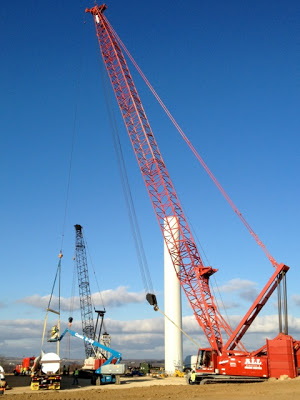
It’s a great day to celebrate wind energy! The first tower section of Epic’s six-turbine Galactic Wind project is now standing. These will be Vestas V-82 turbines, and they are going up in Springfield Township west of Highway 12.
by Ed Blume | Nov 6, 2012 | Uncategorized
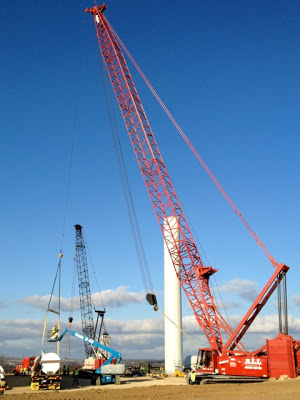
It’s a great day to celebrate wind energy! The
first tower section of Epic’s six-turbine Galactic Wind project is now
standing. These will be Vestas V-82 turbines, and they are going up in
Springfield Township west of Highway 12.