by jboullion | Oct 17, 2008 | Uncategorized
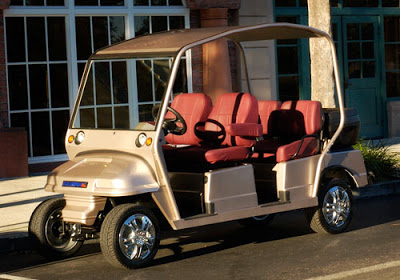
The all-electric vehicles from Columbia ParCar offer one transportation
alternative to the internal combusion engine. (Photo courtesy of
Columbia ParCar, Reedsburg, WI.)
From an editorial in The Thomah Journal:
For all the attention the banking and insurance bailouts have received — and anything that involves $1 trillion of taxpayer money deserves attention — it’s only a short-term fix to what ails the American economy and American living arrangements. To solve its long-term problems, America needs a new sustainability agenda.
Unfortunately, discussions of sustainability are limited to the poor and whether it’s possible, for example, to guarantee adequate health care for everyone. That’s a very narrow definition. We need a broader view of sustainability that examines:
* Mobility. Exurban lifestyles in which people live in big houses and drive big automobiles to jobs located 30, 40 or 50 miles away impose a huge cost on the economy and environment. We need an agenda of sustainable neighborhoods that require us to drive fewer miles — or not at all — to meet basic needs.
* Energy. It’s unclear how much oil lies beneath the earth’s surface, but this much is beyond dispute: oil is a finite resource, and it will run out some day. It’s not too early to invest in clean, renewable energy sources and develop an alternative to the internal combustion engine. . . .
A nation that can massively subsidize exurban sprawl, non-renewable energy, corporate farms and pre-emptive war is capable of sustaining a sturdy safety net for our sickest, poorest and most vulnerable citizens. It’s just a matter of leaders adopting a new vision of what’s sustainable and what needs to change.
by jboullion | Oct 16, 2008 | Uncategorized
From the sustainability Web site of the City of Eau Claire:
A series of Community Workshops will be held in the River Rooms on the ground floor of Royal Credit Union Corporate Center, 200 Riverfront Terrace, Eau Claire, 54703. The next workshop is on November 6, 2008 at 7 p.m.
by jboullion | Oct 15, 2008 | Uncategorized
From a story by Kelly Schlicht on WEAU News:
There’s a lot of buzz about converting old light fixtures and other appliances to new, energy efficient ones, and if the City Council approves a measure at Tuesday’s meeting [Sept. 23], the city of Eau Claire could be joining that trend.
18 different stoplights around the city have yet to be changed over to more efficient LED light bulbs, which will save the city money and help save the environment.
But changing a light bulb is just the beginning of the proposed upgrades.
Change is also in the air for this old ventilation system at the Eau Claire city garage, as the city looks to replace it with a new, more efficient model.
“We can run the system intermittently, instead of consistently, which reduces our energy costs, says Eau Claire Public Works Director Brian Amundson.
by jboullion | Oct 13, 2008 | Uncategorized
From an article on Living Lake Country:
The Wisconsin Department of Administration’s (DOA) Division of Energy Services and the Public Service Commission of Wisconsin (PSC) urge energy customers to contact their local utility if their heat is currently disconnected. The agencies also encourage residents to take advantage of energy-efficiency programs and the state’s low-income bill payment assistance programs to reduce the burden of their utility bills this winter.
Wisconsin law states that consumers cannot be disconnected during the heating moratorium period from Nov. 1 through April 15, if they are connected at the start of the moratorium. Customers who are currently disconnected must make arrangements with their local utility to pay outstanding bills to have their service restored. If a consumer has not made arrangements to pay an outstanding bill, the utility is not required to reconnect the service until payment arrangements have been made.
Payment agreements
Consumers who need to set up a payment agreement should call We Energies at (800) 842-4565. If customers cannot reach an agreement with their utility, they may contact the PSC at (608) 266-2001 or (800) 225-7729.
Energy assistance
There is financial assistance available for eligible households who cannot pay their gas or electric bills this winter. The Wisconsin Home Energy Assistance Program (WHEAP) administers low-income and energy assistance programs for the state. WHEAP is part of the state’s comprehensive Home Energy Plus program which also provides assistance with emergency energy needs, emergency furnace repairs, and weatherization and conservation services.
Eligibility is based on income and family size. For example, a family of four which earns $7,743.75 or less in the three months prior to applying for assistance is potentially eligible. For a two-person family the earnings must be $5,133.75 or less. Benefits are based on income levels and energy bills. Consumers do not have to be behind in their energy bill payments to qualify.
For information about WHEAP, including contact information for local energy assistance offices, call 1(866) 432-8947) or visit www.homeenergyplus.wi.gov.
by jboullion | Oct 10, 2008 | Uncategorized
From a media release posted on BusinessNorth.com:
Duluth, Minn – Caravans of specially-built trucks, accompanied by escort vehicles and state patrol cars have been heading out of the Port of Duluth most every morning since June, loaded with wind turbine components destined for wind energy farms across the Midwest. The pace of that movement is about to pick up as one wind energy leader, in particular, ramps up delivery schedules.
Not surprising, as the demand for wind energy has expanded so, too, has heavy truck traffic. Often those vehicles face road restrictions due to over-weight/over-dimensional (OW/OD) loads and must be rerouted along some circuitous routes to avoid bridges, tight turns, and road construction. As such, motorists along city streets and rural roadways have had to wait patiently while an increasing number of oversized vehicles pass by loaded with huge, white towers, blades, nacelles, hubs and spinners. Freight handlers indicate that those traffic patterns may intensify during the next month as final shipments of wind components head west and south before the snow flies.
Some of these units, the nacelles, weigh 180,000+ pounds. Top tower sections alone are over 100 feet long, with blades measuring up to 150 feet. Permits to haul the majority of OW/OD loads require at least one escort vehicle and a state trooper. For one manufacturer alone, Siemens, there have been four (4) permitted, escorted loads leaving Duluth almost daily this summer carrying nacelles and tower sections, plus an additional six “smaller” trucks loaded with hubs and spinners.