by jboullion | Jul 24, 2009 | Uncategorized
From a letter to the editor of the River Falls Journal by River Falls mayor Don Richards:
Congratulations to James Freeman, a progressive Main Street building owner in River Falls.
Mr. Freeman has received a grant from Wisconsin Focus on Energy to help him put solar panels on the roof of the Whole Earth Grocery. He is the first building owner in downtown River Falls to do his part to join the switch to clean, renewable energy.
He also has secured a revolving loan from the city in this effort.
The panels will produce electricity that will be purchased by WPPI:Energy and will reduce his utility bill. The payback on his investment will be approximately 5-6 years.
We need other businesses to step forward in the same manner. It is only when solar panels are manufactured in great numbers because of great demand that economies of scale will drop the cost so it is competitive with that of coal, now commonly used to produce electricity (and carbon dioxide, a greenhouse gas).
And just as was the case with computers and microchips, the efficiency of the panels will increase as research, spurred by demand, will develop improved versions of the panels.
Mr. Freeman, is helping the city “Lead By Example,” as we were asked to do by WPPI Energy.
by jboullion | Jul 21, 2009 | Uncategorized
From the direct testimony of Michael Vickerman on behalf of RENEW Wisconsin:
Q. What is the purpose of your testimony?
A. The purpose of my testimony is to communicate our organization’s support for the installation of a biomass gasification system that would produce biomass-derived synthetic gas (“syngas”) for serving Northern States Power’s Bay Front Unit #5.
Q. Why does RENEW support this particular application?
A. We note the following public policy objectives that would be advanced if the proposal submitted by Northern States Power Corporation (“NSPW”) were approved. These objectives include:
1) Meeting Wisconsin’s current Renewable Energy Standard;
2) Eliminating a source of coal-fired power from its system;
3) Using a locally available renewable energy resource;
4) Reducing carbon dioxide emissions and other gaseous pollutants;
5) Maintaining a strong generation source in northern Wisconsin; and
6) Investing Wisconsin capital in a renewable energy generating facility power plant within its borders.
by jboullion | Jul 20, 2009 | Uncategorized
From a story on WEAU.com:
A power company says its customers can now choose to have their residential or commercial energy generated by wind farms.
Xcel Energy’s Windsource program started in Wisconsin last month. Since then, Xcel says 200 customers have signed up. The wind farms that generate the power for the program are in Minnesota, North and South Dakota. Customers end up paying a $1.15 per 100-kilowatt hour block above the current electricity rate.
by jboullion | Jul 17, 2009 | Uncategorized
From an article by Paul Snyder in The Daily Reporter:
Wisconsin utilities have a track record of building, operating and maintaining their own wind farms, leaving independent producers little reason to build in the state.
But when those same utilities build wind farms in other states, Wisconsin’s economy and construction work force suffer, said Michael Vickerman, executive director of RENEW Wisconsin.
“There’s quite a lot of construction going on in places like Illinois and Iowa where wind producers can sell their product to utilities,” he said. “But here, the market is controlled by utilities.”
And that keeps independent developers from considering Wisconsin, said Timothy Polz, senior project developer with Chicago-based Midwest Wind Energy.
“If utilities prefer to own the projects, it takes away some of the benefits developers can get from constructing or maintaining the farms while selling the power,” he said.
But more troubling, Vickerman said, is that even though utilities have the power to push new developments, they are building beyond state borders. The only major wind farm under development in Wisconsin is We Energies’ Glacier Hill Wind Farm in Columbia County, which will have about 90 turbines and produce 162 megawatts of electricity.
by jboullion | Jul 16, 2009 | Uncategorized
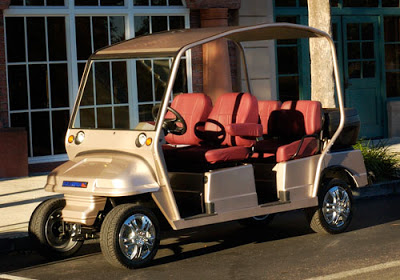
A low-speed vehicle made by Columbia ParCar in Reedsburg, Wisconsin.
From an article by Anita Zimmerman in The Chetek Alert:
If you’re looking for a cheap cruise around town this summer, it’ll cost you about 33cents to charge up a modified golf cart.
Regulation of neighborhood electric vehicles, as the street-legal carts are called, isn’t currently in Chetek’s code book, but forces-in the form of local man-about-town John Banks-are intent on securing their legality.
If Chetek wants to be a retirement-friendly community, officials need to enact retiree-oriented ordinances, Banks insists.
“My reason is, be proactive,” he urges. “Let’s get a jump on this.”
Mike and Lynnette Leavens, owners of Bloomer NEV retailer Master Cart, can go for 100 miles on $1 of electricity. That’s an inexpensive, and impressive, operating cost-but there’s a catch. If you’re not seeing models like E-MERGE out on the streets, it’s probably because the lack of a gas bill doesn’t make up for the other expenses.
Despite federal attempts to promote use of eco-friendly cars and electric- and battery-operated vehicles, Wisconsin’s strict regulations offer little encouragement. In a number of states, uninsured golf carts can be legally driven through town, but not here.
To make NEVs street-legal, manufacturers have to add a host of extras: a parking brake, specially coated windshield, reflectors in the back, headlights, turn signals and stop lamps in the front, seat belts, exterior mirrors and a rearview mirror.
Those costs get passed on to consumers. Carts sell for nearly as much as a cheap car, from $6,000 to $7,000 apiece, and that’s only going to increase. According to Lynnette Leavens, the 2009 E-merge runs $1,000 higher-and that’s just to dealers.
Although NEVs are classified as low-speed vehicles-25 mph at top speed-drivers are required to have full insurance coverage. Leavens called around; average cost of a plan: $32 to upwards of $50 per month.