by jboullion | Apr 22, 2011 | Uncategorized
From an article in the Chicago Tribune:
MADISON, Wis.— A poll of Wisconsin residents finds strong support for increasing the use of wind energy, even if doing so would raise electricity bills several dollars per month.
The Wisconsin Public Radio poll was released Friday. It shows that 77 percent of respondents want to see the state invest more in wind energy. Reasons included decreasing the nation’s reliance on foreign oil and helping the environment.
A majority, 69 percent, wouldn’t mind eight to 10 wind-energy machines being placed closed to where they live, and 79 percent favor placing the machines offshore in Lake Michigan.
Click here for poll results.
by jboullion | Apr 22, 2011 | Uncategorized
From an editorial in the Milwaukee Journal Sentinel:
This Earth Day falls a year and a day after one of the worst environmental disasters to hit the United States. The explosion of BP’s Deepwater Horizon oil rig took the lives of 11 rig workers and released 206 million gallons of oil into the Gulf of Mexico.
What have we done with the lessons learned in that year? Not so much.
Still missing: a comprehensive energy policy that would significantly reduce the consumption of fossil fuels and place more reliance on alternative or renewable fuels.
There has been some improvement. Cleanup efforts continue, but most of the mess has been removed or has disappeared through evaporation or microbes. The disaster was extensive, but the damage turned out not to be quite as devastating as some expected (although not all of the victims have received full compensation and some effects will certainly linger).
Beaches are open again. Commercial and recreational fishing is back in action. Deep water drilling is probably safer than it was before the explosion; the federal government’s inspection program is tougher and more independent.
But critics say this all could happen again – that, in fact, another disaster is inevitable. That’s the risk of drilling in ocean waters. The feds recently approved the 10th deepwater drilling permit since the disaster.
Some of that is necessary in the short term. But in the long term, relying on fossil fuels is unsustainable.
by jboullion | Apr 21, 2011 | Uncategorized
by jboullion | Apr 21, 2011 | Uncategorized
Madison Peak Oil Group listserve subscribers are debating coal vs. wind. To join the debate, drop an email to madisonpeakoil-subscribe@yahoogroups.com.
by jboullion | Apr 21, 2011 | Uncategorized
A news release from Dairyland Power:
Dairyland Power Cooperative and Oakdale Electric Cooperative collaborate on installation
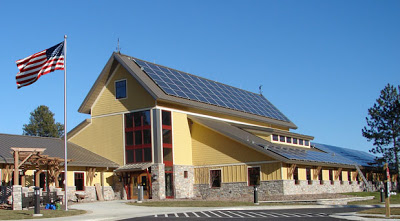
NECEDAH, WI— Dairyland Power Cooperative and one of its 25 member cooperatives, Oakdale Electric Cooperative, have collaborated with the Necedah National Wildlife Refuge to help bring renewable energy to area homes and businesses via a solar project on the Refuge’s Visitor Center.
The new Necedah National Wildlife Refuge Visitor Center is a state-of-the-art energy efficient facility featuring a 46 kilowatt photovoltaic array (solar system). The solar system was funded through the American Recovery and Reinvestment Act. The Refuge also features an interactive
display on solar-powered energy at the visitor center as part of its environmental education programming.
“It has been great to work cooperatively with the Refuge on a sustainable, renewable technology that benefits the environment,” said Bruce Ardelt, General Manager, Oakdale Electric Cooperative. “We support a variety of renewable energy projects by interconnecting to distributed generation resources such as this solar unit, and are very pleased to see this project at completion.”
Dairyland has a power purchase agreement with the Necedah Refuge to buy all the renewable energy produced through the solar installation for distribution to cooperative members through Dairyland’s Evergreen program. Therefore, the renewable energy generated at the refuge ultimately helps power the homes and businesses in the region. The Necedah Refuge is a member of Oakdale Electric Cooperative, which provided electrical transmission interconnection to the solar project.
Evergreen is Dairyland’s renewable energy “green power” program. Supporting Evergreen is an ideal option for cooperative members who want to do more to preserve the environment and promote the growth of renewable energy generation. Dairyland’s diverse portfolio of renewables includes hydro, wind, biomass, landfill gas, cow manure digesters and solar.
A grand opening event for the Necedah National Wildlife Refuge’s Visitor Center is being held on Saturday, April 30. For more information, see www.fws.gov/midwest/necedah.
With headquarters in La Crosse, Wis., Dairyland provides wholesale electricity to Oakdale Electric Cooperative and 24 other member distribution cooperatives and 16 municipal utilities in four states
(Wisconsin, Minnesota, Iowa and Illinois). Dairyland’s generation resources include coal, natural gas, hydro, wind, landfill gas, solar and animal waste. For more information, please visit http://www.dairynet.com/.
Photo courtesy of the Necedah Wildlife Refuge.
by jboullion | Apr 21, 2011 | Uncategorized
It’s looking like it will be a sunny 50F tonight for the RALLY FOR THE EARTH at Phoenix Park. Our main speakers are Rep. Spencer Black, and Northland Adventures’ Dave Carlson.
Rally for the Earth
6-7:30pm
Phoenix Park, Downtown Eau Claire
Other speakers include, Gregg Moore, John “Duke” Welter, Jeff Smith, Kristen Dexter, and yours truly!
Can’t wait to see you there! Come early for music!
by jboullion | Apr 20, 2011 | Uncategorized
From an article by Dan Piller in the the Des Moises (Iowa) Register:
State grants West Branch wind facility $3 million
The Iowa Power Fund on Thursday awarded Acciona Wind Energy a $3 million grant to help finance a $19.9 million demonstration project near Mechanicsville that will show off Acciona’s new three-megawatt wind energy system.
“One tower will be steel and the other concrete. We’ve had requests for both,” said Joe Baker, president of Acciona’s plant at West Branch.
The four-year-old West Branch operation makes the nacelles, or the box behind the blade that houses the gears and generation capacity.
Acciona has focused on building 1.5-megawatt wind systems, but the larger units are becoming more standard in the industry, Baker said.
MidAmerican Energy’s wind farms in west-central Iowa have three-megawatt turbines.
“Within seven to 10 years most of the wind turbines will be three megawatts,” he said. A megawatt of electricity can power 200 to 500 standard-sized homes.
Iowa has 3,675 megawatts of wind generation capacity, ranking second behind Texas in total capacity and first as a percentage of its total electricity generation capacity
Acciona is a century-old Spanish company with roots in construction and water treatment. The West Branch facility, opened in 2007, is its only U.S. wind equipment factory, but Acciona operates five wind farms in Illinois, South Dakota, Oklahoma, Nevada and California.
From an article by Laurenne Ramsdell on Fosters.com:
Goss in Durham (MA) delivers first turbine to Chicago-area
DURHAM — Goss International unveiled its newly developed wind turbine components to area officials and state representatives on Thursday morning.
Goss, primarily a printing press company, has worked throughout the past year with Aeronautica Windpower, a Massachusetts-based licensing company, to cross train employees in order to produce the massive turbines.
According to Greg Norris, marketing communications manager for Goss, the first wind turbine that Goss has manufactured will be ready for shipment to Illinois next week. Norris said the eco-friendly equipment will be delivered to Testa Produce, a Chicago-based wholesale produce distributor.
Norris stressed the turbines are midscale electromechanical pieces of equipment that will be used for warehouses, farms, schools and universities, factories, small housing developments and an array of commercial sites.
Those who attended the update session had the opportunity to tour the area of Goss where the 750 kilowatt and 225 kilowatt machines are being manufactured. Wearing safety goggles, the representatives stood in awe at the size and power of the turbines being created.
As of Thursday, the 750 kilowatt turbine going to Illinois was in pieces for shipping purposes. Once the pieces are assembled, the machine is comparable in size to a small school bus.
by jboullion | Apr 20, 2011 | Uncategorized
From an article by Dan Piller in the the Des Moises (Iowa) Register:
State grants West Branch wind facility $3 million
The Iowa Power Fund on Thursday awarded Acciona Wind Energy a $3 million grant to help finance a $19.9 million demonstration project near Mechanicsville that will show off Acciona’s new three-megawatt wind energy system.
“One tower will be steel and the other concrete. We’ve had requests for both,” said Joe Baker, president of Acciona’s plant at West Branch.
The four-year-old West Branch operation makes the nacelles, or the box behind the blade that houses the gears and generation capacity.
Acciona has focused on building 1.5-megawatt wind systems, but the larger units are becoming more standard in the industry, Baker said.
MidAmerican Energy’s wind farms in west-central Iowa have three-megawatt turbines.
“Within seven to 10 years most of the wind turbines will be three megawatts,” he said. A megawatt of electricity can power 200 to 500 standard-sized homes.
Iowa has 3,675 megawatts of wind generation capacity, ranking second behind Texas in total capacity and first as a percentage of its total electricity generation capacity
Acciona is a century-old Spanish company with roots in construction and water treatment. The West Branch facility, opened in 2007, is its only U.S. wind equipment factory, but Acciona operates five wind farms in Illinois, South Dakota, Oklahoma, Nevada and California.
From an article by Laurenne Ramsdell on Fosters.com:
Goss in Durham (MA) delivers first turbine to Chicago-area
DURHAM — Goss International unveiled its newly developed wind turbine components to area officials and state representatives on Thursday morning.
Goss, primarily a printing press company, has worked throughout the past year with Aeronautica Windpower, a Massachusetts-based licensing company, to cross train employees in order to produce the massive turbines.
According to Greg Norris, marketing communications manager for Goss, the first wind turbine that Goss has manufactured will be ready for shipment to Illinois next week. Norris said the eco-friendly equipment will be delivered to Testa Produce, a Chicago-based wholesale produce distributor.
Norris stressed the turbines are midscale electromechanical pieces of equipment that will be used for warehouses, farms, schools and universities, factories, small housing developments and an array of commercial sites.
Those who attended the update session had the opportunity to tour the area of Goss where the 750 kilowatt and 225 kilowatt machines are being manufactured. Wearing safety goggles, the representatives stood in awe at the size and power of the turbines being created.
As of Thursday, the 750 kilowatt turbine going to Illinois was in pieces for shipping purposes. Once the pieces are assembled, the machine is comparable in size to a small school bus.
by jboullion | Apr 20, 2011 | Uncategorized
From a news release issued by Honeywell:
MINNEAPOLIS, April 19, 2011 /PRNewswire/ — Honeywell (NYSE:HON – News) today announced it has completed the company’s first energy-efficient building upgrades at the University of Wisconsin-Milwaukee (UWM), which will save the school an estimated $620,000 in annual energy costs. The work is part of a multi-phase, $21.7-million energy conservation and infrastructure renewal program that will improve comfort and efficiency in university facilities while cutting utility costs and greenhouse gas emissions.
All the improvements UWM has asked Honeywell to make are expected to reduce energy and operating expenses by $30.8 million over the next two decades. They will also trim electricity use by more than 10 million kilowatt-hours annually — enough energy to power nearly 940 homes. And they will decrease annual carbon dioxide emissions by an anticipated 31 million pounds as well. According to figures from the U.S. Environmental Protection Agency, this is equivalent to removing more than 2,700 cars from the road.
Honeywell is completing the work under three 20-year performance contracts with the university. These contracts allow school officials to pay for the upgrades using the savings they generate, which Honeywell guarantees. As a result, the program won’t increase school budgets or require additional taxpayer dollars.
“Through our Energy Matters program, we demonstrate how progressive partnerships lead to environmental improvements and cost savings that benefit everyone,” said UWM Interim Chancellor Michael R. Lovell. “By working with external partners like Honeywell, we’re making it possible for faculty, staff and students to better understand sustainability and make meaningful reductions in the amount of energy, water and other resources UWM requires to operate each day.”
by jboullion | Apr 20, 2011 | Uncategorized
Subject: Green Drinks on Thursday, April 21, 7:30pm – Stella Blues
Hello Green Drinkers,
Instead of our regularly scheduled meeting tonight we’ll be meeting tomorrow (Thursday) after the Rally for the Earth event at Phoenix Park.
Join us at Stella Blues in Eau Claire for drinks and conversation after the rally.
See the link for more info: http://www.facebook.com/#!/event.php?eid=207398302618780