by jboullion | Jun 6, 2011 | Uncategorized
The Wisconsin Renewable Quarterly, the newsletter of RENEW Wisconsin, features these article:
Siting Rule Suspension Rocks Wind Industry
In a move that sent shock waves through the wind industry in Wisconsin, a joint legislative panel voted on March 1 to suspend the wind siting rule promulgated by the Public Service Commission in December 2010.
Community Biogas Project Fires Up
Home to 400 dairy farms, Dane County recently dedicated a community-scale manure-to-methane generating system designed to reduce nutrient runoff into the Yahara Lakes.
Insty Prints: Mpower ChaMpion
But if I can help other businesses make some of the harder choices by being more vocal, then I’m willing to help.
Manitoba Hydro: A Washout?
On behalf of our members and the many businesses and individuals who support the continued expansion of Wisconsin’s renewable energy marketplace, RENEW Wisconsin is here to express opposition to AB 114 (and its companion SB 81), and urges the Legislature not to pass this bill.
Verona Firm Begins Work on “Epic” PV
With the commissioning of its 1,300-module solar electric canopy spanning its parking deck, Epic Systems joins an elite group of Wisconsin companies embracing on-site energy capture to reduce their dependence on fossil fuels. At 360 kilowatts (kW), Epic’s new photovoltaic system is the largest solar array in Dane County and the third largest in Wisconsin.
Calendar of Renewable and Energy Efficiency Events
June 17-19, 2001 The Energy Fair. Custer, WI. The nation’s premier sustainable energy education event. Three days of workshops, demonstrations, and exhibits highlighting renewable energy and sustainable living. For details see www.midwestrenew.org.
July 8-10, 2011 EcoFair360. Elkhorn, WI. Join hundreds of exhibitors and presenters and thousands of attendees who will Make Green Happen for three days of education, exploration and inspiration. For details see www.ecofair360.org.
July 16, 2011 Western Wisconsin Sustainability Fair. Menomonie, WI, Dunn County Fair Grounds. Exhibitors from business, government, and non-profi t groups, speakers, workshops, music, energy effi cient vehicles, a photo contest, and a tour of the Cedar Falls Dam. See http://sustainabledunn.org for more information.
July 30, 2011 8th Annual Kickapoo Country Fair. LaFarge, WI. The Midwest’s Largest Organic Food and Sustainability Festival. Food, music, bike and farm tours, cooking demonstrations, theater, kids’ activities, dancing. More information at www.kickappoocountryfair.org.
October 1, 2011 Solar Tour of Homes and Businesses. All across Wisconsin. Owners open their doors to let people see how renewable energy is practical, reliable, and affordable in today’s economy. The homes and businesses often include other energy efficiency and renewable technologies. For details see http://nationalsolartour.org.
October 26, 2011 Wisconsin’s Solar Decade Conference. Milwaukee, WI. Now in its seventh year, the Wisconsin
Solar Decade Conference is your opportunity to see fi rsthand the latest developments in the world of solar energy. For details see www.solardecade.com.
by jboullion | Jun 3, 2011 | Uncategorized
From an article by Betsy Bloom in the La Crosse Tribune:
It is “the most gorgeous landfill in the state of Wisconsin,” La Crosse County Solid Waste Director Hank Koch says. He could be considered a bit biased.
But state Department of Natural Resources Secretary Cathy Stepp didn’t disagree after seeing the site Wednesday.
“I never imagined I could be so impressed with a landfill operation,” Stepp later said.
With wind ruffling the tall grass on the surrounding hillsides, Stepp on Wednesday recognized the 300-acre complex as the first publicly owned landfill admitted to the state’s Green Tier program.
The ceremony also included a groundbreaking on the estimated $4 million gas-to-energy partnership that will pipe landfill methane about 1.6 miles to provide virtually all the heat and electrical needs at Gundersen Lutheran’s Onalaska clinic.
Contractor McHugh Excavating and Plumbing of Onalaska is expected to begin work next week, and the gas could begin flowing as early as October, officials said Wednesday.
“The happiest day is going to be when they turn that flare off,” Koch said, referring to the flame now burning off the landfill gas.
While the gas-to-energy arrangement isn’t unique, the partnership with a health care system is, said Jeff Rich, Gundersen’s executive director of efficiency improvements.
“This is just a win-win-win for everybody,” the entire community included, Rich said.
by jboullion | Jun 2, 2011 | Uncategorized

From an article by Lyn Jerde in the Portage Daily Register:
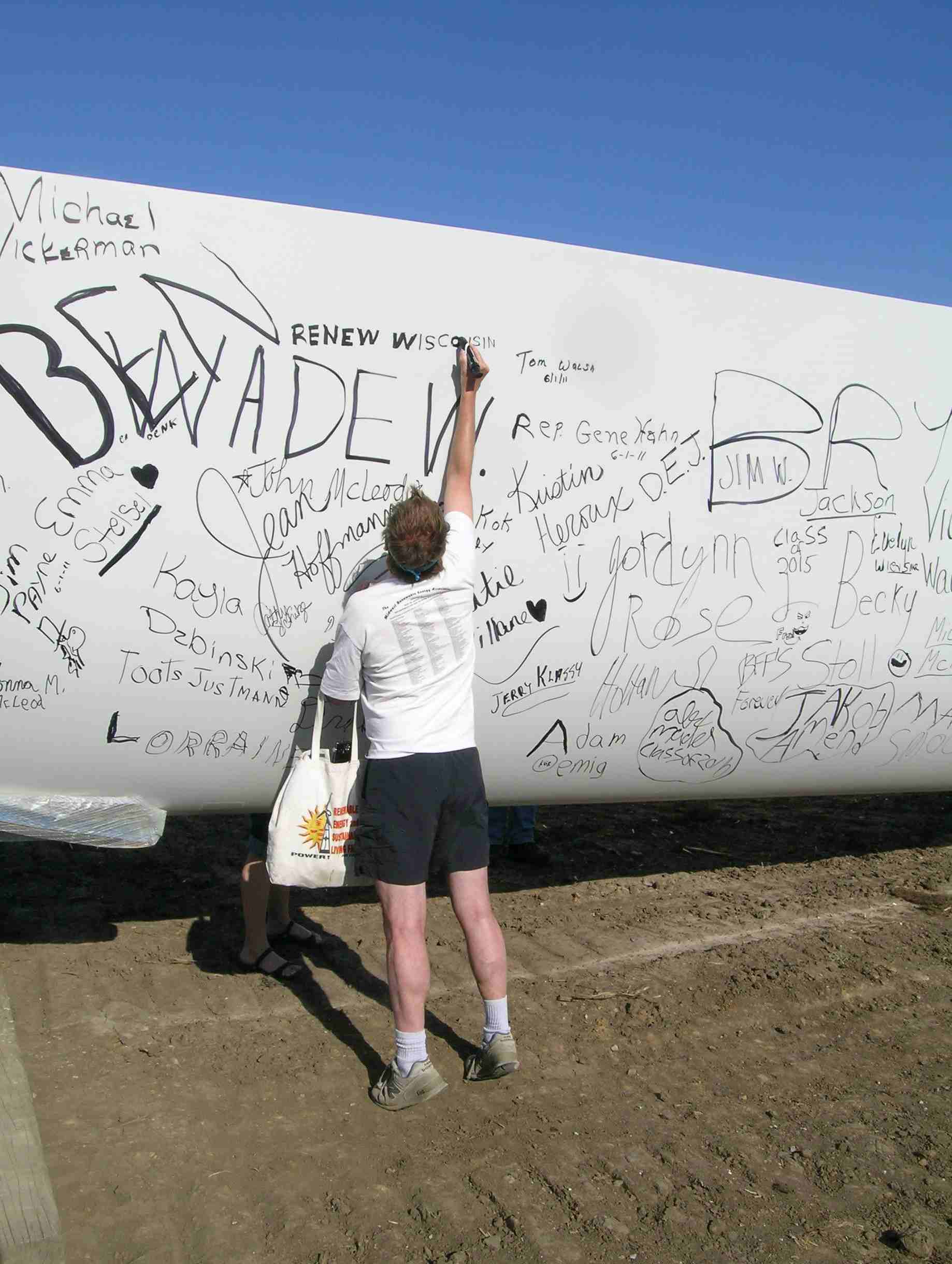
TOWN OF SCOTT – Along with names, dates and shout-outs to favorite sports teams, the writing on the turbine blade included a warning: “Watch out.”
Mark Barden wrote it, in permanent black marker.
The warning, he said, is aimed at any birds that might fly near the blade once it’s turning, 400 feet in the air.
Wednesday’s open house at the Glacier Hills Wind Park was Barden’s first up-close look at the components of the 90 electricity-generating wind turbines that have begun to rise in the skyline in northeast Columbia County.
But it won’t be his last look. Barden said three of the towers will be on his land in the town of Scott, just outside of Cambria.
He said he doesn’t share the health and safety concerns about the wind towers that many of their opponents cited in seeking to block the construction of Glacier Hills – things such as constant low-level noise and shadow flicker.
“I’m more worried,” he said, “about the red lights at night,” he said. “When I look in the sky and try to find constellations, all I’ll see is the red beacons (on the towers).
“But,” Barden added, “we’ll deal with that.”
Barden was one of several hundred people who attended the open house, which included indoor easel and tabletop displays, and a tour – on foot or by school bus – of one of the four towers that, as of Wednesday, had two of its four segments erected.
Mike Strader, site manager for the We Energies project, said that, barring wind or other inclement weather, plans call for adding the top two segments to at least one of the towers today, with the hub, cell and three blades of the turbine to follow soon.
More photos on RENEW’s Facebook page.
by jboullion | Jun 2, 2011 | Uncategorized
From an article by Judy Newman in the Wisconsin State Journal:
About 40,000 homes and businesses from Middleton to north of La Crosse are getting letters this week from American Transmission Co. telling them a powerful electrical transmission line could be built within 3,000 feet — or about half a mile — and inviting them to public meetings later this month.
Plans for the so-called Badger Coulee line, introduced in 2010, are moving into phase 2. ATC has taken the broad swath from south-central to western Wisconsin and identified dozens of corridors to consider for the project, which will carry 345 kilovolts of electricity over 150 miles and will cost about $425 million.
• In Dane County, the line could run north from the town of Middleton or it could skirt the west edge of Waunakee and go through DeForest’s north side, then head up Highway 12, Interstate 39 or Highway 51.
• It could run along the edge of communities such as Prairie du Sac, Lodi, Poynette, Portage, West Baraboo, Elroy or Viroqua. It also could travel through Reedsburg, Wisconsin Dells or Mauston.
• Richland County will be spared.
The area being studied has been expanded north into Trempealeau and Jackson counties. That’s because the Badger Coulee line might meet up with CapX2020, a 700-mile series of mostly 345-kilovolt lines stretching from the Dakotas. CapX2020 proposes to cross into Wisconsin at Alma, in Buffalo County.
by jboullion | May 31, 2011 | Uncategorized
From a presentation by Michael Vickerman Wind Powering America All States Summit in Anaheim, CA, May 26, 2011:
In January 2011, All Hell Broke Loose:
• PSC 128 [statewide wind siting rule] clears legislative review in December;
• Gov. Walker introduces bill Jan. 11 in special session (SB 9) that threatens to bring wind development to a standstill;
• Most important provision in SB 9: greatly extends minimum setback requirement;
• PSC rule: 1.1 x total height from property lines (400-500 ft.);
• SB 9: 1,800 feet from property lines.
How Problematic Are 1,800 ft. Setback Requirements to SitingWind Turbines?
Consider Glacier Hills – a 90-turbine wind project under construction in two townships in Columbia County characterized by a low density of population:
• No. of turbines beyond a 1,250 ft. setback requirement from non-participating residences: 75 to 80;
• No. of turbines beyond an 1,800 ft. setback requirement from property lines: 2 to 5.
by jboullion | May 26, 2011 | Uncategorized
From statements issued by three groups in opposition to Assembly Bill 146:
“Clearly, this bill is a drastic step in the wrong direction for our state. The Wisconsin Energy Business Association therefore opposes this attack on renewable energy in our state.” – Wisconsin Energy Business Association. Full statement.
We strongly recommend that this bill not be approved as it solves no known problem in Wisconsin and seeks only to roll-back policies on renewable energy that have served the state well and are otherwise benefitting Wisconsin residents with cleaner air and lower prices for electricity. – Wind on the Wires. Full statement.
Fresh attack on Wisconsin voters’ desire for a renewable energy standard would kill wind projects and sap state’s economy, say wind energy advocates – American Wind Energy Association. Full statement.
by jboullion | May 26, 2011 | Uncategorized
From statements issued by three groups in opposition to Assembly Bill 146:
“Clearly, this bill is a drastic step in the wrong direction for our state. The Wisconsin Energy Business Association therefore opposes this attack on renewable energy in our state.” – Wisconsin Energy Business Association. Full statement.
We strongly recommend that this bill not be approved as it solves no known problem in Wisconsin and seeks only to roll-back policies on renewable energy that have served the state well and are otherwise benefitting Wisconsin residents with cleaner air and lower prices for electricity. – Wind on the Wires. Full statement.
Fresh attack on Wisconsin voters’ desire for a renewable energy standard would kill wind projects and sap state’s economy, say wind energy advocates – American Wind Energy Association. Full statement.
by jboullion | May 25, 2011 | Uncategorized
While RENEW opposes counting hydro toward a utility’s renewable portofio standard, Wisconsin Public Service agreed to buy 100 MW from Manitoba Hyrdo, according to an article in The Lac du Bonnet Leader:
Premier Greg Selinger announced today that Manitoba Hydro has signed agreements for a 250megawatt (MW) sale of electricity to Minnesota Power and a 100-MW sale to Wisconsin Public Service. Combined with a previously completed 125 MW sale to Northern States Power, these sales total 475 MW with an estimated value of $4 billion, Selinger said.
The premier said these sales will require the construction of new hydroelectric generating capacity in Manitoba. They will trigger the development of the 695-MW Keeyask (Cree for gull) Generating Station located on the lower Nelson River 175 km northeast of Thompson in the Split Lake Resource Management Area. Keeyask is to be developed by a partnership consisting of Manitoba Hydro and the Keeyask Cree Nations-Tataskweyak Cree Nation, War Lake First Nation, Fox Lake Cree Nation, and York Factory First Nation. The $5.6-billion project will provide some 4,500 person-years of construction employment, said Selinger. . .
The 250-MW power sale to Minnesota Power over a 15-year period from 2020 to 2035 requires an additional interconnection between Manitoba and the United States which will provide increased export capability and reliability benefits for Manitoba, said Selinger.
The 100-MW power sale agreement to Wisconsin Public Service covers the 2021-2027 period. Negotiations are continuing to expand the Wisconsin sale to 500 MW which would require construction of the Conawapa Generating Station, the premier said, adding with these sales, Manitoba Hydro and its partners are reviewing scheduling and other requirements for moving forward with Keeyask.
by jboullion | May 25, 2011 | Uncategorized
From a news release issued by Make It Work Milwaukee! Coalition:
The Make It Work Milwaukee Coalition supports the preservation of public
transportation funding. Transit and paratransit services are critical to maintaining the independence of older adults and people with disabilities as many do not drive or own a vehicle because of their disability, aging, and/or limited income.
When transportation is cut, not only are people with disabilities and older adults unable to work or get out in their community, but a caregiver may no longer be able to provide care when it is needed. Some people with disabilities need supports at all hours of the day. Transit lowers government costs by helping people with disabilities live independently and be employed.
Our agencies urge legislators to restore transit operating aids to help preserve public transportation. Over the past decade, we have seen harmful reductions in transit services, as local government struggles to maintain essential services with declining resources and increasing fuel costs. The resulting cutbacks have already taken a heavy toll on the ability of people with disabilities and seniors to work and be contributing members of the community, and also made it very difficult for the caregivers they rely on to get to work.
Nearly half of transit use is for work related purposes. Further cuts in transit will cut off people with disabilities and seniors from jobs and education, and lead to higher unemployment. Transit is vital to Wisconsin’s economy, businesses and families, and lowers government costs by keeping people employed and living independently.
In addition, proposed reductions in transit aids are expected to result in significant reduction of paratransit services which are a lifeline for many people with disabilities and older adults. In Milwaukee County along it is expected that a minimum of 2000 people with disabilities and older adults will completely lose access to transportation, leaving them prisoners in their own homes unable to travel to work, to school, to medical appointments, or to buy food. The majority of those expected to lose
service live in suburban areas including Bay Side, Glendale, Franklin, Oak Creek and Greendale. Thousands more will be impacted by the reduction of the service area and may be unable to get to work, to the doctor, or to visit family.
by jboullion | May 23, 2011 | Uncategorized
From an article on BizTimes Daily:
Schlitz Park in downtown Milwaukee has become the first corporate development in the state to install an electric vehicle (EV) charging station as part of a growing effort to make sustainable transportation easier for its tenants and their employees.
The charging station was provided by ElectriCharge Mobility and manufactured by Coulomb Technologies, which operates the worldwide ChargePoint Network. Major automakers began to sell EV models late last year. Projections estimate that by 2012, 20 models will be available and that by 2015 there will be more than 3 million plug-in electric vehicles in use worldwide.
“As electric vehicle use grows, there will be employee demand for EV charging services at their workplace,” said Dave Hansen of Brookfield-based ElectriCharge Mobility LLC. “Progressive organizations like Schlitz Park are seizing the opportunity to meet this need as part of corporate-wide green initiatives to lower greenhouse gases and to steward independence from petroleum based fuels beyond the workplace.”
Although users will charge vehicles overnight at home, the limited range of early electric vehicles will make the availability of charging stations where people work a necessity, according to Hansen.