by jboullion | Mar 2, 2011 | Uncategorized
From an article by Craig Reber in the Telegraph Herald, Dubuque:
Proponents of two proposed Grant County, Wis., wind farms wonder what’s next after Republican lawmakers suspended statewide wind farm siting rules Tuesday — the day they were set to take effect.
The Joint Committee for Review of Administration Rules voted 5-2, along party lines, to suspend the rules for 30 days.
The state Public Service Commission’s standards, which would have applied to projects less than 100 megawatts in generating capacity, would create uniform guidelines for where wind farms could be built. The committee’s vote means local regulations would remain in place.
The commission’s new rules would have allowed development of the proposed White Oak wind project by Wind Capital Group on parts of Smelser, Hazel Green and Paris townships, a project on hold for more than two years. Another wind project was planned for northern Grant County.
Ron Brisbois, director of Grant County Economic Development Corp., said Tuesday’s vote would “effectively deter wind farms throughout the state of Wisconsin.”
Republicans who took control of the Legislature in November said they were worried the Advertisement
rules would allow developers to build turbines too close to neighbors’ properties, driving down land values and increasing the risk of injury.
“I communicated with members of the committee, as well to our local representatives, (State) Senator (Dale) Schultz and (State Rep.) Travis Tranel,” Brisbois said. “My message to them was, if they do basically what (the committee) did, it will effectively kill my project. There is some hope moving forward is possible, but it’s highly unlikely.”
The committee must draft a bill supporting the suspension. It has drafted a measure that would require the commission to develop new rules within six months.
The vote disappointed John Beinborn, president of Grant County Economic Development Corp.
by jboullion | Mar 1, 2011 | Uncategorized
For immediate release:
March 1, 2011
More information
Michael Vickerman
Executive Director
608.255.4044
mvickerman@renewwisconsin.org
(Madison) – The wind industry in Wisconsin suffered a serious setback when a joint legislative panel voted to suspend the wind siting rule promulgated by the Public Service Commission (PSC) in December, according to RENEW Wisconsin, a statewide renewable energy advocacy group.
The five-to-two vote tracked along party lines, with all five votes to suspend coming from Republican members of the Joint Committee for Review of Administrative Rules (JCRAR).
Many companies involved in windpower supported the PSC’s rule as a workable compromise that would have created a stable and predictable permitting environment for all wind energy systems regulated by local governments. The rule, which was scheduled to take effect today, would have fulfilled the Legislature’s intent to create uniform siting regulations to replace what had become a restrictive hodgepodge of local requirements.
“The committee gave the state of Wisconsin a black eye that, in the view of the wind industry, will linger well into the future,” Vickerman said.
“The suspension rolls the wind permitting environment back to the dark days when wind project developers routinely faced arbitrary and ever-shifting local regulations – the kind of chaos that will hasten their departure from Wisconsin to more business-friendly states.”
“As of today, Wisconsin utilities have placed more megawatts of wind capacity in neighboring states than in Wisconsin. As indicated in the following table, importing wind generation from other states deprives Wisconsin of a valuable source of employment, income for rural residents, and property tax relief,” said Vickerman.
The figures compiled by RENEW show that the 219 utility-owned wind turbines that will be operational by January 1, 2012, will yield nearly $2.7 million per year in potential property tax relief for towns and counties hosting wind projects. All told, these projects will be responsible for nearly 300,000 construction-related job-hours.
“We have a hard time foreseeing in-state utility-scale wind development going forward without statewide siting standards.”
“It’s a shame to see the end of bipartisanship that led to the passage of the rule requirement in 2009. What we are seeing here is a breakdown of governance that will rob the state of one of its brightest economic hopes for the future,” Vickerman said.
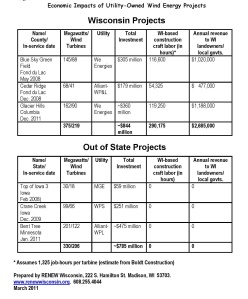
Click on table to enlarge.
RENEW Wisconsin is an independent, nonprofit 501(c)(3) organization that acts as a catalyst to advance a sustainable energy future through public policy and private sector initiatives. More information on RENEW’s Web site at www.renewwisconsin.org.
by jboullion | Mar 1, 2011 | Uncategorized
For immediate release:
March 1, 2011
More information
Michael Vickerman
Executive Director
608.255.4044
mvickerman@renewwisconsin.org
(Madison) – The wind industry in Wisconsin suffered a serious setback when a joint legislative panel voted to suspend the wind siting rule promulgated by the Public Service Commission (PSC) in December, according to RENEW Wisconsin, a statewide renewable energy advocacy group.
The five-to-two vote tracked along party lines, with all five votes to suspend coming from Republican members of the Joint Committee for Review of Administrative Rules (JCRAR).
Many companies involved in windpower supported the PSC’s rule as a workable compromise that would have created a stable and predictable permitting environment for all wind energy systems regulated by local governments. The rule, which was scheduled to take effect today, would have fulfilled the Legislature’s intent to create uniform siting regulations to replace what had become a restrictive hodgepodge of local requirements.
“The committee gave the state of Wisconsin a black eye that, in the view of the wind industry, will linger well into the future,” Vickerman said.
“The suspension rolls the wind permitting environment back to the dark days when wind project developers routinely faced arbitrary and ever-shifting local regulations – the kind of chaos that will hasten their departure from Wisconsin to more business-friendly states.”
“As of today, Wisconsin utilities have placed more megawatts of wind capacity in neighboring states than in Wisconsin. As indicated in the following table, importing wind generation from other states deprives Wisconsin of a valuable source of employment, income for rural residents, and property tax relief,” said Vickerman.
The figures compiled by RENEW show that the 219 utility-owned wind turbines that will be operational by January 1, 2012, will yield nearly $2.7 million per year in potential property tax relief for towns and counties hosting wind projects. All told, these projects will be responsible for nearly 300,000 construction-related job-hours.
“We have a hard time foreseeing in-state utility-scale wind development going forward without statewide siting standards.”
“It’s a shame to see the end of bipartisanship that led to the passage of the rule requirement in 2009. What we are seeing here is a breakdown of governance that will rob the state of one of its brightest economic hopes for the future,” Vickerman said.
Click on table to enlarge.
RENEW Wisconsin is an independent, nonprofit 501(c)(3) organization that acts as a catalyst to advance a sustainable energy future through public policy and private sector initiatives. More information on RENEW’s Web site at www.renewwisconsin.org.
by jboullion | Mar 1, 2011 | Uncategorized
For immediate release:
March 1, 2011
More information
Michael Vickerman
Executive Director
608.255.4044
mvickerman@renewwisconsin.org
(Madison) – The wind industry in Wisconsin suffered a serious setback when a joint legislative panel voted to suspend the wind siting rule promulgated by the Public Service Commission (PSC) in December, according to RENEW Wisconsin, a statewide renewable energy advocacy group.
The five-to-two vote tracked along party lines, with all five votes to suspend coming from Republican members of the Joint Committee for Review of Administrative Rules (JCRAR).
Many companies involved in windpower supported the PSC’s rule as a workable compromise that would have created a stable and predictable permitting environment for all wind energy systems regulated by local governments. The rule, which was scheduled to take effect today, would have fulfilled the Legislature’s intent to create uniform siting regulations to replace what had become a restrictive hodgepodge of local requirements.
“The committee gave the state of Wisconsin a black eye that, in the view of the wind industry, will linger well into the future,” Vickerman said.
“The suspension rolls the wind permitting environment back to the dark days when wind project developers routinely faced arbitrary and ever-shifting local regulations – the kind of chaos that will hasten their departure from Wisconsin to more business-friendly states.”
“As of today, Wisconsin utilities have placed more megawatts of wind capacity in neighboring states than in Wisconsin. As indicated in the following table, importing wind generation from other states deprives Wisconsin of a valuable source of employment, income for rural residents, and property tax relief,” said Vickerman.
The figures compiled by RENEW show that the 219 utility-owned wind turbines that will be operational by January 1, 2012, will yield nearly $2.7 million per year in potential property tax relief for towns and counties hosting wind projects. All told, these projects will be responsible for nearly 300,000 construction-related job-hours.
“We have a hard time foreseeing in-state utility-scale wind development going forward without statewide siting standards.”
“It’s a shame to see the end of bipartisanship that led to the passage of the rule requirement in 2009. What we are seeing here is a breakdown of governance that will rob the state of one of its brightest economic hopes for the future,” Vickerman said.
Click on table to enlarge.
RENEW Wisconsin is an independent, nonprofit 501(c)(3) organization that acts as a catalyst to advance a sustainable energy future through public policy and private sector initiatives. More information on RENEW’s Web site at www.renewwisconsin.org.
by jboullion | Mar 1, 2011 | Uncategorized
For immediate release:
March 1, 2011
More information
Michael Vickerman
Executive Director
608.255.4044
mvickerman@renewwisconsin.org
(Madison) – The wind industry in Wisconsin suffered a serious setback when a joint legislative panel voted to suspend the wind siting rule promulgated by the Public Service Commission (PSC) in December, according to RENEW Wisconsin, a statewide renewable energy advocacy group.
The five-to-two vote tracked along party lines, with all five votes to suspend coming from Republican members of the Joint Committee for Review of Administrative Rules (JCRAR).
Many companies involved in windpower supported the PSC’s rule as a workable compromise that would have created a stable and predictable permitting environment for all wind energy systems regulated by local governments. The rule, which was scheduled to take effect today, would have fulfilled the Legislature’s intent to create uniform siting regulations to replace what had become a restrictive hodgepodge of local requirements.
“The committee gave the state of Wisconsin a black eye that, in the view of the wind industry, will linger well into the future,” Vickerman said.
“The suspension rolls the wind permitting environment back to the dark days when wind project developers routinely faced arbitrary and ever-shifting local regulations – the kind of chaos that will hasten their departure from Wisconsin to more business-friendly states.”
“As of today, Wisconsin utilities have placed more megawatts of wind capacity in neighboring states than in Wisconsin. As indicated in the following table, importing wind generation from other states deprives Wisconsin of a valuable source of employment, income for rural residents, and property tax relief,” said Vickerman.
The figures compiled by RENEW show that the 219 utility-owned wind turbines that will be operational by January 1, 2012, will yield nearly $2.7 million per year in potential property tax relief for towns and counties hosting wind projects. All told, these projects will be responsible for nearly 300,000 construction-related job-hours.
“We have a hard time foreseeing in-state utility-scale wind development going forward without statewide siting standards.”
“It’s a shame to see the end of bipartisanship that led to the passage of the rule requirement in 2009. What we are seeing here is a breakdown of governance that will rob the state of one of its brightest economic hopes for the future,” Vickerman said.
Click on table to enlarge.
RENEW Wisconsin is an independent, nonprofit 501(c)(3) organization that acts as a catalyst to advance a sustainable energy future through public policy and private sector initiatives. More information on RENEW’s Web site at www.renewwisconsin.org.
by jboullion | Feb 28, 2011 | Uncategorized
From an article by Chris Clayton in the Progressive Farmer:
USDA released a study Friday showing 8,569 farms nationally had either solar panels, wind turbines or methane digesters in 2009.
The study highlighted at the USDA Outlook Forum looked at the costs savings of farms producing their own energy, as well as the costs of building such facilities.
One clear takeaway from the study is that the vast majority of solar panels, methane digesters or wind turbines being used for on-the-farm power were build since 2005.
Of the three major renewable-energy sources drawn from the survey, solar power by far the largest renewable power source being used on farms. USDA showed 7,968 farms reported using photovaltic or thermal solar panels in 2009. California was the largest state in terms of farms reporting panels, and was also far and way the largest state in terms of the number of solar panels.
by jboullion | Feb 28, 2011 | Uncategorized
From an article by Tom Content in the Milwaukee Journal Sentinel:
Wisconsin’s first solar panel factory has opened in the Menomonee River Valley, on the site of stockyards that contributed to the city’s leadership in the meatpacking and processing industries more than 100 years ago.
Later this year, solar panels will go up on the roof of the building that replaced the stockyards, and the panels will be made downstairs in Steve Ostrenga’s factory.
Privately held Helios USA started making robots this month, using an automated production line to build high-efficiency solar panels. The goal: to help put an emerging, 21st-century industry on the map in the state.
That’s what excited Patrick Shaw of Cudahy about working at the plant, he said during a recent tour of the W. Canal St. factory.
“I wanted to get into the green field,” said Shaw, a former Marine. “All you hear about is how that’s up and coming.” Then he attended a veterans job fair where Helios was recruiting employees.
“Six months later, here I am,” Shaw said.
Production started this month after five weeks of 12-hour days getting the first manufacturing line ready.
Workers installed robots that largely automate the manufacturing process and began test production earlier this month. Finished panels sit in stacks in an area of the plant where future production lines are planned.
A ribbon-cutting at the plant is scheduled for Monday.
During the plant tour, Shaw showed pride in having helped set up the robots.
“They said people’s kids could name the robots,” Shaw said. Pointing to one hoisting a nearly complete panel, he added, “My 4-year-old named that one Buzz Lightyear.”
Shaw is one of 17 workers who, after working to open the plant, began operating its first production line two weeks ago. Ostrenga hopes to nearly triple employment by the end of the year.
by jboullion | Feb 28, 2011 | Uncategorized
From an article in the Stevens Point Journal:
ROTHSCHILD — Wausau-area residents will have their final opportunity Tuesday to weigh in on a controversial biomass power plant proposed in Rothschild.
The project, a joint partnership of Milwaukee-based utility We Energies and Domtar Paper, has generated strong opinions from supporters and opponents alike since it was announced in September 2009. Public hearings on the project held by local entities and state regulators have drawn crowds in the hundreds, and on Tuesday, those hearings will draw to a close.
Both the Wisconsin Department of Natural Resources and the Public Service Commission must approve permits for the project before construction can begin.
The utility initially pushed for confirmation of the project by both agencies before the end of 2010. We Energies spokesman Brian Manthey said construction still can be completed before 2013, making the plant eligible for a federal tax credit.
The members of the PSC could rule on the project at any time. DNR regulators gave preliminary approval for an air permit earlier this month, a key step for We Energies.
The approval process has been incremental, first at the local level with height variances from the village of Rothschild and the city of Wausau. The PSC also gave preliminary approval for the project and rejected requests for a comprehensive study of its potential environmental effects by opponents and environmental groups.
The plant, located next to the Domtar Mill on Old Highway 51 in Rothschild, would burn woody biomass from tree tops and other collected wood, supplying Domtar with steam for its paper-making process and We Energies with energy to sell.
by jboullion | Feb 25, 2011 | Uncategorized
The UW- Eau Claire Environmental Adventure Center (EAC) In Support of the UW-Eau Claire Confluence Center & Watershed Institute Presents the 6th Annual Aldo Banquet & Silent Auction.
Join us for this very special evening, featuring:
• Introduction of the Aldo Leopold land ethic
• Exquisite Native American dining: Smoked Buffalo with wild rice, nut-crusted river trout, and
…gourmet vegetarian options
• Musical entertainment courtesy of the “Stoop Singers”
• Special guests appearances by:
• Kenny Salwey: “Mississippi: Tales of the Last River Rat”
– Joe Knight: Eau Claire Leader Telegram outdoor writer/author
– Dr. Sean Hartnett: UW-Eau Claire Geography and Anthropology Department
– Dr. Garry Running: UW-Eau Claire Confluence Center & Watershed Institute
– Sam Worple and the student staff at the Environmental Adventure Center
Tickets: $15.00 Students $20.00 Faculty/Staff & Community Members.
This year’s proceeds benefit the Wisconsin Youth Success Program (WYSP); connecting Aldo Leopold with the “Next Generation”
Call Dan Langlois at 715-836-3616 or email langlodt@uwec.edu for more information.
by jboullion | Feb 23, 2011 | Uncategorized
From the American Wind Energy Association (AWEA):
The Joint Committee for Review of Administrative Rules (JCRAR) has now scheduled a special meeting on March 1st to consider suspending the PSC128 Wind Siting rule that our industry worked on in 2009-2010 that are scheduled to take effect on March 1st. If the JCRAR suspends the PSC128 rule, before it otherwise would take effect that same day, we will be back where we started two years ago on wind siting reform in Wisconsin.