by jboullion | Jan 18, 2011 | Uncategorized
For immediate release:
January 18, 2011
More information
Michael Vickerman
Executive Director
608.255.4044
mvickerman@renewwisconsin.org
Walker’s Wind Siting Proposal Strips Local Control
Mandating by statute an extreme setback distance for commercial wind turbines, Governor Scott Walker’s wind siting proposal would strip local governments of their ability to negotiate lesser setback distances with wind developers, according to RENEW Wisconsin, a statewide renewable energy advocacy group.
Walker’s proposal would require a setback distance between a turbine and neighboring property line of 1,800 feet, which can be shortened only by an agreement between the project owner and owners of adjoining properties, entirely bypassing towns and counties.
Walker’s proposal would eliminate the ability of local governments to attract wind developments that would generate revenues in lieu of taxes to help buffer the expected cuts to local governments in the upcoming state budget.
A story in the Fond du Lac Reporter on January 12 quoted town and county officials as saying the wind project revenue helped save on property taxes by filling the gap between rising municipal expenses and declining state-paid shared revenue dollars.
“We’ve seen five towns in Fond du Lac and Dodge counties enter into joint development agreements specifying reasonable setback distances because town officials wanted to capture the economic benefits of hosting wind projects larger than 50 megawatts,” Vickerman said.
The statewide siting rule, approved by the Public Service Commission (PSC) and set to take effect March 1, preserved local government authority to specify less restrictive conditions.
“This unreasonable proposal is a steamroller driven by anti-wind special interests, like realtors, bent on denying local governments the ability to decide what’s in their best interests,” said Vickerman.
END
by jboullion | Jan 18, 2011 | Uncategorized
For immediate release:
January 18, 2011
More information
Michael Vickerman
Executive Director
608.255.4044
mvickerman@renewwisconsin.org
Walker’s Wind Siting Proposal Strips Local Control
Mandating by statute an extreme setback distance for commercial wind turbines, Governor Scott Walker’s wind siting proposal would strip local governments of their ability to negotiate lesser setback distances with wind developers, according to RENEW Wisconsin, a statewide renewable energy advocacy group.
Walker’s proposal would require a setback distance between a turbine and neighboring property line of 1,800 feet, which can be shortened only by an agreement between the project owner and owners of adjoining properties, entirely bypassing towns and counties.
Walker’s proposal would eliminate the ability of local governments to attract wind developments that would generate revenues in lieu of taxes to help buffer the expected cuts to local governments in the upcoming state budget.
A story in the Fond du Lac Reporter on January 12 quoted town and county officials as saying the wind project revenue helped save on property taxes by filling the gap between rising municipal expenses and declining state-paid shared revenue dollars.
“We’ve seen five towns in Fond du Lac and Dodge counties enter into joint development agreements specifying reasonable setback distances because town officials wanted to capture the economic benefits of hosting wind projects larger than 50 megawatts,” Vickerman said.
The statewide siting rule, approved by the Public Service Commission (PSC) and set to take effect March 1, preserved local government authority to specify less restrictive conditions.
“This unreasonable proposal is a steamroller driven by anti-wind special interests, like realtors, bent on denying local governments the ability to decide what’s in their best interests,” said Vickerman.
by jboullion | Jan 18, 2011 | Uncategorized
For immediate release:
January 18, 2011
More information
Michael Vickerman
Executive Director
608.255.4044
mvickerman@renewwisconsin.org
Walker’s Wind Siting Proposal Strips Local Control
Mandating by statute an extreme setback distance for commercial wind turbines, Governor Scott Walker’s wind siting proposal would strip local governments of their ability to negotiate lesser setback distances with wind developers, according to RENEW Wisconsin, a statewide renewable energy advocacy group.
Walker’s proposal would require a setback distance between a turbine and neighboring property line of 1,800 feet, which can be shortened only by an agreement between the project owner and owners of adjoining properties, entirely bypassing towns and counties.
Walker’s proposal would eliminate the ability of local governments to attract wind developments that would generate revenues in lieu of taxes to help buffer the expected cuts to local governments in the upcoming state budget.
A story in the Fond du Lac Reporter on January 12 quoted town and county officials as saying the wind project revenue helped save on property taxes by filling the gap between rising municipal expenses and declining state-paid shared revenue dollars.
“We’ve seen five towns in Fond du Lac and Dodge counties enter into joint development agreements specifying reasonable setback distances because town officials wanted to capture the economic benefits of hosting wind projects larger than 50 megawatts,” Vickerman said.
The statewide siting rule, approved by the Public Service Commission (PSC) and set to take effect March 1, preserved local government authority to specify less restrictive conditions.
“This unreasonable proposal is a steamroller driven by anti-wind special interests, like realtors, bent on denying local governments the ability to decide what’s in their best interests,” said Vickerman.
by jboullion | Jan 17, 2011 | Uncategorized
From an editorial in The Tomah Journal:
Perhaps it’s Gov. Scott Walker’s goal to have 99 percent of Wisconsin’s energy come from fossil fuels by 2020.
How else to explain his push to effectively ban wind turbines in Wisconsin?
A governor who said job creation is his top priority couldn’t wait two weeks into his new administration before putting the kibosh on the state’s wind energy business.
Walker’s proposal would mandate minimum setbacks of 1,800 feet between a wind turbine and the nearest property line. That compares with a setback distance of 1,250 feet from a neighboring residence approved by the Public Service Commission in a rule adopted last year.
How draconian are Walker’s proposed rules?
“There are very few locations in the entire Badger State that could overcome such extreme constraints,” said Michael Vickerman of Renew Wisconsin. “You can count the locations on the fingers of one hand.”
Walker’s proposal is wrong on multiple levels.
*Renewable energy. Like it or not, fossil fuels are a finite resource, but Walker has shown an almost mindless hostility toward alternative energy and alternative transportation. It doesn’t take a tree hugger to question that hostility. Wisconsin has no fossil fuel resources of its own, and every BTU generated by oil and coal represents dollars that leave the state.
*Jobs. It takes labor to manufacture, build and maintain wind turbines. The same governor who killed a big chunk of the passenger train industry in Wisconsin is poised to terminate the wind turbine industry.
*Private property rights. The same governor who can’t wait to allow developers to fill wetlands suddenly transforms into the great regulator when it comes to contracts between private property owners and wind turbine companies.
by jboullion | Jan 17, 2011 | Uncategorized
From a news release issued by the Wisconsin League of Conservation Voters:
Illinois Stands to Benefit from Walker’s Excessive Wind Regulations
Madison – Just days after appearing on TV and radio in Chicago to remind Illinois that Wisconsin is open for business, Governor Walker introduced a bill that would essentially ban wind development in Wisconsin. The move would leave Wisconsin dependent on other states, including Illinois, to meet our energy demand.
In the bill introduced for consideration in the special session, Governor Walker suggests placing regulations on wind development that are so restrictive, they would essentially prohibit the development
of future wind projects in Wisconsin, and even stop some already on the docket. If passed, it’s estimated that Wisconsin will immediately lose $1.8 billion in new wind power investments and jeopardize eleven currently proposed wind projects. Illinois has no restrictions on wind siting.
Wisconsin currently ranks fifth in the nation in the portion of its electricity derived from imported coal. Wisconsin sends more than $850 million out of state every year to places like Indiana, Wyoming, and Illinois to purchase coal.
“While other states are moving forward with their own energy independence, it appears Governor Walker wants Wisconsin to remain dependent on places like Illinois for our dirty coal habit. This move is sending a very dangerous message to the global wind industry. From those who install wind turbines to those who manufacture them, Governor Walker is suggesting they take their business elsewhere,” said Kerry Schumann, Executive Director of Wisconsin League of Conservation Voters.
There is growing concern that Governor Walker’s rejection of twenty-first century energy projects is becoming a pattern.
by jboullion | Jan 14, 2011 | Uncategorized
From a news release issued by RENEW Wisconsin:
The window on new wind power developments is likely to slammed completely shut by the end of 2011 under a proposal released by Governor Scott Walker, according to RENEW Wisconsin, a statewide renewable energy advocacy organization.
“As part of a larger proposal ostensibly to create jobs, Governor Walker unveiled new restrictions on wind energy development that, if adopted by the Legislature, would drive development activity worth $1.8 billion out of state,” said Michael Vickerman, executive director of RENEW Wisconsin.
Governor Walker’s proposal would mandate minimum setbacks of 1,800 feet between a wind turbine and the nearest property line, a dramatic increase from the setback distance of 1,250 feet from a neighboring residence approved by the Public Service Commission in a rule that would otherwise take effect on March 1.
“There are very few locations in the entire Badger State that are windy and large enough, and located near transmission lines, to overcome such extreme constraints,” said Vickerman.
This setback requirement, which would be more stringent than any other statewide regulation in the nation, would also apply to permitted projects that have not begun construction, such as the two-turbine project in a Village of Cashton industrial park that was ready to begin construction this spring. A 99-megawatt project near Darlington in Lafayette County would also be blocked, said Vickerman.
“Because construction has commenced, We Energies’ 90-turbine Glacier Hills Wind Park in Columbia County will avoid these extreme restrictions,” said Vickerman. “Adoption of Walker’s proposal will draw the curtain on projects that would follow Glacier Hills, which will be able to power up to 45,000 homes.”
by jboullion | Jan 14, 2011 | Uncategorized
From a news release issued by RENEW Wisconsin:
The window on new wind power developments is likely to slammed completely shut by the end of 2011 under a proposal released by Governor Scott Walker, according to RENEW Wisconsin, a statewide renewable energy advocacy organization.
“As part of a larger proposal ostensibly to create jobs, Governor Walker unveiled new restrictions on wind energy development that, if adopted by the Legislature, would drive development activity worth $1.8 billion out of state,” said Michael Vickerman, executive director of RENEW Wisconsin.
Governor Walker’s proposal would mandate minimum setbacks of 1,800 feet between a wind turbine and the nearest property line, a dramatic increase from the setback distance of 1,250 feet from a neighboring residence approved by the Public Service Commission in a rule that would otherwise take effect on March 1.
“There are very few locations in the entire Badger State that are windy and large enough, and located near transmission lines, to overcome such extreme constraints,” said Vickerman.
This setback requirement, which would be more stringent than any other statewide regulation in the nation, would also apply to permitted projects that have not begun construction, such as the two-turbine project in a Village of Cashton industrial park that was ready to begin construction this spring. A 99-megawatt project near Darlington in Lafayette County would also be blocked, said Vickerman.
“Because construction has commenced, We Energies’ 90-turbine Glacier Hills Wind Park in Columbia County will avoid these extreme restrictions,” said Vickerman. “Adoption of Walker’s proposal will draw the curtain on projects that would follow Glacier Hills, which will be able to power up to 45,000 homes.”
by jboullion | Jan 14, 2011 | Uncategorized
From a news release issued by RENEW Wisconsin:
The window on new wind power developments is likely to slammed completely shut by the end of 2011 under a proposal released by Governor Scott Walker, according to RENEW Wisconsin, a statewide renewable energy advocacy organization.
“As part of a larger proposal ostensibly to create jobs, Governor Walker unveiled new restrictions on wind energy development that, if adopted by the Legislature, would drive development activity worth $1.8 billion out of state,” said Michael Vickerman, executive director of RENEW Wisconsin.
Governor Walker’s proposal would mandate minimum setbacks of 1,800 feet between a wind turbine and the nearest property line, a dramatic increase from the setback distance of 1,250 feet from a neighboring residence approved by the Public Service Commission in a rule that would otherwise take effect on March 1.
“There are very few locations in the entire Badger State that are windy and large enough, and located near transmission lines, to overcome such extreme constraints,” said Vickerman.
This setback requirement, which would be more stringent than any other statewide regulation in the nation, would also apply to permitted projects that have not begun construction, such as the two-turbine project in a Village of Cashton industrial park that was ready to begin construction this spring. A 99-megawatt project near Darlington in Lafayette County would also be blocked, said Vickerman.
“Because construction has commenced, We Energies’ 90-turbine Glacier Hills Wind Park in Columbia County will avoid these extreme restrictions,” said Vickerman. “Adoption of Walker’s proposal will draw the curtain on projects that would follow Glacier Hills, which will be able to power up to 45,000 homes.”
by jboullion | Jan 14, 2011 | Uncategorized
From an article by Tom Content in the Milwaukee Journal Sentinel:
More than 160 people got their first glimpse Thursday of what a city wind turbine development near the Port of Milwaukee would look like.
A packed house at the South Shore Park Pavilion took a look at the renderings. Some asked questions about the project, its cost, and the noise the turbines would generate, among other concerns.
The city’s Office of Environmental Sustainability is proposing the project to make a statement in support of renewable energy and to tap greener sources of electricity for the Port of Milwaukee’s administration building.
The turbines would be either 115 or 156 feet tall, depending on the model selected. That’s less than half as tall as the utility-scale turbines built in recent years by We Energies and Invenergy in Fond du Lac and Dodge counties.
Ken Szallai, president of the Lake Express Ferry, said the city should consider making a broader statement toward sustainability that could incorporate solar power and informational exhibits, potentially at the Lake Express terminal that the city owns.
He said he shares concerns about how noisy the turbines would be, and is worried that the turbines could harm migratory birds.
“This is one of the premier places in the state to look at waterfowl and other migratory birds,” he said.
Residents at the meeting were mixed in their views. Some raised questions about whether the project is a worthwhile use of taxpayer money. The maximum project cost, $400,000, would be financed through a federal renewable-energy and energy-efficiency grant.
But that’s still taxpayer money, said Sharon Murphy, a 25-year resident of Bay View Terrace.
“That grant is a federal grant,” she said. “It’s our money!”
Bay View resident Dianne Sinnwell prompted cheers when she said she favored the plan. “We have an opportunity to be a leader in environmental clean energy, and we ought to take advantage of this opportunity,” she said.
by jboullion | Jan 13, 2011 | Uncategorized
From an article by Tom Content of the Journal Sentinel:
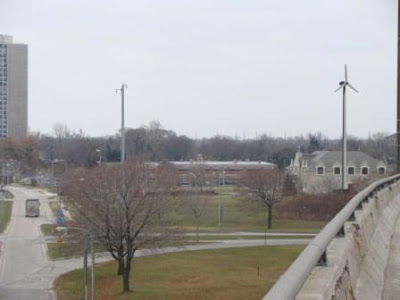
The city’s Office of Environmental Sustainability has released renderings of what a proposed wind turbine near the Port Administration building would look like.
Here are two views, showing one of each turbine. It’s not an apples-to-apples comparison because they are shown at two different sites, one by the port building and one closer to the lakeshore near the Lake Express ferry terminal. The renderings were prepared by the University of WIsconsin-Milwaukee Institute for Ecological Design.
The first shows the smaller turbine, a 20-kilowatt tower standing 115 feet tall. designed by Renewegy of Oshkosh, by the Port Administration building:
Below is a view of the North Power 100, built by Vermont-based Northern Power Systems, near the Lake Express terminal. It’s a 100-kilowatt turbine that would be 156 feet tall at the tip of the wind turbine blade.
A community meeting to discuss the possible placement of turbines at one of the two sites is planned for 6 p.m. Thursday at South Shore Park Pavilion.