by jboullion | Oct 18, 2010 | Uncategorized
From a column by Matthew Davidson, CEO, XTen Industries, Kenosha, in BizTimes:
Xten Industries, a Kenosha-based injection molding firm, has found several ways to reduce its environmental footprint by using less electricity and natural gas and more earth-friendly plastics. Matthew Davidson, chief executive officer of the company, has made being “green” a central tenet of his company’s operating model.
“There are many ways for manufacturing companies to become more sustainable – to make choices that benefit the environment while actually saving cash. This is even true of small companies like Xten Industries, an injection molder dependent on heavy machinery, high energy use and the consumption of plastic.
“We found it easiest to approach sustainability in three broad areas: reduce waste, reduce energy and design parts more intelligently.
“As an example, Xten reduced our scrap by over 40 percent last year by re-examining our internal processes and how we identify, sort and reuse plastic, steel, oil and corrugated.
“This year we slashed our electric usage by more than 30 percent with the help of Wisconsin’s Focus on Energy program and Clean Tech Partners, which allowed Xten to retrofit its large machines and lighting through incentives and an innovative, cash-positive financing program that allows us to pay back the loans with the energy savings. These are terrific programs for Wisconsin manufacturers.
by jboullion | Oct 15, 2010 | Uncategorized
From a blog post by Tom Content on JSonline:
American Transmission Co. plans to propose a new power line in Wauwatosa and a portion of the city of Milwaukee to help meet growing demand for electricity in the U.S. Highway 45 development corridor, the Pewaukee company said Wednesday.
The power line company has planned an informational open house on Thursday, Oct. 21, to provide area property owners and the public an opportunity to hear more about the proposal and offer input on the 138,000-volt power line.
The preliminary cost of the project is $21 million to $37 million. A final cost estimate will depend on the route that is selected for the line, said ATC spokeswoman Luella Dooley-Menet.
The roughly 2-mile transmission line would be needed to connect a new substation that We Energies plans to build next to its Milwaukee County substation and Milwaukee County power plant at 93rd Street and Watertown Plank Road.
We Energies’ planning studies indicate electric demand in the U.S Highway 45 corridor in western Milwaukee County is projected to double as soon as 2016-2018.
“Studies also indicate that existing distribution substations and feeders that serve the area will not be adequate to meet anticipated future electric demand,” said Andrew Gumm, We Energies manager of project siting.
During the next year, ATC will narrow the potential routes before filing an application to build the line with the Public Service Commission of Wisconsin in early 2012. If approved by the state Public Service Commission, construction of the new line would begin in 2014 and the line would be completed in 2015.
by jboullion | Oct 14, 2010 | Uncategorized
From an article by Tom Content in the Milwaukee Journal Sentinel:
Companies looking to get involved with the wind power supply chain should be ready to compete with top-notch quality and be prepared to adapt to swings in business activity in the sector, speakers at a wind energy symposium said Wednesday.
The wind power supply chain has plenty of opportunity, as the industry aims for a return to growth next year after a down year in 2010, said Jeff Anthony, business development director with the American Wind Energy Association.
“There are a lot of challenges in the wind industry. It’s not an easy industry to get in, but there are plenty of opportunities,” Anthony said.
Anthony addressed hundreds of participants at the Milwaukee symposium sponsored by Wisconsin Wind Works, a group focused on building up Wisconsin’s participation in the wind power supply chain.
David Lisle, chief executive of Wausaukee Composites, is already a veteran of the fluctuating wind market.
“Tremendous opportunities do exist, but it can be treacherous waters,” Lisle said.
In a few short years, the company has opened a plant in Cuba City that employed as many as 90 people, and then had to close it twice because of a downturn in the economy and tight credit markets that make banks reluctant to finance projects, he said.
But the company has diversified to the point where it now has four different customers in the wind industry instead of just one, he said. The company announced plans recently to expand its wind component factory in Cuba City to 76,000 square feet and create up to 200 jobs.
The challenge for suppliers dealing with the wind sector is to realize that this may be a new market in the United States but it’s not new around the world. European makers of wind turbines have been relying on European suppliers for years, and are now shifting to the U.S. market, he said.
by jboullion | Oct 13, 2010 | Uncategorized
From a news release issued by Governor Jim Doyle:
Projects to Create and Retain More Than 1,000 Jobs
PLOVER, GERMANTOWN – Governor Jim Doyle today announced $4.85 million in funding for McCain Foods and TecStar Manufacturing Company to help create and retain more than 1,000 jobs in the state. The funding comes from the State Energy Program (SEP).
“My top priority this year has been to help companies and communities move forward and create good-paying jobs for Wisconsin families,” Governor Doyle said. “With this funding, we will be able to help McCain Foods and TecStar Manufacturing Company expand their businesses and create hundreds of new jobs.”
McCain Foods USA, Inc. is a subsidiary of McCain Foods Limited, an international corporation that is the world’s largest producer of french fries and frozen potatoes, as well as a variety of frozen food products. McCain has been awarded $1.1 million in SEP funding for equipment purchases that will increase the efficiency of the company’s heat recovery capabilities. Specifically, the funding will help the company purchase $2.2 million in new and improved heat exchangers for various parts of their production line. The funding will help McCain in retaining 650 jobs at their Plover location.
Established in 1997, TecStar Manufacturing Company is a plastic injection molding manufacturer and a wholly owned subsidiary of the MGS Manufacturing Group. TecStar has been awarded $3.75 million in SEP funding to build injection molding machines for producing frames for photovoltaic panels. The total project cost is $15 million. With this funding, TecStar, of Germantown, has committed to creating 186 full-time positions in addition to the 170 already employed at the facility.
by jboullion | Oct 12, 2010 | Uncategorized
From a news release issued by the Interstate Renewable Energy Council (IREC):
October 11, 2010. Los Angeles, CA – The Interstate Renewable Energy Council (IREC) today awarded five Innovation Awards and six Special Recognition Awards at its 2010 Annual Meeting.
“Efforts like these are why I feel confident that the children of today will grow up to a world where solar and other clean energy technologies are as common place to them then as their cell phones, iPods and the Internet,” said Ken Jurman, IREC Chair.
“This year’s Innovation Awards targeted initiatives aimed at supporting clean energy workforce development, community renewables, financial incentives, clean energy ARRA projects, and efforts to grow the small wind market,” said Ken Jurman, IREC chair. “Each of this year’s winning submissions demonstrate initiatives and best practices that are helping move clean energy technologies closer to becoming the norm rather than the exception.”
Selected through a competitive process, the 2010 Innovation Awardees include: Lakota Solar Enterprises for its Solar Energy for Great Plains Tribal Communities (clean energy ARRA project); Mountain View Solar’s The JOBS Project (community renewables); We Energies’ Solar for Humanity (clean energy workforce development); The Morris County Improvement Authority’s MORRIS Model (clean energy financial program); and iCast’s rural agricultural applications for small wind in rural Eastern Colorado (small wind). . . .
2010 Innovation Award Winners
Clean Energy Workforce Development Category:
We Energies: Solar for Humanity
Solar for Humanity, focused on workforce development and community partnerships, uses Habitat for Humanity homes as real training roofs for solar PV and solar thermal installers.
By the end of 2010, more than 90 solar PV and solar thermal systems will be installed on homes throughout the We Energies service territory, in partnership with Habitat for Humanity chapters in Wisconsin, Midwest Renewable Energy Association, International Brotherhood of Electrical Workers and non-union contractors. The partnerships were developed to help develop jobs and to create a more robust NABCEP solar installer base within the service territory, educate the general public about solar technologies and energy efficiency, and bring solar power to lower income households. All parties plan to grow and continue this effort making it the largest renewable energy training partnership in the Midwest. Visit http://www.we-energies.com/business/energyeff/solarforhumanity.htm
by jboullion | Oct 11, 2010 | Uncategorized
From a report published by the Wisconsin Sustainable Business Council, The Green Tier Porgram at the Wisconsin Department of Natural Resources, and the Wisconsin School of Business:
By 2007, 68,203 businesses in the United States had generated more than 770,000 jobs in the green economy (Pew Charitable Trust, 2009). Every state has a piece of America’s green economy. The leading states include Oregon, Maine,California, Colorado, Massachusetts and Minnesota. Wisconsin is not currently among the leading states:
SOURCE: PEW Charitable Trusts, 2009, based on the National Establishment Time Series 2007 Database; analysis by Pew Center on the Statesand Collaborative Economics
Green job growth in Wisconsin through the 2001 recession (where WI lost 100,000 manufacturing jobs that were never recovered) was anemic. Wisconsin has lost an additional 70,000 manufacturing jobs (through July, 2010) because of the recession of 2008 (Center on Wisconsin Strategy, 2010).
While Wisconsin ranks either first or second in the nation in manufacturing jobs per capita, there is still a great deal of idle capacity in Wisconsin.
In 2007, jobs associated with the green economy accounted for 0.49 percent of all jobs nationally. WI was slightly below the national average with 3,150,000 total jobs and 0.48 percent of them being green.
A closer look at the data reveals that Wisconsin ranks as a top ten state in energy efficiency jobs. Energy efficiency is one of the five types of green jobs identified in the Pew report. Wisconisn ranked sixth in energy efficiency with 2,801 jobs. Midwestern states generally did well in all sectors, with Minnesota, Michigan, and Illinois appearing among the top 10 states in multiple sectors.
In 2007, jobs associated with the green economy accounted for 0.49 percent of all jobs nationally. WI was slightly below the national average with 3,150,000 total jobs and 0.48 percent of them being green.
A closer look at the data reveals that Wisconsin ranks as a 2,801 jobs. Midwestern states generally did well in all sectors, with Minnesota, Michigan, and Illinois appearing amongthe top 10 states in multiple sectors.
The report concludes:
The United States, and Wisconsin, will be focused on job creation over the next five to ten years. Creating green jobs has to be a part of the future if we hope to maintain our roleas a manufacturing state. Green jobs will gravitate towards states that are the most attractive, or to states that actively increase their attractiveness relative to competing states. The states that actively recruit green businesses will prosper in the longer run.
Wisconsin has a long history of manufacturing strength, and we are increasingly attracting manufacturing companies that are creating green jobs. But we can do more. We have only to look at our neighboring states of Iowa or Minnesota to see the benefit of establsihing Wisconsin as a hotbed of green expertise.
New green businesses can create jobs, generate revenues, and help Wisconsin re-emerge as a bell-weather state in the heartland of America.
by jboullion | Oct 11, 2010 | Uncategorized
From a report published by the Wisconsin Sustainable Business Council, The Green Tier Porgram at the Wisconsin Department of Natural Resources, and the Wisconsin School of Business:
By 2007, 68,203 businesses in the United States had generated more than 770,000 jobs in the green economy (Pew Charitable Trust, 2009). Every state has a piece of America’s green economy. The leading states include Oregon, Maine,California, Colorado, Massachusetts and Minnesota. Wisconsin is not currently among the leading states:
SOURCE: PEW Charitable Trusts, 2009, based on the National Establishment Time Series 2007 Database; analysis by Pew Center on the Statesand Collaborative Economics
Green job growth in Wisconsin through the 2001 recession (where WI lost 100,000 manufacturing jobs that were never recovered) was anemic. Wisconsin has lost an additional 70,000 manufacturing jobs (through July, 2010) because of the recession of 2008 (Center on Wisconsin Strategy, 2010).
While Wisconsin ranks either first or second in the nation in manufacturing jobs per capita, there is still a great deal of idle capacity in Wisconsin.
In 2007, jobs associated with the green economy accounted for 0.49 percent of all jobs nationally. WI was slightly below the national average with 3,150,000 total jobs and 0.48 percent of them being green.
A closer look at the data reveals that Wisconsin ranks as a top ten state in energy efficiency jobs. Energy efficiency is one of the five types of green jobs identified in the Pew report. Wisconisn ranked sixth in energy efficiency with 2,801 jobs. Midwestern states generally did well in all sectors, with Minnesota, Michigan, and Illinois appearing among the top 10 states in multiple sectors.
In 2007, jobs associated with the green economy accounted for 0.49 percent of all jobs nationally. WI was slightly below the national average with 3,150,000 total jobs and 0.48 percent of them being green.
A closer look at the data reveals that Wisconsin ranks as a 2,801 jobs. Midwestern states generally did well in all sectors, with Minnesota, Michigan, and Illinois appearing amongthe top 10 states in multiple sectors.
The report concludes:
The United States, and Wisconsin, will be focused on job creation over the next five to ten years. Creating green jobs has to be a part of the future if we hope to maintain our roleas a manufacturing state. Green jobs will gravitate towards states that are the most attractive, or to states that actively increase their attractiveness relative to competing states. The states that actively recruit green businesses will prosper in the longer run.
Wisconsin has a long history of manufacturing strength, and we are increasingly attracting manufacturing companies that are creating green jobs. But we can do more. We have only to look at our neighboring states of Iowa or Minnesota to see the benefit of establsihing Wisconsin as a hotbed of green expertise.
New green businesses can create jobs, generate revenues, and help Wisconsin re-emerge as a bell-weather state in the heartland of America.
by jboullion | Oct 11, 2010 | Uncategorized

From a news release issued by Governor Jim Doyle:
Company to Install Anaerobic Digester and Create 13 Jobs
MADISON – Governor Jim Doyle today announced a $550,000 loan for Betin Incorporated from the State Energy Program (SEP). Department of Commerce Secretary Aaron Olver and Department of Agriculture, Trade and Consumer Protection Secretary Randy Romanski made the announcement today in Belmont on behalf of the Governor.
“In Wisconsin, we are taking the lead to not only address environmental challenges, but also to find opportunities for innovation and growth,” Governor Doyle said. “I’m pleased that we could help Betin, Inc. install technology to use renewable energy and cut costs.”
“We are grateful to operate in a state where our Governor and Department of Commerce recognize the need to encourage and support private projects like ours that build environmentally-sound solutions to manufacturing,” said company President Arnaud Solandt. “The loan will allow us to expand further and create new jobs within the community.”
The SEP loan is funded by the American Recovery and Reinvestment Act. Betin, Inc. is one of the nation’s largest goat-cheese manufacturers using the trade name Montchevre. It will install an anaerobic digester to process whey and waste water. The resulting methane will be used to help meet up to 80 percent of the company’s energy needs. The project will create 13 jobs and represent total investment of $3.5 million.
by jboullion | Oct 8, 2010 | Uncategorized
From an article by Tom Content in the Milwaukee Journal Sentinel:
The Wisconsin Sustainable Business Council has published a 2010 Green Jobs Report focusing on areas of opportunity and investment for the state to focus on to build jobs in the clean-tech sector.
The report sees opportunities in jobs linked to energy efficiency, green building, renewable energy and mass transit.
“Green jobs are a critical part of the state’s recovery from the recession,” said Tom Eggert, executive director of the business council and co-director of the business, environment and social responsibility program at the University of Wisconsin School of Business.
The aim of the report was to look at green jobs in Wisconsin at a time when other Midwest states have moved to capitalize and promote the attractiveness of their states for clean-tech companies, Eggert said.
“We can do more,” the report concludes. “We have only to look at our neighboring states of Iowa or Minnesota to see the benefit of establishing Wisconsin as a hotbed of green expertise.”
Strengths that the state can build on include its manufacturing tradition and the experience of its workforce in manufacturing technology, Eggert said.
“Green jobs will gravitate toward states that are the most attractive, or to states that actively increase their attractiveness relative to competing states,” the report says.
Wisconsin has invested heavily in energy efficiency initiatives and in research linked to cellulosic ethanol and biofuels. Cellulosic ethanol is a biofuel produced from wood, grasses, or the nonedible parts of plants.
But Eggert sees an opportunity by increasing the state’s renewable portfolio standard as a way to send a message to companies that may want to locate here that the state is committed to renewable energy. A renewable portfolio standard is a regulation that requires increased production of energy from renewable energy sources, such as wind, solar, biomass and geothermal.
by jboullion | Oct 8, 2010 | Uncategorized
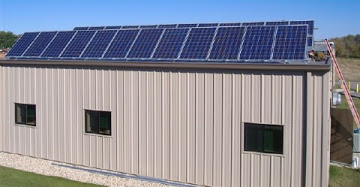
This week, New Glarus Utilities, a member of WPPI Energy, completed a new 5 kW solar project at their wastewater treatment plant located in the village. The energy produced will offset usage at the office building on-site.