by jboullion | Jun 28, 2010 | Uncategorized
From Madison Gas Electric:
“Many of us have seen giant wind turbines from the road… but very few people get a chance to go inside. In this story, see what’s in the core and climb with us to the very top of the turbine!
It’s a 26 story vertical climb in a very tight space. See how it’s done and find out how energy is transferred from the blades, into the nacell and down the core of the turbine”
by jboullion | Jun 28, 2010 | Uncategorized
From an article by Rick Olivo in the La Crosse Tribune:
BARKSDALE, Wis. – One of the fundamental tenants of Christianity is the duty of Christians to care for those less well off than themselves.
Indeed, the New Testament plainly states that when one gives food to those who hunger, drink to those who thirst, they do more than aid a fellow human being.
“Amen, I say to you, whatever you did for one of these least brothers of mine, you did for me,” reads Chapter 25 of the Book of Matthew.
It is an injunction that a number of bay area residents have taken to heart through the Northern Garden of Life, an effort to provide high quality fruits and vegetables, locally and sustainably grown, available at moderate cost to the general public, with profits and a substantial selection of the crop going to the BRICK ministries. The funds go to assist the BRICK’s programs for the needy and the vegetables and fruit are made available for distribution to families and individuals in need of food.
The Northern Garden of Life is located on a five-acre tract of land on Cherryville Road in the Town of Barksdale. Surrounded by woods, the farm is in its second year of operation and would be the envy of any home gardener. Surrounded by a deer and bear-proof fence, the field is exquisitely maintained by a corps of volunteers who give of their time to grow crops that include tomatoes, potatoes, corn, onions, garlic, squash, watermelons, beans, cucumbers, grapes, carrots, cantaloupes, herbs, cabbage, cauliflower, and a host of other garden delights. Water is supplied to the garden through slow-drip irrigation tubes placed next to the plants and fed from a 5,000-gallon plastic water tank that is, in turn, filled from a well dug on the property specifically to serve the facility. There is also a 2,500-gallon tank stocked with a fertilizer solution available.
The garden is located on land owned by Town of Barksdale resident George Vernon. He says the effort is a natural outgrowth of the beliefs held by the volunteers who keep the Northern Garden of Life going.
by jboullion | Jun 28, 2010 | Uncategorized
From an article by Nick Paulson in the Stevens Point Journal:
Stevens Point in 2009 spent more than $1.5 million on energy, used more than 73,000 million BTUs and emitted more than 21 million pounds of carbon dioxide, according to an inventory taken by the city.
As the city develops and implements a plan to cut its energy use, that inventory will be used as a benchmark with which to compare future use.
Where the biggest problems are depends on what the city’s goal ultimately is: decreasing energy use, energy cost or carbon emissions.
Sustainability coordinator Joe Kottwitz said the Stevens Point Energy Team, which is creating the plan, hasn’t decided specifically which to focus on yet. However, decreasing one likely will have positive effects on the others.
“If we use less energy and less electricity, odds are the taxpayers and ratepayers will receive those benefits,” said Mayor Andrew Halverson, who also is a member of the team.
Regardless of which avenue the city chooses, the primary focus likely will be electricity, which has the highest consumption (41 percent), cost (64 percent) and carbon dioxide emissions (71 percent) in the city.
That is because the electricity comes from coal-fueled power plants, Kottwitz said, which kick out a lot of emissions. Lighting is the most expensive use of energy for the city, costing almost $1 million, partially because it is powered by electricity, and partially because about half the streetlights are owned by Wisconsin Public Service, which charges a maintenance fee in addition to electricity fees.
by jboullion | Jun 28, 2010 | Uncategorized
From a news story by Mary Rinzel on WEAU-TV — http://www.weau.com/home/headlines/97103734.html
As they lined up their lawn chairs in Chippewa County, their eyes were to the sky. It was a big day at Sylvan and Leona’s Rothbauer’s Tilden farm. It was a day more than three years in the making.
“I think it’s a good idea, I really do. I think we’re going the right way,” Leona says.
For years, Sylvan and Leona dreamed of putting up a wind turbine. Now, that dream is up and running.
“Every state we went through had wind turbines,” Sylvan says of a Midwest vacation some years back.
It was that vacation that planted an idea in the farmer’s mind. He started saving for a turbine of his own.
“I just decided I was going to get one up, put one up and see what it does anyway,” Sylvan says.
Wednesday, that turbine [Ventura VT10-240] started spinning thanks in part to a grant from the U.S. Department of Agriculture’s Rural Energy for America Program.
“Nationwide, we’re going to fund more than $100 million worth of grants in this program this year. In Wisconsin, that’s going to be about 75 to 100 projects that we will fund this year,” says Jeff Hudson with the U.S. Dept. of Agriculture.
Hudson says the Rothbauers will get a $15,750 grant to cover 25 percent of the turbine’s $63,000 cost. The company [SolarWinds, Bloomer, WI] that put up the turbine says federal and state tax credits also help.
by jboullion | Jun 24, 2010 | Uncategorized
From an article by Nathan Vine in the Stevens Point Journal:
CUSTER — Bill McKibben said he considered himself fortunate to be at the 21st annual Midwest Renewable Energy Fair.
Being in a Midwestern atmosphere that he characterized as “very clear, practical and ready to get things done,” McKibben said it was a great backdrop for the theme of his keynote address at the fair Saturday.
McKibben, an internationally known environmentalist and founder of the 350.org campaign, said those who seek to fight the planet’s climate problems face a difficult task.
“We’re losing, and losing pretty badly to do what we need to make this planet work,” McKibben said. “If we are going to win, it’s going to take an enormous amount of that practical spirit.”
In between being honored by a pair of standing ovations, and the announcement that the MREA had planted a tree in his honor next to others planted for founding members of the event and past speakers at the event, McKibben focused on the work that still needs to be done.
He pointed out that despite the obvious effects of too much carbon in the atmosphere — which now stands at 392 parts per million, and which he hopes to reduce to 350 — from the increase of global temperature to the pollutive effect on the oceans, political forces and the fossil fuel industry have successfully kept substantive change from being made.
“The only way we are going to have the kind of change we need is to radically increase the cost of fossil fuels,” McKibben said. “To do that, we need to be engaging in the political battle that we haven’t been able to.”
McKibben has tried to rally support to that battle through his work with 350.org. In 2009, he and his team coordinated some 5,200 events in 181 countries in one day to bring awareness to the problem of carbon. This year on Oct. 10, they are planning a global work party, where people can take on environmentally friendly projects.
by jboullion | Jun 24, 2010 | Uncategorized
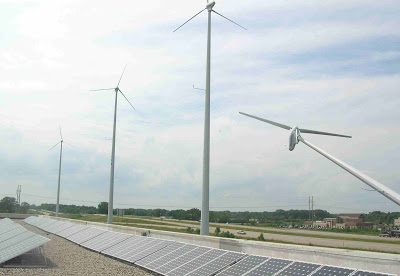
With three turbines set, crews raise a fourth one beside the SCA Tissue office building in the Town of Menasha.
From an article by Michael King in the Appleton Post-Crescent:
TOWN OF MENASHA — SCA Tissue is at the forefront of renewable energy applications and looking for more opportunities.
On Monday, the papermaker installed the first of four 100-foot-tall, 20-kilowatt wind turbines outside the SCA Tissue Service Excellence Center offices at 1451 McMahon Drive as part of a $300,000 project. The turbines with the 15-foot blades tower over the building, which has rooftop solar panels that were installed a few years ago.
“This is the first commercial wind (turbine project) in the town,” said Mike Dillon, SCA Tissue manager of environmental and risk management. He said SCA once again turned to local firms to aid its latest renewable, or “green” initiative.
“The turbines are the first commercial units built by a new Oshkosh company called Renewegy,” he said. “Faith Technologies in Menasha is doing the electrical work and the foundation work for the towers was done by our neighbor, Miron Construction.”
Once in place, the four turbines will produce 100 to 125 megawatt-hours annually, enough to power 10 to 12 homes each year, but the electricity is being used exclusively in the office building, Dillon said.
“We’re actually going to consume every bit of (electricity) in the building,” Dillon said. “This is a continuation of our work with renewable energy, looking at new technologies and improved technologies. It’s another piece of a (renewable) portfolio we’re trying to develop.”
SCA Tissue already is looking at solar and wind power options for its converting facility on Ehlers Road in the Town of Menasha and for its Menasha paper mill, along with SCA facilities in Arizona, New York and Alabama.
by jboullion | Jun 23, 2010 | Uncategorized
From an article by Paul Ryan in The Daily Reporter:
Deadline pressure and 100 amendments are cracking the unity of the state‘s Wind Siting Council as it strives to agree on turbine placement standards.
Even the definition of agreement is a point of contention among the 15 members. The state law that formed the council requires only that the panel make recommendations that will go to the Public Service Commission of Wisconsin and, ultimately, the state Legislature.
But some council members insist they will testify against recommendations not based on a consensus vote.
“I told them they can come in with studies and articles and hearsay,” said Larry Wunsch, a Brownsville resident and council member. “I come in with experience. I live in a wind farm, and I can tell you what it looks like and how it sounds.”
“But if they’re going to go with majority rule, then, yeah, I would argue against it at future hearings.”
The council is designed to establish turbine placement standards for wind farms that generate less than 100 megawatts of electricity. The PSC already reviews wind farms that generate more than 100 megawatts.
The PSC intends to finalize rules based on the council’s recommendations by Sept. 1, PSC spokeswoman Teresa Weidemann-Smith said.
Public hearings on draft rules begin next week, and the public comment period for recommendations ends July 7.
That puts the council on a tight timeline to finish its work, said Michael Vickerman, a member of the council and executive director of RENEW Wisconsin, a nonprofit organization focused on clean energy. . . .
Vickerman said he doubts there will be consensus. But, he said, the council represents a wide array of experience and interest, and the PSC and Legislature must take that into account when approving rules for wind turbine placement.
“Those who oppose wind have already made their minds up,” Vickerman said. “We can have a dialogue with them, but I don’t think we can have a meeting of the minds.”
by jboullion | Jun 23, 2010 | Uncategorized
From a story on WXOW-TV, La Crosse:
LA CROSSE, Wisconsin (WXOW) — The Black River Neighborhood Center is complete.
To commemorate that milestone, La Crosse’s Park and Rec Department held a grand opening at the beach house.
Mike Novak and his son Nick visit family in La Crosse often and enjoy seeing the area while they’re at it.
“Oh yeah, beautiful. We were talking about, look at that view coming down the road. You wind down and there’s the bluffs and stuff,” Mike says.
They came to the North Side to see the Black River and happened to catch the grand opening of the new neighborhood center.
“We had to come check it out, definitely,” Mike says.
Around eight years ago, the city took a look at how to improve the North-South Corridor.
Citizens and business owners started a plan to renovate the old bath house that was there.
After talking to the community about what they wanted, the city decided a new building was worth the investment.
“Four years ago, I would have said, ‘The building will be about this size and will have running water, and it’ll be clean.’ I didn’t have this vision. I truly didn’t. But it’s marvelous,” says North side merchant Randy Eddy, Sr..
“From a $40,000 renovation of a bath house, it ended up being a $1.3 million community facility,” says Steve Carlyon, Park and Recreation Director.
The 8,000 square-foot facility is set up for different uses, like parties, wedding receptions or just relaxing.
It uses green technology, like geo-thermal and solar energy.
by jboullion | Jun 23, 2010 | Uncategorized
From an article by Nick Paulson in the Stevens Point Journal:
Mid-State Technical College will begin offering this fall certificate courses in renewable energy aimed at giving displaced workers additional skills to make them more marketable.
The programs are in five emerging renewable industries that not all journey workers have training in. Mid-State hasn’t begun officially accepting applications for the program, and only last week hired the case worker who will screen applicants and fill the classes. Though classes start in late August, likely at the Wisconsin Rapids campus, there should be plenty of demand for the 15 slots in each program.
“We’ve got a lot of dislocated workers, so I think a lot of people will look at this as a real opportunity,” said Ronald Zillmer, associate dean of Mid-State’s technical and industrial division. “The fastest impact on our economy is taking people who already have skills in those areas and tweaking them a little bit.”
The certificate programs, and the tuition for the first year’s students, is being paid for with a $428,000 Department of Labor grant. Mid-State recently began offering associate degrees in renewable energy programs, and the certificates are an extension of that focus.
Three of the certificates — photovoltaic systems, wind systems and solar thermal — require the student to be practicing journey workers who have completed their apprenticeship. The biorefinery certificate is for those with some previous industrial workplace experience. The energy efficiency certificate has no requirements.
by jboullion | Jun 22, 2010 | Uncategorized
From an article by Ilissa Gilmore in the Sheboygan Press:
ASHWAUBENON — An advocacy group said Wednesday that the high-speed rail system that will connect several Midwest cities will benefit the environment and provide more than 9,000 jobs in Wisconsin.
Members of the Wisconsin Public Interest Research Group student chapters came to the National Railroad Museum in Ashwaubenon to promote the $823 million project that will connect Green Bay, Chicago, Milwaukee, Madison, and Minneapolis-St. Paul, among other cities.
WISPIRG — which works on economic, environmental, and social concerns — is conducting its second annual tour for the system. The group also has visited Eau Claire, La Crosse and Madison and will hit Oshkosh, Milwaukee and Racine.
States need to invest in railways instead of more roads and highways, said WISPIRG student leader Sarah Seibold.
“The Midwest is behind the East Coast and Europe and Asia in railway travel,” said Patricia Terry, a science professor at the University of Wisconsin-Green Bay. “Rails are needed to maintain our economic competitiveness.”
An expanded rail system in Wisconsin would produce 9,000 new, permanent jobs, and it would reduce dependency on oil because railroads are 23 percent more fuel efficient than airplanes and 40 percent more efficient than single-passenger cars, Seibold said.
The rail system will use diesel gas before eventually moving to electricity, she said, but it would still be more efficient than standard modes of transportation. With oil dependency and gas prices on the rise, rail travel is a favorable alternative, Terry said.