by jboullion | Dec 7, 2009 | Uncategorized

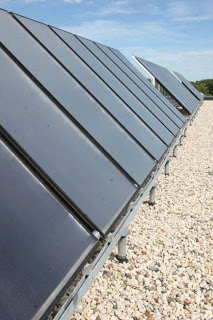
The solar water heating systems serve Fort Atkinson high school and the middle school. The radiant energy striking the rooftop panels year-round is efficiently collected and taken inside to preheat the swimming pools inside each structure. Except during the winter months, the incoming solar energy is sufficient to maintain pool temperatures at 84°F. Even in January, however, the savings that a solar hot water system yields simply by preheating a pool to 70°F is substantial when multiplied over several decades.
From a story by Michael Vickerman, RENEW’s executive director:
As a result of educating themselves on the connection between energy use and atmospheric pollution, several school districts in Wisconsin are taking increasingly aggressive steps to conserve energy as well as produce a portion of what they use on-site. Some have embraced ground source heat pump systems (Fond du Lac High School), while others have installed solar hot water systems (Osceola Middle School) and solar electric systems (Paul Olson elementary school in Madison). Not to be outdone, Wausau East High School recently installed a 100 kW Northwind turbine, which is now the largest wind generator attached to a school building in Wisconsin.
Yet if one measures success by substantial reductions in energy expenditures and emissions reductions, there is one school district in Wisconsin that stands head and shoulders above its peers: Fort Atkinson. Serving 2,700 school-age children in a community of 12,000, the Fort Atkinson School District operates six buildings: four elementary schools, one middle school and a high school. School officials have made no secret of their aspiration to make Fort Atkinson the most energy-efficient and self-sufficient K-12 district in the state.
Since 2005, Fort Atkinson has rigorously pursued a sustainable energy agenda that integrates, in a systematic and complementary fashion, continuous monitoring of consumption, aggressive building efficiency measures, and renewable energy capture. As articulated in its 2009 energy plan, the district, the district’s principal goals for 2010 are nothing if not ambitious:
+ Pare energy costs by 20% from 2005 levels;
+ Lower carbon emissions by 25% from 2005 levels;
+ Obtain EnergyStar certification for all six schools; and
+ Install on-site renewable production at all six schools.
by jboullion | Dec 7, 2009 | Uncategorized
Adapted from the on-line monitor site of Northern Power Systems:
Wausau East High School was given a very generous gift by the Walter Alexander Foundation to inspire and motivate students to study renewable energy. Wausau School District is the first School District in the state to have a Northwind 100. Lauren Ebbecke, science teacher at WEHS, also received a wind energy opportunity grant from Focus on Energy to fund the turbine. The Northwind provides about 5% of the power for Wausau East High School, saving about $14,000 each year in electricity bills.
The wind turbine will provide students with a unique learning experience. All students (K-12) will have access to real-time data on wind speed and energy output, gaining a practical understanding of renewable energy and power generation.
The site shows the amount of electricity generated since the turbine was installed (4,265 kWh), the avoided amounts of pollutants (sulfer dioxide, carbon dixoxide, and nitrogen oxides), and other environmental measures.
by jboullion | Dec 7, 2009 | Uncategorized
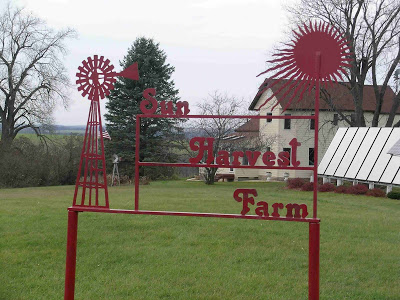
The Koerner’s installed the domestic hot water system (right)in March 2006. It also provides a portion of the heat for the house.
Sun Harvest Farm, owned by Jerry and Penny Kroener, Ridgeway, WI
Renewable Energy Projects
September 2009 Update
General:
In 2005 we embarked on major renovations and additions to our old farmhouse. This included working with Focus on Energy to have site assessments performed for Solar Photovoltaic, Solar Thermal and Wind Turbine Systems. We also investigated wood burning systems because we have substantial quantities of firewood on our property. Our decisions included the following:
1. Add additional insulation, all new windows and new doors.
2. Replace our old oil burning furnace with a high efficiency propane boiler (our little Munchkin).
3. Install a Solar Photovoltaic grid-connected system to produce electricity.
4. Install a Solar Thermal (hot water) system to preheat domestic hot water and provide some house heat.
5. Install a counter-flow masonry heater fireplace using our own limestone for the masonry cladding.
6. In 2008 we built and installed a hot air collector to provide some heat in our barn workshop.
7. In 2009 we installed our 2nd Photovoltaic grid-connected system.
8. In 2009 we also upgraded our solar hot water storage tank.
Continued
by jboullion | Dec 4, 2009 | Uncategorized
From an article by Julie Lawrence posted on OnMilwaukee.com:
The temperatures outside are plummeting. It’s winter in Wisconsin and the cozy comfort of our homes becomes our refuge after hours of shoveling and ice scraping. What we’re forced to endure in the Midwest could be considered criminal in other parts of the country, but the real crime Wisconsinites face is not adequately preparing their homes for the seasons.
Kent Borden has been an energy audit consultant for Five Star Energy Corp. for close to three years and he’s seen homes at just about every level of efficiency. Interestingly, it’s not that most people aren’t willing to work to limit energy loss, it’s that they don’t fully understand its source.
Wisconsinites often misinterpret old windows as the major culprit. Borden says not necessarily. While windows are a very visible part of the home, Borden says our notion that they are leaking like sieves is largely thanks to window manufacturers who like to portray that message.
“I don’t want to completely refute what they’re saying; windows certainly can be a factor.”
But, he says, a homeowner planning to drop $10,000 to $15,000 on new windows will never see the payback in energy savings.
So if the windows aren’t the biggest energy loss offenders, what are?
by jboullion | Dec 3, 2009 | Uncategorized
From a news release issued by the Lawrence Berkeley National Laboratory:
Home sales prices are very sensitive to the overall quality of the scenic vista from a property, but a view of a wind energy facility does not demonstrably impact sales prices.Over 30,000 megawatts of wind energy capacity are installed across the United States and an increasing number of communities are considering new wind power facilities. Given these developments, there is an urgent need to empirically investigate typical community concerns about wind energy and thereby provide stakeholders involved in the wind project siting process a common base of knowledge. A major new report released today by the U.S. Department of Energy’s (DOE) Lawrence Berkeley National Laboratory evaluates one of those concerns, and finds that proximity to wind energy facilities does not have a pervasive or widespread adverse effect on the property values of nearby homes.
The new report, funded by the DOE, is based on site visits, data collection, and analysis of almost 7,500 single-family home sales, making it the most comprehensive and data-rich analysis to date on the potential impact of U.S. wind projects on residential property values.
“Neither the view of wind energy facilities nor the distance of the home to those facilities was found to have any consistent, measurable, and significant effect on the selling prices of nearby homes,” says report author Ben Hoen, a consultant to Berkeley Lab. “No matter how we looked at the data, the same result kept coming back – no evidence of widespread impacts.”
An expert witness on real estate voiced the same conclusion during hearings on We Energies proposed Glacier Hills Wind Park.
by jboullion | Dec 3, 2009 | Uncategorized
From an article by Raghav Mehta on The Minnesota Daily:
As policymakers and environmentalists search for new sources of renewable energy, researchers at the University of Minnesota are working on turning leaves and branches into energy.
University researchers are currently exploring the viability of using forest-based biomass as an alternative energy source. Last month they received a $2.7 million federal grant to expand the footprint of their research to cover 50 million acres of forestland in Minnesota, Wisconsin and Michigan.
Forest resources professor Anthony D’Amato will lead the study in collaboration with scientists and researchers from the U.S. Forest Service and the University of Wisconsin.
Researchers will gather branches, leaves and shrubs to analyze the economic and ecological costs and benefits of harvesting the woody biomass over the next four years.
D’Amato said forest-based biomass gives another option in the search for a more environmentally friendly source of energy.
by jboullion | Dec 3, 2009 | Uncategorized
From a story by Colby Robertson on WAOW-TV:
WAUSAU (WAOW) — The Wisconsin Public Service Foundation is giving Wausau East $1,000 for the education of the wind turbines outside the high school.
The money is part of the Innovative Educator Grant program that targets areas of science, math and technology.
Lauren Ebbecke, a Science teacher at Wausau East says the money will be used to purchase a 5 year license for a web page titled Public View.
Public View is a web page hosted by Northern Power Systems. It allows anyone to go to this website to see how much power the Northwind 100 is producing, wind speed of the day, and how much energy the Northwind has produced to date.
The web page will have an engaging “dashboard” complete with dials that capture 10 minute energy and wind data, easy to understand metrics and general trend information.
Ebbecke says, “I believe that public view will be an invaluable educational tool for the entire school system and public. Students can access real time data on wind speed and energy output, gaining a practical understanding of renewable energy resources and power generation.”
Also, Monday morning, Focus on Energy will present Wausau East with more grant money. A $100,000 check that will go towards education related to the wind turbines.
by jboullion | Dec 3, 2009 | Uncategorized
From a news release issued by Kohl’s Corporation:
MENOMONEE FALLS, Wis., December 2, 2009 – Kohl’s Department Stores (NYSE: KSS) today became the first retailer to announce a commitment to reach net zero U.S. greenhouse gas emissions as part of its ongoing partnership with the U.S. Environmental Protection Agency’s (EPA’s) Climate Leaders program. To achieve this goal of being carbon neutral, Kohl’s will continue to invest in projects to reduce the same amount of greenhouse gas emissions that the company emits into the atmosphere.
The goal accounts for U.S. emissions at all Kohl’s facilities, including stores, distribution centers and corporate offices, as well as emissions resulting from business travel. Kohl’s goal, once realized, will be equivalent to removing more than 130,842 vehicles from the road for a year or offsetting the annual emissions from electricity used by more than 99,084 homes. . . .
Initiatives central to Kohl’s achievement of its Climate Leaders goal include a continuation of the company’s five environmental strategies: maximize energy efficiency, minimize waste, improve new building design, reduce emissions and encourage environmental values. Highlights include:
• Commitment to green power: Kohl’s strongly supports the development of renewable energy and was named one of EPA’s 2009 Green Power Partners of the Year. The company currently ranks as the no. 1 retailer on EPA’s list of Green Power Purchasers in its Green Power Partnership. In 2009, Kohl’s purchased 851 million kilowatt-hours in renewable energy credits – enough to meet 71 percent of the company’s purchased electricity use. Kohl’s plans to reach 100 percent green power by the end of 2010.
• Leading solar program: Kohl’s is currently the world’s largest retail host of solar power with 79 solar locations in six states – California, Wisconsin, Oregon, Connecticut, Maryland and New Jersey. The company aims to expand the program into additional states in 2010 to reach more than 100 solar locations.
• Central Energy Management Systems: As of 2008, all Kohl’s locations are operated by a system that controls most interior and exterior lighting, as well as heating and cooling systems. Last year, even while adding more than one million square feet of retail space through new and existing store expansion, Kohl’s reduced its greenhouse gas emissions by 12 percent.
• ENERGY STAR: The EPA ENERGY STAR national energy performance rating system provides a score on a 1 to 100 scale relative to similar buildings nationwide, with 50 as the average score. Buildings with a score of 75 or higher are eligible to receive EPA’s ENERGY STAR label. To date, more than 350 Kohl’s stores have earned the ENERGY STAR label – this is more than one third of all Kohl’s stores and more than 70 percent of retail buildings to date that have earned the ENERGY STAR. As a whole, Kohl’s stores average an ENERGY STAR score of 72, well above industry standard.
by jboullion | Dec 2, 2009 | Uncategorized
From the newly released handbook on “Community Wind Financing,” published by the Environmental Law & Policy Center:
. . . community wind [i]s any project up to 20 MW which was “initiated and (at least partially) owned locally.”
Community wind power projects represent a relatively small, but growing, share of the wind energy market. As of July 2008, community wind projects accounted for at least 736 MW of the total installed wind energy projects in the United States, primarily in the Midwest, and more have been developed in the last year. These projects are largely owned by farmers and other local investors, schools, tribes and municipal utilities and rural electric cooperatives. Such local ownership generates powerful economic and social benefits for rural areas. . . .
This updated Handbook provides the latest information on financing community wind projects, including ownership structures, roles of financial intermediaries, and sources of federal and state financial support. Although building these projects has become easier over time as landowners have benefited from the experiences of the community wind pioneers, understanding and accessing financing opportunities remains perhaps the most important requirement for a successful project.
by jboullion | Dec 2, 2009 | Uncategorized
From the newly released handbook on “Community Wind Financing,” published by the Environmental Law & Policy Center:
. . . community wind [i]s any project up to 20 MW which was “initiated and (at least partially) owned locally.”
Community wind power projects represent a relatively small, but growing, share of the wind energy market. As of July 2008, community wind projects accounted for at least 736 MW of the total installed wind energy projects in the United States, primarily in the Midwest, and more have been developed in the last year. These projects are largely owned by farmers and other local investors, schools, tribes and municipal utilities and rural electric cooperatives. Such local ownership generates powerful economic and social benefits for rural areas. . . .
This updated Handbook provides the latest information on financing community wind projects, including ownership structures, roles of financial intermediaries, and sources of federal and state financial support. Although building these projects has become easier over time as landowners have benefited from the experiences of the community wind pioneers, understanding and accessing financing opportunities remains perhaps the most important requirement for a successful project.