by jboullion | Nov 19, 2009 | Uncategorized
From an article by Steve Cahalan in the La Crosse Tribune:
The final version of a Wisconsin Department of Transportation long-range plan still has alternate routes through Eau Claire and La Crosse for high-speed passenger rail service between Tomah and the Twin Cities.
The DOT soon will study which route might be best.
The agency said Wednesday it has formally adopted its new Connections 2030 long-range plan, available online at www.wiconnections2030.gov.
Local business and government leaders argued at an Aug. 26 public hearing on the plan in La Crosse that studies years ago already had determined Amtrak’s Empire Builder route is the most ideal in the region for planned high-speed passenger rail service between Chicago and St. Paul. That route goes through Tomah and La Crosse, as well as Winona and Red Wing in Minnesota.
Backers of that route announced last week they have formed the Empire Builder High Speed Rail Coalition.
Coalition members remain convinced that is the best route, said the group’s coordinator, James Hill, who also is executive director of the La Crosse Area Development Corp.
by jboullion | Nov 19, 2009 | Uncategorized
From an article by Joel Costanza in the News of the North:
RHINELANDER – Hoping for bipartisan support and action by next April, a group of northern Wisconsin Republican lawmakers outlined plans on Monday (Nov. 16) to make or save jobs in the state, and promote the growth of biofuels as an alternative energy source.
Rep. Dan Meyer (R-Eagle River), Rep. Don Friske (R-Merrill) and Rep. Jeff Mursau (R-Crivitz) were joined by business and education officials at an hour-long news conference Monday afternoon held at Ponsse North America headquarters in Rhinelander.
Aimed mainly to help agribusiness and the forest products industry – “the two largest engines of the state’s economy” in Friske’s words – Meyer and his colleagues said they would sponsor nine bills and a resolution over the coming months to provide tax breaks and other incentives to spur economic growth.
The lawmakers said the tax relief would be modeled after $1.3 million in dairy modernization tax credits passed earlier this year.
“We’re looking to do the same thing for loggers and sawmills, for example, to help them upgrade their equipment and expand their facilities to create new jobs,” Meyer said.
Mursau said, “The same great idea for agriculture will work for our aging sawmills around Wisconsin by providing tax incentives.”
Friske conceded that the job creation plan faces an uphill fight in the Democratically-controlled legislature, but said he’s optimistic that the effort will garner support from both sides of the aisle.
“We have a common enemy, which is the slumping economy,” Friske said.
In addition to tax exemptions for businesses, the proposals are aimed at streamlining government permitting, helping educators spread the word about bio-energy, and easing worker compensation costs, which officials said put Wisconsin at a competitive disadvantage in luring new industry compared to neighboring states such as Michigan, Minnesota and many others where the business climate is friendlier.
by jboullion | Nov 18, 2009 | Uncategorized
A report from WQOW-TV:
Eau Claire (WQOW) – Minnesota regulators have approved a measure to allow Xcel Energy to increase the amount of radioactive waste.
Excel Energy requested to expand its nuclear waste plant near the Western Wisconsin border at Red Wing. The utility will spend roughly $600 million to upgrade the plant to handle higher pressures and temperatures and increase its output. The plan also calls for storage of 98 casks on a concrete pad next to the plant. The plant is located on an island in the middle of the Mississippi River.
Red Wing’s mayor is disappointed with the decision. Now the measure goes to legislators for final approval.
by jboullion | Nov 18, 2009 | Uncategorized
From a news release issued by U.S. Rep. Gwen Moore:
(Washington, DC)— Congresswoman Gwen Moore (D-Wisc.) today announced that Milwaukee will receive $5,839,100 in Energy Efficiency and Conservation Block Grant (EECBG) funding awarded by the U.S. Department of Energy as part of the Recovery Act. These funds are intended to create local green jobs and help improve energy efficiency in communities across the country by reducing energy use and fossil fuel emissions.
“This funding will make improvements in homes, businesses and municipal buildings that will help keep energy costs down,” Congresswoman Moore said. “Not only are these improvements important for personal, business and city finances, they also move Milwaukee toward better overall energy efficiency, create green jobs, reduce our environmental impact, and demonstrate that our city can keep up with energy innovation.”
The city of Milwaukee will use these funds to make energy efficiency improvements in municipal buildings including retrofits that will update older lighting systems. The city will also actively seek additional opportunities to make energy efficiency improvements in municipal buildings.
A residential retrofit program will provide a revolving loan fund for homeowners to complete energy retrofits, and a similar program will offer the same type of revolving loan fund to businesses.
by jboullion | Nov 17, 2009 | Uncategorized
From a news release issued by Focus on Energy:
(Nov. 16, 2009) – LED (light emitting diode) holiday lights are a proven way to help consumers trim energy costs while trimming their trees. How? This technology saves energy, while helping to preserve the environment. What’s more, Focus on Energy, Wisconsin’s statewide energy efficiency and renewable energy resource, is offering financial incentives toward the purchase of ENERGY STAR® qualified LED holiday light strings.
Now through Dec. 31, 2009, or until supplies last, Focus on Energy is offering a $3Instant Reward, taken at the register, on the purchase of ENERGY STAR qualified LED holiday light strings at participating locations including Ace Hardware, Costco, Do it Best, Hardware Hank, Menards, Mills Fleet Farm, Shopko, Stein Gardens & Gifts and True Value Hardware locations. Limit twelve (12) light sets per customer.
by jboullion | Nov 17, 2009 | Uncategorized
From a news release issued by Focus on Energy:
(Nov. 16, 2009) – LED (light emitting diode) holiday lights are a proven way to help consumers trim energy costs while trimming their trees. How? This technology saves energy, while helping to preserve the environment. What’s more, Focus on Energy, Wisconsin’s statewide energy efficiency and renewable energy resource, is offering financial incentives toward the purchase of ENERGY STAR® qualified LED holiday light strings.
Now through Dec. 31, 2009, or until supplies last, Focus on Energy is offering a $3Instant Reward, taken at the register, on the purchase of ENERGY STAR qualified LED holiday light strings at participating locations including Ace Hardware, Costco, Do it Best, Hardware Hank, Menards, Mills Fleet Farm, Shopko, Stein Gardens & Gifts and True Value Hardware locations. Limit twelve (12) light sets per customer.
by jboullion | Nov 17, 2009 | Uncategorized
From Green Drinks – Eau Claire:
Green Drinks will be November 18th at 6:30PM at Dooley’s Pub on Water Street, in Eau Claire.
We’ll start with introductions and then a quick presentation by Meg Marshall of Sustainable Eau Claire. Meg will be discussing Sustainable Eau Claire and Eco-Teams – a way to make your home, business, and community “greener”!
Buy a drink and stay for the “Conservation-Conversation” and find out what “green” issues and events are happening in the Chippewa Valley!
Invite your friends to JOIN OUR FACEBOOK GROUP!
Eau Claire Green Drinks
6:30PM
Wednesday, November 18
Dooley’s Pub on Water Street (Upstairs Room)
PS – December 16th’s featured presenter will be Erin O’Brien of Erin Designs – discussing green design and eco-friendly products!
by jboullion | Nov 17, 2009 | Uncategorized
From an article by Tom Content in the Milwaukee Journal Sentinel:
Given our climate, Wisconsin would never be mistaken for the best solar state in the country.
But among non-Sun Belt states, the state is staking a claim in providing power from the sun.
Except for California and Texas, Wisconsin is the only state with two cities – Milwaukee and Madison – in the national Solar America Cities program.
A $19.6 million project for Roundy’s Corp. in Oconomowoc would become the largest solar power project in the Midwest, if it gets $8.8 million in federal stimulus funding.
And the state has more certified solar installers per capita than nearly every state in the country, according to Tehri Parker, executive director of the Midwest Renewable Energy Association. Even with the recession, the number of solar installations is expanding – and so is training for solar-contracting jobs, Parker said.
On a recent weekend in Milwaukee, trainees from Wyoming, Virginia and Missouri were on a rooftop in Milwaukee’s central city installing solar panels on a Habitat for Humanity home.
Habitat is partnering with We Energies and the Midwest Renewable Energy Association to provide much-needed training for solar technicians – a job that’s expected to be in high demand given the growth trajectory that solar enjoys.
John Price, a firefighter with the Brookfield Fire Department, is looking to switch careers into a greener line of work.
He’s getting trained in solar installation, working on installing solar panels at Habitat for Humanity homes in Milwaukee, and forming a Waukesha business, Access Solar, with his sons.
He was leading an installation at a Habitat house a few weeks back and learned his students hailed from across the country.
“It’s people who’ve been laid off, or are people who are in their 40s who are changing careers or laid off and looking for something else,” said Price, 50.
Small fraction
Solar represents a fraction of the energy supply puzzle. If the state’s energy supply in 2007 were a 500-piece jigsaw puzzle, coal would account for more than 300 pieces, and renewable energy would account for about 20 pieces. All the solar power in the state wouldn’t add up to a piece.
But the growth rate for solar has been something to behold, even as advocates concede the numbers are small in total.
“It’s been a remarkable year,” said Niels Wolter, who heads solar programs at the state Focus on Energy program. “We’re projecting out 73% growth over last year. Before that it was growing at about 80% per year since 2002. So it’s slowed down a little bit in the growth rate, but it’s still a booming market. . . .”
Even with all these projects and announcements, some renewable energy advocates say the growth rate will slow considerably in 2010 because electric utilities no longer are offering extra incentives to give the solar market a boost.
We Energies had a generous solar buyback rate in place two years ago, and replaced it with a different program this year. That program is fully subscribed, and no more applications are being accepted.
Michael Vickerman, executive director of the advocacy group Renew Wisconsin, said the expiration of those incentives is unfortunate. He’s urging the state to move aggressively to require utilities to offer generous buyback rates.
“We are clearly the leading state in the Midwest, but that momentum is in danger of dissipating,” said Vickerman. “Because what really attracts customers and would-be system owners is the buyback rate.”
And developers of large solar projects aren’t coming to Wisconsin, said green-energy consultant Brett Hulsey, because Wisconsin hasn’t followed states such as California and New Jersey in adopting tax credits to bring down the price of solar projects.
Utilities say that the incentives are being subsidized by other utility customers. Other incentives are still available, including a 30% federal tax credit and rebates from Focus on Energy, said We Energies spokesman Brian Manthey.
In addition, the prices for solar panels themselves have dropped by 15% in recent months, shortening the number of years it would take to pay back the investment in solar from about 23 years to about 20 years, depending on the project.
by jboullion | Nov 16, 2009 | Uncategorized
From a news release issued by Focus on Energy:
(Nov. 16, 2009) – LED (light emitting diode) holiday lights are a proven way to help consumers trim energy costs while trimming their trees. How? This technology saves energy, while helping to preserve the environment. What’s more, Focus on Energy, Wisconsin’s statewide energy efficiency and renewable energy resource, is offering financial incentives toward the purchase of ENERGY STAR® qualified LED holiday light strings.
Now through Dec. 31, 2009, or until supplies last, Focus on Energy is offering a $3Instant Reward, taken at the register, on the purchase of ENERGY STAR qualified LED holiday light strings at participating locations including Ace Hardware, Costco, Do it Best, Hardware Hank, Menards, Mills Fleet Farm, Shopko, Stein Gardens & Gifts and True Value Hardware locations. Limit twelve (12) light sets per customer.
by jboullion | Nov 16, 2009 | Uncategorized
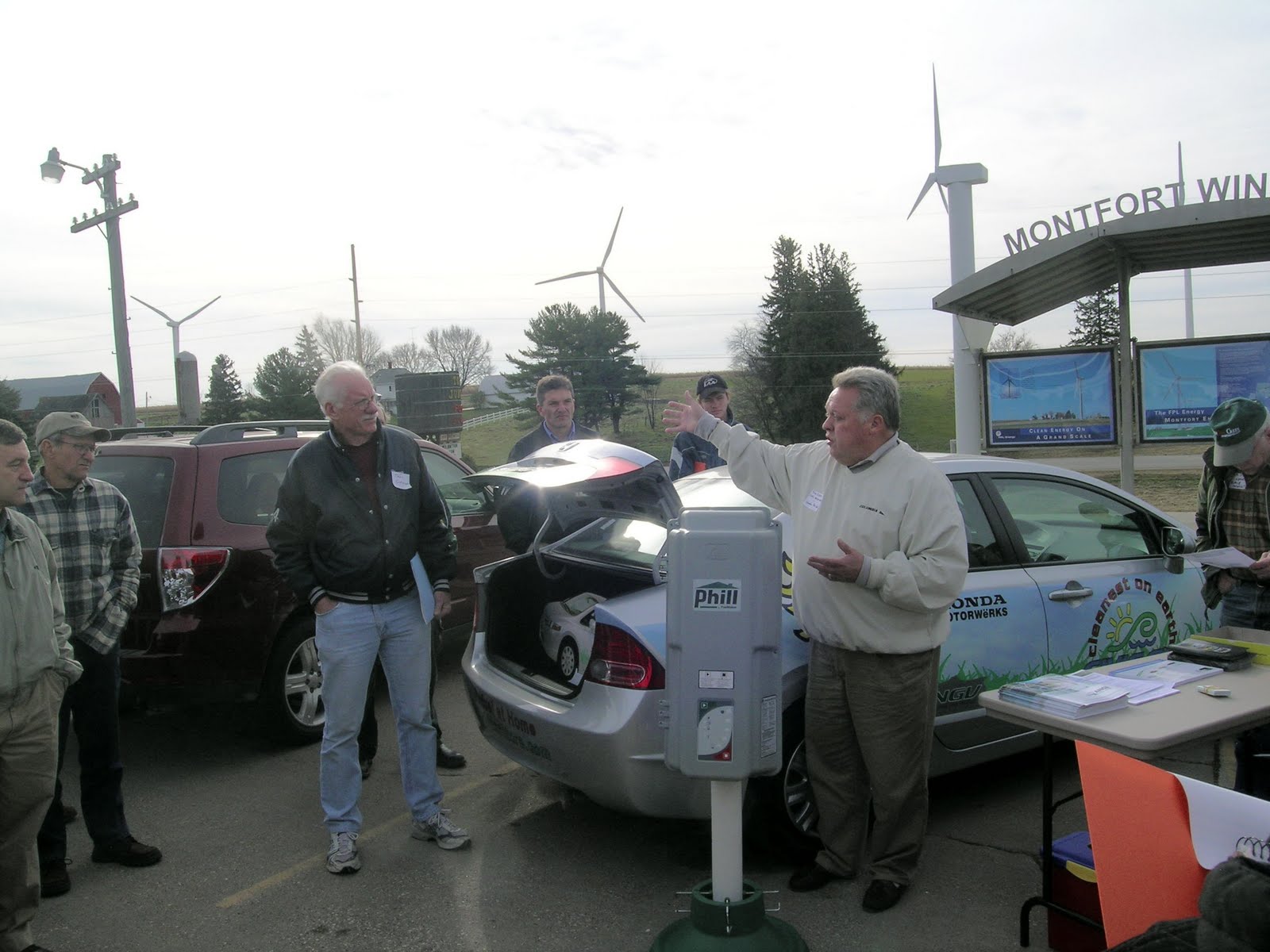
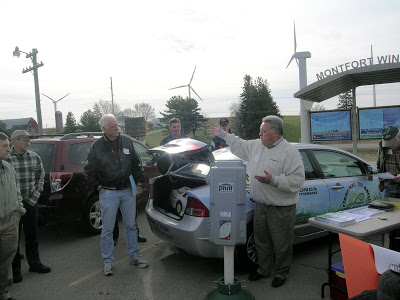
Standing behind an electrical vehicle charger at the beginning of the Homegrown Renewable Energy tour, Tom Shee, Honda Motorwerks, La Crosse, explains that the electricity from the turbines at the Monfort Wind Farm could provide the power for the plug-in hybrid behind him. Photo by Laura Stoesz.