by jboullion | Nov 16, 2009 | Uncategorized
From a post by Tom Content on his blog at JSOnline:
Milwaukee and one other city are in the running for a Spanish wind energy supplier as it considers its first manufacturing plant in the United States.
The name of the firm and the name of the city competing against Milwaukee haven’t been disclosed, but Tim Sheehy, president of the Metropolitan Milwaukee Association of Commerce, said the company was in the alternative energy business.
State and city economic development leaders were in Spain this week for meetings with the Spanish firm. Brian Manthey, a spokesman for We Energies, said the team that headed to Spain brought along a representative of the utility who has expertise about wind energy.
The company would be expected to create 100 to 200 jobs here, Sheehy said.
Milwaukee is a finalist for the investment, after earlier competing against more than a dozen cities that the firm was considering.
Representatives of the company have been to the city twice to evaluate potential suppliers and the availability of skilled manufacturing workers, he said.
Representatives of the state at the meeting this week were state Commerce Secretary Dick Leinenkugel, city development director Rocky Marcoux, and Pat O’Brien and Jim Paetsch from the Milwaukee 7 economic development group.
“It’s fair to call this a significant investment,” Sheehy said. “We’ve got a lot of manpower on the ground over there – not that we’re not going to chase every possible job out there – but I think the manpower is appropriate to the potential in this deal.”
by jboullion | Nov 16, 2009 | Uncategorized
From an article by Cara Spoto in the Stevens Point Journal:
Efforts to reduce the amount of energy at its new wastewater treatment facility have paid off for the village of Whiting.
A representative from Focus on Energy — Wisconsin’s statewide energy efficiency program — was at the plant Friday to hand village officials a $34,000 check to help it pay for some of the many energy-efficient components that make up the $4.8 million plant.
Touring the facility with Joe Cantwell, Focus on Energy’s industrial energy adviser, and Mike Resch, an account executive with Wisconsin Public Service, Whiting Utilities manager Matt Saloun and Kim Hoppenrath, chairman of the village’s utilities committee, rattled off a list of energy-saving elements that went into the design and construction of the facility.
Some of the major elements include solar panels that heat the building and generate power, skylights, solar thermal heating, carbon dioxide monitoring and several variable frequency drive, or VFD, motors, used in nearly all elements of the wastewater reclamation process. The facility even has a white roof, which reflects sunlight, reducing cooling costs.
“These are our blowers over here. They provide aeration for our aerobic digesters. The VFDs are much more energy-efficient, compared to our old ones that just wailed away,” Saloun explained.
Because of all the energy efficiencies, the plant should consume about one-fifth of the energy consumed by similar-sized wastewater treatment plants, Saloun said.
by jboullion | Nov 13, 2009 | Uncategorized
From an article in Solar Today by Bob Ramlow, Amherst, a solar consultant for Focus on Energy:
For its comfort and economy, radiant heating is growing in popularity. Pairing a radiant heat-delivery system with solar energy as the heat source is an excellent choice for several reasons. Above all, these systems and operate efficiency and effectively at the relatively low temperatures common with solar energy systems. They‘re relatively easy to retrofit into an existing building and can be easily incorporated into new construction.
by jboullion | Nov 12, 2009 | Uncategorized
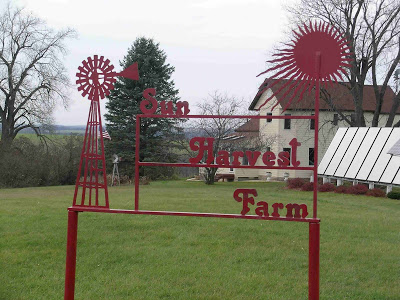
From a description by Jerry and Penny Kroener of Sun Harvest Farm, Ridgeway, WI, one stop on the Renewable Energy Tour, November 13, 2009:
In 2005 we embarked on major renovations and additions to our old farmhouse. This included working with Focus on Energy to have site assessments performed for Solar Photovoltaic, Solar Thermal and Wind Turbine Systems. We also investigated wood burning systems because we have substantial quantities of firewood on our property. Our decisions included the following:
1. Add additional insulation, all new windows and new doors.
2. Replace our old oil burning furnace with a high efficiency propane boiler (our little Munchkin).
3. Install a Solar Photovoltaic grid-connected system to produce electricity.
4. Install a Solar Thermal (hot water) system to preheat domestic hot water and provide some house heat.
5. Install a counter-flow masonry heater fireplace using our own limestone for the masonry cladding.
6. In 2008 we built and installed a hot air collector to provide some heat in our barn workshop.
7. In 2009 we installed our 2nd Photovoltaic grid-connected system.
8. In 2009 we also upgraded our solar hot water storage tank.
by jboullion | Nov 12, 2009 | Uncategorized
The Koerner’s installed the domestic hot water system (right)in March 2006. It also provides a portion of the heat for the house.
Sun Harvest Farm, owned by Jerry and Penny Kroener, Ridgeway, WI
Renewable Energy Projects
September 2009 Update
General:
In 2005 we embarked on major renovations and additions to our old farmhouse. This included working with Focus on Energy to have site assessments performed for Solar Photovoltaic, Solar Thermal and Wind Turbine Systems. We also investigated wood burning systems because we have substantial quantities of firewood on our property. Our decisions included the following:
1. Add additional insulation, all new windows and new doors.
2. Replace our old oil burning furnace with a high efficiency propane boiler (our little Munchkin).
3. Install a Solar Photovoltaic grid-connected system to produce electricity.
4. Install a Solar Thermal (hot water) system to preheat domestic hot water and provide some house heat.
5. Install a counter-flow masonry heater fireplace using our own limestone for the masonry cladding.
6. In 2008 we built and installed a hot air collector to provide some heat in our barn workshop.
7. In 2009 we installed our 2nd Photovoltaic grid-connected system.
8. In 2009 we also upgraded our solar hot water storage tank.
Improving Efficiency
Our first goal was to improve the efficiency of the areas in the old part of the farmhouse, and to include very high efficiency within the new addition. We installed new Pella windows and doors throughout. Additional insulation was added where possible and a moisture/air barrier under new fiber cement siding, which was installed on the entire house. The new construction included R-21 insulation in the walls and blown-in R-50 in the ceiling. We removed the old oil-fired hot water heater and the oil burner from the warm air furnace. A high efficiency propane gas boiler (Munchkin T-50) was installed to be our back up for heating and the new domestic hot water tank. We also installed radiant under floor heating in the new great room area and plan to install additional radiant heating in certain of the old house areas. The existing warm air furnace was retained, with the addition of a water-to-air heat exchanger, which allowed us keep the central AC unit and also to provide warm air heating to the upstairs area. We have also installed compact fluorescent light bulbs throughout the entire house and in the barn workshop area.
Solar Thermal Hot Water System
Our system as designed to provide domestic hot water and a portion of the house heating and was put into operation in March 2006. It includes:
+ Eight 4 ft x 10 ft Heliodyne Gobi 410 collectors, ground-mounted at a 60 degree tilt angle
+ 1000 gallon concrete hot water storage tank, with EPDM rubber liner
+ Approximately 600 ft of 1 inch copper tubing made into coils for heat exchangers
+ Pump, valves, expansion tanks, controller, copper piping, propylene glycol, insulation, etc.
We performed a considerable amount of the work to install the system including:
+ Installing the concrete tank and liner
+ Bending the tubing into coils and installing them in the tank
+ Installing 14 concrete pillars
+ Digging trenches and installing piping from collectors into basement
+ Erecting the framework and the collectors
We worked with Light Energy Systems of Madison (now Full Spectrum Solar) to design the system and to provide the parts and some of the labor. The total system cost was approximately $20,000, but we received a Focus on Energy grant of $3,000 and a Federal Tax Credit of $2,000 so our out-of-pocket costs were about $15,000.
During 2009 we decided to replace the concrete tank due to excessive moisture problems in the basement area. We demolished the tank piece by piece and carried it out of the basement. We replaced it with a tank made by STSS Co. Inc from Mechanicsburg PA. The new tank is collapsible so it can be moved through regular sized doorways. When in place it will be 80 round and 4 high with all penetrations installed at the factory according to our heat exchanger specifications. It is sealed, insulated and with hold up to 822 gallons of water. We reused the copper heat exchangers that we had made for the old tank. We also installed a heat dump under the solar collectors, which was made of 24 ft of Slant Fin baseboard hydronic registers. The purpose of the heat dump is to dissipate excess heat produced during the summer when we only use the hot water for pre-heating the domestic hot water. The total costs for the new tank, including demolishing the old tank, were about $3,500.
Masonry Heater Fireplace
We investigated wood-burning systems and decided to build a masonry heater fireplace in order to take advantage of renewable resources on our property. We have an ample supply of trees on our property that we harvest by cutting dead trees. We constructed a woodshed that dries and stores about 10 cords of split firewood.
The fireplace is specially designed to be efficient and environmentally friendly because the combustion chamber burns at between 1500-2000 degrees F. The fire burns for 2-3 hours but the large amount of masonry mass stores and radiates the heat for 12-24 hours. Our fireplace is centrally located so it radiates heat over a large area of our kitchen and great room. Two stainless steel U-Tube heat exchangers are also built into the core to capture some heat, which is circulated to the solar storage tank in the basement.
The core of our heater was designed by Heat-Kit of Canada, but originated centuries ago from designs in Europe and Russia. Gimme Shelter Construction of Amherst, WI constructed the core.
We decided to use natural limestone and sandstone from our property for the masonry cladding. Some of the stones were recovered from the foundation of our old summer kitchen. We performed the masonry work ourselves, which saved us $20,000+ in labor costs. Our cost for the core, chimney materials and mortar for the limestone was approximately $12,000.
Solar Photovoltaic Electric System # 1
This system was designed to produce about half of our annual electricity needs and was put into operation in April 2006. We chose a grid-tied system that sends excess electricity to the Alliant Energy power grid. We have a net-metering agreement where we are compensated for the power we produce at the same rate as we pay for electricity. During the first full year of operation our PV system produced 4,700 kilowatt-hours, which was 43% of our total usage of 11,100 kWh.
The PV system includes the following components:
+ 16 Kyocera 170 watt modules for a total output of 2.7 kW
+ Wattsun dual axis tracker system (the system follows the sun morning until night)
+ SMA Sunny Boy 2500 inverter/controller (converts DC voltage to AC for the grid)
+ Concrete foundation (5 yds with rebar), steel post & framework
+ Disconnect switches, wires, conduit, and other miscellaneous electrical items
Our system produces between 200-600 volts (DC current) when the sun shines. It is facing east when the sun rises and follows the sun all day so it is facing west when the sun goes down. The DC current comes into the basement, goes through a disconnect switch and into the Sunny Boy inverter/controller. This device changes the DC current into AC current and controls how the power goes out into the grid. The current goes outside through a disconnect switch, back through our main breaker panel, and then out through the meter to the grid. The best days are when we are not using much power and the meter is actually going backward!
We worked with Light Energy Systems of Madison (now Full Spectrum Solar) to design the system and to provide the parts and some of the labor.
The total cost of the system was about $25,000, but we received a Focus on Energy grant of $8,700 and a Federal Tax Credit of $2,000, so out out-of-pocket costs were about $14,000.
Solar Photovoltaic Electric System # 2
In 2009 we installed our second PV system. We took advantage of a special program from Alliant Energy where we have contracted for 10 years to sell all of the power produced by the system for 25 cents per kWh. It did require us to install a new meter pedestal, at a cost of $1,100 so that the electricity from the new system could be metered separately. We also have to pay about 41 cents/day for the new meter charge, as well as sign up for the Alliant Second Nature program (where we pay a small premium for our energy purchased, which will be from renewable sources). Our total cost for the system was $31,168, and we did some of the work ourselves (digging, concrete, trenching, wire, etc). We will get a 25% Focus on Energy grant of about $7,800 and a 30% Federal tax credit in 2010 of about $9,300. Therefore, our out of pocket costs will be about $14,000. This system has the potential to produce about an 11% annual rate of return.
We purchased the main part of the system from DH Solar. Their system uses a tracking system that they adapted from their experience with commercial satellite tracking systems. The system has 16 Suncast PV panels, each of which is rated at 210 watts, or a total of 3.36 kW. The inverter is a SMA Sunny Boy 3000US.
Barn Workshop Hot Air Collector System
In 2008 we designed, built and installed a hot air collector system on the south side of the old milkhouse. The collector was made from tempered glass, aluminum expandable tubes, painted black, and solid foil-faced insulation. The 6 outlet and inlet piping contains a bi-metallic sensor/control relay and a small in-duct fan to pipe the heat into the barn workshop. The total cost of this system was about $600. A woodstove in the milk house provides backup heat on cloudy days, which is piped with the same piping system into the barn. This is a trial and error system. It looks like we might have to reposition the system to more directly face south to maximize the heat output.
by jboullion | Nov 12, 2009 | Uncategorized
Wisconsin Chapter of Women of Wind Energy Please join us for a November happy hour in Milwaukee!
Thursday, November 19, 2009
5:00 – 7:00pm
Sugar Maple
441 E Lincoln Ave
Milwaukee, WI 53207-1756
414) 481-2393
Come meet and network with others interested in the engagement, professional development and advancement of women in the wind industry.
Please RSVP for the Milwaukee happy hour to amy@the-mrea.org
Feel free to invite others you think might be interested!
And watch for information coming soon on a December event in Madison!
Website: www.womenofwindenergy.org
email: wisconsinwowe@gmail.com