by jboullion | Aug 3, 2009 | Uncategorized
From a story on WISN-TV:
MILWAUKEE — Wisconsin State Fair has a new creation on a stick, but it’s not something fair goers can eat. It’s called “energy on a stick.”
Solar panels have been installed on top of the Wisconsin Products Pavilion, as well as a single stick on Grandstand Avenue.
The stick can produce 34,000 kilowatts of electricity a year.
“That’s really the future we’re working toward,” said Niels Woleter, Solar Electric Program Manager for Focus on Energy. “Part of that future is preparing everyone, by showing them yes, here it is. This is what it looks like. It does work in Wisconsin. Today might be a cloudy day, but its still generating power.”
State Fair officials said in 1 year the panels will generate enough power to make cream puffs for 3 years, as well as run the sky gliders for 12 years.
by jboullion | Aug 3, 2009 | Uncategorized
From Carol Gruba:
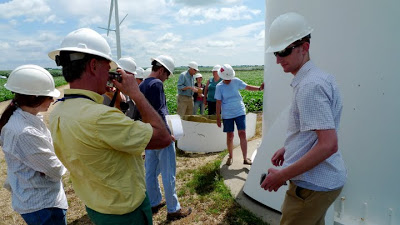
Prairie winds were in full force when a Next Step Wisconsin group visited the Montfort Wind farm on July 25. Carol Gruba gathered the fourteen wind watchers who hailed from Dodgeville, Chicago, UW Madison, The Natural Step Monona, MATC Madison, and the Madison Area Permaculture Guild.
The enthusiastic wind tourists peppered their guide Carol Anderson with questions about the wind plant, and Carol readily answered. She owns the land that is underneath 4 of the GE turbines owned by NextEra, and she has compiled information and photographs on the wind farm since its construction. She hosts about 55 tours a year for elementary, high school, college, and community groups. Carol told the Next Step Wisconsin group that the wind installation was the largest wind farm in the U.S. upon its commission in summer of 2001.
Other facts about the wind farm include:
*Montfort Wind Farm turbines begin to generate electricity at a wind speed of 8.9 mph and their computer-monitored blades ensure they safely cease operation at 56 mph
*Each 1.5 mW turbine generates enough electricity to power 350 homes
*The 20 wind turbines operate optimally at a speed of 26.8 mph.
*6 land owners lease land to NextEra for the 20 wind farm turbines
Carol Anderson rotates her family’s 550 acre Montfort-area farm through soybeans and corn with the help of her brother. She is a retired Cornell professor of human development and former Associate Director of Cornell’s Cooperative Extension.
To register your interest in future green road trips or find more information on the trip’s sponsor, The Next Step Wisconsin, visit
thenextstepwisconsin.wordpress.com
by jboullion | Jul 31, 2009 | Uncategorized
From an article in the Wisconsin State Journal:
WASHINGTON — The government plans to suspend its popular “cash for clunkers” program amid concerns it could quickly use up the $1 billion in rebates for new car purchases, congressional officials said Thursday.
The Transportation Department called lawmakers’ offices to alert them to the decision to suspend the program at midnight Thursday. The program offers owners of old cars and trucks $3,500 or $4,500 toward a new, more fuel-efficient vehicle. . . .
A White House official said later that officials were assessing the situation facing the popular program but auto dealers and consumers should have confidence that transactions under the program that already have taken place would be honored. . . .
Congress last month approved the Car Allowance Rebate System program, known as CARS, to boost auto sales and remove some inefficient cars and trucks from the roads. The program kicked off July 24 and was heavily publicized by car companies and auto dealers.
Through late Wednesday, 22,782 vehicles had been purchased through the program and nearly $96 million had been spent. But dealers raised concerns about large backlogs in the processing of the deals in the government system, prompting the suspension.
by jboullion | Jul 31, 2009 | Uncategorized
From an article in the Wisconsin State Journal:
WASHINGTON — The government plans to suspend its popular “cash for clunkers” program amid concerns it could quickly use up the $1 billion in rebates for new car purchases, congressional officials said Thursday.
The Transportation Department called lawmakers’ offices to alert them to the decision to suspend the program at midnight Thursday. The program offers owners of old cars and trucks $3,500 or $4,500 toward a new, more fuel-efficient vehicle. . . .
A White House official said later that officials were assessing the situation facing the popular program but auto dealers and consumers should have confidence that transactions under the program that already have taken place would be honored. . . .
Congress last month approved the Car Allowance Rebate System program, known as CARS, to boost auto sales and remove some inefficient cars and trucks from the roads. The program kicked off July 24 and was heavily publicized by car companies and auto dealers.
Through late Wednesday, 22,782 vehicles had been purchased through the program and nearly $96 million had been spent. But dealers raised concerns about large backlogs in the processing of the deals in the government system, prompting the suspension.
by jboullion | Jul 31, 2009 | Uncategorized
From an article in the Wisconsin State Journal:
WASHINGTON — The government plans to suspend its popular “cash for clunkers” program amid concerns it could quickly use up the $1 billion in rebates for new car purchases, congressional officials said Thursday.
The Transportation Department called lawmakers’ offices to alert them to the decision to suspend the program at midnight Thursday. The program offers owners of old cars and trucks $3,500 or $4,500 toward a new, more fuel-efficient vehicle. . . .
A White House official said later that officials were assessing the situation facing the popular program but auto dealers and consumers should have confidence that transactions under the program that already have taken place would be honored. . . .
Congress last month approved the Car Allowance Rebate System program, known as CARS, to boost auto sales and remove some inefficient cars and trucks from the roads. The program kicked off July 24 and was heavily publicized by car companies and auto dealers.
Through late Wednesday, 22,782 vehicles had been purchased through the program and nearly $96 million had been spent. But dealers raised concerns about large backlogs in the processing of the deals in the government system, prompting the suspension.
by jboullion | Jul 31, 2009 | Uncategorized
From an article in the Wisconsin State Journal:
WASHINGTON — The government plans to suspend its popular “cash for clunkers” program amid concerns it could quickly use up the $1 billion in rebates for new car purchases, congressional officials said Thursday.
The Transportation Department called lawmakers’ offices to alert them to the decision to suspend the program at midnight Thursday. The program offers owners of old cars and trucks $3,500 or $4,500 toward a new, more fuel-efficient vehicle. . . .
A White House official said later that officials were assessing the situation facing the popular program but auto dealers and consumers should have confidence that transactions under the program that already have taken place would be honored. . . .
Congress last month approved the Car Allowance Rebate System program, known as CARS, to boost auto sales and remove some inefficient cars and trucks from the roads. The program kicked off July 24 and was heavily publicized by car companies and auto dealers.
Through late Wednesday, 22,782 vehicles had been purchased through the program and nearly $96 million had been spent. But dealers raised concerns about large backlogs in the processing of the deals in the government system, prompting the suspension.
by jboullion | Jul 30, 2009 | Uncategorized
From a news release issued by the U.S. Department of Agriculture:
WASHINGTON, July 29, 2009 – USDA Farm Service Agency Administrator Jonathan Coppess today announced that biomass conversion facilities can begin signing up to participate in the Biomass Crop Assistance Program, which will help increase production of renewable energy. The program, authorized in the 2008 Farm Bill, provides financial assistance to producers who deliver eligible material to biomass conversion facilities and FSA will provide financial assistance to collect, harvest, store and transport eligible materials.
“This program will benefit producers, the developing biomass industry, the general public and the environment as we continue working to expand production and availability of renewable energy,” said Coppess. “Owners of eligible material can receive financial assistance for delivering qualified biomass to conversion facilities that use biomass for heat, power, bio-based products or advanced biofuels.”
Biomass conversion facilities and material owners or producers should contact their FSA state offices or visit www.fsa.usda.gov for more information. FSA will begin accepting applications from biomass facilities interested in participating in the Biomass Crop Assistance Program (BCAP).
by jboullion | Jul 30, 2009 | Uncategorized
From a news release issued by the U.S. Department of Transportation:
U.S. Transportation Secretary Ray LaHood today kicked off a buyer incentive program designed to help consumers purchase new fuel efficient vehicles and boost the economy at the same time. The Car Allowance Rebate System (CARS), commonly referred to as Cash for Clunkers, is a new federal program that gives buyers up to $4,500 towards a new, more environmentally-friendly vehicle when they trade-in their old gas guzzling cars or trucks.
“With this program, we are giving the auto industry a shot in the arm and struggling consumers can get rid of their gas-guzzlers and buy a more reliable, fuel-efficient vehicle,” Secretary LaHood said. “This is good news for our economy, the environment and consumers’ pocketbooks.”
The National Highway Traffic Safety Administration (NHTSA) also released the final eligibility requirements to participate in the program. Under the CARS program, consumers receive a $3,500 or $4,500 discount from a car dealer when they trade in their old vehicle and purchase or lease a new, qualifying vehicle. In order to be eligible for the program, the trade-in passenger vehicle must: be manufactured less than 25 years before the date it is traded in; have a combined city/highway fuel economy of 18 miles per gallon or less; be in drivable condition; and be continuously insured and registered to the same owner for the full year before the trade-in. Transactions must be made between now and November 1, 2009 or until the money runs out.
The vehicle that is traded in will be scrapped. NHTSA estimates the program could take approximately 250,000 vehicles that are not fuel efficient off the road.
by jboullion | Jul 30, 2009 | Uncategorized
From an article by Paul Medinger in the Jackson County Chronicle:
The Ho-Chunk Housing and Community Developing Agency building in Tomah has made a switch to solar power.
HHCDA Executive Director Mark Butterfield said that the solar power for the facility at 1116 E. Monowau St. was expected to be up and running Monday after 39 solar panels were installed on the roof of the building last Wednesday and Thursday.
“The switch will be thrown on Monday,” Butterfield said. “This is all part of a pilot project.”
The 39 solar panels were installed by H & H Solar of Madison, and will generate nearly enough electricity to power the entire building. The project is funded through grant money from the American Recovery and Reinvestment Act. Butterfield said that the project will also receive approximately a 25-percent rebate from Focus on Energy. The HHCDA will also be credited 25 cents per kilowatt hour through Alliant Energy, which will provide about $2,500 per year.
Butterfield said that the system likely will pay for itself in 12 years. The cost of the project before the rebate is $77,000. Butterfield said that the switch is also part of the green energy movement, and he hopes that four other HHCDA facilities in Nekoosa, Wisconsin Dells, Black River Falls and the Blue Wing Village will make the switch to solar power in the future.
“We hope to eventually reduce all of (the facilities) to zero net energy,” Butterfield said. “Part of the whole plan is to save money. If we don’t spend it on the annual (electricity) expenses, we can put more money into housing.”
by jboullion | Jul 30, 2009 | Uncategorized
From blog post by Stacy Forster on JSOnline:
Madison – Lawmakers who represent the City of Milwaukee are appealing to a Spanish train company planning to make two trains for Wisconsin to locate their manufacturing facility in the state’s urban center.
The train maker, Talgo, is expected to make two 14-car train sets to be used on Amtrak’s Milwaukee-to-Chicago Hiawatha Service, which will cost the state $47 million. The train sets include the cab car that powers the train. The order will create about 80 manufacturing and maintenance jobs, with the possibility the company could add more if other states buy its trains, Gov. Jim Doyle has said.
Talgo hasn’t chosen a location for its assembly and maintenance facility, but Doyle said it was likely to be located in south-central or southeastern Wisconsin. Antonio Perez, chief executive officer and president of Talgo Inc., the company’s U.S. subsidiary, said it has scouted locations in Milwaukee and Janesville.