by jboullion | Jun 9, 2009 | Uncategorized
From Wind for Wisconsin:
SB 185/AB 256 direct the Public Service Commission (PSC) to initiate an administrative rule-making process to establish statewide siting standards for wind energy projects. The bill draft requires the PSC to establish an advisory committee of diverse interests to advise the Commission on the rules. The legislature will have the opportunity to review the proposed rules prior to their publication.
+ The PSC is an independent regulatory agency dedicated to serving the public interest. The agency is responsible for the regulation of more than 1,100 Wisconsin public utilities, including those that are municipally-owned.
+ The PSC works to ensure that, in the absence of competition, adequate and reasonably priced service is provided to utility customers. The PSC has oversight on every form of electric generation in the state.
+ Alternatives to bypass the PSC are designed to introduce more delay and confusion into the siting process. Additional layers of bureaucracy only serve to reinforce the siting stalemate.
+ Under the bill the PSC would establish a unique, comprehensive review of siting issues. Any attempt to predict the rule-making is speculative at best.
+ The PSC is the agency with the expertise to provide the appropriate scientific, fact based review of issues related to siting wind energy projects. The bill does not specify any siting requirements but establishes a process to review the relevant health and safety issues.
“I pledge to you a rule-making process which will be open and inclusive…The Commission will continue to be a fair partner with local government to ensure that the siting process is equitable to all, and that decisions are made in a timely and transparent way…The PSC’s rulemaking process is as open and inclusive a process as any.”(Joint public hearing May 12, 2009)
-Eric Callisto, PSC Chairman
by jboullion | Jun 9, 2009 | Uncategorized
An Associated Press story on WSAW.com:
MADISON, Wis. (AP) — Gov. Jim Doyle and lawmakers plan to eliminate funding for a grant program that helps Wisconsin companies discover new sources of energy.
The Legislature’s budget committee last week cut all $30 million the governor had proposed for the Wisconsin Energy Independence Fund that gives grants and loans to businesses researching and developing clean energy.
Environmental groups and companies who received the first batch of funding from the program last year say they are upset with the move.
Doyle spokeswoman Carla Vigue says the governor and lawmakers had to cut the funding to balance the budget. She says some of the federal stimulus money coming to Wisconsin will also help promote renewable energy businesses.
by jboullion | Jun 9, 2009 | Uncategorized
A letter to the editor by James E. Becher, Norwalk, in the La Crosse Tribune on June 2, 2009:
The situation here at Ridgeville, town of Wilton, Monroe County Wis., is a prime example why the state needs to overrule these unrealistic ordinances with normal setbacks (500 feet property line dwelling to 1,000 feet, no greater) allowing a wind farm here in Monroe County.
(Aren’t we fortunate the NIMBYs weren’t here when the power lines came through? With greater setbacks, we may not have electricity.)
Recent polls in a local newspaper resulted in about 85 percent in Monroe County favoring wind power. That makes only 15 percent against it.
In 2005, about 45 landowners signed easements with Invenergy LLC, a reputable wind company, looking forward to construction in 2006. A committee drew up an ordinance approved by the state, county, towns, landowners and wind company — no problems.
Then the anti-wind group (NIMBYs) formed, holding many “mis-informational” meetings, hiring six lawyers, plus many speakers with negative, fictional stories — sending DVDs, pictures, propaganda, etc. to every household in Monroe County and beyond, pestering people until their resistance wore them down, persuading them to join the group.
Some were elected to our town boards to veto the approved ordinance, halting construction, then drawing up their own restrictive ordinance, preventing all wind farms from ever coming in here, ruining our wind farm business, income and taking away our landowner rights.
Prime examples why proper-normal setbacks are so important: calculating normal setbacks means 1 turbine per 40-acre plot; calculating greater setback requires four 40-acre plots, leaving very few landowners eligible.
We commend Sen. Jeff Plale and Rep. Jim Soletski and the other legislators co-sponsoring the two bills to bring statewide wind siting to Wisconsin, helping the energy crisis.
by jboullion | Jun 9, 2009 | Uncategorized
A letter to the editor by James E. Becher, Norwalk, in the La Crosse Tribune on June 2, 2009:
The situation here at Ridgeville, town of Wilton, Monroe County Wis., is a prime example why the state needs to overrule these unrealistic ordinances with normal setbacks (500 feet property line dwelling to 1,000 feet, no greater) allowing a wind farm here in Monroe County.
(Aren’t we fortunate the NIMBYs weren’t here when the power lines came through? With greater setbacks, we may not have electricity.)
Recent polls in a local newspaper resulted in about 85 percent in Monroe County favoring wind power. That makes only 15 percent against it.
In 2005, about 45 landowners signed easements with Invenergy LLC, a reputable wind company, looking forward to construction in 2006. A committee drew up an ordinance approved by the state, county, towns, landowners and wind company — no problems.
Then the anti-wind group (NIMBYs) formed, holding many “mis-informational” meetings, hiring six lawyers, plus many speakers with negative, fictional stories — sending DVDs, pictures, propaganda, etc. to every household in Monroe County and beyond, pestering people until their resistance wore them down, persuading them to join the group.
Some were elected to our town boards to veto the approved ordinance, halting construction, then drawing up their own restrictive ordinance, preventing all wind farms from ever coming in here, ruining our wind farm business, income and taking away our landowner rights.
Prime examples why proper-normal setbacks are so important: calculating normal setbacks means 1 turbine per 40-acre plot; calculating greater setback requires four 40-acre plots, leaving very few landowners eligible.
We commend Sen. Jeff Plale and Rep. Jim Soletski and the other legislators co-sponsoring the two bills to bring statewide wind siting to Wisconsin, helping the energy crisis.
by jboullion | Jun 9, 2009 | Uncategorized
SB 185/AB 256 direct the Public Service Commission (PSC) to initiate an administrative rule-making process to establish statewide siting standards for wind energy projects. The bill draft requires the PSC to establish an advisory committee of diverse interests to advise the Commission on the rules. The legislature will have the opportunity to review the proposed rules prior to their publication.
+ The PSC is an independent regulatory agency dedicated to serving the public interest. The agency is responsible for the regulation of more than 1,100 Wisconsin public utilities, including those that are municipally-owned.
+ The PSC works to ensure that, in the absence of competition, adequate and reasonably priced service is provided to utility customers. The PSC has oversight on every form of electric generation in the state.
+ Alternatives to bypass the PSC are designed to introduce more delay and confusion into the siting process. Additional layers of bureaucracy only serve to reinforce the siting stalemate.
+ Under the bill the PSC would establish a unique, comprehensive review of siting issues. Any attempt to predict the rule-making is speculative at best.
+ The PSC is the agency with the expertise to provide the appropriate scientific, fact based review of issues related to siting wind energy projects. The bill does not specify any siting requirements but establishes a process to review the relevant health and safety issues.
“I pledge to you a rule-making process which will be open and inclusive…The Commission will continue to be a fair partner with local government to ensure that the siting process is equitable to all, and that decisions are made in a timely and transparent way…The PSC’s rulemaking process is as open and inclusive a process as any.”(Joint public hearing May 12, 2009)
-Eric Callisto, PSC Chairman
by jboullion | Jun 9, 2009 | Uncategorized
A story by Tom Murray on WTMJ:
SHOREWOOD – The Presbyterian church at Bartlett Avenue and Capitol Drive claims to be the first green church on the North Shore.
The congregation believes in making God’s green earth a little greener.
“It’s a way of helping to reduce our carbon footprint,” said Reverend Jim Bender.
The 55-year-old church has a new look. There are three rows of solar panels on the roof pointing toward heaven.
Jackie Keltner and Sam Kashou belong to North Shore Presbyterian’s very own eco focus group.
“I think they look fabulous,” said Keltner. “Even on a relatively small scale, you can make a difference.”
It’s quite a leap of faith for Sam, who’s been attending this church since 1948.
“Solar panels? They didn’t even have that in the vocabulary,” he quipped.
The panels will not do all the work. Church leaders estimate they will provide about 10-20 percent of the building’s electricity.
It does add up to energy bill savings of almost $2,000 a year. Reverend Bender says the project adds up to better ministry.
“Churches are beginning to get back to the true Biblical idea that the earth is not something to be dominated, but the earth is something to be maintained for future generations,” Bender told TODAY’S TMJ4 reporter Tom Murray.
The panels are paid for by anonymous donations and grants from We Energies and Focus on Energy.
by jboullion | Jun 8, 2009 | Uncategorized
From an article in the e-newsletter of Focus on Energy:
You may already know that Focus on Energy offers a $500 bonus incentive to homeowners who build a Wisconsin ENERGY STAR® Home or improve their homes through the Home Performance with ENERGY STAR Program. What you may not know is that Focus will extend this special bonus to homeowners who install wind energy systems starting July 1, 2009!
That’s right — when you build a Wisconsin ENERGY STAR Home or fully participate in Home Performance with ENERGY STAR, you’ll automatically qualify to receive a $500 bonus above and beyond the standard financial incentive when you install a wind turbine, solar electric or solar hot water system!
With this $500 bonus, we hope to encourage Wisconsin homeowners to take a “whole-house” approach to economic and environmental sustainability. The benefits of living in a high-performance, renewably powered home are many, and Focus on Energy wants to help you enjoy them affordably.
Build efficient with Wisconsin ENERGY STAR Homes.
Building a new home is a major investment. Wisconsin ENERGY STAR Homes can help you make the most of that investment with a home that saves energy and money. New homes certified by the program automatically qualify for the $500 bonus when a solar or wind energy system is installed.*
Improve efficiency with Home Performance with ENERGY STAR.
Home Performance with ENERGY STAR helps you make energy efficient improvements that save money and increase the comfort, safety and durability of your existing home. Homeowners who participate in this program prior to installing a solar or wind energy system are automatically qualified for the $500 bonus.*
by jboullion | Jun 8, 2009 | Uncategorized
From an article published in the e-newsletter of Focus on Energy:
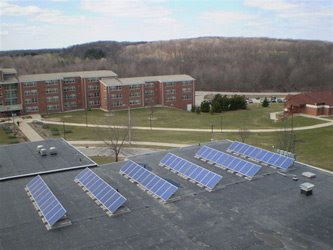
Drive through the UW-Parkside campus today and you’ll notice a new energy on campus—solar energy, to be exact. UW-Parkside just put Kenosha on the renewable energy map in a big way with the installation of a 26 kilowatt solar electric system.
Under the guidance of UW-Parkside’s Task Force on Sustainability, Don Kolbe, the university’s director of facilities management, oversaw the installation of three separate, highly visible solar electric systems across the campus. According to Mr. Kolbe, “We [UW-Parkside] wanted a visual representation of the sustainability initiative that our university has been actively pursuing.” These three solar electric systems will convert the sun’s energy into more than 34,000 kilowatt-hours of renewable electricity each year (view real-time energy production here) that will help power the campus for the next 30-plus years. This energy production is enough to power three average single-family homes in Wisconsin and offset the release of more than 75,000 pounds of carbon dioxide (CO2), a greenhouse gas that is a major contributor to global warming.
The environmental attributes of this project are undeniable, but just as attractive is the portfolio of incentives from which UW-Parkside was able to benefit. According to Don Wichert, director of the Focus on Energy Renewable Energy Program, “With the confluence of state, federal, and utility incentives that are available for the installation of renewable energy systems, now is an excellent time to install a solar system.” A $50,000 incentive through the Focus on Energy Program, a $100,000 grant through the We Energies Renewable Energy Development Program, generous donations, and the annual revenue that this system will net, all made this project financially viable.
by jboullion | Jun 8, 2009 | Uncategorized
SB 185/AB 256 will improve the regulatory climate in Wisconsin and advance current state energy policy. The erratic permitting environment for wind projects means that state policy is being blocked at the local level.
+ Current law requires that 10 percent of utilities’ electrical sales be generated from renewable resources by 2015.
+ Wind will be the workhorse for Wisconsin utilities. Between 75% and 95% of the energy needed to meet the 10% statewide target will be generated with wind.
+ The single biggest constraint to increasing wind generation in Wisconsin is the permitting environment, which is far more problematic here than in neighboring states.
+ Regulatory uncertainty increases project costs, harming Wisconsin ratepayers. The absence of statewide siting standards forces wind energy out of state forfeiting Wisconsin jobs and investment while adding transmission costs.
“We support SB 185/AB 256…Industrial customers are very concerned about electric rates and their impact on jobs in state. We want to do everything we can to hold down rates here in Wisconsin to keep our jobs here and stay competitive…This bill is one way of mitigating these costs. Wind is the only resource that will meet the current 10% renewable mandate. (Joint public hearing May 12, 2009)
-Todd Stuart, Executive Director of WIEG
“Wisconsin is counting on wind power to propel the state 90 percent of the way toward meeting a goal of more than doubling the renewable energy contribution to electric needs over the next six years.”
-Wisconsin State Journal (“A win for wind power in Wisconsin”)
“Wind power is not a passing fad. It has to be a part of the solution to weaning the U.S. from fossil fuels…Wisconsin has chosen to be a leader, not a follower in the use of renewable sources of energy.”
-Sheboygan Press (“Have uniform rules for siting wind turbines”)
by jboullion | Jun 8, 2009 | Uncategorized

