by jboullion | Apr 30, 2009 | Uncategorized
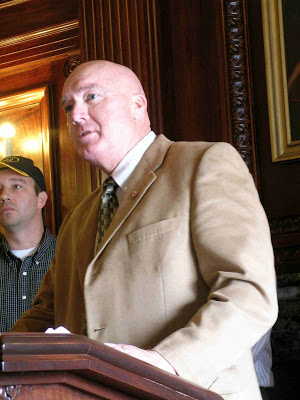
Terry McGowan of the International Union of Operating Engineers Local 139 speaks at the press conference for the introduction of a bill to set uniform siting standards for wind projects in Wisconsin.
From a news release issued by Sen. Jeff Plale, Rep. Jim Soletski, Sen. Randy Hopper, and Rep. Phil Montgomery:
MADISON – A bipartisan coalition of Wisconsin legislators announced that they are introducing legislation that calls for the creation of uniform siting standards for wind energy projects. Senate Bill 185 (SB 185), and its Assembly companion, directs the Public Service Commission (PSC), after public input, including a stakeholder committee, to establish by rule, permitting standards to be applied by local or state government to wind energy installations, regardless of size and location.
“Too many wind projects are victims of delay tactics and other obstructions,” Senator Jeff Plale, Chair of the Senate Committee on Commerce, Utilities, Energy, and Rail said. “SB 185 will enhance Wisconsin’s economy by protecting and creating “green-collar” jobs; it will attract new investment to our state and support state energy policy. I look forward to working with my colleagues to ensure that we can make Wisconsin more attractive to wind energy and achieve the resulting economic and environmental benefits.”
“A sensible wind energy policy will help Wisconsin harness the jobs and growth opportunities that green power provides,” stated Representative Jim Soletski, Chair of the Assembly Energy and Utilities Committee. “I am excited to be working with a bipartisan group of legislators from diverse regions of the state to remove the obstacles to more development of wind power in Wisconsin. By advancing this legislation, Wisconsin utilities can move toward meeting their obligation to generate clean energy and much needed jobs can be created for our workers.”
“We can’t build a 21st century energy infrastructure by digging in our heels,” Senator Randy Hopper said. “This legislation will ensure that interested parties from all over our state can take part in developing the Public Service Commission’s guidelines.”
“Wind power is job-creating power,” according to Representative Phil Montgomery. “A fair and uniform state standard for siting wind developments will create an environment of investment in our state while moving us closer to our green energy goals.”
In addition to RENEW, the following organizations issued statements of support for Senate Bill 185: CREWE, Clean Wisconsin, Citizens Utility Board, Customers First!, Renewegy, Wind Capital Group, WPPI/Municipal Electric Utilities.
by jboullion | Apr 30, 2009 | Uncategorized
From a presentation on wind permitting in Wisconsin by Michael Vickerman, executive director, RENEW Wisconsin:
Why are so many wind projects serving WI utilities located out of state?
1. The wind resource is stronger in states to our west, which reduces the per/MWH cost of development.
2. It is proving exceptionally challenging to secure a permit to build wind projects in Wisconsin, especially those under 100 MW.
by jboullion | Apr 30, 2009 | Uncategorized
From an article by Nick Halter in the Wausau Daily Herald:
Both houses of the Wisconsin Legislature on Tuesday passed bills that would fine drivers who open their doors without first checking for bikers.
The bill, which is expected to be signed by Gov. Jim Doyle, would fine motorists up to $40 for the first offense and up to $100 for the second time in one year. The bill also eliminated the part of the law that requires bicyclists to stay three feet from vehicles.
Nick Holzen, 26, a mechanic at City Bike Works on Third Street in Wausau, said he has been hit by a car in the past and is glad attention is being paid to the issue. He said bike sales are way up at Bike Works and there will be more bicyclists hitting the roads this summer.
“With the economy down, there will be more people out on the road,” he said.
by jboullion | Apr 29, 2009 | Uncategorized
From a fact sheet published by Focus on Energy:
Many people are interested in using renewable energy to meet their home or business energy needs, but sometimes the process is not clear and people don’t know where to turn for help. Use the steps below as a guide to help you discover whether renewable energy can work for you. . . .
1. LEARN ALL ABOUT IT. . . .
2. GET A SITE ASSESSMENT. . . .
3. CALL AN INSTALLER; GET ESTIMATES. . . .
4. CHECK ZONING, UTILITY REQUIREMENTS, INSURANCE AND OTHER LEGALITIES. . . .
5. SECURE FINANCING. . . .
6. LEARN HOW TO MAINTAIN YOUR SYSTEM—SAFELY. . . .
7. ENJOY SAVING MONEY AND ENERGY. . . .
FOR MORE INFORMATION: focusonenergy.com
Contact Focus on Energy to learn more about renewable energy choices. We have fact sheets and case studies featuring solar water heating, solar electricity, passive solar design, bioenergy and wind turbines for homes, farms and businesses. Renewable
energy incentives are also available. Call 800.762.7077 for more information.
by jboullion | Apr 29, 2009 | Uncategorized
From a fact sheet published by Focus on Energy:
Rising energy costs and concern for energy security and the environment are driving forces in a growing trend to incorporate renewable energy technology into residential housing. Focus on Energy and the Wisconsin ENERGY STAR® Homes Program recognize this as an opportunity for builders. The following checklist of building details is a first step to promote and market the construction of new homes that are built “ready” for future renewable energy installations.
PLANNING AHEAD IS THE RIGHT THING TO DO
To maximize the potential benefit of any future solar renewable energy system, the following should be considered when planning and building a home.
1. Reduce loads
Reduce or minimize energy loads where possible through the home’s heating, cooling, water heating and electrical systems. At a minimum the home should satisfy the Wisconsin ENERGY STAR Homes Program building performance standards and, where possible, incorporate ENERGY STAR qualified lighting, appliances and HVAC systems.
2. Maximize solar access
To maximize solar access, face the roof surface and pitch within 30 degrees of due south. The roof should be unobstructed from both the winter and summer sun and have a slope of between 30 degrees and 60 degrees. For more information on solar access, see the Passive Solar Design fact sheet or contact the Focus on Energy Renewable Energy Program at 800.762.7077 for solar site assessment information.
3. Follow zoning laws and applicable codes
Wisconsin State law does not allow zoning or covenants that restrict the use of a solar energy system except for reasons of health and safety. Also investigate applicable Uniform Dwelling Code and the National Electric Code as they pertain to any pre-installation requirements.
by jboullion | Apr 29, 2009 | Uncategorized
From a fact sheet pubilshed by Focus on Energy:
Pole-mounted solar electric systems offer an excellent opportunity for businesses to display a commitment to renewable energy. Also called solar flags, these systems are economical because they tend to be small. Today, solar flags are seen outside business establishments, in parking lots and in city parks. Not only do solar flags generate electricity, they also promote clean energy technology in a highly visible way.
When most people think of solar panels, they think of roof-mounted systems. However, roof-mounted systems are often hidden from view, partially shaded by trees, or not facing the best direction to capture solar energy. Solar flags can be installed in highly visible locations and positioned optimally to capture sunlight. Installing a solar flag does not involve attaching anything to your building, and the occasional maintenance requirements will not include a trip to the roof. Also, unlike roofmounted systems, pole-mounted solar flags do not need to be removed and reinstalled when the roof is replaced.
Solar electric flags can offer great economics and a relatively low cost. They are available in different sizes and prices (see Table 1). Costs tend to be significantly lower for business owners who pay federal taxes. If your electric utility offers a solar buyback rate, your solar flag can pay for itself in less than ten years. What’s more, some utilities offer additional incentives to nonprofit organizations and government agencies.
by jboullion | Apr 29, 2009 | Uncategorized
An article from The Business Journal of Milwaukee:
Kohl’s Corp. now get more than 50 percent of its energy from renewable energy sources, enough to rank it the third-largest buyer of “green” power in the country, according to federal officials.
The Menomonee Falls-based department store chain moved up in the U.S. Environmental Protection Agency’s Green Power Partnership list of the top 50 buyers of green power from eighth in 2008. Kohl’s more than doubled its annual usage of power from renewable sources to 601 million kilowatt-hours from 236 million a year ago, the EPA said Monday.
Kohl’s trails fellow Fortune 500 companies Intel Corp. (1.3 billion kWh) and PepsiCo (1.14 billion kWh) on the list. Kohl’s is the top ranked retail company. Retailer Whole Foods Market (527 million kWh) ranked fifth on the list behind Dell Inc. (553.7 million kWh).
Kohl’s purchases of green power includes energy from such sources as solar, wind and landfill gas. According to the EPA, Kohl’s green power purchase is equivalent to avoiding carbon dioxide emissions of more than 79,000 passenger vehicles per year, or is the equivalent amount of electricity needed to power nearly 60,000 average American homes annually.
Ranking 37th on the list of the top 50 green power purchasers was the state of Wisconsin (92.4 million kWh). The state is buying biomass, solar and wind generated power from state utilities Madison Gas & Electric, We Energies and Wisconsin Public Power Inc. No other Wisconsin-based concern made the EPA’s 2009 list.
by jboullion | Apr 28, 2009 | Uncategorized
From a news release issued by Clean, Responsible Energy for Wisconsin’s Economy (CREWE):
MADISON, Wis.— CREWE supports the current legislative proposal recommending uniform standards for the siting of large and small wind energy systems to be set by the Public Service Commission (PSC).
The bill proposed by State Sen. Jeff Plale (D- South Milwaukee), chair of the Senate Energy and Utilities Committee advocates that the Public Service Commission develop uniform siting standards for wind power projects across the state. The bill is circulating in the legislature but has not yet been introduced.
The current siting rules are just not fair says Curt Pawlisch, attorney for Wind for Wisconsin, a member of CREWE. Recent disputes over municipal ordinances have had a negative impact on developing energy alternatives and a greener economy.
Wind power is a growing and maturing industry that can play a significant role in Wisconsin. Perhaps the single greatest barrier to the development of this sector of energy policy is a lack of consistent and stable policy.
“Adopting a consistent and uniform siting policy will signal to land owners, wind developers, wind turbine manufacturers and in essence, to the rest of the nation, that Wisconsin is open for business in terms of wind development and growth.” Supporters of this legislation also contend that the single biggest constraint to increasing wind generation in Wisconsin is the current permitting environment which is far more problematic in Wisconsin than other states in the region. . . .
CREWE members include Wisconsin Energy Corp., Alliant Energy, Xcel Energy, EcoEnergy LLC MillerCoors, Johnson Controls, the Forest County Potawatomi Tribe, Madison Gas & Electric, Orion Energy Systems, C5•6 Technologies, American Transmission Co., Wind for Wisconsin, WPPI Energy and Emerging Energies of Wisconsin.
by jboullion | Apr 28, 2009 | Uncategorized
From a news release issued by Focus on Energy:
(April 27, 2009) – What’s the best way to reduce my home’s cooling costs? Are there tax credits available for my renewable energy project? What’s the most energy efficient hot water heater? Could new lighting fixtures save my business money? These are among the thousands of questions Wisconsin residents are asking themselves every day. Thankfully, there’s an easy and accessible resource where they can get their energy questions answered, as Focus on Energy has launched a new interactive Web site titled ‘Ask Focus on Energy’ (askfocusonenergy.com).
“The purpose of the Web site is to fulfill the public’s growing desire for easily accessible information on the timely topic of energy,” said Kathy Kuntz, program director for Focus on Energy. “Given the economic and energy climate, consumers and businesses are now, more than ever, looking to learn how energy efficiency and renewable energy relates specifically to their needs.”
How the Web site Works
When you visit the ‘Ask Focus on Energy’ Web site you have the opportunity to submit a question, or search other questions that may relate to your area of interest. Once your question is submitted, if it is similar to a question already on the site, the answer will immediately appear. However, if your question is unique from any on the Web site, it will be sent to a panel of Focus on Energy experts for review. If your question is selected, it will be answered by one of our experts and posted on the Web site.
As so many people have similar questions and shared interests, you can also search a variety of energy-related topics to see what other people are asking. And to stay even more connected, you can now find Focus on Energy on Facebook and Twitter. These communities allow you to stay up-to-date on the questions and answers being added to the new Web site, as well as get regular energy saving tips.
by jboullion | Apr 28, 2009 | Uncategorized
From an article by Tom Daykin in the Milwaukee Journal Sentinel:
An industrial facility that would collect wood waste and other biomass and use it to make wood pellets and natural gas has been proposed for the Port of Milwaukee.
The renewable-energy facility would be operated by Waters’ New Biotech Inc., a Pewaukee start-up led by Edward L. Waters.
The Common Council’s Public Works Committee on Wednesday is to review a proposal to lease 3.7 acres on the Port’s south harbor to Waters’ New Biotech. The company would pay $85,100 annually for 15 years, according to the lease proposal.
The firm would demolish some city-owned buildings to make way for the facility and would receive rent credits to cover $116,000 in estimated demolition costs, the proposal said.
Waters’ New Biotech plans to convert wood waste into wood pellets that can be burned as fuel, said Eric Reinelt, port director.
The development would include a gasification facility, with natural gas produced as a byproduct, he said.