by jboullion | May 13, 2009 | Uncategorized
From an announcement by the People’s Food Coop:
If interested in attending the Energy Fair with us please contact the People’s Food Co-op by June 6. Sign up at the customer service desk in person or over the phone—payment for the bus will be taken at this time ($15.00) and does not include fair admission—Get $5 dollars off admission when you ride the bus (sorry, no cancellations)
The Energy Fair is the oldest and largest event of its kind in the U.S.
by jboullion | May 13, 2009 | Uncategorized
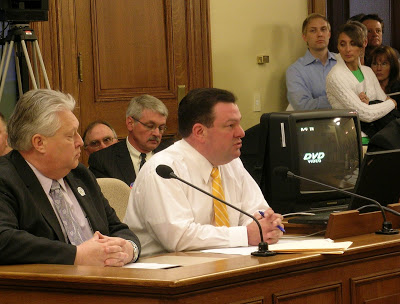
State Senator Jeff Plale (right) of Milwaukee testifies in support of identical companion bills (Senate Bill 185 and Assembly Bill 256) that he co-authored with State Rep. James Soletski (left). The bills direct the Public Service Commission to begin a process to set state-wide uniform standards for wind project permitting.
From an article by Paul Snyder in The Daily Reporter:
In addition to missing out on an estimated $3.5 million of economic opportunity for each wind turbine not built in Wisconsin, the state also is missing out on new energy without uniform standards.
“We’re looking at about 600 megawatts of stalled energy right now,” said R.J. Pirlot, director of legislative relations for Wisconsin Manufacturers & Commerce.
State Sen. Jeff Plale, D-South Milwaukee, author of the statewide wind farm siting bill and chairman of the Senate Committee on Commerce, Utilities, Energy and Rail said the inactivity is disappointing.
“That’s a lot of missed opportunity,” he said. “And it’s a sad commentary for this state when we’re out there saying we want more renewable energy.”
RENEW Wisconsin’s executive director Michael Vickerman also testified.
by jboullion | May 12, 2009 | Uncategorized
From a news release issued by WPPI Energy:
The GreenMax Home, the region’s first owner-designed and occupied net zero energy home (NZEH), has quickly generated interest for community members and renewable energy enthusiasts. Homeowners Tom and Verona Chambers are opening the doors to their NZEH and hosting public tours with WPPI Energy to showcase the energy-efficient construction and sustainable energy systems that make their Black River Falls home unique.
With grant funding from WPPI Energy’s GreenMax Home initiative, the Chambers’ designed and constructed an all-electric NZEH, which they completed in spring 2009. Through careful planning and research, the Chambers worked to refine their home’s design to control energy use, ultimately advancing the status of their home from highly efficient to net zero.
Together WPPI Energy and the Chambers will host three opportunities for interested participants to tour and learn more about the special features of their NZEH. The tours are open to the public; however, participants are encouraged to schedule a tour in advance for one of the following dates:
Saturday, May 16 from 1 to 5 p.m.
Sunday, Sept. 13 from 1 to 5 p.m. in conjunction with the Black River Falls Memorial Hospital Fundraiser
Saturday, Oct. 3 from 10 a.m. to 4 p.m. in conjunction with the Solar Tour of Homes and Public Power Week
To schedule a tour, visit www.greenmaxhome.com/projects. Open to the public, the tours will take place at the site of the Chambers’ NZEH. From the ground source heat pump to structural plumbing and the solar photovoltaic system, interested parties will learn about home energy use and renewable energy systems while getting a first-hand look at the state-of-the-art, energy-efficient construction techniques and features that make this NZEH so unique.
by jboullion | May 12, 2009 | Uncategorized
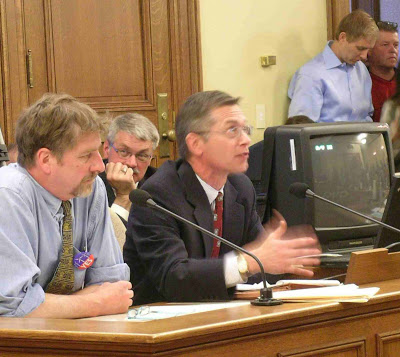
Michael Vickerman (left), RENEW Wisconsin’s executive director, listens to Curt Pawlisch, repesenting Wind for Wisconsin, during their testimony on May 12 in support of identical companion bills (Senate Bill 185 and Assembly Bill 256) to begin a process to create state-wide standards for wind siting in Wisconsin. Brian Rude of Dairyland Power looks on from the background.
From Vickerman’s testimony:
By 2010, more than one-half of the wind energy serving Wisconsin utilities will come from neighboring states.
+ Crane Creek, a 99 MW project located in Iowa that Green Bay-based WPS will own, was permitted in 2008 and will be operating by 12/31/09.
+ Twin Creeks, a 98 MW project located in Manitowoc County in WPS territory, received a permit in 2005. Due to a combination of litigation and ordinance changes, ground was never broken. Under the current ordinance, it is highly unlikely that the Twin Creeks project will be built, even though it has a permit.
If Twin Creeks is not built:
+ Local governments lose $392,000/year in future revenues.
+ Local landowners lose $294,000/year in future rents.
+ A local component manufacturer loses a 98 MW order to build towers
+ Construction jobs are outsourced to Iowa.
If we don’t initiate a process to establish uniform permitting standards, it will be difficult for utilities to comply with an increased Renewable Energy Standard at any level above current law.
by jboullion | May 12, 2009 | Uncategorized
From a news release issued by WPPI Energy:
The GreenMax Home, the region’s first owner-designed and occupied net zero energy home (NZEH), has quickly generated interest for community members and renewable energy enthusiasts. Homeowners Tom and Verona Chambers are opening the doors to their NZEH and hosting public tours with WPPI Energy to showcase the energy-efficient construction and sustainable energy systems that make their Black River Falls home unique.
With grant funding from WPPI Energy’s GreenMax Home initiative, the Chambers’ designed and constructed an all-electric NZEH, which they completed in spring 2009. Through careful planning and research, the Chambers worked to refine their home’s design to control energy use, ultimately advancing the status of their home from highly efficient to net zero.
Together WPPI Energy and the Chambers will host three opportunities for interested participants to tour and learn more about the special features of their NZEH. The tours are open to the public; however, participants are encouraged to schedule a tour in advance for one of the following dates:
Saturday, May 16 from 1 to 5 p.m.
Sunday, Sept. 13 from 1 to 5 p.m. in conjunction with the Black River Falls Memorial Hospital Fundraiser
Saturday, Oct. 3 from 10 a.m. to 4 p.m. in conjunction with the Solar Tour of Homes and Public Power Week
To schedule a tour, visit www.greenmaxhome.com/projects. Open to the public, the tours will take place at the site of the Chambers’ NZEH. From the ground source heat pump to structural plumbing and the solar photovoltaic system, interested parties will learn about home energy use and renewable energy systems while getting a first-hand look at the state-of-the-art, energy-efficient construction techniques and features that make this NZEH so unique.
by jboullion | May 12, 2009 | Uncategorized
Excerpts from the testimony of Michael Vickerman, executive director, RENEW Wisconsin in support of identical companion bills (Senate Bill 185 and Assembly Bill 256) which direct the Wisconsin Public Service Commission to begin a process to set state-wide permitting standards:
By 2010, more than one-half of the wind energy serving Wisconsin utilities will come from neighboring states.
Crane Creek, a 99 MW project located in Iowa that Green Bay-based WPS will own, was permitted in 2008 and will be operating by 12/31/09.
Twin Creeks, a 98 MW project located in Manitowoc County in WPS territory, received a permit in 2005. Due to a combination of litigation and ordinance changes, ground was never broken. Under the current ordinance, it is highly unlikely that the Twin Creeks project will be built, even though it has a permit.
If Twin Creeks is not built:
+ Local governments lose $392,000/year in future revenues.
+ Local landowners lose $294,000/year in future rents.
+ A local component manufacturer loses a 98 MW order to build towers
+ Construction jobs are outsourced to Iowa.
If we don’t initiate a process to establish uniform permitting standards, it will be difficult for utilities to comply with an increased Renewable Energy Standard at any level above current law.
by jboullion | May 12, 2009 | Uncategorized
4th STREET FORUM
at MILWAUKEE TURNER HALL
Stimulus money is flowing. It could nurture green jobs, energy, and transit.
But will bureaucratic inertia and a powerful status quo stifle Wisconsin’s green future?
FORUM DATE AND TIME: MAY 14, NOON
WHERE: Milwaukee Turner Hall, 2nd Floor, 1034 N. 4th Street (Main entrance across from the Bradley Center on 4th; elevator access off the parking lot on 4th and Highland.)
MODERATOR: ENRIQUE FIGUEROA, PhD, Director, Roberto Hernández Center, UW-Milwaukee, www.uwm.edu
WITH GUESTS
ANN BEIER is the director of Milwaukee’s Office of Environmental Sustainability. She coordinates the City’s efforts to improve water quality, reduce energy consumption, and to create more green technology jobs throughout Milwaukee. Prior to accepting her position here, Ms. Beier worked on environmental issues in government both in Oregon and in Washington DC. www.ci.mil.wi.us/greenteam
CURT HARRIS is the executive director of the African American Chamber of Commerce, which works to increase minority business involvement in Milwaukee and the region. A more recent focus is to encourage minority entrepreneurship in the green sector. Mr. Harris is also a business consultant. www.aaccmke.org
MELISSA SCANLAN is the founder and senior legal counsel for Midwest Environmental Advocates, which provides legal services to implement innovative solutions for environmental problems. Ms. Scanlan is the author of, “Blueprint to Wisconsin’s Green Economy.” www.midwestadvocates.org
NEAL VERFUERTH is president and CEO of Orion Energy Systems that employs over 250 people in Manitowoc and Plymouth. Recently, President Obama recognized Orion in a White House speech, applauding the company for creating green collar jobs in the clean energy sector. www.oriones.com
CAN’T ATTEND?
Milwaukee Public Television will broadcast this forum on Friday, May 15, Channel 10.1and 10, 10PM and Sunday, May 17, Channel 36.1 and 36, 3PM.
Programs also run on Time Warner’s, “Wisconsin on Demand,” (WIOD), Channel 1111. Check listing.
All programs will be available for checkout from your local public library.
Podcasts of the programs will be posted after broadcast at www.4thStreetForum.org.
by jboullion | May 11, 2009 | Uncategorized
From a news release issued by WPS Community Foundation:
Green Bay, WI – Twenty-seven high school teams are set to take part in the 13th Annual Solar Olympics on Wednesday, May 13, on the campus of UW-Stevens Point. The event is free and open to the public.
The event, sponsored by WPS Community Foundation and UWSP, begins at 9 a.m. and continues until 2:30 p.m. in and around the Dreyfus University Center and Learning Resource Center. For the seventh consecutive year, a record number of schools will participate. Twelve different activities, which range from building solar devices to creating art with a solar theme, test students’ knowledge of solar energy in events ranging from solar cookers and model cars to sculptures and building design. Schools attending this year include:
Participating Schools:
Antigo High School
Ashwaubenon High School
Bay Port High School
Beecher Dunbar Pembine High School
Chilton High School
Crivitz High School
D.C. Everest High School
De Pere High School
Denmark High School
Gibraltar High School
Green Bay Southwest
Green Bay West High School
Lourdes High School, Oshkosh
Marathon High School Marinette High School
Merrill High School
Oconto High School
Oshkosh West High School
Pacelli High School
Pulaski High School
Tomahawk High School
Valders High School
Wausau High School
Wausaukee High School
West De Pere High School
Wrightstown High School
Lena High School (Observing)
“The schools’ energy and creativity really shine at Solar Olympics,” said Chip Bircher, Renewable Energy Product Manager for WPS. “These high school students are really enthused about making a difference with renewable energy. Many of our customers are investigating “green” options to benefit the environment, and Solar Olympics is a great event for everyone to learn more.”
by jboullion | May 11, 2009 | Uncategorized
The spring edition of RENEW’s newsletter includes the following articles:
Legislature to Tackle Wind Permitting
The Importance of Doing the Math
Stimulus Package 101
Policy Drives Solar Hot Water Market
PSC Investigates Renewable Tariffs
Open Letter from RENEW President
Calendar
by jboullion | May 11, 2009 | Uncategorized
Editor’s note: Legislative committees will hold a hearing on the bill (Senate Bill 185 and an identical companion Assembly Bill 265) on May 12 in the State Capitol.
From an article by Brad Bryan in The Country Today:
Bipartisan legislation introduced in the state Senate last week seeks to make it easier for developers to build wind turbines in Wisconsin.
Authored by State Sen. Jeff Plale, D-South Milwaukee, Rep. Jim Solestki, D-Green Bay, and Rep. Phil Montgomery, R-Ashwaubenon, the bill would keep local municipalities from putting in place restrictive, anti-wind ordinances.
Tremplealeau County and the towns of Magnolia and Union in Rock County recently adopted ordinances that make it difficult, if not impossible, to construct wind turbines.
In 2007, Trempealeau County adopted an ordinance with a 1-mile setback limit from any occupied dwelling, which some have called the strictest anti wind power regulations in the country.
“There literally isn’t one square inch in Trempealeau County where you can lawfully place a turbine,” said Ryan Schryver, an advocate with Clean Wisconsin. “It’s no accident that every municipality uses different setbacks. There are no standards.”
Senate Bill 185 would establish statewide setback and other standards and would require a Public Service Commion-led stakeholder committee to oversee the process.
“I think everyone will get a seat at the table,” Schryver said. Among those at the table would be non-compensated landowners, PSC representatives, developers and other state agencies.
The bill would not, however, automatically roll back the strict standards already in place in some towns and counties.
“It’s not going to trump any existing ordinances without taking them into consideration,” Schryver said.
Ron Winn of Ettrick hopes the bill would roll back existing ordinances.
Winn is suing Trempealeau County for the right to build a turbine on his property.
Winn, who is suing on his own behalf, is a partner in the development company AgWind Energy Partners, which had erected test towers near Ettrick before a wave of backlash killed the project.
Because of the pushback it received in Trempealeau County – and the resulting expense – the company has set its sights on other wind projects, including one near Alma in Buffalo County.