by jboullion | May 11, 2009 | Uncategorized
Editor’s note: Legislative committees will hold a hearing on the bill (Senate Bill 185 and an identical companion Assembly Bill 265) on May 12 in the State Capitol.
From an article by Brad Bryan in The Country Today:
Bipartisan legislation introduced in the state Senate last week seeks to make it easier for developers to build wind turbines in Wisconsin.
Authored by State Sen. Jeff Plale, D-South Milwaukee, Rep. Jim Solestki, D-Green Bay, and Rep. Phil Montgomery, R-Ashwaubenon, the bill would keep local municipalities from putting in place restrictive, anti-wind ordinances.
Tremplealeau County and the towns of Magnolia and Union in Rock County recently adopted ordinances that make it difficult, if not impossible, to construct wind turbines.
In 2007, Trempealeau County adopted an ordinance with a 1-mile setback limit from any occupied dwelling, which some have called the strictest anti wind power regulations in the country.
“There literally isn’t one square inch in Trempealeau County where you can lawfully place a turbine,” said Ryan Schryver, an advocate with Clean Wisconsin. “It’s no accident that every municipality uses different setbacks. There are no standards.”
Senate Bill 185 would establish statewide setback and other standards and would require a Public Service Commion-led stakeholder committee to oversee the process.
“I think everyone will get a seat at the table,” Schryver said. Among those at the table would be non-compensated landowners, PSC representatives, developers and other state agencies.
The bill would not, however, automatically roll back the strict standards already in place in some towns and counties.
“It’s not going to trump any existing ordinances without taking them into consideration,” Schryver said.
Ron Winn of Ettrick hopes the bill would roll back existing ordinances.
Winn is suing Trempealeau County for the right to build a turbine on his property.
Winn, who is suing on his own behalf, is a partner in the development company AgWind Energy Partners, which had erected test towers near Ettrick before a wave of backlash killed the project.
Because of the pushback it received in Trempealeau County – and the resulting expense – the company has set its sights on other wind projects, including one near Alma in Buffalo County.
by jboullion | May 8, 2009 | Uncategorized
From an article article by Tom Content in the Milwaukee Journal Sentinel:
Chicago – Anyone looking for signs that sectors of the economy have found some shelter from the recession needed only to walk the halls of the McCormick Place convention center Thursday.
With more than 1,200 exhibitors, the world’s largest trade show for the wind power industry saw record attendance in its bid to prove that energy from wind has escaped the label “alternative.”
“When you look at this show, you wouldn’t know there’s a slowdown in the economy,” Kim Zuhlke, an executive at Alliant Energy Corp., said while standing between massive booths at the conference Thursday.
Organizers of Windpower 2009, sponsored by the American Wind Energy Association, weren’t sure how their conference would do, but the show ended up attracting more than 20,000 people. That’s 60% more than attended last year in Houston, the association said.
The recession has hit the wind power industry just like every other sector of the economy, as projects stalled for lack of financing. In an industry forecast earlier this year, the association said the wind industry is likely to slow this year after setting records for new projects last year.
“Everyone’s been in a holding pattern. It’s not just wind energy – the entire country had taken a pause,” said Ellen Shafer of Broadwind Energy, based near Chicago.
But the mood at the convention this week has been one of optimism, said Shafer, whose company has two Wisconsin subsidiaries – TowerTech, a Manitowoc maker of wind towers, and Badger Transport of Clintonville, a trucking company specializing in hauling the oversized components that are the of a wind farm development.
by jboullion | May 8, 2009 | Uncategorized
From an article article by Tom Content in the Milwaukee Journal Sentinel:
Chicago – Anyone looking for signs that sectors of the economy have found some shelter from the recession needed only to walk the halls of the McCormick Place convention center Thursday.
With more than 1,200 exhibitors, the world’s largest trade show for the wind power industry saw record attendance in its bid to prove that energy from wind has escaped the label “alternative.”
“When you look at this show, you wouldn’t know there’s a slowdown in the economy,” Kim Zuhlke, an executive at Alliant Energy Corp., said while standing between massive booths at the conference Thursday.
Organizers of Windpower 2009, sponsored by the American Wind Energy Association, weren’t sure how their conference would do, but the show ended up attracting more than 20,000 people. That’s 60% more than attended last year in Houston, the association said.
The recession has hit the wind power industry just like every other sector of the economy, as projects stalled for lack of financing. In an industry forecast earlier this year, the association said the wind industry is likely to slow this year after setting records for new projects last year.
“Everyone’s been in a holding pattern. It’s not just wind energy – the entire country had taken a pause,” said Ellen Shafer of Broadwind Energy, based near Chicago.
But the mood at the convention this week has been one of optimism, said Shafer, whose company has two Wisconsin subsidiaries – TowerTech, a Manitowoc maker of wind towers, and Badger Transport of Clintonville, a trucking company specializing in hauling the oversized components that are the ingredients of a wind farm development.
by jboullion | May 8, 2009 | Uncategorized
From an article by Liz Welter in The Stevens Point Journal:
MARSHFIELD — A ranch-style home under construction in Marshfield’s Prairie Run subdivision will be central Wisconsin’s first verified “green-built” home.
“That means it meets the national standards for green building and it will be certified” during different steps in the construction process, said Jeff Redetzke, owner of JR Builders of Marshfield, which is constructing the house.
“A green-built home is a good value for a home buyer,” Redetzke said. Using geothermal energy cuts a natural gas bill by 50 percent to 70 percent, he said.
There are a multitude of components considered and used in building a home that maximizes energy efficiency while diminishing its carbon impact on the Earth, Redetzke said.
“We try to use materials that will last for 50 years and are recyclable afterwards. Like a metal roof is very green. It lasts for the life of the house and later can be recycled,” he said.
Geothermal energy and other energy efficiency building standards are practices embraced by the developers and owners of Prairie Run, said Dan Helwig, one of the development’s owners.
“We’re just totally excited. This is the kind of home that hasn’t been seen in this marketplace,” Helwig said.
Prairie Run was conceived to utilize green or sustainable concepts in developing the site and in building a variety of homes and businesses, Helwig said.
“I’ve wanted to do something like this, and Prairie Run is the right place,” Redetzke said.
by jboullion | May 8, 2009 | Uncategorized
FIRST RELEASED May 8, 2009
REVISED May 12, 2009
MORE INFORMATION
Ed Blume
608.819.0748
eblume@renewwisconsin.org
State snares federal dollars for renewable energy work
In the most recent round of federal renewable energy grants, Wisconsin led all states in capturing project dollars to address market and development challenges associated with wind energy.
The U.S. Department of Energy (DOE) announced that a Wisconsin non-profit organization and three post-secondary schools captured more than $1 million for projects to promote market acceptance and workforce development, two challenges identified in a 2008 DOE report.
The University of Wisconsin-Madison will receive nearly $600,000, while the University of Wisconsin-Milwaukee will receive just over $300,000 and Lakeshore Technical College (Cleveland, WI) a little less than $200,000.
“Our success in receiving these awards is a reflection of the State of Wisconsin’s strong commitment to expanding the wind energy marketplace here,” said Michael Vickerman, executive director of RENEW Wisconsin, a statewide renewable energy advocacy organization.
RENEW Wisconsin proposed in its grant application to develop a one-stop online source of information for wind developers, state and local policymakers and regulators, and the general public.
The web site will include documents and links to relevant state and federal statutes and rules, facts sheets on everything from aesthetics to court decisions, zoning, and other resources, as well as a calendar of upcoming workshops, seminars, training, briefings, grant opportunities, RFPs, and other relevant events and opportunities.
The other grants will promote workforce development. The UW-Madison will provide short courses in wind power plant design, construction and operations and develop curriculum to integrate wind energy systems curriculum into power engineering education programs; the UW-Milwaukee intends to create a wind energy educational collaborative in southeastern Wisconsin; and Lakeshore Technical College will develop additional partnerships to boosts its ongoing wind technician training programs.
DOE Awards in Market Acceptance:
• RENEW Wisconsin (Madison, WI) – Sowing the Seeds for a Bountiful Harvest: Shaping the Rules and Creating the Tools for Wisconsin’s Next Generation of Wind Farms – $93,348
DOE Awards in Workforce Development
• The Board of Regents of the UW System (Madison, WI) – A Continuing Education Short Course and Engineering Curriculum to Accelerate Workforce Development in Wind Power Plant Design, Construction, and Operations – $119,135
• Lakeshore Technical College (Cleveland, WI) – POWER – Purposeful Partnerships Coordinating Wind Education Resources – $199,236
• University of Wisconsin (Madison, WI) – Integration of Wind Energy Systems into Power Engineering Education Programs at UW-Madison – $399,931
• University Wisconsin-Milwaukee (Milwaukee, WI) – Southeast Wisconsin Wind Energy Educational Collaborative – $330,184
Full list of awards and DOE news release at http://www.energy.gov/news2009/print2009/7381.htm.
–END–
RENEW Wisconsin is an independent, nonprofit 501(c)(3) organization that acts as a catalyst to advance a sustainable energy future through public policy and private sector initiatives. More information on RENEW’s Web site at www.renewwisconsin.org.
by jboullion | May 8, 2009 | Uncategorized
From a news release issued by Focus on Energy:
MILWAUKEE (May 5, 2009) — On April 4, 2009, Prairie Apartments, an innovative eco-friendly new construction building, opened its doors to low-income Milwaukee residents experiencing obstacles such as homelessness and mental illness. With the help of Focus on Energy, developers Heartland Housing of Chicago and Guest House of Milwaukee were able to integrate energy efficiency measures into the 24-unit complex.
“Not only does the apartment provide high-quality affordable housing for Milwaukee residents in need, it incorporates important energy efficient features,” said Carter Dedolph, Focus on Energy Program Manager. “Prairie Apartments is a shining example of our goal to help buildings throughout the state reduce their energy use, operating costs and environmental impact.”
Energy Efficient Features
To save energy and money, Focus on Energy worked with the developers to make extensive use of ENERGY STAR® qualified compact fluorescent fixtures and lighting occupancy sensors in most of the common areas. In addition, ENERGY STAR qualified appliances, programmable thermostats and windows were also used throughout.
Moreover, the building’s well-sealed envelope reduces air leakage, and works hand in hand with high efficiency cooling and heating equipment. In fact, the facility’s standards of design are so high it was built to achieve the prestigious Leadership in Energy and Environmental Design (LEED) for Homes certification. Overall, the improvements should save the building more than 4,000 therms of natural gas and about 72,500 kilowatt hours of electricity annually; not to mention $13,000 a year on energy costs.
by jboullion | May 6, 2009 | Uncategorized
Wisconsin State Journal, May 16, 2009
An eight-hour public hearing last week at the Capitol highlighted a threat to the statewide interest in developing wind power.
The hearing also demonstrated why lawmakers should quell that threat by replacing a hodgepodge of local rules for smaller wind farms with uniform state standards.
At stake is not only a clean, renewable source of energy, but also the state’s economic vitality.
Wisconsin is counting on wind power to propel the state 90 percent of the way toward meeting a goal of more than doubling the renewable energy contribution to electric needs over the next six years. Developing wind power, and other forms of renewable energy, can help resolve global warming worries, improve energy security and generate jobs.
But a barrier looms: When developers of smaller wind farms apply to local governments to build turbines on specific sites, they too often find that local officials are cowed into imposing impossible-to-meet requirements, or even moratoriums, after opponents raise alarming concerns, commonly based in misinformation.
As a result, a few people gain veto power over the state’s energy policy.
Granted, not every location is suitable for wind farms. Local concerns about public safety and health should be respected, when based on sound science. But local officials confronted by alarmed constituents are not in a good position to evaluate competing arguments.
Meanwhile, larger wind farms face no such array of local Mixmasters. They go to one agency — the state Public Service Commission. Wind farm plans face a rigorous PSC review process. But at least developers know what they are dealing with from the outset. It’s a far better system, both for encouraging wind farm development and protecting public safety and health.
Wisconsin’s hostile regulatory environment for smaller wind farms is taking a toll. The state lags far behind neighboring Iowa, Minnesota and Illinois in wind power. Part of the reason is that Wisconsin has less potential for wind power than those states. But testimony at last week’s hearing indicated that regulatory hostility is also a factor, driving some wind farms away from Wisconsin to its neighbors.
That conclusion is supported by the fact that Michigan, with a relatively small potential for wind power, has a far higher wind farm growth rate than Wisconsin.
The solution lies in the proposed legislation that was the subject of last week’s hearing. The plan calls for lawmakers to grant the PSC authority to establish, with public input, a model set of wind farm standards to guide local governments.
Local governments would be forbidden from exceeding the standards.
Any party would have a right to appeal a local decision to the PSC and then to court.
Wisconsin can protect the health and safety of residents and encourage wind farm development. The proposed wind farm siting reform is the answer.
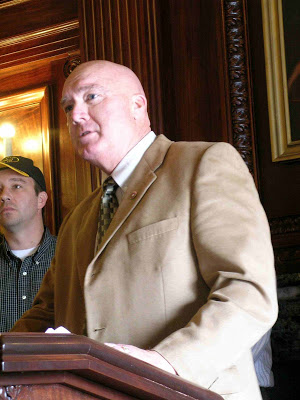
by jboullion | May 4, 2009 | Uncategorized
Terry McGowan of the International Union of Operating Engineers Local 139 speaks at the press conference for the introduction of a bill to set uniform siting standards for wind projects in Wisconsin.
From a news release issued by Sen. Jeff Plale, Rep. Jim Soletski, Sen. Randy Hopper, and Rep. Phil Montgomery:
MADISON – A bipartisan coalition of Wisconsin legislators announced that they are introducing legislation that calls for the creation of uniform siting standards for wind energy projects. Senate Bill 185 (SB 185), and its Assembly companion, directs the Public Service Commission (PSC), after public input, including a stakeholder committee, to establish by rule, permitting standards to be applied by local or state government to wind energy installations, regardless of size and location.
“Too many wind projects are victims of delay tactics and other obstructions,” Senator Jeff Plale, Chair of the Senate Committee on Commerce, Utilities, Energy, and Rail said. “SB 185 will enhance Wisconsin’s economy by protecting and creating “green-collar” jobs; it will attract new investment to our state and support state energy policy. I look forward to working with my colleagues to ensure that we can make Wisconsin more attractive to wind energy and achieve the resulting economic and environmental benefits.”
“A sensible wind energy policy will help Wisconsin harness the jobs and growth opportunities that green power provides,” stated Representative Jim Soletski, Chair of the Assembly Energy and Utilities Committee. “I am excited to be working with a bipartisan group of legislators from diverse regions of the state to remove the obstacles to more development of wind power in Wisconsin. By advancing this legislation, Wisconsin utilities can move toward meeting their obligation to generate clean energy and much needed jobs can be created for our workers.”
“We can’t build a 21st century energy infrastructure by digging in our heels,” Senator Randy Hopper said. “This legislation will ensure that interested parties from all over our state can take part in developing the Public Service Commission’s guidelines.”
“Wind power is job-creating power,” according to Representative Phil Montgomery. “A fair and uniform state standard for siting wind developments will create an environment of investment in our state while moving us closer to our green energy goals.”
In addition to RENEW, the following organizations issued statements of support for Senate Bill 185: CREWE, Clean Wisconsin, Citizens Utility Board, Customers First!, Renewegy, Wind Capital Group, WPPI/Municipal Electric Utilities.
by jboullion | May 4, 2009 | Uncategorized
Focus on Energy provides links to renewable energy training courses — professional development, technical colleges, and universities.
by jboullion | May 4, 2009 | Uncategorized
Focus on Energy provides links to renewable energy training courses — professional development, technical colleges, and universities.