by jboullion | Apr 8, 2009 | Uncategorized
From a post by Don Albinger, VP of Renewable Energy, on the blog of Johnson Controls:
I was very pleased to be one of the speakers at the recent Wisconsin Renewable Energy Summit in Milwaukee. The session topic was the Role of Local Governments in Moving Towards Energy Independence with Renewable Energy – and I was honored to appear with a distinguished group of people who are doing just that:
Larry Nelson, Mayor of Waukesha, Wisconsin. Larry talked about the work he and his colleagues are doing to demonstrate that cities can be fiscally and environmentally responsible at the same time. . . .
Jeanne Hoffman, Facilities and Sustainability Manager for the City of Madison, Wisconsin. Jeanne talked about MadiSUN – the city’s solar energy program aimed at doubling installations of solar electric and solar hot water systems by 2001. . . .
Dave Merritt, Dane County, Wisconsin. Dave correctly pointed out that “the key to energy independence and climate change is local.” And he provided an excellent example of how Dane County is doing more than giving that lip service: Cow Power is the County’s program to build two digester systems to turn cow manure from a number of dairy farms in the County into electricity. . . .
And Ann Beier, director of the City of Milwaukee Office of Environmental Sustainability. Ann painted a clear picture of the critical role Milwaukee city government is playing in energy independence by setting the right example, testing new technologies, and developing innovative programs and policies. Ann talked about the progress the city is making in meeting its goal to reduce energy use by 15% by 2012 by installing solar electric and geothermal systems in municipal buildings, and converting city stoplights to high-efficiency LED fixtures – a step the city is also studying for municipal parking garages. . . .
In my mind, the stories told by each one of these speakers demonstrate how we already have the means, the funding mechanisms, the technologies and the expertise to put energy efficiency and renewable energy to work in city halls and county courthouses across America to save money, create jobs and protect the environment.
Waukesha, Madison, Dane County and Milwaukee – they’re all leading the way. A lot more like them need to find the will to join in.
What do you think?
by jboullion | Apr 8, 2009 | Uncategorized
From a letter to the editor by Chamomile Nusz, Amherst, and Bill Christofferson of The Capital Times:
Dear Editor: As co-chairs of the Wisconsin Network for Peace and Justice, a statewide network of 165 organizations working for social justice and a sustainable world, we ask Gov. Jim Doyle and members of the Legislature to continue Wisconsin’s long-standing and reasonable limitations on the construction of nuclear plants.
Although Doyle’s Task Force on Global Warming recommended changes to the nuclear power plant law, we believe that the current law provides vital protections to Wisconsin’s consumers, environment, and future generations — protections the proposed change would remove.
Current law requires that before the Public Service Commission can authorize the construction of a nuclear plant, “a federally licensed facility … with adequate capacity to dispose of high-level nuclear waste from all nuclear power plants operating in this state will be available, as necessary, for disposal of the waste.”
For more than 50 years, the nuclear industry and the federal government have failed to solve this critical problem.
Christofferson and Nusz co-chair the Wisconsin Network for Peace and Justice.
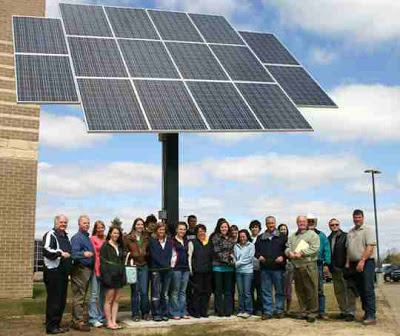
by jboullion | Apr 8, 2009 | Uncategorized
Prairie Solar Power & Light, headed by Rich Bannen (in the cowboy hat, third from right), installed the solar system for Reedsburg Utility.
From a news release issued by Reedsburg Utility:
Electric customers in Reedsburg are benefitting from a new application of solar power in the city. The community-owned utility recently installed an array of solar photovoltaic (PV) panels at the Reedsburg Area High School.
Reedsburg Utility installed a dual axis tracker with a peak output of 3.584, providing approximately 6,000 kilowatt-hours of emissions-free electricity each year.
“It is our objective to be a model for the use of renewable energy,” said Jim Schieble, Energy Services Representative. “By supporting community-wide renewable projects, Reedsburg Utility is illustrating the practical use of renewable energy and enticing customers to do the same.”
Solar PV systems collect energy from sunlight and convert it into electricity, providing renewable, emissions-free energy. These highly visible projects demonstrate the technology, while educating the community on their benefits, operation and performance. The solar unit will provide education and student involvement for many years to come at RAHS, said Dave Mikonowicz, General Manager of Reedsburg Utility.
Reedsburg Utility pursued various grant opportunities, including funding from its power supplier WPPI Energy, to help fund the purchase and installation of the solar PV systems. The project is contracted through Prairie Solar Power & Light of Priarie Du Chien and became operational on March 30, 2009.
by jboullion | Apr 8, 2009 | Uncategorized
From an article by Megan VerHelst in the Jackson County Chronicle:
The city of Black River Falls is testing a new kind of street light bulb that could ultimately save taxpayers money and provide a more efficient way keep the streets lit.
Four LED, or light-emitting diode, street lights were recently installed on N. Eighth Street for a trial run. City Utility Manager Jerry Ewert said the city decided to try out the alternative lights after WPPI Energy made the technology available to Wisconsin cities at a discounted price.
“We’re experimenting with them,” Ewert said. “Other communities are experimenting with them as well.”
The utility, in conjunction with the city of Black River Falls, decided to try out the LED lights because they are supposed to decrease both energy and maintenance costs, compared to the high-pressure sodium bulbs the city uses now.
The city currently sets a $70,000 budget for street lighting, said City Clerk Bill Arndt. Homeowners in Black River Falls pay, on average, $35 per year for street light costs.
“The street light budget was getting so high, so we are looking at something we can do,” Arndt said.
The city purchased the four LED lights — two with a strength of 30 LED and two with 40 — and installed them in the 500th block of North Eighth Street. Each light cost $600 and gives out a whiter, clearer light than the high-pressure sodium bulbs throughout the rest of the city.
Ewert said the main disadvantage to the LED lights are the initial cost. The four installed now were offered to the city at a discounted price, and Ewert said a standard LED replacement unit could cost up to $800 — 10 to 15 times the cost of a high-pressure sodium bulb.
But if the city were to replace all 439 street lights with the LED technology, it would be worth it in the long run, Ewert said.
“The expected life of one (LED light) is 30 to 40 years,” Ewert said. “The high-pressure sodium bulbs are significantly lower than that. Three to four years is about average.”
by jboullion | Apr 7, 2009 | Uncategorized
From a post by Jeramey Jannene on Urban Milwaukee:
We’ve unveiled a Google Maps implmentation of Mayor’s Tom Barrett’s proposed streetcar system for downtown Milwaukee. Take a look yourself, we think it’s a little more exciting than a PDF.
The route is likely to change as the planning process continues, and we’ll track those changes on our map.
by jboullion | Apr 7, 2009 | Uncategorized
From a story on WSAW-TV:
A new state report says Wisconsin utilities should meet the state’s basic energy needs over the next five years without building more new plants.
The Public Service Commission issued its latest biennial Strategic Energy Assessment Monday. The report found the state should not need any new baseload generation — energy needed for a reliable supply barring electricity-sapping events such as heat waves — through 2014 if all currently authorized projects are constructed.
The report directs PSC staff to evaluate how utilities can cheaply prepare for greenhouse gas limits, saying state, regional and federal constraints look inevitable.
From a news release issued by the Public Service Commission on the final Strategic Energy Assessment – Energy 2014:
Biennially the PSC prepares a strategic energy assessment to evaluate the state’s current and future energy demands. The final report, based on data and information collected in 2007 and 2008 from Wisconsin utilities and power cooperatives highlights several conclusions:
· Mandatory constraints on greenhouse gas emissions at the state, regional and federal level appear to be inevitable, and will carry significant implications for Wisconsin’s electric utilities, as electric power generation is responsible for more than 30 percent of Wisconsin’s greenhouse gas emissions;
· Significant approved new generation coming online is expected to keep planning reserve margins near or above 19 percent through 2012 and based on already approved construction, the planning reserve margin for 2014 is expected to be nearly 12 percent. This number is expected to increase as more energy efficiency is implemented and new generation is proposed;
· Generation planning shows no new baseload generation is needed during this SEA period on a statewide basis;
· It is expected that the current and ongoing transmission system expansion and improvements will greatly enhance the ability to move electricity into and within Wisconsin by 2010; and
· Energy efficiency, conservation, and load control will play an important role in reducing Wisconsin’s energy costs and environmental impacts.
by jboullion | Apr 7, 2009 | Uncategorized
The 2nd Sawyer County Earth Day Event of 2008 was listed as one of the top news stories in the Sawyer County Record’s Year in Review.
We didn’t need to read that the Celebration of Earth Day-local solutions to global problems- drew more than two hundred local people to the Sawyer County Fairgrounds We were there again bringing together organizations, businesses, schools, & people from our area exhibiting and speaking about renewable energy, composting, fuel efficiency, gardening, natural & locally produced foods, water quality, and many other displays
Sustainability is defined as “development that meets the needs of the present without compromising the ability of future generations to meet their own needs.”
The first & second Earth Day Events facilitated by the Sawyer County Democratic Party and Good Friends highlighted and informed the visitors as to what is available in our area to assist them in not only becoming more sustainable in their individual lives, but how our communities can work together to be sustainable.
Because we know you are a community leader and pioneer in the sustainability movement and have been working hard in assisting our county’s residents in understanding and incorporating green and healthy practices in their lives, we would like to invite you to participate in the 3rd Earth Day Event- Local Solutions to Global Issues, April 25, 10-4 pm at the Sawyer County Fairgrounds near Hayward.
There is no charge to you for table or space for displays. You will be responsible for whatever taxes or fees for any products that might be sold by you. You are encouraged to fill out the attached document and return it at your earliest convenience. This will help us to assist you with your needs and assure a space for you. Set up time will begin at 9am on the 25th.
This year instead of a separate area for speakers and presentations, we will provide a “roving mic” which will be available throughout the day in the exhibition hall for you to do a short presentation about your display to visitors and other participants if you wish.
Protecting the earth and living lives individually and as communities that ensure that our grandchildren & their grand children will enjoy the good sustainable life has never been a politically partisan goal. It is all of our goal. We all are responsible for leaving the earth in better shape than we inherited. We all need to work together, no matter our beliefs or political leanings.
Thank you for what you are already doing and providing to the people of Sawyer County and our region. And thank you for your consideration in being a participant in the 3rd Sawyer County Earth Day Event this year.
For more information, questions, comments, you can call Waldo at 715-354-7450 or email sawyerdemocrats@yahoo.com. You can also contact damzel02@gmail.com
by jboullion | Apr 7, 2009 | Uncategorized
From a commentary by Mark Hirsch on Smelsertownship.com:
With an eroding tax base and an expected reduction in the state’s shared revenue (county and municipal aid payments) local municipalities and townships will need to adjust their spending or find other sources of revenue to support their operating budgets in 2010 and 2011.
In this dire economic downturn, the good luck fairy has offered to sprinkle the dust of fortune on Grant County in the form of a commercial project that fits very well in an agricultural economy. On top of the nice fit, we have the opportunity to augment our budget shortfall with some newfound and state-mandated revenue.
That newfound revenue would come in the form of the $80,000 a year Smelser Township would receive in lieu of taxes through state requirements enacted in 2003 Act 31. This act guarantees income in lieu of taxes to the host municipalities. In simplest terms, the additional $80,000 would be equal to 23% of the township’s 2008 operating revenue of $350,000.
For Smelser Township though, it seems some local citizens would rather pay higher taxes than embrace the financial windfall the township would receive from the proposed White Oak Wind Project.
by jboullion | Apr 6, 2009 | Uncategorized
From an article on North American Windpower:
Seventy-nine percent of Americans do not believe a large wind farm project is detrimental to their health and welfare, according to the 2009 Saint Index survey of attitudes toward real estate development projects.
Slightly more than one in 10 adults, 11%, say a large wind project could diminish health and welfare.
The fourth annual Saint Index survey involved interviews with 1,000 adults nationwide. The study is conducted by The Saint Consulting Group, which tracks the politics of land use in the U.S, Canada and U.K.
Eighty-two percent of Americans support a wind farm project in their hometown – an increase from 76% a year ago. Opposition to a local wind project dropped to 15%, which is down 5 percentage points from last year, according to the survey.
Forty-three percent of Americans say they support a local power project, an increase from the 38% who expressed support a year ago, and just 23% in 2006.
However, America’s not-in-my-back-yard attitude toward local development remains strong. Nearly three out of four Americans, 74%, stated that they do not want new development in their communities, saying their hometown is fine the way it is or is already over-developed.
by jboullion | Apr 6, 2009 | Uncategorized
We Energies Renewable Energy Research and Development (R&D) Grant Program
We Energies has established the Renewable Energy Research and Development (R&D) Grant Program to offer financial assistance in the form of a grant (up to a maximum award of $200,000) to conduct research on renewable energy technologies that results in the generation of electric energy, or to help demonstrate a renewable energy product associated with the production of renewable electricity. Eligible applicants include We Energies electric business and non-profit customers. Organizations other than We Energies customers may apply if partnered with a customer. A proposed research project must be located within We Energies electric service territory, or if not located within the service territory it must clearly provide local benefits to the electric service territory. Grants are intended for research and development endeavors that will clearly advance a technology or product, and will clearly contribute positively to the renewable energy industry. Applications received on an ongoing basis through 2009.
We Energies Renewable Energy Scholarship Program
The 2009 Renewable Energy Scholarship Program provides grants to We Energies electric customers or individuals employed by a We Energies customer to attend a renewable energy conference. Eligible participants of this Scholarship Program include:
+ Private industry representatives whose companies are located within We Energies’ electric service territory, whose companies are engaged in the training, development or manufacturing of a renewable energy product or technology. Also considered are representatives of companies that are actively pursuing on-site installation of a renewable energy generating facility. Applicants must be full-time employees in good standing and directly engaged in renewable energy related activities.
+ Full-time staff members of non-profit organizations engaged in activities directly related to the renewable energy industry, such as policy development, where such activities have a direct impact within We Energies’ electric service territory.
+ More information.
+ Also, separate scholarship program for K-12, Post-Secondary and Community Educators.