by jboullion | Apr 14, 2009 | Uncategorized
From a post on Tom Content’s blog on JSOnline:
A bill to create uniform siting standards for wind power projects across Wisconsin is being introduced again after stalling a year ago.
Sen. Jeff Plale (D-South Milwaukee), chair of the Senate Energy and Utilities Committee, is circulating a bill that would call on the state Public Service Commission to develop uniform siting standards for wind power projects across the state.
Wisconsin state law requires large wind power proposals to be reviewed and approved by the state Public Service Commission, but leaves smaller projects in the hands of local governments.
Several counties and communities around the state have enacted ordinances that amount to bans on wind power, however. His bill would call on the state Public Service Commission to engage with counties, towns, utilities and others on developing a comprehensive set of standards that wind projects would have to follow.
“We made it a priority in this state to harness wind, and if we’re going to do that we can’t have one township or one village dictating energy policy for the rest of the state,” Plale said. “We have to have a comprehensive look at it. That’s what we’re getting at.”
Plale said the bill is expected to fare better this year because it is being handled earlier in the legislative session and there is less confusion about what the bill would do.
by jboullion | Apr 14, 2009 | Uncategorized
From an article by Joe Knight in the Eau Claire Leader-Telegram:
A national expert on sustainability who has met with Eau Claire city officials, UW-Eau Claire staff and Luther Midelfort staff says Eau Claire is taking the first steps toward being more efficient and environmentally friendly.
“I think there’s a real interest and excitement in Eau Claire … the hospital has been doing some great things, and the city and university,” Gips said.
Gips, president of Minnesota-based Sustainability Associates, will speak Monday at UW-Eau Claire to kick off a series of events the university and community groups are planning to commemorate Earth Day (April 22), which they have expanded to Earth Month.
“I’m going to share about this very exciting movement going on around the country, actually around the world, but especially in Wisconsin,” he said.
Wisconsin has more cities designated as “eco-municipalities”, which have agreed to use sustainable principals, he said. Washburn and Ashland were the first two. Madison, La Crosse, Menomonie, Dunn County and the city of Eau Claire are among more than 20 communities in the state that are either “eco-municipalities” already or are taking steps in that direction.
Gips advocates what he calls the “natural-step framework” for making companies, cities – even churches – more efficient and sustainable. The framework was developed in Sweden. IKEA was the first business to use it, but now many U.S. companies have adopted it, he said. The U.S. Army and Navy are also using the “natural-step framework.”
Over the past year, various Eau Claire city departments have been assessing sustainability, said city manager Mike Huggins.
“Specifically, they’re looking at energy, reducing waste streams and looking at the concept of sustainability through the ‘natural step’ process,” Huggins said.
by jboullion | Apr 14, 2009 | Uncategorized
From a news release on Yahoo! Finance:
WISCONSIN RAPIDS, Wis.–(BUSINESS WIRE)–Energy Composites Corporation (OTCBB:ENCC – News) announced the launch of its comprehensive WindFiber™ composites-in-wind-energy program. WindFiber™ is the strategic umbrella under which we carry out our wind-related innovation, engineering, customer proposition, production and services planning, and logistics activities to drive value for the sector.
Sam Fairchild, ECC’s CEO, stated that “Our comprehensive strategy platform — which we have named WindFiber™ — brings us full square into delivering value across all three channels:
+ manufacturing the advanced composite structures for wind energy systems,
+ servicing the composite components of wind energy systems as a composites Maintenance, Repair and Overhaul (MRO) contractor to integrators and wind farm operators, and
+ supplying composites-related raw materials and material and technology innovations to the wind energy sector.
“We believe that composites play an increasingly important role in driving financial success to wind farm development, and our integrated WindFiber™ approach will accelerate greater and more innovative use of composites in wind energy systems throughout North America. With WindFiber™, we are upping the game.”
by jboullion | Apr 14, 2009 | Uncategorized
From a news release issued by Venture Electronics:
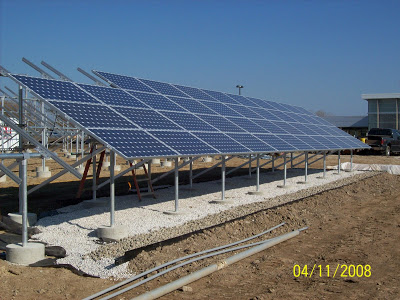
Venture recently finished the installation of a 250 kW solar array at the Johnson Controls Headquarters in Glendale, WI. This massive solar array is currently the largest ground mounted solar field in Wisconsin. The largest roof mount array at the GE Waukesha facility also was installed by Venture Electric.
“The Johnson Controls job was quite a project. It took a total team effort to get this array built on time. It proves that solar energy isn’t just for the Sun Belt,” said Venture Electric’s project manager Jim Seefeldt. Venture’s crew battled sub-zero temperatures to erect an intricate maze of piping that created the framework to support the 1452 solar panels. “Each panel had to be at exactly 30 degree for optimal collection of solar energy. It’s like a massive erector set that makes electricity,” said Electrician Foreman Marty Schultz.
A single solar panel generates approximately 33 volts DC (direct current). Each panel is combined with other panels until it reaches 480 volts DC. This DC voltage is then converted to AC (alternating current) thru an inverter. AC is used in virtually all homes in the United States. The inverter takes this converted voltage and places it back on the power grid for use by Johnson Controls and its neighbors.
The installation of these solar arrays requires a new skill set for traditional electrical contractors. “It requires electricians to abide by codes a lot of electrical contractors don’t use every day. I took it as a personal challenge (to learn the codes). It’s a lot of fun to be part of a new industry,” said Schultz
Venture Electric is excited about the growth of photovoltaic in Wisconsin. “It (PV) is the future of electrical generation and we are proud to be part of it,” said Jeffrey Robertson President of Venture Electric. “With the current administration’s commitment to “green technology” I see this as a real growth area. Photovoltaic and wind power are definitely here to stay.”
by jboullion | Apr 13, 2009 | Uncategorized
From a news release issued by Alliant Energy:
MADISON, WI – April 13, 2009 – Wisconsin Power and Light Company (WPL), an Alliant Energy company recognizes that times are tough right now. We are all trying to figure out where to cut back.
One way to energize your wallet and save cash is to enroll in the Appliance Cycling program.
When Midwestern summers bring high heat and humidity, the huge demand for electricity puts a big strain on power plants. With Alliant Energyþs Appliance Cycling program, you can help us meet electricity needs during peak demand times — and we will pay you for participating.
Alliant Energy customers who sign up for the program will have a small control switch placed on or near their central air conditioner. If the demand for electricity escalates to a critical point a signal will be sent to the switch on your air conditioner. The air conditioner will then cycle the outdoor cooling unit off and on every 15 minutes. The furnace fan will continue to circulate the cooler, drier air already in the home.
Not only will customers reduce their energy costs, Alliant Energy will pay each participating customer an incentive whenever we cycle the air conditioner.
+ 100% option: The air conditioner will be off up tosix continuous hours; you’ll receive an $8 credit per cycling event.
+ 75% option: The air conditioner will be off 22.5 minutes of each half-hour, up to six hours; you’ll receive a $5 credit per cycling event.
+ 50% option: The air conditioner will be off 15 minutes of each half hour, up to six hours; you’ll receive a $2 credit per cycling event.
Customers can save up to $40 each year and reduce energy costs without sacrificing comfort and convenience.
by jboullion | Apr 13, 2009 | Uncategorized
From an article by Scott Williams in the Milwaukee Journal Sentinel:
The National Weather Service has issued a new kind of warning because of a Dodge County wind farm that is disrupting the agency’s ability to monitor storms in southeastern Wisconsin.
The wind farm’s giant turbines – each as wide as a football field and as tall as a 20-story building – are sending false storm signals to the government’s weather radar system.
Weather service officials say they see no significant public safety threat, although they say the wind farm has caused radar interference and could confuse some storm watchers.
Meteorologist Marc Kavinsky said the approaching summer storm season will be the federal agency’s first opportunity to gauge the wind farm’s full impact.
“It’ll be interesting,” he said. “I’m hoping the effects will be minimal.”
Located just outside the Dodge County community of Iron Ridge, the wind farm includes 36 turbines that began operating over the past few months, generating electricity for several surrounding communities. . . .
Weather service officials said they began to notice the problem almost immediately after the Dodge County wind farm began operating.
According to a report on the agency’s Web site, the spinning wind turbines have presented “persistent interference” that mimics storm systems and could “negatively impact warning effectiveness” when real storms move into the area.
Rusty Kapela, the agency’s warning coordinator meteorologist, said officials have tried to adjust the radar system to block out the wind farm readings.
But because it affects such a small geographic area and is easily recognized by the weather service’s trained experts, Kapela said, the situation is not a significant problem. It was posted on the Web site only as an informational report for the general public, he said.
“It’s just interesting science stuff,” he said. “In the grand scheme of things, it’s just a minor blip.”
by jboullion | Apr 13, 2009 | Uncategorized
From the Energy Center of Wisconsin:
Identify operational and maintenance improvements in existing buildings and ensure their continued performance over time.
Retro-commissioning is a systematic process for identifying and implementing improvements to an existing building’s equipment and systems. The process focuses on building operation and maintenance activities. It targets energy using systems with the goal of reducing energy waste, achieving energy cost savings and selecting the most cost-effective solutions to achieve these goals and fix existing problems. Results of retro-commissioning may include improved temperature control, better indoor air quality, building pressurization, laboratory safety, infection control and/or electrical system reliability. Potential savings from low-cost to no-cost energy efficiency improvements typically range from 10%-20%.
This half-day training provides an introduction to retro-commissioning. Participants will learn how to conduct a process-based evaluation of building systems performance and energy consumption. Participants will also learn how to determine whether a building is a good candidate for retro-commissioning.
For more information, please visit www.ecw.org/university.
by jboullion | Apr 13, 2009 | Uncategorized
From an article by Liz Welter in the Marshfield News-Hearld:
Issues raised by the city’s Sustainable Marshfield Committee transcend political agendas, resulting in wide-spread community support, said Marty Anderson, chair of the committee and a former alderman.
“Sustainability is living and working in ways that don’t jeopardize our current and future social, environmental and economic resources,” he said.
“You can come at this from a lot of different angles. Whether it’s economic, the environment or health issues, there’s a wide-spread understanding we need to act,” said Anderson, adding that the committee recommends initiatives and tactics to the Common Council that will move the city towards achieving sustainability.
“When the city switched to LED lights in all the traffic lights, I think the savings is about $16,000 annually,” Anderson said.
Marshfield can be a model for what is pragmatically possible, he said. Two initiatives the committee recommended to the city have been approved. One was supporting the use of phosphate-free fertilizers and the other was to support state legislation to protect groundwater.
Through the committee, Marshfield’s city buildings and fleet vehicles will participate in a state-funded study. Wisconsin has a goal to reduce fossil fuel use by 25 percent by 2025. The committee will determine by December what the city would need to do to meet this goal.
“This could give us a road map for the future,” Anderson said.
To encourage the public’s use of compact fluorescent light bulbs, the committee purchased more than 1,500 to give away at various community events.
“We gave out about 1,000 during the Cultural Fair,” said committee member Sue Meyer, who talked at the fair about the energy needed to create electricity for an average four-person family house in one month.
“Most Wisconsin power plants use coal to generate electricity. It takes 162 pounds of coal to light the average home for one month using incandescent light bulbs,” Meyer said.
by jboullion | Apr 10, 2009 | Uncategorized
From an article by Steve Schultze in the Milwaukee Journal Sentinel:
Hybrid diesel-electric buses run cleaner and quieter and get better mileage than their conventional diesel engine counterparts, advocates say.
Dozens of cities around the United States use hybrids, including Madison, Chicago and New York. But don’t expect to see them anytime soon in Milwaukee.
Higher hybrid costs have put them out of reach for the Milwaukee County Transit System, at least for now. The local bus system is seeking $16.4 million in federal stimulus aid, which it plans to use to replace 41 aging diesel-powered buses with new diesel buses, transit system managing director Anita Gulotta-Connelly told county supervisors this week.
The big reason is cost. Hybrid models each cost about $500,000, or up to $200,000 more than conventional diesel buses, according to an analysis by the Union of Concerned Scientists, a national environmental policy advocacy group. The hybrids also cost an extra $30,000 to $60,000 in expected costs of replacing their battery packs, according to a report from the transit system.
Cheaper fuel costs for the hybrids – they get about 30% better mileage – would save up to $85,000 over the 12-year life of a bus if diesel fuel averaged $3.50 a gallon, the transit system report says. That still makes traditional diesel buses more affordable.
by jboullion | Apr 10, 2009 | Uncategorized
From the Energy Center of Wisconsin:
Identify operational and maintenance improvements in existing buildings and ensure their continued performance over time.
Retro-commissioning is a systematic process for identifying and implementing improvements to an existing building’s equipment and systems. The process focuses on building operation and maintenance activities. It targets energy using systems with the goal of reducing energy waste, achieving energy cost savings and selecting the most cost-effective solutions to achieve these goals and fix existing problems. Results of retro-commissioning may include improved temperature control, better indoor air quality, building pressurization, laboratory safety, infection control and/or electrical system reliability. Potential savings from low-cost to no-cost energy efficiency improvements typically range from 10%-20%.
This half-day training provides an introduction to retro-commissioning. Participants will learn how to conduct a process-based evaluation of building systems performance and energy consumption. Participants will also learn how to determine whether a building is a good candidate for retro-commissioning.
For more information, please visit www.ecw.org/university.