by jboullion | Jan 9, 2009 | Uncategorized
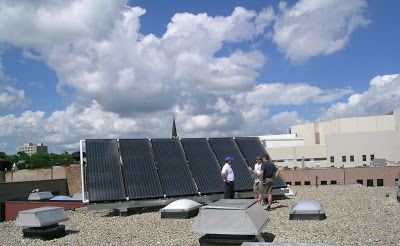
Solar installer Shawn Young (H&H Solar), RENEW’s Michael Vickerman, and the City of Madison’s Kay Schindel (left to right) inspect the solar hot water system on Station No. 1 with the downtown Madison skyline in the background.
From an article by Julian Emerson and Andrew Dowd in the Leader-Telegram:
Eau Claire city officials have outlined 58 infrastructure projects totaling $70.58 million that could be started this year if they receive money.
The proposed city projects span a range of infrastructure improvement initiatives and have not been prioritized. Besides the Hobbs remodeling, other big-ticket items on the list include a $6.8 million L.E. Phillips Memorial Public Library upgrade, $6 million to relocate the Police Department, a $5 million North Barstow Redevelopment District parking ramp and a $4 million city bus transit center.
The list includes some less costly endeavors too, such as City Hall heating, ventilation and air conditioning improvements costing $117,000 and a $23,200 rooftop solar water heating system for City Hall and fire station No. 2.
by jboullion | Jan 9, 2009 | Uncategorized
From a letter to the editor by Bobby Gifford:
In print we recently heard from a member of the Stevens Point Plan Commission regarding the pace of planning for downtown, including the mall. We need to look not at the pace of planning, but at the assumptions of planning and how they square with our new economic reality.
A key component of the mall plan is spending over $2 million on parking spaces. It appears that PDI, the paid consultants we are using in Point, are unaware of the peak oil problem, or ignore it. It seems that most planning in our region is based on the assumption that cheap oil and gas will persist far into the future.
The global peak of oil production is still here. The global economic collapse has not increased global petroleum supply. Instead, crashing petroleum prices are driving supply capacity from the market. The next upswing in crude oil and natural gas prices will be a brake on recovery.
Our recovery from global recession will be very slow. The retail sector as we know it is probably already history.
Our Plan Commission and local sustainability groups need to be on the same page. Local elected officials need to consistently consult with local sustainability activists such as Farmshed, Sustain Central Wisconsin, Eco-municipality committees, UWSP, students, and the Interfaith Council for the Earth and read all available sustainability literature.
Gifford offered these Web sites for research:
http://www.energybulletin.net
http://www.peakoil.net
http://www.theoildrum.com
http://aspo-usa.com
http://www.simmonsco-intl.com/research.aspx?Type=msspeeches
by jboullion | Jan 9, 2009 | Uncategorized
From a story on WXOW News 19, La Crosse:
While President Elect Obama won’t take the oath of office until January 20th, some local politicians already see some changes.
The Governor has been asked to work with county officials to find ways to make La Crosse more energy efficient and bring more jobs to the area.
Today County Administrator Steve O’Malley met with the Joint Committee on Sustainability.
They discussed a number of green projects for the county if Obama’s Federal Stimulus Plan passes.
They primarily focused on three solar hot water projects.
The proposed design would add solar panels to the county jail, and county nursing homes.
If the county can get federal funding, officials say we would see an immediate impact on the economy.
Steve O’Malley says, “Following what Congress and the President talked about, we think La Crosse is on the cutting edge or trying to increase the demand for alternative energy and we hope to be a part of that.”
by jboullion | Jan 9, 2009 | Uncategorized
From an article by Pete Millard in The Business Journal:
Wisconsin Electric Power Co. [d/b/a We Energies], the state’s largest public energy utility, is seeking Public Service Commission approval to spend $3 million to study the feasibility of harnessing the Great Lakes’ wind power.
With more than a half-dozen wind farms sprouting up in corn and soybean fields from Montfort in southwest Wisconsin to Portage, Eden and Kewaunee on the banks of Lake Michigan in northeast Wisconsin, the real potential for wind power exists on the Great Lakes. That’s according to a November 2008 PSC report.
While no one doubts the potential for wind power on the Great Lakes, there are environmental, construction, transmission and maintenance issues that need examination before wind turbines and towers begin rising in the depths of Lake Michigan and Lake Superior.
“What we’re proposing is taking the next step forward from the PSC report,” said Roman Draba, WEPCO’s vice president of regulatory affairs and policy.
The PSC’s own Great Lakes wind power study summarizes the various state, federal and tribal statutes, rules and regulations that may have to be changed before any proposal to build an off-shore wind project can move ahead, but these are not insurmountable obstacles, said Carl Siegrist, WEPCO’s senior renewable energy strategist.
Less known is whether the technology exists to economically transmit the wind power from off-shore turbines to on-shore transmission lines. Also unknown is the cost to build and maintain the turbines and towers, especially in winter, Siegrist said.
“A big part of the study will also monitor exactly what the wind patterns are and how productive they may be,” said Draba.
The WEPCO Lake Michigan study also will look at the potential environmental impact the towers and turbines would have on bats and migratory birds.
by jboullion | Jan 7, 2009 | Uncategorized
From the list of items in an article on a vision for 2009 from the Shepherd Express:
Develop a green economy. We must also create jobs that will last, and hopefully will not be easily exported to another state or country. Good options are green jobs that will benefit Wisconsin residents by helping the state to use our resources wisely. Right now, Wisconsin is an energy island-that is, a fossil fuel energy island. But the state is rich in clean energy potential, such as wind, solar, hydro and biomass. We absolutely must wean ourselves from our reliance on gas and coal.
What’s more, these green job projects will train workers in skills that will be helpful in the coming decades, whether they’re upgrading the city’s aging housing stock, house by house, or launching massive clean energy projects like a wind farm or a green roof.
by jboullion | Jan 7, 2009 | Uncategorized
From an article in the Wausau Daily Herald:
Focus on Energy, Wisconsin’s energy efficiency and renewable energy initiative has announced that Clark Electric Cooperative officially became a program member as of Jan. 1.
The utility serves about 8,800 customers in Clark, Chippewa, Jackson, Marathon, Taylor and Wood counties.
“Clark Electric Cooperative’s decision to participate in Focus on Energy will result in a healthier environment for Wisconsin and will provide options for its customers to make sound energy decisions,” said Eric Callisto, chairman of the Public Service Commission of Wisconsin, the agency that manages the Focus on Energy program.
Clark Electric will participate in the business, residential and renewable energy offerings under the Focus on Energy umbrella. Benefits of participating include:
• Business programs that help manufacturers, commercial businesses, farmers, schools and local governments reduce operating costs, increase their bottom line and improve productivity and employee and customer comfort.
• Wisconsin Energy Star Homes, a program that helps homeowners and landlords integrate energy improvements in their remodeling projects.
• Lighting and appliance programs that increase the availability of Energy Star-qualified products, ranging from compact fluorescent light bulbs to heating and cooling equipment.
• Renewable energy programs that help residents and businesses harness energy from sunlight, wind and organic materials.
by jboullion | Jan 7, 2009 | Uncategorized
From a media release issued by Northland College and posted on BusinessNorth.com:
ASHLAND, Wis. – Northland College is taking another step to reduce its environmental impact by no longer offering trays in its cafeteria.
In the fall semester, the College began Tray-less Tuesdays, an initiative that saved 138 gallons of water each Tuesday by not offering trays to students. Now, Northland is extending the policy for the other six days of the week.
“We estimate we ran 828 fewer trays through the dish machine on Tuesdays” said Jeff Spangenberg, the director of food service at Northland. Because a tray takes twice as much space in the dishwashing machines as a plate, eliminating them is a simple but effective way to reduce the environmental impact of food service.
In addition to saving water, energy, dish soap and time, the policy also will cut down on food waste. By only using a plate, and going back to the buffet for seconds if necessary, students are less likely to over-estimate their appetites and take food they won’t eat. When Viterbo University went tray-less in 2007, they eliminated nearly three tons of food waste in two semesters. While Northland has fewer mouths to feed, the results are still expected to be significant.
by jboullion | Jan 7, 2009 | Uncategorized
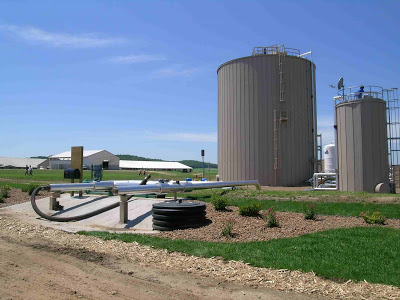
The larger of the two tanks digests the manure at the Five Star Dairy near Eau Claire. Photo by Ed Blume, RENEW Wisconsin
From an article in the Daily Pioneer (Platteville):
PLATTEVILLE – Tim Zauche, associate professor of chemistry and engineering physics at the University of Wisconsin-Platteville, wants manure from area dairy farms. But he just wants to borrow it.
Zauche and Christopher Baxter, UWP associate professor of agriculture, met with about 25 Grant and Lafayette county dairy farmers on Monday, Jan. 5, to discuss the feasibility of building an anaerobic digester in the region. The digester would collect methane gas from cow manure. The methane could be converted into a variety of useable energy sources.
“The university is interested in anaerobic digesters because we’re striving to become more sustainable,” Zauche said. “We’re looking to become more independent of our energy needs from other places.”
The project is just in the exploratory stage. Details of the project – including who would own the digester, where it would be located, what would be expected of participating farmers and a number of more technical details – need to be worked out, Zauche said.
Zauche said that the digester would need to process manure from at least 500 cows to be economically feasible. That could be reduced somewhat if the digester also processes production waste from several area cheese factories. Baxter said that the UWP Pioneer Farm plans to increase its herd to 300 cows, which includes dairy cows and a planned expansion of its beef herd.
by jboullion | Jan 6, 2009 | Uncategorized
From the Wisconsin League of Conservation Voters:
Join Us For CONSERVATION LOBBY DAY 2009!
Wednesday, February 25, 2009 – RSVP here!
*RSVP Required—RSVP DEADLINE is February 13!
Since the first Conservation Lobby Day in 2005, it has grown from just over 100 citizens to over 500! Each year these citizens from across Wisconsin descend on the Capitol to share their conservation values with their Legislators. As we head into the 5th annual Conservation Lobby Day, there is one thing we can guarantee-when citizens come together to make their conservation values known, legislators listen, and conservation victories soon follow!
The reauthorization of the Knowles-Nelson Stewardship Fund and the passage of the Strong Great Lakes Compact are two great examples of how citizen lobbying resulted in ground-breaking conservation laws.
The participation of local groups and citizens like YOU is incredibly important to the success of Conservation Lobby Day. Every day throughout the state, countless citizens work tirelessly to protect the local land, water, and wildlife.
Conservation Lobby Day is a unique opportunity to share your conservation stories and experiences with legislators and have a huge impact on conservation policies affecting all of Wisconsin.
In 2009-2010, the conservation community will be fighting to:
Preserve Groundwater: Wisconsin’s Buried Treasure: manage Wisconsin’s groundwater resources to preserve drinking water supplies, lakes, streams, and wetlands.
Stop Global Warming in Wisconsin: address the threats of global warming in Wisconsin through clean, renewable energy jobs and energy conservation.
Restore Conservation Integrity: return Wisconsin to an Independent DNR Secretary and a timely appointment of Natural Resource Board members.
Protect Wisconsin’s Drinking Water: protect Wisconsin’s drinking water supplies by making sure we safely spread agricultural, municipal, and industrial waste.
For a 1-page brief on each of these issues, click on their title above.
by jboullion | Jan 6, 2009 | Uncategorized
From the Wisconsin League of Conservation Voters:
Join Us For CONSERVATION LOBBY DAY 2009!
Wednesday, February 25, 2009 – RSVP here!
*RSVP Required—RSVP DEADLINE is February 13!
Since the first Conservation Lobby Day in 2005, it has grown from just over 100 citizens to over 500! Each year these citizens from across Wisconsin descend on the Capitol to share their conservation values with their Legislators. As we head into the 5th annual Conservation Lobby Day, there is one thing we can guarantee-when citizens come together to make their conservation values known, legislators listen, and conservation victories soon follow!
The reauthorization of the Knowles-Nelson Stewardship Fund and the passage of the Strong Great Lakes Compact are two great examples of how citizen lobbying resulted in ground-breaking conservation laws.
The participation of local groups and citizens like YOU is incredibly important to the success of Conservation Lobby Day. Every day throughout the state, countless citizens work tirelessly to protect the local land, water, and wildlife.
Conservation Lobby Day is a unique opportunity to share your conservation stories and experiences with legislators and have a huge impact on conservation policies affecting all of Wisconsin.
In 2009-2010, the conservation community will be fighting to:
Preserve Groundwater: Wisconsin’s Buried Treasure: manage Wisconsin’s groundwater resources to preserve drinking water supplies, lakes, streams, and wetlands.
Stop Global Warming in Wisconsin: address the threats of global warming in Wisconsin through clean, renewable energy jobs and energy conservation.
Restore Conservation Integrity: return Wisconsin to an Independent DNR Secretary and a timely appointment of Natural Resource Board members.
Protect Wisconsin’s Drinking Water: protect Wisconsin’s drinking water supplies by making sure we safely spread agricultural, municipal, and industrial waste.
For a 1-page brief on each of these issues, click on their title above.