by jboullion | Dec 16, 2008 | Uncategorized
From an article by Nick Paulson in the Wisconsin Rapids Tribune:
STEVENS POINT — The average American has gained 10 pounds in the past decade, and the extra weight is helping cause climate change.
“What that means is that the airlines that crisscross this country burn 350 million more gallons of jet fuel every year, schlepping around that extra weight,” said Terry Tamminen. “If all of us, myself included, would lose that 10 pounds, the planet would be better off and so would we.”
The idea may be a little harsh, but it is the kind of forward thinking Tamminen is known for and has helped him land some of the most prestigious climate jobs in the country. He has worked as the Secretary of the California Environmental Protection Agency under Gov. Arnold Schwarzenegger, and Thursday night was part of a conference call with the transition team for President-elect Barack Obama.
Tamminen was Friday morning’s keynote speaker at the Wisconsin Climate Change Summit at the University of Wisconsin-Stevens Point.
From ideas such as his weight loss theory to broader changes like converting 1.2 million buildings nationwide to more efficient systems, Tamminen shared four steps he believes will stimulate the economy and create a more sustainable country: renewables, efficiency, markets and democracy.
by jboullion | Dec 16, 2008 | Uncategorized
From an article by K.J. Lang in the La Crosse Tribune:
Western’s newest vehicle is a commitment to environmental sustainability and a conversation starter.
“People practically break their neck to look at you,” said Marlin Peterson, site supervisor for Per Mar Security at Western.
Marlin Peterson, Per Mar Security sight supervisor at Western Technical College, gets back into Western’s new NEV (Neighborhood Electric Vehicle) while working parking detail Thursday.
Peterson drives the $13,000 vehicle around campus for parking enforcement and security. He often stops to answer questions about the vehicle, a Neighborhood Electric Vehicle or NEV, that runs on eight, six-volt batteries.
It costs considerably less than the previous security department fleet vehicle, a Chevy Malibu. A typical fleet vehicle had cost the department about 48 cents per mile to run; the NEV costs about 3 cents per mile.
by jboullion | Dec 16, 2008 | Uncategorized
From a story by Larry Sandler in the Milwaukee Journal Sentinel:
A new study by a libertarian think tank claims the projected economic benefits of a proposed Milwaukee-to-Kenosha commuter rail line have been inflated and questions its ridership estimates.
But a business leader noted that the author of the study, Los Angeles-based transit consultant Tom Rubin, took a far more positive view of the $200 million project in June, when pro-transit business leaders were pushing the Southeastern Wisconsin Regional Transit Authority to hire him as the authority’s consultant. And a regional planner said the commuter rail projections were sound.
The Reason Foundation study, being released today, says the transit authority should consider express buses as an alternative to the KRM Commuter Link, which would connect downtown Milwaukee and the southern suburbs to Racine and Kenosha with 14 round trips each weekday.
Rubin said his latest study wasn’t meant to bash the KRM, but to highlight the advantages of bus options.
“We’re not saying that KRM is a dumb idea and it should be dropped,” Rubin said Monday. “I am not saying that KRM is going to fail. I am saying there are other options that should be studied before you make that commitment.”
by jboullion | Dec 15, 2008 | Uncategorized
From an article article by Deneen Smith in the Kenosha News:
Shawn Henoch can’t wait for frigid weather and the first serious heating bills of winter.
“I’m really looking forward to January and February to see,” Henoch said. “Who is excited to get their electric bill? But I am.”
Henoch hired a company to do an energy efficiency overhaul of her 60-year-old Kenosha home this year. The work was completed in June, and she said she’s already seen a dramatic reduction in her energy bills and an improvement in the coziness-factor of her home.
The project sealed air leaks in the house, added insulation in the walls and ceiling, and replaced an old, inefficient furnace and air conditioner.
Before the overhaul, her typical winter heating bills were about $400 “and that was keeping my heat set at 67 or 68,” she said. “Now I can really keep my house at 72, and my last bill was, I think, $136.”
Learn more about an energy efficiency evaluaition at Focus on Energy.
by jboullion | Dec 15, 2008 | Uncategorized
From an article by Mark Sommerhauser in the La Crosse Tribune:
A proposal for high-speed rail service from Chicago to St. Paul – with stops in La Crosse and Winona, Minn. – is gaining new steam, buoyed by new federal interest in passenger rail and an aggressive push from St. Paul-area officials.
St. Paul Mayor Chris Coleman and Ramsey County officials are engaging leaders in Winona and other Minnesota municipalities on Amtrak’s Empire Builder line, which they say could eventually be improved to carry high-speed trains if federal lawmakers fund the project as early as 2009. Coleman and others say overhauling the Empire Builder line would fast-track Minnesota’s best bid for high-speed rail, though the proposal may face questions from state officials and Rochester leaders who hope to be included on a new route.
A high-speed rail on the Empire Builder line, which runs from Chicago to La Crosse, and up the Mississippi River through St. Paul, was first proposed in a 2004 study by transportation departments in Minnesota and 10 other Midwest states. That study estimated an upfront cost of $1.86 billion to improve the line and proposed running five, 110-mph trains per day on the route.
Now, with Amtrak ridership climbing, President-elect Obama and other newly elected Democrats are discussing an ambitious, nationwide effort to fund high-speed rail, possibly as part of a stimulus package focused on infrastructure projects. The sudden prospect of federal support has put supporters in high gear: Mayor Jerry Miller confirmed he plans to meet with Coleman and Rep. Tim Walz, DFL-Minn., next week to discuss high-speed rail.
by jboullion | Dec 14, 2008 | Uncategorized
From an article by Brian Reisinger in the Wausau Daily Herald:
Alternative energy is something officials in the Wausau area say they want to encourage among residents, but properly regulating such technology remains uncharted territory.
From wind turbines to solar panels to electric cars, enabling the use of alternative energy comes with benefits and challenges.
Kelly Warren, a volunteer with Wausau’s Commission for a Greener Tomorrow, said energy alternatives only will be feasible if people and government scale back consumption.
“The first thing should always be to conserve,” he said.
In the meantime, local governments are addressing the issue to varying degrees.
Weston’s Village Board could consider an ordinance Monday that identifies wind as an important resource while placing height and other restrictions on turbines.
Administrator Dean Zuleger wants the village to foster such alternatives, possibly by using money from business development districts.
“You have to be willing to be forward-thinking with those folks in the business community that want to give that a shot,” Zuleger said.
by jboullion | Dec 12, 2008 | Uncategorized
From an article in the Osceola School District newsletter:
Over the past year, the school district of Osceola has begun to take an inventory of how many ways it’s becoming a “green friendly” environment. Prompted by a state movement for schools to gain certification as “Green and Healthy,” as well as a community interest in becoming more sustainable, the district began to formally address the initiative district-wide. All buildings have a goal of becoming certified as “Green and Healthy” by the Wisconsin Department of Public Instruction.
Schools have collected and submitted much data. Many statistics that students and staff tracked were used in earning the titles, from the amount of food waste produced to the temperature of the buildings over time. Buildings also submitted curriculum documentation of environmental education. Finally, each site completed an action and implementation plan for continuing its initiatives. These plans have become a vehicle for communicating with students and staff at each building as to their progress and next steps.
Director of Building and Grounds, Bob Schmidt, has been a solid resource for each building. “When we sat down and looked at the criteria, we realized how much work we had already done as a district to become more efficient and environmentally esponsible. It was positive to see the efforts we had made previously make this transition fairly easy. We still have steps we can take, but we’ve begun to cut our costs, energy usage, and effect on the environment already.”
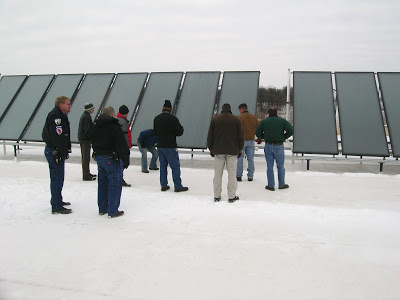
One of the most noticeable additions to the district is that of 32 flat panel solar energy collectors installed on top of the Osceola Middle School. “We researched solar options for months, traveling to other educational institutions to find out pros and cons of different systems,” stated Mr. Schmidt. “Last spring, we made a presentation to the school board about the different system options as well as grant funding available for the project. The school board has been extremely supportive and proactive in this area.” In the end, the district received grant monies from Focus on Energy in the amount of $46,960.94 to use for the project.
by jboullion | Dec 12, 2008 | Uncategorized
From an article by Paul Snyder in The Daily Reporter:
Summit Ridge Energy LLC isn’t yet ready to let a Monroe County Circuit Court ruling kill a 60-turbine wind farm proposal for the towns of Ridgeville, Wells and Wilton.
“At this point we’re talking with our consultants and looking at all our options,” said Susan Dennison, spokeswoman for Summit Ridge’s parent company, Chicago-based Invenergy LLC. “I don’t think we’re ready to say it’s over.”
After the company developed the Forward Energy Center wind farm in Fond du Lac and Dodge counties, Invenergy planned to build its next Wisconsin farm on land in Ridgeville, Wells and Wilton.
All three towns in 2007 granted Summit Ridge conditional-use permits for the wind farm, but Ridgeville and Wilton vetoed those permits, prompting Summit Ridge to sue.
As the case played out, the two towns also passed ordinances requiring wind farms to be set back a half-mile from property lines. Wilton Supervisor Tim O’Rourke said the ordinance leaves little developable space in the town.
Monroe County Circuit Court Judge Michael McAlpine at the end of November upheld the two towns’ vetoes, but ordinances and withdrawn permits might not be enough to stop the farm.
The development’s estimated energy output is just less than 100 megawatts. Ridgeville Chairman Mike Luethe said he would not be surprised if Summit Ridge increases the capacity to more than 100 megawatts, which, by law, puts project approval in the hands of the Public Service Commission of Wisconsin.
If Invenergy is willing to wait, it might not need to increase capacity. Several state lawmakers said the Legislature will try to pass a bill establishing statewide requirements for wind farms, regardless of size.
That possibility does not sit well with small communities that passed their own ordinances.
“If (lawmakers) do that, they take power away from local governments,” Luethe said. “I’m a big believer in local government, and I think it’s hard for them (lawmakers) to make decisions about areas where they don’t even know what it looks like.”
But local governments might have an ally in state Rep. Andy Jorgenson, the newly appointed chairman of the Assembly Committee on Renewable Energy and Rural Affairs. The Fort Atkinson Democrat said he sympathizes with local governments on development issues. But he would not commit to opposing statewide wind farm regulations, arguing any developments need to be considered if they can help the state snap out of the economic crisis.
“We need to hear what the concerns of the local governments are because it’s something we can all learn from,” he said. “But it’s a discussion I’m looking forward to having, and hopefully we can come together on a decision.”
by jboullion | Dec 12, 2008 | Uncategorized
From an article by Mark Schaff in West Allis Now:
West Allis residents will get the chance next week to tell the city if proposed restrictions blow too gently or too hard when it comes to an alternative energy source for local homes.
A public hearing will be held at 7 p.m. Tuesday, Dec. 16, on an ordinance that would allow West Allis residents to install mini wind turbines on their properties. The public hearing will come at the beginning of the Common Council meeting at City Hall, 7525 W. Greenfield Ave.
On Dec. 3, the Plan Commission unanimously recommended approval of the ordinance.
Wind proponent
Earlier this year, resident Conrad LeBeau asked the city to change its municipal code so he could install such a system at his residence.
LeBeau, who has long been interested in alternative energy, had purchased a wind turbine with a 46-inch rotor diameter — a device capable of generating about 400 watts of power in a 28-mph wind.
In an interview earlier this fall, LeBeau, 65, said he could power his garage and lawn lights with the turbine, but hopes to continue experimenting to someday reduce his energy bill to zero.
Setting the rules
City officials responded to LeBeau’s request with a proposed set of rules that address safety and noise concerns.
Under terms of the ordinance, home-based wind energy systems could only be placed outside homes in certain places.
A tower for a wind energy system must be set back 1.5 times its total height from any public road right of way and all property lines and utility lines not serving the property.
As proposed, the system could only be located in a backyard, and all electrical wires must be underground. The base of the wind system must be at least eight feet from the ground and the total height could not be more than 60 feet.
The system could generate no more than 60 decibels of sound — the rough equivalent of normal conversation, according to the University of Wisconsin’s College of Engineering— as measured from property lines.
Too restrictive?
City officials stressed safety in drafting the ordinance because of West Allis’ small lot sizes and high-density neighborhoods, said Steve Schaer, planning and zoning manager.
LeBeau said he shared those same concerns, but he also wanted the city to keep costs and restrictions at a minimum to give homeowners flexibility.
by jboullion | Dec 11, 2008 | Uncategorized
From an article by Sara Elmquist in the Winona Post:
Opponents to proposed new high-voltage, 345-kilovolt transmission lines which could cross the Mississippi in Winona rallied Monday night at an open house against the project.
One of the new lines would run from the southeast Twin Cities to La Crosse following a route that would cross the Mississippi in either Winona, Alma or La Crescent.
CapX2020, a group of 11 energy companies in Minnesota, held an open house on the project Monday night, a required step for the routing of the lines for Minnesota and Wisconsin permits. Public scoping meetings are expected in February, with public hearings set for early 2009.
CapX2020 spokesperson Tim Carlsgaard said that the lines would be used to carry power from new wind projects and to help meet state mandates for renewable energy. But opponents at Monday’s meeting said that there was no guarantee the power grid wouldn’t haul coal-generated power to more urban areas on the dime of energy rate-payers in Minnesota.
And discussions, which turned into a roundtable debate, included claims from members of Bluff Land Environment Watch (BLEW) and others that the lines simply weren’t needed.
“The best solution is conservation,” said local wildlife enthusiast Richie Swanson. He said that migratory bird populations would be threatened at transmission river crossings and advocated incentives for using less energy. He said that taller towers would simply exacerbate the dangers birds and other wildlife face along the Mississippi. “We live in a world where wildlife is already getting hammered on the river,” he said, rattling off a list of species seeing huge declines in numbers.