by jboullion | Oct 28, 2008 | Uncategorized
From an article by Paul Snyder in The Daily Reporter:
La Crosse County will pay for a greenish jail, but the price tag for LEED honors might be too steep.
“I’m willing to spend money for energy conservation,” said County Supervisor John Medinger.
“But I’m not sure what we get for LEED certification at about $200,000.
“If it’s just a plaque that says, ‘Nice job, now give us $200,000,’ I’m going to lean against it.”
The La Crosse County Board last week approved a $29.5 million expansion for the county jail in La Crosse, but members delayed a vote on seeking Leadership in Energy and Environmental Design certification or adding green features that were not in the original bid package.
County Administrator Steve O’Malley said the board has until the second week in December to decide on certification, which he said would cost $166,000, or an alternate package of green features, such as a solar hot water system, a retention pond and a heat-reclaiming system.
“From what I can tell, the board is really on the fence about it right now,” O’Malley said. “Some green features are already built into the project, but I think they’ll go for additional energy-saving features if they can see the payback.”
The county estimated the alternate package of green elements would add $500,000 to $600,000 to the project cost. Medinger said some projects related to the jail expansion, including a probation center, could be delayed to free up the money.
County officials owe it to their constituents to find a way to achieve the greenest possible jail, said County Supervisor Maureen Freedland, who chairs the La Crosse County Law Enforcement Center Construction Committee.
“We’re looking for more than just efficiency,” she said. “It’s the societal factor, what it means to the area, and what we’re saying to the community.”
Freedland said LEED certification is an important part of that package.
“There are people on the committee that think it’s just a plaque or a piece of paper,” she said. “But that money gets you site visits to make sure programs and features are set up and running properly.”
by jboullion | Oct 27, 2008 | Uncategorized
From a media release issued by Focus on Energy:
As fall turns to winter and the sun sets earlier each night, Wisconsinites are turning on their lights, and in doing so, spending more money on electricity. Fortunately, there is a way to turn on lights and turn back energy costs.
With just a twist of the wrist, ENERGY STAR® qualified compact fluorescent light bulbs (CFLs) can reduce energy use by up to 75 percent, and changing out the five most used bulbs in a home can save $35 in energy costs the first year alone.
To add another twist on the savings, Focus on Energy, Wisconsin’s energy efficiency and renewable energy initiative, is offering ENERGY STAR qualified CFLs for a discounted price at participating retail locations, beginning October 1 for a
limited time.
“Over the past several years, residents throughout Wisconsin have reduced their energy use and their utility bills by using ENERGY STAR qualified CFLs, but there are still many who have not made the switch,” said Mike Plunkett, Lighting Program Manager. “Fortunately, for those still holding out, the technology has improved over the years with the issues of humming, flickering and poor light quality having been eliminated. So people who didn’t like the early bulbs may be surprised to find they’ll get a great functioning bulb that saves them money for years to come.”
. . . ENERGY STAR qualified CFLs are being sold for a discounted price at select retail locations, including Ace Hardware, Big Lots, Copps Food Center, Cub Foods, Do it Best, Dollar Tree, Festival Foods, Hardware Hank, Home Concept, Menards, Mills Fleet Farm, Pick ‘n Save, Sentry Foods, ShopKo, True Value Hardware, Trustworthy Hardware and Woodman’s locations.
by jboullion | Oct 27, 2008 | Uncategorized
From a media release issued by Focus on Energy:
Focus on Energy, Wisconsin’s energy efficiency and renewable energy initiative, announced today that Oakdale Electric Cooperative officially became a program member beginning October 1, 2008. The utility serves approximately 15,000 customers throughout Monroe and Juneau counties and portions of Jackson, Sauk and Wood counties. . . .
Oakdale Electric Cooperative will participate in the Business, Residential and Renewable Energy offerings under the Focus on Energy umbrella. The benefits of participating include:
· Business Programs that help manufacturers, commercial businesses, farmers, schools and local governments reduce operating costs, increase their bottom line and improve productivity and employee and customer comfort. The programs offer technical expertise, training and financial incentives to help implement innovative energy management projects.
· Wisconsin ENERGY STAR Homes, Home Performance with ENERGY STAR and Apartment & Condo Efficiency Services Programs that encompass new and existing homes,
multi-family construction and remodeling projects for all types of residential dwellings. These programs help homeowners and landlords integrate energy improvements into their remodeling projects, as well as deliver newly-built homes, apartments and condominiums that are comfortable, safe, durable and energy efficient.
· Lighting and appliance programs that increase the availability of ENERGY STAR qualified products ranging from compact fluorescent light bulbs to heating and cooling equipment. These efforts deliver lower energy bills for residents and businesses and increased sales for retailers and contractors.
· Renewable Energy Programs that help residents and businesses harness energy from sunlight, wind and organic materials.
· Targeted Home Performance that reduces energy bills while increasing comfort and safety for income-qualified participants
by jboullion | Oct 27, 2008 | Uncategorized
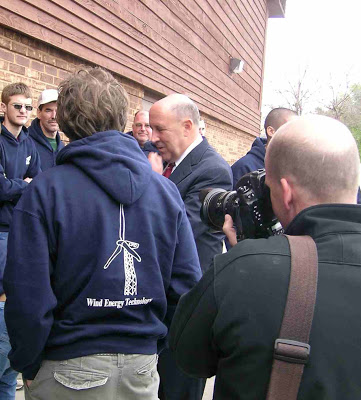
Govenor Doyle chatted during the dedication program with students from Lakeshore Technical College’s Wind Energy Technican program.
A report from Jeff Anthony of the American Wind Energy Association (AWEA):
At the first wind project dedication ceremony for a major wind project in the state of Wisconsin in over seven years, Governor Jim Doyle (D) and other state government officials dedicated the Forward Wind Center in Brownsville, WI. Governor Doyle gave remarks at the ceremony on Wednesday, October 22, 2008 at the Brownville Community Center, noting that “the project represents a clean energy milestone for Wisconsin, meaning greater energy security, better wages in green jobs, and clean air and water for generations to come”. He also emphasized that in the economic turbulence “clean energy future greater investment, more jobs, and more security at home”.
A global warming task force commissioned by Governor Doyle issued a report in August recommending that Wisconsin accelerate its Renewable Energy Standard targets, achieving 10% by 2013, 20% by 2020 and 25% by 2025. Governor Doyle also reiterated his intent to pass the enhanced RES in the 2009 legislative session to require state utilities to get 25% of their electricity from renewable energy such as the energy produced by the Forward Wind Center by the year 2015. He also called for the great manufacturing capabilities in Wisconsin to be directed towards clean energy technologies such as wind power as well.
Michael Polsky, President and CEO of Invenergy, welcomed an over-flowing crowd to the project dedication ceremony and described the benefits of wind power, saying “It just makes sense” from so many different perspectives, including energy security, long-term clean energy production, and environmental benefits. Tours were conducted throughout the afternoon by developer Invenergy, the project owner and operator. The output of the project is under contract to four Wisconsin utilizes: Madison Gas & Electric, Wisconsin Public Service, Wisconsin Power & Light (Alliant Energy), and Wisconsin Public Power, Inc. The Forward Wind Center consists of 86 General Electric 1.5 MW wind turbines (for a total of 129 MW) covering 12,000 acres in Dodge and Fond du Lac counties in Southeastern Wisconsin. Commercial operations at the facility began in March 2008, the project is expected to produce enough energy to power 30,000 homes and avoid the burning of 187 million pounds of coal per year. The Forward wind project is one of four major wind projects schedule to come on-line in 2008, representing a major step forward for the state of Wisconsin.
More from an article by Aubrey Fleischer in The Reporter (Fond du Lac).
by jboullion | Oct 24, 2008 | Uncategorized
A video from Focus on Energy and Fox 6 on cutting energy costs by adding installation and sealing air leaks in a home.
by jboullion | Oct 23, 2008 | Uncategorized
A PowerPoint (in PDF) by RENEW Wisconsin’s Executive Director Michael Vickerman presents the preliminary conclusions of a forthcoming white paper on solar hot water system:
When energy prices rise above $1.00/therm and incentives are available to reduce system cost by half, the internal rate of return (IRR) on investment in a commercial SHW system will surpass those of traditional investments. Moreover, it is as risk-free an investment as one can make.
Natural gas price volatility will invariably impart a herky-jerky pattern to annual returns and installation activity.
To ensure the steady of expansion of SHW technology, governments should consider policy options to provide some buffer against fuel price volatility and reduce front-end costs.
by jboullion | Oct 22, 2008 | Uncategorized
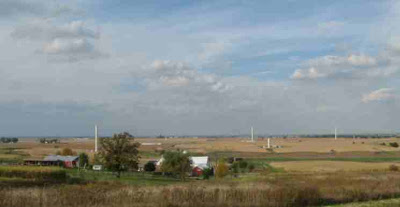
Towers await turbines at EcoEnergy‘s EcoGrove wind project near Lena, Illinois.
by jboullion | Oct 22, 2008 | Uncategorized
Energy Concepts, Hudson, installed Minnesota’s largest solar system, according to an August article Jean Hopfensperger in the Minneapolis-St. Paul Star Tribune:
A Minnesota first is unfolding this month on the rooftop of a Vadnais Heights social service agency, where 525 solar panels are being installed to take energy conservation to new heights.
When completed this month, the largest solar electric project in the state will sit atop an agency best known for helping adults with disabilities. State officials say it will increase Minnesota’s solar capacity by 10 percent.
What’s even more unusual is that the rooftop rays will fuel a geothermal energy system hidden below the concrete parking lot of the building, home to Merrick Inc., a nonprofit that is making its energy production — and its own products — a Minnesota model of green.
“We’ve married two emerging technologies, geothermal and solar, in a commercial setting,” said John Wayne Barker, executive director of Merrick Inc. “We’ve taken an ugly duckling — this building — and turned it into a swan. Hopefully we’ll inspire others to do the same.”
The 100-kilowatt project reflects the rise of large-scale solar experiments in Minnesota, said Stacy Miller, solar administrator at the Minnesota Office of Energy Security. Of the 250 or so solar installations, the average-sized project is just four kilowatts, she said.
From the newsletter of Energy Concepts:
With the help of Energy Concepts, the Merrick building in Vadnais Heights, recently broke a record for solar installations in Minnesota. Lined up on its flat roof just south of St. Paul, 108 solar modules are daily converting the sun’s energy into electricity. The 130,000 kilowatts it is expected to generate annually will be the highest ever for a single Minnesota project and represents fully 10% of installed solar capacity in the Gopher State.
Designed by Energy Concept’s Craig Tarr, the solar installation powers the company’s underground geo-thermal system, which provides most of the building’s heating and cooling.
“It’s a biggie,” Tarr says, “and represents a new level of achievement in terms of combining solar and geo-thermal at one site. Senator Klobuchar, the Governor—they have VIPs visiting that site almost every day.”
Minnesota and Wisconsin, despite their stereotype of being cold and dark, actually, according to Tarr, have excellent overall solar potential.
by jboullion | Oct 22, 2008 | Uncategorized
From a media release issued by Milwaukee Shines:
On Thursday, October 23rd, Milwaukee will host the fourth annual Solar Decade Conference at the Midwest Airlines Center, expected to draw 400 people. Sponsored by We Energies, Focus on Energy and the Wisconsin Green Building Alliance, the conference will focus on reducing the informational, economic and procedural barriers to solar energy proliferation in the region.
“The benefits of solar energy are great,” said Mayor Tom Barrett, “Not only does solar energy provide power from a secure domestic source, promote sustainable urban development, and support greenhouse gas reduction targets, but advancing solar technology creates new economic opportunities for our residents and businesses.”
Also during the conference, Mayor Tom Barrett will accept a grant of $200,000 from Tom Kimbis, Director of Market Transformation for the U.S. Department of Energy Solar Energy Technologies Program. Earlier this year, the City of Milwaukee was named one of America’s 25 Solar Cities by the Department of Energy because of its commitment to solar technology adoption. This grant was awarded at that time.
Roman Draba, Vice President of Regulatory Affairs & Policy at We Energies will present a matching grant also in the amount of $200,000.
The awards are intended to accelerate solar adoption in cities by supporting their innovative efforts with financial and technical assistance. Selected cities are those prepared to make a comprehensive, city-wide approach to solar technology that facilitates its mainstream adoption.
The Solar Decade Conference, open to the public, will feature “renowned industry experts as they discuss the benefits of solar energy for your home, business and career!”
by jboullion | Oct 21, 2008 | Uncategorized
From a media release issued by Alliant:
MADISON, WI – October 17, 2008 – A decision on the future of the Nelson Dewey Generating Station is just weeks away. The final phase of the regulatory process kicked off today, as Wisconsin Power and Light Company (WPL), a subsidiary of Alliant Energy Corporation (NYSE: LNT), filed its . . . brief in the case.
The brief highlights that no generating facility in Wisconsin history has ever provided the varied benefits that Nelson Dewey 3 will bring. These benefits include helping to jump start the biofuels economy in Wisconsin and establishing an estimated $50 million dollars annually in economic development from that market, creating much-needed jobs for southwest Wisconsin during the construction and operation of the plant, and increasing the transmission import capability into the state by as much as 600 megawatts.
Also addressed in the brief is the importance of strong ratemaking principles to the project. Ratemaking principles define how construction costs will be recovered in utility rates throughout the life of the generating facility. “These are clearly challenging economic times for all of us,” said William D. Harvey, Chairman, President, and CEO – Alliant Energy. “We are thankful that, in Wisconsin, our regulators have the ability to fix the financial parameters for the lifetime of the project. That certainty can help provide our customers and our company with stability, which, now more than ever, is critical.”
The proposed 300 megawatt plant will have the ability to burn not only coal, but also switchgrass (native prairie grass), corn stalks and waste wood from area fields and forests. The Public Service Commission of Wisconsin (PSCW) is considering WPL’s proposal, with final briefs in the docket due at the end of this month. The PSCW is expected to issue an oral decision about the future of the project in mid-November, with a written order due in mid-December.