by jboullion | Sep 25, 2008 | Uncategorized
From the Green Racine blog:
Salem, Ore.-based Kettle Foods says that it has yielded environmental and economic benefits by adopting measures that include offsetting all of the electricity used to operate both its Salem and Beloit factories with wind power. Additionally, the Beloit plant is home to 18 rooftop wind turbines.
“When we decided to go for green – or in this case, gold – with LEED certification of our new factory, we knew it was the right thing to do,” says Tim Fallon, president of Kettle Foods’ North American division.
The company also recycles of 2,300 gallons of waste oil with conversion to biodiesel used to power a company fleet of diesel-engine cars called BioBeetles, and reduces more than three million pounds of carbon dioxide emissions annually resulting from the elimination of shipping lines between Oregon and the Midwest.
by jboullion | Sep 25, 2008 | Uncategorized
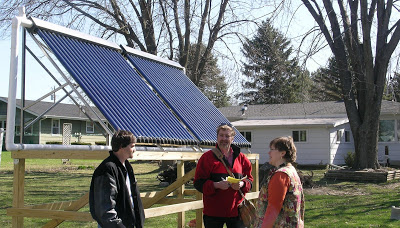
From left to right: Todd Timmerman, solar installer;
Michael Vickerman, RENEW Wisconsin; and Nancy Collins.
From an article in the newsletter of RENEW Wisconsin:
Ben and Nancy Collins weren’t only thinking about energy savings when they installed a solar hot water system at their Platteville residence to serve their family of six. They also wanted to influence their children’s attitudes toward renewable energy use.
Says Nancy Collins: “We want our children to grow up thinking that it’s normal for families to harvest solar energy.”
”It’s not space age or futuristic technology,” she adds. “I was surprised at the simplicity of the system and the efficiency of the heat exchange. It is a sound investment for energy savings. Gas prices have gone up but our bills have stayed the same.”
But there are aspects of the Collins’ solar hot water system that are decidedly not normal. For example, due to heavy shading from nearby trees, the solar collectors could not be placed on the rooftop of the Collins’ home. Instead, the installer, Todd Timmerman of Timmerman’s Talents, Platteville, went searching for the least-shaded section of their yard, which turned out to be their garden.
But such is the Collins’ commitment to harvesting solar energy that they decided to move the garden, and situate the collectors in its place, amidst the cilantro, basil and strawberries. On that space now stands a four-foot-tall wooden structure, housing two collector panels facing the sun at a 45º angle. Since its completion in September 2007, the ground-mounted system has become a neighborhood fixture, a few feet from where neighborhood children congregate and play in the Collins’ yard.
The array installed by Timmerman captures radiant solar energy through a series of vacuum-sealed tubes (also called evacuated tubes). Inside each tube is a copper heat pipe. Sunlight striking each of the 40 tubes heats a liquid inside each heat pipe, which quickly turns into a vapor. The gas travels upwards and releases heat into a larger pipe running along the top of the array. At that point the heat is transferred to a glycol solution that is then pumped into the house to where it heats the water inside.
by jboullion | Sep 25, 2008 | Uncategorized
2012
12.04.12 PSCW Decisions “Tax” Renewable Energy
11.08.12 The Real Meaning of Kewaunee’s Demise
08.16.12 Natural Gas: Wrestling with Reality
2011
07.11.11 Wisconsin’s Widening War on Renewables
2010
11.10.10 Shirley Wind: An Auspicious Debut for Emerging Energies
09.30.10 Meet Butler Ridge, Wisconsin’s Newest Wind Project
09.27.10 Touring This Year’s Renewable Energy Crop
07.12.10 The Oil Spill and You
05.05.10 Impressions of Wind Siting Council’s Tour of Wind Development in Fond du Lac County
05.04.10 A Cruel Month for Renewable Energy
04.15.10 Legislators Fire Blanks at Clean Energy Jobs Act
04.07.10 Costs of Coal Plants Keep Going Up
02.22.10 Of Molehills and Renewable Energy Purchases
02.17.10 Clearing Up Wisconsin’s Lakes With Clean Energy
02.12.10 Letter to Sen. Miller & Rep. Black on rate impacts of ARTs
2009
12.22.09 Think Tank Flunks Renewable Energy Analysis
11.20.09 Fact sheet: Renewable energy buyback rates
10.19.09 Educating Schools on Solar Air Heating
10.10.09 Plain English explanation of wind siting reform law
09.25.09 CWESt’s Report Adds Noise to Wind Debate
08.11.09 Pursuing Sustainability Through Economic Adversity
07.10.09 It’s Time to Bring Renewable Energy Home
06.02.09 Windpower – A Stabilizing Force in an Economic Downdraft
04.07.08 The Importance of Doing the Math
01.27.09 Response to anti-wind comments of State Rep. Bob Ziegelbauer
2008
12.05.08 Q&A on higher buyback rates on electricity from renewables
10.07.08 Palin’s Folly
07.24.08 Sock maker steps up to solar hot water
07.10.08 An Open Letter to Congress: Extend Renewable Energy Tax Incentives
05.19.08 Fossil Fuel Watch: Gas Tax Pain
03.31.08 Oppositon to Windpower Pollutes Climate Policy
01.04.08 Walling Out Wind
2007
07.27.07 A Federal Energy Policy: Can It Happen Here?
03.20.07 Fossil Fuel Watch: Solar, The No-risk Path to Wealth Creation
2006
12.28.06 Fossil Fuel Watch: Meet My Solar Clothes Dryer
11.16.06 Mid-Term Elections: Renewable Energy Cleans Up
11.02.06 Draining Canada First
2005
10.06.05 Fossil Fuel Watch: Stirrings in the Land of What-Me-Worry?
09.21.05 Fossil Fuel Watch: The Eye Between the Storms
by jboullion | Sep 25, 2008 | Uncategorized
From a story on WKBT.com:
The Holmen School District is undertaking an energy challenge.
Tuesday Lietenant Governor Barbara Lawton announced Holmen will participate in her Energy Star School Challenge.
The challenge means the school district makes a committment to reducing its energy consumption by 10 percent.
La Crosse is already participating in the challenge by doing things like turning off lights and computers when they’re not in use, to cut down on energy consumption.
“Becoming more efficient in the use of energy remains an important and necessary goal for the School District of Holmen,” said Holmen School District Superintendent Dale Carlson. “We look forward to partnering with Lt. Governor Lawton and her Energy Star Challenge as we commit to continually improving our energy performance.”
Lawton issued her Energy Star School Challenge in April as part of her Green Economy Agenda. Lawton said that her goal for the challenge is to commit at least 100 new school districts, nearly 25 percent of all Wisconsin school districts, to reduce their energy costs by at least 10 percent.
by jboullion | Sep 24, 2008 | Uncategorized
From an article by Jeff Sherman posted on OnMilwaukee.com:
According to a story today from sustainlane.com, Milwaukee is the 12th most sustainable city in the country. It is first in a ranking of “water supply” and second in one of “natural disaster risk.”
The health and sustainable living Web site says, “America’s 50 biggest cities are thinking green and the 2008 SustainLane U.S. City Rankings-topped by Portland, Ore.-reveal which cities are increasingly self-sufficient, prepared for the unexpected and taking steps toward preserving and enhancing their quality of life.”
Sustainlane.com said this about Milwaukee, “Since Milwaukee inaugurated its first office of sustainability in 2006, green momentum in the Midwestern city has picked up steam. Located on the western shore of Lake Michigan, Milwaukee has invested in New Urbanist redevelopment, consciously folding sustainability into it’s planning and design (one green public housing development nabbed a Sierra Club honor in 2005). It has also taken great care to manage storm water and reduce runoff into the lake and area rivers. And that’s not all: In 2006, five percent of its fleet vehicles ran on alternative energy. A year later, more than 40 percent of the city’s fleet are powered by alternative fuel. A 2006 energy audit of the City Hall complex led to power-saving measures that reduced energy use there by nine percent and saved the city $35,000 in one year. The city also has public outreach campaigns for recycling, composting, and water conservation. The city’s updated bike plan may help get the near-75 percent of car commuters heading out to work…riding their bikes instead!”
by jboullion | Sep 24, 2008 | Uncategorized
From a story on the Web site of WQOW, Eau Claire:
SUPERIOR, Wis. (AP) – Seven shiploads of wind turbine components are being unloaded at the Duluth-Superior port for transport to wind farms across the Midwest and beyond.
The components are being stored on nearly 50 acres at the Twin Ports before they’re trucked to Illinois, Iowa, North Dakota and even as far as Montana.
100-ton-capacity cranes lift and load generators, blades and hubs onto specially built trucks designed to hold the weight. About 2,000 wind turbine components have come through the Twin Ports so far this year.
The Duluth-Superior port set a record in 2007 when 310,000 freight tons of wind cargo passed through.
by jboullion | Sep 23, 2008 | Uncategorized
RENEW Wisconsin’s summer/fall edition of Wisconsin Renewable Quarterly is now online, including the following articles:
Peak Oil Spices Meeting with Cong. Baldwin
Countdown to Solar Tour
Solar H2O on Madison Fire Stations
Global Warming Task Force Report
Wisconsin’s Newest Wind Projects
PHEV+Wind=Clean Air
Small Wind Conference Wrap-up
by jboullion | Sep 23, 2008 | Uncategorized
From a media release from Wisconsin Public Power, Incorporated:
Homeowners looking to build or remodel in communities served by WPPI member utilities have an opportunity to reduce their carbon footprint through WPPI’s GreenMax Home program. WPPI is now soliciting competitive proposals for grants to help fund the construction of up to three net zero energy homes within WPPI member utility service areas.
As part of WPPI’s overall efforts to encourage public and community support for renewable energy, energy conservation and energy efficiency, the GreenMax Home program will help customers build highly efficient, environmentally friendly homes. Grants will be awarded to cover part of the incremental cost of designing and building a GreenMax Home over the cost of constructing a conventional Upper Midwest house. Incremental costs will include the design elements and technologies directly related to reducing energy use or producing energy through renewable resources.
“We are pleased to present another opportunity for homeowners in WPPI member communities to build and live in homes with net zero energy use,” said Senior Vice President of Customer Services and Administration Tom Paque. “The GreenMax Home program allows homeowners to take advantage of renewable energy technologies and demonstrate practical approaches to the efficient use of energy.”
WPPI’s GreenMax Home program supports the design and lifestyle choices that move a home from “highly efficient” to “net zero.” Net zero homes combine state-of-the-art green and environmentally friendly technologies and practices with renewable energy technology to ensure that the homes produce as much energy as they consume. To the greatest extent possible, the energy consumption (heating, cooling and electrical) of the homes will be provided by renewable energy sources.
WPPI’s member utilities are
Alger Delta, MI
Algoma
Baraga, MI
Black River Falls
Boscobel
Brodhead
Cedarburg
Columbus
Cuba City
Eagle River
Evansville
Florence
Gladstone, MI
Hartford
Hustisford
Independence, IA
Jefferson
Juneau
Kaukauna
L’Anse, MI
Lake Mills
Lodi
Maquoketa, IA
Menasha
Mount Horeb
Muscoda
Negaunee, MI
New Glarus
New Holstein
New London
New Richmond
Norway, MI
Oconomowoc
Oconto Falls
Plymouth
Prairie du Sac
Reedsburg
Richland Center
River Falls
Slinger
Stoughton
Sturgeon Bay
Sun Prairie
Two Rivers
Waterloo
Waunakee
Waupun
Westby
Whitehall
by jboullion | Sep 23, 2008 | Uncategorized
From an article in The Country Today:
RIVER FALLS – High prices, uncertainty over future supplies and concerns about global warming have brought energy issues to the forefront of policy debates in Washington and communities across the country.
These same factors are at play in western Wisconsin, where “green” economic development opportunities and the desire to sustain rural working lands are fueling a growing interest in renewable energy such as wind, solar, hydroelectric and biomass, say organizers of a recent survey conducted by the UW-River Falls Survey Research Center.
But data the center has collected show that, while there is a lot of interest and support for green energy, there is not a great deal of actual use at this point.
The survey finds that electricity from renewable sources makes up slightly more than 7 percent, on average, of total energy use in public institutions in western Wisconsin.
The proportion of total electricity used by those organizations that comes from “green” sources is variable, ranging from 25 percent to 2.5 percent.
“There is a huge groundswell of support for renewable energy in St. Croix County,” said Pete Kling, UW-Extension agent for St. Croix County, which funded the survey. “In the past year, more than 500 people have attended renewable-energy forums, round-tables and field tours in western Wisconsin to learn more about opportunities in our own backyards.”
by jboullion | Sep 22, 2008 | Uncategorized
From a media release from Wisconsin Public Power, Incorporated:
Homeowners looking to build or remodel in communities served by WPPI member utilities have an opportunity to reduce their carbon footprint through WPPI’s GreenMax Home program. WPPI is now soliciting competitive proposals for grants to help fund the construction of up to three net zero energy homes within WPPI member utility service areas.
As part of WPPI’s overall efforts to encourage public and community support for renewable energy, energy conservation and energy efficiency, the GreenMax Home program will help customers build highly efficient, environmentally friendly homes. Grants will be awarded to cover part of the incremental cost of designing and building a GreenMax Home over the cost of constructing a conventional Upper Midwest house. Incremental costs will include the design elements and technologies directly related to reducing energy use or producing energy through renewable resources.
“We are pleased to present another opportunity for homeowners in WPPI member communities to build and live in homes with net zero energy use,” said Senior Vice President of Customer Services and Administration Tom Paque. “The GreenMax Home program allows homeowners to take advantage of renewable energy technologies and demonstrate practical approaches to the efficient use of energy.”
WPPI’s GreenMax Home program supports the design and lifestyle choices that move a home from “highly efficient” to “net zero.” Net zero homes combine state-of-the-art green and environmentally friendly technologies and practices with renewable energy technology to ensure that the homes produce as much energy as they consume. To the greatest extent possible, the energy consumption (heating, cooling and electrical) of the homes will be provided by renewable energy sources.
WPPI’s member utilities are
Alger Delta, MI
Algoma
Baraga, MI
Black River Falls
Boscobel
Brodhead
Cedarburg
Columbus
Cuba City
Eagle River
Evansville
Florence
Gladstone, MI
Hartford
Hustisford
Independence, IA
Jefferson
Juneau
Kaukauna
L’Anse, MI
Lake Mills
Lodi
Maquoketa, IA
Menasha
Mount Horeb
Muscoda
Negaunee, MI
New Glarus
New Holstein
New London
New Richmond
Norway, MI
Oconomowoc
Oconto Falls
Plymouth
Prairie du Sac
Reedsburg
Richland Center
River Falls
Slinger
Stoughton
Sturgeon Bay
Sun Prairie
Two Rivers
Waterloo
Waunakee
Waupun
Westby
Whitehall