by jboullion | Jun 13, 2008 | Uncategorized
From a news release issued by Miller Brewing:
MILWAUKEE (June 4, 2008) – Miller Brewing Company today released its second annual Sustainable Development Report, entitled “Live Sustainably.” The report details the company’s progress against its global sustainable development priorities, including areas such as alcohol responsibility, water conservation, energy and carbon reduction, recycling, supply chain management and social investment. The report also features employees who are driving notable sustainable development efforts within the company. . . .
Available online at www.millerbrewing.com, the 28-page report includes the following highlights and efforts by Miller employees:
• Reduced Miller’s water-to-beer ratio to less than 4:1. This reduction is nearly two years ahead of schedule, as the company set this as a 2010 goal.
• Reduced fossil fuel consumption to 1.45 therms per barrel, putting Miller well within reach of a 2010 target of 1.40 therms per barrel.
• Reduced waste to landfill by 2.5 million pounds over the last five years. Miller currently recycles 99.9 percent of all packaging waste.
• Initiated a switch to energy-efficient fluorescent lights in all six brewery facilities that will drive a 9 million kilowatt hour reduction across the company.
• Recycled brewery waste water to generate biogas at our Irwindale brewery that produced enough electrical capacity to power 50 average California homes.
• Expanded the Respect 21® Responsible Retailing Program into 10 new markets and launched Keep Your Balance®, a program designed to educate motorcyclists about responsible riding.
• Tallied more than 1.7 million riders over the 20 year history of the Miller Free Rides program that offers alternative transportation on key holidays to prevent drunk driving incidents.
• Made corporate social investments totaling more than $5.1 million across our brewery communities, representing 1.4 percent of the company’s pre-tax profit.
• Contributed more than $1.7 million since 2001 through the Miller Brewing Company Employee Fund, a cross-functional committee of employees who spearhead the giving campaign, establish a set of criteria for non-profit funding and oversee the distribution of the employee donations to local non-profits. In 2007, the fund contributed $278,217 to 19 organizations that focus on hunger, at-risk youth and domestic violence issues.
by jboullion | Jun 12, 2008 | Uncategorized
From a story by Steve Schultze in the Milwaukee Journal Sentinel:
A Milwaukee County Board committee Wednesday revived the idea of levying a half-cent local sales tax to pay for transit, after hearing appeals from major civic and business groups.
The board’s transportation committee voted 4-3 in favor of holding an advisory referendum on the sales tax idea on the November ballot. The tax would be dedicated to transit and generate an estimated $65 million a year. That’s nearly triple what the county is spending in property taxes on transit.
The additional money could help pay for new buses, enhanced bus security, reduced fares and other improvements, said Supervisor Patricia Jursik, the author of the transit sales tax measure.
Under the language of the referendum question, the county tax levy would be reduced by the same amount the new sales tax would raise — a vital safeguard needed to win public support, county supervisors said.
Jursik described the issue as switching transit funding from the property tax, where Wisconsin ranks high, to the sales tax, where the state is comparatively low. Visitors to Milwaukee also would help fund local transit through a transit sales tax, she said.
by jboullion | Jun 11, 2008 | Uncategorized
From a media release issued by the Milwaukee Common Council:
The Common Council has approved a measure that allows for the acceptance of the U.S. Department of Energy’s Solar America Cities 2008 grant. The measure directs the city’s Office of Environmental Sustainability to apply for and accept a $200,000 grant, matched by $100,000 in allocated city funds, to help remove barriers to the implementation of solar technologies in the city. Milwaukee is one of 12 cities selected for this grant in 2008 and the results of this project will be shared across the country.
Ald. Tony Zielinski (District 14), lead sponsor of the resolution, said the two-year grant will include training for solar panel installers and also provides funds for the production of educational materials to make more residents aware of how solar
technologies work to increase efficiency and save costs.
Under a similar grant, the City of Madison has begun assisting businesses and homeowners who are interested in solar installations.
by jboullion | Jun 10, 2008 | Uncategorized
From a media release issued by Johnson Controls:
MILWAUKEE, June 10 /PRNewswire-FirstCall/ — As increasing numbers of consumers look for fuel-efficient, low emission vehicle options, a test fleet of Ford Escape plug-in hybrid electric vehicles (PHEVs) is making its way on the road today. Powered by lithium-ion batteries from Johnson Controls-Saft, the demonstration fleet will examine the future of PHEVs as part of a complete vehicle, home and grid energy system. The fleet is the result of an ongoing collaboration among Ford, Johnson Controls-Saft, Southern California Edison (SCE) and Electric Power Research Institute (EPRI).
“This fleet demonstrates a major step forward toward validating plug-in hybrid vehicle technology,” said Mary Ann Wright, who leads the Johnson Controls-Saft joint venture and is vice president and general manager of Johnson Controls’ hybrid battery business. “PHEVs, which have the ability to drive an extended range on electric-only power, can significantly reduce emissions and improve fuel economy.”
The 20-vehicle fleet will be tested first in California by SCE and later by other utilities in the New York/ New Jersey area, to help determine regional differences in vehicle usage and performance, as well as how PHEVs will affect the electric grid system and associated infrastructure requirements. The first unit was delivered to California in December; additional units will be on the road in June.
The outcome of the fleet will help to continue to address barriers to commercialization including cost, technology validation, and strategies for charging the vehicles.
by jboullion | Jun 9, 2008 | Uncategorized
Articles in the Renewable Energy Quarterly, Spring 2008, include:
RENEW Battles Local Opposition to Wind
Starting a Renewable Energy Business
Renewable Profiles: Wes Slaymaker
Solar Hot Water from the Garden
Reviving a Classic Wind Machine
Calendar
by jboullion | Jun 6, 2008 | Uncategorized
From an editorial on The Journal Times (Racine):
With the emphasis on global warming this week as the U.S. Senate debates a bill to limit carbon dioxide emissions, let us begin with the idea that the bill is fundamentally wrong.
It wants to impose a cap-and-trade system to control greenhouse gases. The government would allow a certain number of tons of carbon dioxide to be emitted every year — with the number diminishing as time passes — and an auction would allow companies with low emissions could sell their excess capacity to industries with high emissions.
The idea is to adhere to current science and cut carbon emissions below year 2000 levels in order to avoid the more extreme effects of global warming. There is a better method of doing this than the Senate plan, and that is with a tax.
It makes more sense, is more uniform, is much more honest, and would achieve the objective more efficiently.
A cap-and-trade system does not impose a real cost — indeed, as long as a dirty plant can buy credits it can continue operation — and thus interferes with market pressure for change. If all carbon emissions were taxed, all of us would have incentive to reduce our consumption of fossil fuels or choose other power sources. There would be more incentive for energy markets to develop alternatives. Better still, a carbon tax could be, and should be, segregated into a pool of money used for alternative energy research and development.
by jboullion | Jun 5, 2008 | Uncategorized
From an article by Karen Herzog in the Milwaukee Journal Sentinel:
A partnership between a city farm and a Milwaukee trade school will build an urban agricultural training space atop a “green” garage in the Riverwest neighborhood, complete with year-round, rooftop garden.
The project, called Growing Spaces, is a joint venture of the non-profit farm Growing Power Inc., 5500 West Silver Spring Road, and Bradley Tech High School, 700 S. 4th St. Details are to be announced at a 3 p.m. press conference today at the school.
Bradley Tech seniors in carpentry, electrical and plumbing classes will build the 3.5-bay garage beside a private home in Riverwest, starting in the fall. The homeowner, Kate Halfwassen, will coordinate the project and lease the garage back to Growing Power in what amounts to at least a five-year donation of the space, Halfwassen said Tuesday.
The garage will be built against a hillside with wood concrete forms – a green material combining recycled wood and cement. Solar panels on a rooftop shed will power the garage doors and heat water and soil for winter food production in the rooftop hoop-house.
by jboullion | Jun 4, 2008 | Uncategorized
From the Energy Fair workshop schedule of the Midwest Renewable Energy Association (MREA):
The MREA will host a special session on eco-municipalities for elected officials or other municipal government staff . This session will be held on the same day of Torbjorn Lahti’s keynote presentation, and will build on the concepts presented. Don’t miss this chance to get a fun, in-depth study of sustainable community initiatives that can be implemented in everyday governmental decisions and policies. Course Cost: $30.00 Course Prerequisite: The Natural Step for Communities, which can be purchased through the MREA Marketplace online or at the Energy Fair.
by jboullion | Jun 3, 2008 | Uncategorized
From a story by Avrum Lank in the Milwaukee Journal Sentinel:
Sturgeon Bay – John Hippensteel believes a person has only one original idea in a lifetime.
His can be summed up in two words: flower power.
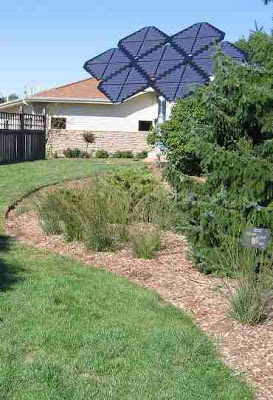
Not the kind expressed in bright splashes of color on psychedelic concert posters or daisies put down gun barrels during anti-war demonstrations, but actual power from flowers.
OK, not real flowers. Rather from sculptures that look like flowers – and rather unusual sculptures at that.
A professional engineer, Hippensteel designs, builds and installs large arrays of photovoltaic solar panels made to look like flowers. He hopes the product line he and wife, Ann, have dubbed Solar Flairs will be the key to a blossoming of their business, Lake Michigan Wind and Sun Ltd., which they run out of a 100-year-old farmhouse on 40 acres near the Lake Michigan shoreline in the southern Door County Town of Clay Banks.