by RENEW Wisconsin | Dec 16, 2022 | Community, Local Initiatives, Press Release, Solar for Good
MADISON, WI – The Solar for Good grant program has awarded over $120,000 in grants and solar panel donations to Wisconsin nonprofit organizations. Thirteen nonprofits will install approximately 460 kilowatts of solar electricity, leading to more than $1.2 million in renewable energy investments in Wisconsin.
The following organizations have been offered Fall 2022 Solar for Good grants to install new solar energy systems:
Chequamegon Humane Association – animal shelter, Ashland
Cinnaire Solutions – affordable housing, Lac du Flambeau
Clyde Community Center – community service, Avoca
Friends of Sauk Prairie Parks & Recreation – community service, Prairie du Sac
Harry and Rose Samson Family JCC – religious, Mequon
Peace Lutheran of Pigeon Falls – religious, Pigeon Falls
People’s United Methodist Church – religious, Oregon
Racine Dominican Eco-Justice Center – community service, Racine
Rotary Club of Greater Portage County – community service, Stevens Point
Shirley M. Wright Memorial Library – community service, Trempealeau
St. Dunstan’s Episcopal Church – religious, Madison
WAFER Food Pantry – meal distribution, La Crosse
* One organization has asked to remain anonymous at this time.
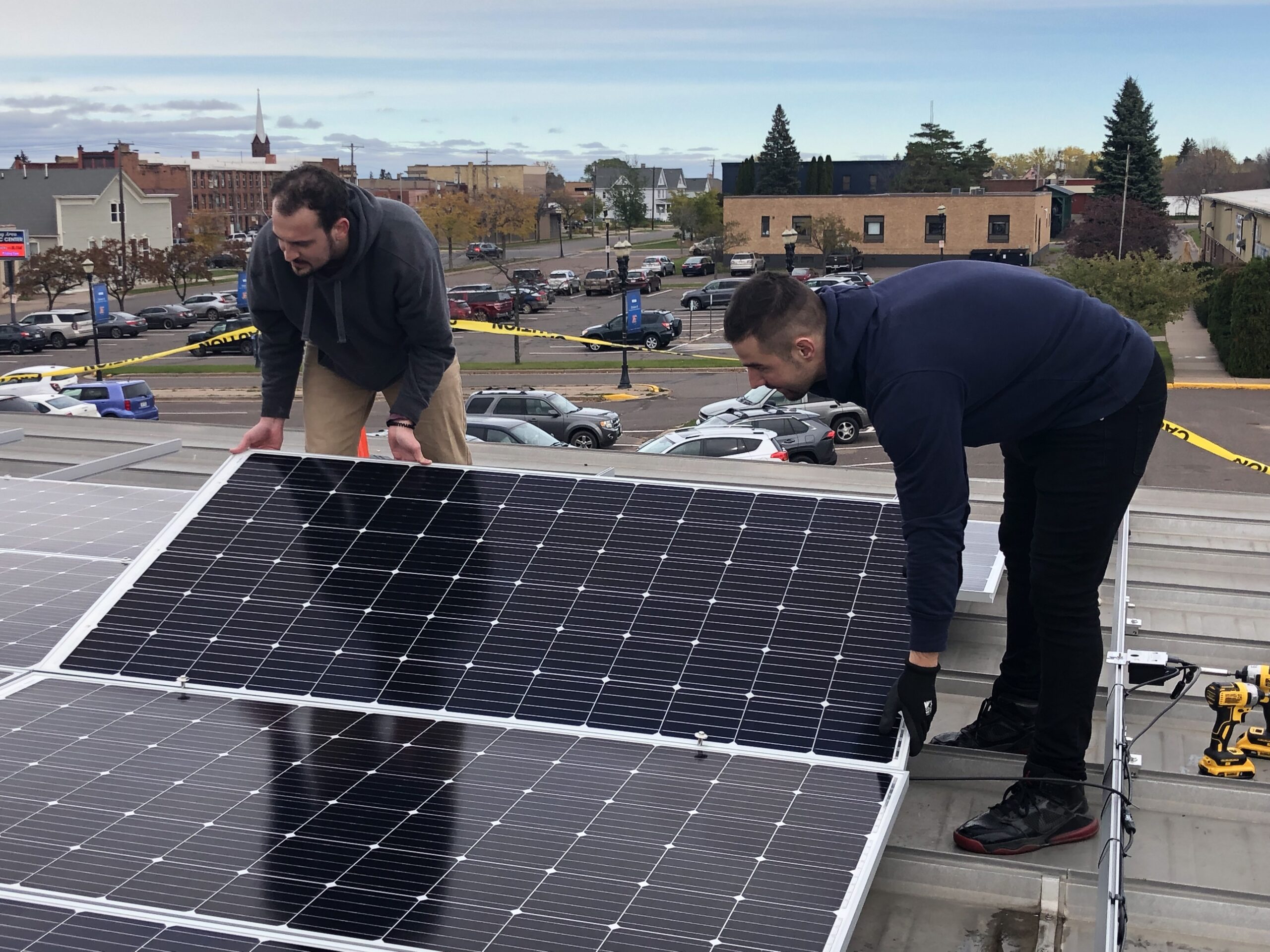
The nonprofit grant recipients from the Fall 2022 round represent a wide range of organizations across Wisconsin. Cinnaire Solutions, an affordable housing provider, will install 100 kilowatts of solar at their Forest Edge development in Lac du Flambeau, which will directly provide energy to 40 low-income tenants. The Rotary Club of Portage County is working with students from Mid-State Technical College to install a 7-kilowatt solar system on top of the Salvation Army Hope Center in Stevens Point. And the Shirley M. Wright Memorial Library will install 60 solar panels at the public library in Trempealeau.
“The Solar for Good grant is a transformative addition to this project,” stated Elizabeth Rask of Cinnaire Solutions. “Solar infrastructure is rarely included in affordable housing developments due to cost. With Solar for Good’s support, we will be able to install photovoltaic infrastructure, which will reduce the cost to residents and ensure long-term sustainability.”
The main stipulation of the grant requires each organization to highlight its solar project in the community and educate its members about the benefits of renewable energy.
“This project is a true community collaboration involving the Rotary Club of Greater Portage County, the Salvation Army, Mid-State Technical College, the Community Foundation of Central Wisconsin, and the local community of professional solar installers,” said Ben Nusz of the Rotary Club of Portage County. “The completed installation will leave a lasting impact on an organization in great need.”
The 13 nonprofits are a part of Solar for Good’s 11th round of funding. The program has offered solar grants to 161 Wisconsin-based nonprofits since it began in 2017. When all projects are complete and energized, Solar for Good grant recipients will add over 7.6 megawatts of renewable energy to Wisconsin’s electric grid, providing enough electricity to power approximately 1,600 Wisconsin households.
###
About Solar for Good RENEW Wisconsin’s Solar for Good initiative fosters the expansion of solar power among mission-based nonprofits and houses of worship in Wisconsin. Through a generous partnership with Couillard Solar Foundation, RENEW Wisconsin awards grants and solar panels to nonprofit organizations, helping them switch to clean, renewable, solar energy.
About RENEW Wisconsin RENEW Wisconsin is a nonprofit organization that promotes renewable energy in Wisconsin. We work on policies and programs that support solar power, wind power, biogas, local hydropower, geothermal energy, and electric vehicles. www.renewwisconsin.org.
About Couillard Solar Foundation the Couillard Solar Foundation is a 501c3 nonprofit whose mission is to further the urgent path to decarbonization for Wisconsin and create a cleaner, safer environment for everyone, regardless of socio-economic status. The Couillard Solar Foundation helps schools and nonprofits gain vital access to solar power by providing solar panels, programs, and education through the Solar for Good and Solar on Schools grant programs. For more information, please visit www.CouillardSolarFoundation.org

by Jodi Jean Amble | Dec 14, 2022 | Community, Press Release, Solar
December 14, 2022 – SUN PRAIRIE, WI, has been selected by the National Renewable Energy Laboratory (NREL) as one of 12 communities nationwide to adopt the innovative solar permitting platform SolarAPP+. Through the program, Sun Prairie is eligible to receive $15,000 if SolarAPP+ is adopted successfully.
“We’re excited to see NREL’s announcement and the fact that residential solar is receiving its time in the spotlight in Sun Prairie,” said Sam Dunaiski, Executive Director of RENEW Wisconsin. “This platform will help Wisconsin households remove barriers to accessing solar energy.”
SolarAPP+ is an online platform that instantly issues permits for code-compliant residential rooftop photovoltaic (PV) and battery systems. As many consumers and local jurisdictions know, permitting can often slow the process for residential solar and battery installations. Current permitting delays are estimated to increase the cost of solar by $7,000 per project. With the convergence of increased consumer interest in solar installation and federal legislative momentum, clearing this potential bottleneck of long review timelines and complicated permitting applications is imperative. SolarAPP+ provides local governments, installers, and homeowners with a streamlined process to quickly achieve clean power generation from the sun.
Burke O’Neal, co-owner of Full Spectrum, a solar installer based in Madison, WI, is looking forward to Sun Prairie using the SolarApp+ platform to standardize the residential solar permitting process and make it more efficient cost-effective. “Widespread adoption of the program will reduce system costs and speed up installations,” he said. “This means more homeowners will be able to cut their energy bills with a photovoltaic system on their own roof.”
SolarAPP+ has approved more than 10,000 permits across jurisdictions, including successful programs in Arizona, California, Illinois, and Texas. Since SolarAPP+ provided an immediate permit for those communities vetted and determined to be eligible, projects have been installed about two weeks faster under the program.
“The City of Sun Prairie applied to participate in the SolarAPP+ competition to explore the tool and better understand how our permitting process could utilize support from NREL,” said Scott Semroc, Sustainability Coordinator for the City of Sun Prairie. “The city will learn more about the potential integration of the SolarAPP+ platform to augment our existing permitting process, potentially reducing permitting time, freeing up Building Maintenance staff capacity, and overall enabling community investment in renewable energy resources by lowering barriers and streamlining the Solar PV permit process for 1-2 family residences. We are excited to participate in this challenge with our peer communities and further explore this opportunity.”
To see the existing residential Solar PV permit application for the City of Sun Prairie, visit the City of Sun Prairie’s website.
In Sun Prairie and across Wisconsin, RENEW Wisconsin continues to work tirelessly to ensure programs like SolarAPP+ and others are helping both new and existing solar customers reap benefits from their rooftop PV systems. RENEW hopes this first step inspires more local governments to use this free platform to cut red tape and reduce costs for every taxpayer and government entity.
by RENEW Wisconsin | Oct 31, 2022 | Advocacy, Community, Local Government, Local Initiatives, Press Release, RENEW Wisconsin
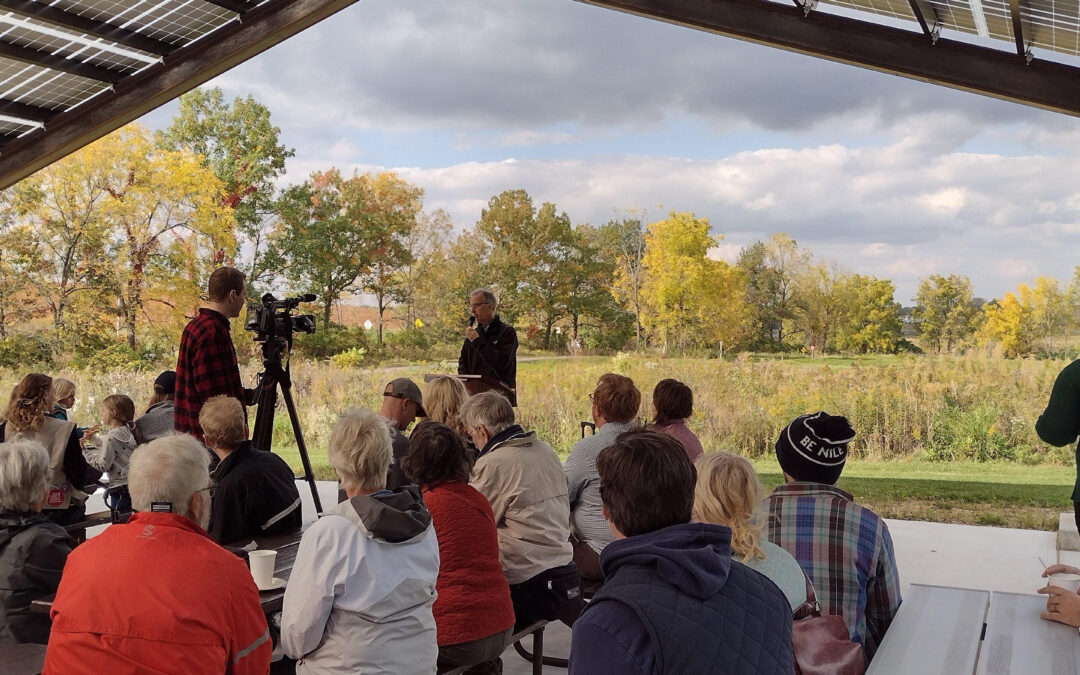
On Thursday, October 6th, County Executive Joe Parisi joined the Office of Energy and Climate Change (OECC) to recognize local entities leading on climate action through Dane County’s Climate Champions program. The aim is to celebrate local leadership in fulfilling the goals outlined in Dane County’s Climate Action Plan, which commits Dane County to reduce greenhouse gas emissions 50% county-wide by 2030 and puts the county on a path to be carbon-neutral by 2050.
This year 87 Climate Champions are being awarded, representing 77 organizations. The Office of Energy & Climate Change recognizes achievements across ten categories, including:
- Building Energy Use -for entities with very energy-efficient buildings.
- Building Design -for still-under-construction facilities projected to be very energy efficient.
- Fleet Operations -for entities with a fleet powered by clean fuels.
- Employee Commuting -for entities where the workforce commutes via bike, walking, transit, or telecommuting.
- Water Saving Practices -for entities that have implemented practices to reduce water usage.
- Waste Diversion Practices -for entities that have strong waste diversion practices.
- Sustainable Land Use Practices -for farms and land with strong sustainability practices.
- Catalysts -entities that help others take climate actions.
- GHG Emissions -for entities that have reduced their carbon footprint.
- Other -for entities that have taken actions that don’t fit into other categories.
Entities that achieve Climate Champion status receive signage and recognition on the OECC website.
“We are excited to celebrate another cohort of Climate Champions,” said Dane County Executive Joe Parisi. “The leadership these organizations are taking to enhance their sustainability and meet our climate goals is admirable and inspiring to others.”
Each Climate Champion category has four levels of distinction, with four stars indicating the highest level of achievement in that category. In 2022, six entities representing three projects are receiving four stars. These entities include design craft Advertising, Greater Madison MPO, Madison Friends Meeting (Religious Society of Friends), and its building team: Ferch Architecture, Ideal Builders, and Full Spectrum Solar.
Additionally, nine local entities are earning awards in two or more categories, including design craft Advertising; Mad Local Food Group LLC, dba “Pasture and Plenty”; Madison Christian Community; Middleton Community Church, UCC; Monona Grove School District; Summit Credit Union; Sun Prairie Area School District; UW-Madison; and Willy Street Grocery Cooperative.
“The Climate Champions program is an important way for us to recognize how organizations across the county are helping to accelerate climate action. We are energized by how much this program has grown since its inception and are hopeful the actions these organizations are taking can spur additional action across Dane County,” Parisi added.
The full list of 2022 Dane County Climate Champions:
- AprilAire – AprilAire achieved 2022 Climate Champion (Catalyst) status for developing ENERGY STAR-certified dehumidifiers and fresh air ventilators that help customers make their homes more energy efficient.
- Arch Solar – Arch Solar achieved 2022 Climate Champion (Catalyst) status for helping over 100 homeowners install nearly 1 MW of solar in Dane County over the past two years. In addition, Arch Solar volunteers with renewable energy nonprofits to educate the community about solar and related technologies and has received grants to grow the solar workforce in underserved areas.
- Bayview Foundation and its construction partners Horizon Development Group, Kubala Washatko Architects, SmithGroup, Spire, and Design Engineers – Bayview Foundation and partners achieved 2022 Climate Champion (3 Star/Building Design) status for their redevelopment of the Bayview affordable housing units and community center. These apartment buildings and community centers incorporate high energy efficiency features, including Passive House for the Community Center and ENERGY STAR for the townhomes. The facility is projected to use just a quarter of the energy used by comparable facilities.
- Belle Farm – Belle Farm achieved 2022 Climate Champion (3 Star/Other) status for the Belle Farm development. The 44-acre eco/agri/wellness neighborhood in Middleton is planned to create a sustainable, walkable community of 880 dwelling units. To achieve near-net zero, all facilities will use geothermal heating and cooling, rooftop solar, passive design measures, and robust EV capabilities.
- Biological Farming Friends – The Biological Farming Friends achieved 2022 Climate Champion (3 Star/Sustainable Land Use) status for sustainable land practices, including using cover crops, reducing fertilizer and chemical inputs, and increasing the use of no-till agriculture on over 10,000 acres since 2018, as well as adopting rotational grazing on over 500 acres. Creating resilient farming systems has reduced carbon emissions and sequestered carbon on marginal cropland through perennial covers.
- Boys & Girls Clubs of Dane County and its construction partners OPN Architects, JSD, Hooper, Staff Electric, and Dave Jones Plumbing – Boys & Girls Clubs of Dane County and partners achieved 2022 Climate Champion (1 Star/Building Design) status for their new Workforce Training Center. The center will use approximately 25% less energy than a comparable facility and include geothermal heating and solar panels to support student learning about sustainable construction.
- Capital Area Regional Planning Commission – The Capital Area Regional Planning Commission achieved 2022 Climate Champion (3 stars/Employee Commuting) status for 90% of employees regularly telecommute, bike to work, or take mass transit to work than driving alone.
- City of Madison
- The City of Madison achieved 2022 Climate Champion (3 Star/Building Energy Use) status for Fire Station 13, which uses around 75% less energy than similar buildings through a combination of solar power, geothermal, and passive lighting systems that are efficient and cost-effective.
- The City of Madison achieved 2022 Climate Champion (2 Star/Building Energy Use) status for Pinney Library, which uses over 50% less energy than a comparable building. The LEED® Gold building has geothermal energy and LED lighting with daylight sensors.
- The City of Madison achieved 2022 Climate Champion (1 Star/Building Energy Use) status for the Police Training Center, which uses about 25% less energy than a comparable building.
- The City of Madison achieved 2022 Climate Champion (1 star/Building Energy Use) status for the Water Utility Building, which uses approximately 25% less energy than a comparable building.
- City of Sun Prairie – The City of Sun Prairie achieved 2022 Climate Champion (2 Star/Employee Commuting) status for creating policies such as telecommuting, carpool facilitation, and emergency rides that encouraged 45% of employees to choose not to drive alone to work.
- Cooper’s Tavern – The Cooper’s Tavern achieved 2022 Climate Champion (1 Star/Other) status for using local, organic, and sustainably sourced food to reduce emissions for transporting food; working to recycle fryer oil into biodiesel for farmyard vehicles; partnering with university students to turn food waste into compost, and using recycled materials in takeout packaging and other paper materials.
- Couillard Solar Foundation – Couillard Solar Foundation achieved 2022 Climate Champion (Catalyst) status for helping 41 sites in Dane County acquire a total of 2.58 MW of solar power via grants to nonprofits and schools.
- CUNA Mutual Group and its construction partners Eppstein Uhen Architects (EUA) and Affiliated Engineers (AEI) – CUNA Mutual Group and partners achieved 2022 Climate Champion (1 Star/Building Design) status for their rebuilding of the 5810 Mineral Point Road building. The energy-efficient building will use approximately 25% less energy than a comparable building. It will support employee well-being and offer outdoor spaces with native vegetation, while captured rainwater will be used for irrigation and building flush fixtures, saving 348,000 gallons of water a month.
- designCraft Advertising – DesignCraft Advertising achieved 2022 Climate Champion (4 Star/Employee Commuting) status for allowing all employees to telecommute rather than travel to the office in person. They also achieved 2022 Climate Champion (2 Star/Greenhouse Gas Emissions) status for having corporate emissions lower than 70% of their peer companies.
- Door Creek Orchard – Door Creek Orchard achieved 2022 Climate Champion (3 Star/Sustainable Land Use) status for sustainable land practices on the 80-acre property since 1984. These include reduced or no-till agriculture, continuous cover crops, increased nitrogen use efficiency, active tree maintenance, rotational grazing, controlled burns, and 16-plus acres of prairie/wetland restoration.
- Drews Solar LLC – Drews Solar achieved the 2022 Climate Champion (Catalyst) for installing rooftop solar arrays and electric car chargers to help families produce 90-110% of their annual electricity needs. The company is on track to install over 2,000 solar panels in 2022.
- Edgerton Hospital – Edgerton Hospital achieved 2022 Climate Champion (1 Star/Building Energy Use) status. The hospital, which features geothermal heating and cooling, uses about 25% less energy than a comparable hospital. Edgerton Hospital was the first hospital in Wisconsin to be built with geothermal heating and cooling.
- Filament Games – Filament Games achieved 2022 Climate Champion (3 Star/Employee Commuting) status for allowing all employees who would like to work from home to do so, resulting in less than 6% of employees regularly driving alone. This also allowed the office to downsize to less than a tenth of its previous square footage when the company’s employee count is the highest it’s ever been.
- First Unitarian Society of Madison – First Unitarian Society of Madison achieved 2022 Climate Champion (1 Star/Building Energy Use) status. Solar power and energy-efficient features enable this campus to use about 25% less energy than comparable facilities. FUS Madison achieved LEED® Gold status in 2009 with a modern addition that featured ground source heat pumps. After the addition, the FUS green team continued to pursue energy savings with a large solar array and smart HVAC management.
- Girl Scout Troops #1477 & #1952 – Girl Scouts of Wisconsin Badgerland Council – Girl Scout Troops #1477 and #1952 achieved 2022 Climate Champion (Catalyst) status for their advocacy to reduce the embodied carbon of building materials, including concrete. Through two videos and various in-person and virtual presentations, the Girl Scouts reached thousands of building professionals worldwide. Locally they inspired the City of Madison Engineering Department to explore low-carbon concrete options and hosted a virtual roundtable to facilitate dialogue between local building industry groups.
- Glass Nickel Pizza Co, West – Glass Nickel Pizza Co, West achieved 2022 Climate Champion (1 Star/Other) status for taking sustainable actions every day, including shopping locally, using recycled materials, reducing single-use plastics, composting, and recycling fryer grease.
- Greater Madison MPO – Greater Madison MPO achieved 2022 Climate Champion (4 Star/Employee Commuting) for encouraging alternate transportation options so that no employees regularly commute to work by driving alone.
- Green Box, LLC – Green Box achieved 2022 Climate Champion (Catalyst) status for collecting and composting 26,000 pounds of food waste in seven months, preventing that waste from ending in a landfill, and producing methane.
- HGA – HGA achieved 2022 Climate Champion (Catalyst) status for working with clients to design energy-efficient new and retro-commissioned buildings with renewable energy and reduced embodied carbon. Recent HGA clients include SSM Health, Sun Prairie School District, Oregon School District, and Middleton Business Park.
- Holy Wisdom Monastery – Holy Wisdom Monastery achieved 2022 Climate Champion (3 Star/Sustainable Land Use) status for sustainable land practices, including 190 acres of continuous cover, 170 acres managed with controlled burns, 130 acres of native prairie restoration, and a restored lake.
- Legacy Solar Co-op – Legacy Solar Co-op achieved 2022 Climate Champion (Catalyst) status for increasing solar education and adoption of solar in Dane County. In 2020 and 2021, they educated hundreds of residents and supported 32 installations for 245 kW of solar. Legacy Solar Co-op (LSC) is a statewide member-owned cooperative that provides expert consulting and financing services to facilitate solar projects for communities and nonprofits in Wisconsin.
- Mad Local Food Group LLC, dba “Pasture and Plenty” – Pasture and Plenty achieved 2022 Climate Champion (3 Star/Waste Diversion Practices) status for diverting at least 60% of their waste from the landfill via minimizing packaging and other raw materials, incentivizing reuse, reducing contamination of the waste streams, recycling, and composting. Pasture and Plenty also achieved 2022 Climate Champion (2 Star/Greenhouse Gas Emissions) status for having fewer emissions than at least half of the comparable businesses. Pasture and Plenty achieved lower emissions via bike delivery of meal kits, buying local food, reducing energy usage in their building, and buying green power. Pasture and Plenty advocates for environmental equity through food access programs, community classes, and training.
- Madison Christian Community – Madison Christian Community achieved 2022 Climate Champion (3 Star/Sustainable Land Use) status for sustainable land practices on their 0.66-acre property, which they have been implementing since 1970. They have practiced reduced/no-till agriculture, controlled burns, and riparian/wetland restoration on their land. They also achieved 2022 Climate Champion (1 Star/Water Saving Practices) status for minimizing winter salt application, installing rain barrels and green infrastructure, and using native plants.
- Madison Friends Meeting (Religious Society of Friends) with its construction partners Ferch Architecture, Ideal Builders, and Full Spectrum Solar – Madison Friends Meeting (Religious Society of Friends) and its partners achieved 2022 Climate Champion (4 Star/Building Design) status for their renovation of Friends Meetinghouse. A geothermal heating and cooling system coupled with rooftop solar arrays make the facility nearly net-zero in energy consumption. In addition to using less than 20% of the energy of comparable facilities, the Meetinghouse is now all electric. Project partners include Friends Meeting renovation managers Susan Kummer and Richard Pifer; David Ferch, architect; Hein Engineering Group; Ideal Builders; Full Spectrum Solar; Legacy Solar Co-op; Johnson Bank; and Quaker Power and Light.
- Metcalfe’s Markets – Metcalfe’s Markets achieved 2022 Climate Champion (Catalyst) for their commitment to local producers and using food miles signs to help shoppers make sustainable choices by understanding where their food comes from and their carbon footprint. The stores also have a strong tradition of sustainable practices, including reducing single-use plastics, using renewable electricity, and working to minimize food excess.
- Middleton Community Church, UCC – Middleton Community Church UCC achieved 2022 Climate Champion (Catalyst) status for their Earth Day Every Day: EV Car & Sustainability Show. Over 150 people visited the event, with 25 electric cars on display, e-bikes for test-driving exhibits from numerous local solar and environmental organizations, electric lawn equipment, and more. They also achieved 2022 Climate Champion (1 Star/Greenhouse Gas Emissions) status for having 45% fewer carbon emissions than a similar church.
- Midwest Solar Power – Midwest Solar Power achieved 2022 Climate Champion (Catalyst) status for installing over 650 kW of residential and small commercial solar in 2021 and providing education about solar.
- Monona Grove School District
- Monona Grove School District achieved 2022 Climate Champion (2 Star/Building Energy Use) status for Granite Ridge, a new elementary school in Cottage Grove that uses about half the energy of a comparable school.
- Monona Grove School District and its construction partner McKinstry Inc. LLC achieved 2022 Climate Champion (1 Star/Building Design) status for the energy efficiency upgrades and addition of solar panels on the roof of Monona Grove High School. The solar array is the largest in a K-12 school in Wisconsin and should provide about half of the school’s electric usage.
- Odyssey Farm – Odyssey Farm achieved 2022 Climate Champion (3 Star/Sustainable Land Use) status on 14 acres, focusing on regenerative agricultural practices such as continuous cover, rotational grazing, increased nitrogen efficiency, and tree maintenance.
- Promega – Promega achieved 2022 Climate Champion (2 Star/Building Energy Use) status for the Kornberg Center. A 250 kW solar array and ground source heat pumps reduce the building’s energy needs, while a 50,000-gallon rainwater collection system and green roof reduce stormwater run-off. The center uses less than half as much energy as comparable facilities.
- Purple Cow Organics – Purple Cow Organics achieved 2022 Climate Champion (1 Star/Other) status for manufacturing compost that will increase the organic matter in soil and improve the soil’s ability to sequester carbon. Purple Cow processes an average of 18 million pounds of green material annually, resulting in over 4,000 additional tons of carbon sequestered this year.
- RENEW Wisconsin – RENEW Wisconsin achieved 2022 Climate Champion (Catalyst) status for leading the MadiSUN program, which makes it easier for households across Dane County to access solar power. As part of MadiSUN, RENEW is also developing a workforce development plan to increase the solar labor force in Dane County by recruiting candidates from historically underserved populations, providing training, and connecting them with potential employers.
- RenewAire – RenewAire achieved 2022 Climate Champion (2 Star/Building Energy Use) status. Leveraging natural daylighting and LED lighting, the LEED® gold-certified building uses only half as much energy as comparable facilities.
- Short Stack Eatery – Short Stack Eatery achieved 2022 Climate Champion (2 Star/Waste Diversion Practices) status for its efforts to minimize waste, incentivize reuse, reduce packaging, and minimize contamination. This has resulted in diverting over 50% of their waste from landfill.
- Slipstream – Slipstream achieved 2022 Climate Champion (Catalyst) status for helping to develop energy-efficient affordable housing via the Bayview project, hosting webinars and classroom events to educate building professionals, and managing the Commercial Property Assessed Clean Energy (C-PACE) program to help property owners obtain low-cost loans for energy efficiency, renewable energy, and water conservation.
- Standard Imaging, Inc. – Standard Imaging achieved 2022 Climate Champion (3 Star/Building Energy Use) status. With solar panels and geothermal heating and cooling, the building is fully electric and uses just a quarter of the energy of a comparable facility.
- Summit Credit Union
- Summit Credit Union achieved 2022 Climate Champion (1 Star/Building Energy Use) status for their Headquarters building, which has solar panels, a rainwater cistern for irrigation, a white roof, electric car charging, and prairie landscaping, resulting in over 25% less energy usage than a similar building.
- Summit Credit Union achieved 2022 Climate Champion (1 Star/Other) status for supporting employees and members in sustainability efforts through a Summit Sustainability Champions group, offering energy efficient and solar loans, reducing waste, and participating in environmental events.
- Sun Badger Solar – Sun Badger Solar achieved 2022 Climate Champion (Catalyst) status for installing over 60 residential solar arrays in Dane County in 2022 with a combined capacity of 555 kW and an annual output of almost 750,000 kWh of electricity.
- Sun Prairie Area School District
- Sun Prairie Area School District and its construction partners Bray Architects, Fredericksen Engineering, Muermann Engineering, and HGA – Sun Prairie Area School District and its partners achieved 2022 Climate Champion (2 Star/Building Design) status for West High School. A solar array will provide 10% of the building’s energy, while geothermal heat pumps and LED lighting will reduce the school’s energy consumption. The school is expected to use about half as much energy as a comparable school.
- Sun Prairie’s Patrick Marsh Middle School achieved 2022 Climate Champion (2 Star/Other) status for a student project to reduce food waste at the school. Students developed initiatives to reduce up to 60% of wasted food heading to the landfill and partnered with the City of Sun Prairie to lead composting classes.
- SunVest Solar LLC – SunVest Solar achieved 2022 Climate Champion (Catalyst) status for developing and installing commercial and distribution-level utility solar projects. Past projects include the 1.85 MW array at Madison College. SunVest is working with Dane County and Alliant Energy to complete the 17 MW Yahara Solar Project to provide renewable energy to Dane County facilities. In addition, SunVest works to educate students and other community members on the benefits of solar.
- Sustain Dane – Sustain Dane achieved 2022 Climate Champion (Catalyst) status for their Climate Action Program, which resulted in 143 climate action commitments and another educational program to inspire climate action across the county.
- The Neutral Project and its construction partners Michael Green Architecture, Equilibrium Engineers, ARUP, and RDH – The Neutral Project and partners achieved 2022 Climate Champion (3 Star/Building Design) status for Bakers Place, a new apartment building featuring mass timber construction, green roofs, a community garden, and electric car and bike sharing. The 15-story building was designed to reduce both operational and embodied carbon emissions. The building is projected to use just a quarter of the energy of comparable facilities.
- UW Health
- UW Health achieved 2022 Climate Champion (3 Star/Building Energy Use) status for the UW Health Union Corners Clinic at 2402 Winnebago St., which uses about a quarter of the energy of similar clinics. The LEED® Silver clinic was a 2 Star Climate Champion in 2020 and has continued to improve, earning it 3 Stars and an ENERGY STAR Rating of 98.
- UW Health achieved 2022 Climate Champion (1 Star/Building Energy Use) status for the UW Health hospital at 4602 Eastpark Blvd, which is 20% more energy efficient than average hospitals. This building was recognized as an “Emerging” Champion in 2020 but has continued to improve, earning an ENERGY STAR score of 81.
- UW Madison
- UW Madison achieved 2022 Climate Champion (1 Star/Building Energy Use) status for Cooper Hall, which is approximately 25% more energy efficient than similar buildings. The building uses centrally supplied steam and chilled water to heat and cool the building.
- UW Madison achieved 2022 Climate Champion (2 Star/Employee Commuting) status for having 40% of UW Madison employees commute to work by bike, bus, carpool, or on foot most of the time, with additional employees able to telecommute. Programs such as discounted employee bus pass, campus bus service, covered bike storage, carpool programs, custom route planning assistance, and the emergency ride home program reduce single-passenger driving.
- Village of McFarland Police Department – The village of McFarland Police Department is recognized as an Emerging 2022 Champion (Fleet Operations) for purchasing its first battery electric police vehicle for its fleet.
- Willy Street Grocery Cooperative – Willy Street Grocery Cooperative achieved 2022 Climate Champion (3 Star/Waste Diversion Practices) status for its efforts to minimize waste and increase recycling and composting, resulting in over 60% of waste being diverted from landfill. They also achieved 2022 Climate Champion (2 Star/Water Saving Practices) status for their food waste reduction measures, efforts to educate customers about water-saving practices, and installation of green infrastructure for gardening and run-off reduction.
- Wisconsin Creation Care Ambassadors – Wisconsin Creation Care Ambassadors achieved 2022 Climate Champion (Catalyst) status for supporting faith communities interested in reducing their energy use or “greening” their building by adding solar panels, etc. They act as ambassadors for climate action by reaching out to congregations and providing speakers. In addition, they created a green team network to offer opportunities to environmentally-minded members of Dane County faith communities to network, collaborate, and inspire each other.
To learn more about the 2022 Climate Champions, visit the Dane County of Energy and Climate Change website and the related Climate Champions map.
by RENEW Wisconsin | Aug 15, 2022 | Advocacy, Community, Electrification, Policy, Press Release, Renewables
After decades of inaction punctuated by occasional half-measures, Congress has passed monumental legislation committing the nation to pursue a clean energy transformation that will benefit all sectors of American society.
The enactment of the Inflation Reduction Act, which cleared the House of Representatives today, will signal to the rest of the world that the United States is “all in” on decarbonizing the domestic economy while greatly expanding investment and career opportunities in the clean energy arena.
Specifically, this legislation represents a 10-year commitment to scaling up the deployment of clean energy technologies, electric vehicles, and electrified heating and cooling systems produced and delivered by U.S. companies.
With its emphasis on strengthening America’s productive capacity and workforce to deliver clean energy to our fellow citizens, this legislation is genuinely an industrial-strength response to the climate emergency enveloping our planet.
We at RENEW look forward to working collaboratively with federal and state agencies, businesses, farmers, local governments, and schools to help deliver the benefits of the clean energy transformation to every Wisconsinite.

by Jodi Jean Amble | Jul 25, 2022 | Local Initiatives, Press Release, Public Service Commission, Solar
On Thursday, the Wisconsin Public Service Commission (PSC) agreed to open a docket to determine whether individual residents and businesses may access renewable energy produced on their premises using equipment owned by third parties.
“RENEW Wisconsin commends the PSC decision,” said RENEW Wisconsin Policy Director Michael Vickerman. “While this arrangement, often described as third party-financing, is expressly legal in 29 states, it has remained a legal gray area in Wisconsin for far too long.”
“In accepting the petitions filed by Vote Solar and the Midwest Renewable Energy Association, the PSC has now committed to resolving this ambiguity,” Vickerman continued. “PSC affirmation of third party financing is essential to spreading the benefits of clean energy to all Wisconsin utility customers.”
Vickerman noted that this lingering uncertainty has greatly impeded renewable energy uptake among individuals and organizations that cannot afford large upfront outlays or do not qualify for federal tax credits. These particular customers include nonprofits, small businesses, houses of worship, schools and local governments, and low-to-moderate income residents.
Vickerman continued: “A favorable ruling from the PSC would allow Wisconsin’s solar marketplace to catch up with neighboring states such as Iowa and Illinois. In those states, there is no barrier to customers hosting renewable energy systems owned by third parties and paying for this service through a lease or a power sale agreement.”
“We believe third-party financing is a critically important tool for empowering customers to scale back their fossil fuel usage,” Vickerman said. “Without expressly affirming the legality of ordinary financing mechanisms such as leases, we do not see how the state of Wisconsin will come anywhere near close to achieving a net zero carbon goal by 2050.”
by Michael Vickerman | Apr 28, 2022 | Advocacy, Press Release, PSC Priorities, Solar
But a federal anti-dumping investigation jeopardizes solar power build-out in Wisconsin
Having secured approval today from the Public Service Commission (PSC) to build six more solar power plants, Alliant Energy’s Wisconsin affiliate is on a trajectory to source 20% of its electricity from solar power by 2025.
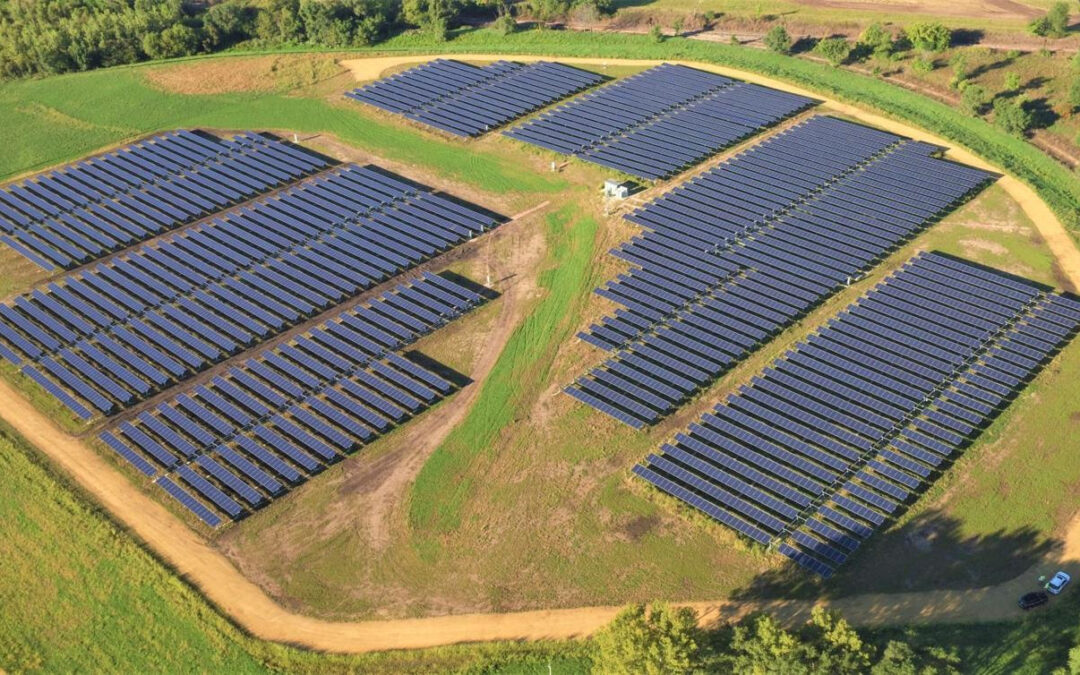
The PSC decision enables Alliant to construct and operate 414 megawatts (MW) of solar generating capacity in Dodge, Grant, Green, Rock, and Waushara counties. In combination with the 675 MW of projects approved in April 2021, Alliant’s solar power portfolio now consists of a dozen projects totaling more than one gigawatt, or 1,089 MW. Alliant’s approved solar projects are listed in the table below.
Over the last three years, the PSC has approved 1,850 MW of utility-owned solar generating capacity in Wisconsin. Of that total, nearly 60% of that generation will serve Alliant Energy’s Wisconsin customers.
“Today’s approval by the PSC affirms the uniquely valuable set of benefits that large-scale solar will bring to Wisconsin’s power industry,” RENEW Executive Director Heather Allen said. “When placed in service, these 12 solar projects will support the grid long after Alliant retires its coal-fired power plants, generating clean, affordable energy here in Wisconsin while delivering a reliable revenue stream to participating landowners and host communities.”
But a recently initiated U.S. Commerce Department investigation into alleged unfair trade practices has already begun to disrupt utility-scale solar farm development nationwide, including projects in Wisconsin. If not resolved soon, the collateral damage from this investigation will likely spread to the Alliant solar portfolio approved today, causing construction delays and increasing costs.
The investigation, which could extend until August 28th, targets solar products imported from Cambodia, Malaysia, Thailand, and Vietnam. Eighty percent (80%) of all U.S. solar panel imports are sourced from these four countries. If an unfair trade practice is identified, the Commerce Department is empowered to remedy the situation with very high tariffs on panels. For that reason, manufacturers in the targeted countries have been forced to cease production of solar panels destined for U.S. projects.
“Not even a month has gone by, and it is already disrupting solar projects at all stages of the development pipeline,” Allen said. “We are concerned that this investigation can do serious damage to the solar build-out now underway as well as undermine Wisconsin’s Clean Energy Plan.” Allen added: “We ask Senators Baldwin and Johnson and Wisconsin’s Congressional delegation to stand up for Wisconsin jobs, Wisconsin farmers, and Wisconsin’s rural economy and urge the Commerce Department to issue a negative ruling on this matter as soon as possible.”
APPROVED ALLIANT ENERGY SOLAR PROJECTS
| Docket: 6680-CE-183
Approved April 28, 2022 |
| Project name |
Location (county) |
Capacity (in MW) |
| Albany |
Green |
50 |
| Beaver Dam |
Dodge |
50 |
| Cassville |
Grant |
50 |
| Paddock |
Rock |
65 |
| Springfield (Lomira) |
Dodge |
100 |
| Wautoma |
Waushara |
99 |
| Subtotal |
414 |
| Docket: 6680-CE-182
Approved April 21, 2021 |
| Project name |
Location (county) |
Capacity (in MW) |
| Bear Creek |
Richland |
50 |
| Crawfish River |
Jefferson |
75 |
| Grant County |
Grant |
200 |
| North Rock |
Rock |
50 |
| Onion River |
Sheboygan |
150 |
| Wood County |
Wood |
150 |
| Subtotal |
675 |
| Grand total |
1,089 |