by jboullion | Jan 20, 2010 | Uncategorized
Green Drinks Tonight!
5PM @ Dooley’s
Eau Claire Green Drinks
5:00-7:00PM
The Backroom of Dooley’s Pub (Corner of 5th and Water St)
Come relax with friends and make some new ones as we get together and discuss environmental issues that are important to YOU at Eau Claire’s Green Drinks. Green Drinks is an opportunity for folks interested in “green” environmental issues to come together over drinks and conversations to find out what interesting things are going on in the Chippewa Valley. Green Drinks is unique because there is no agenda, there are no dues, there’s no board of directors – it’s just a social opportunity for people to come together and talk with other like-minded environmentalists about ideas, events, and issues going on around our community.
A common sentiment often heard in the local environmental community is that there is no clearinghouse of information regarding environmental issues. Green Drinks has already successfully served Wisconsin communities as a place to share ideas in La Crosse, Madison, and Green Bay – it’s time to add Eau Claire to that list!
by jboullion | Jan 20, 2010 | Uncategorized
From an article by Larry Sandler of the Milwaukee Journal Sentinel:
South Milwaukee – Milwaukee County could create its own transit authority, funded by a sales tax of up to a half-cent, to take over the county’s cash-strapped bus system, under proposed legislation unveiled Tuesday.
The full 0.5% sales tax would bring in about $60 million a year, or roughly $20 million more than the Milwaukee County Transit System would need to end property tax support and meet its funding needs, bus system spokeswoman Jacqueline Janz said. The new transit authority would be required to use the additional money to restore bus routes cut since 2001, to increase service or to reduce fares.
Planners have warned the bus system would face a major service cut without new state or local funding to replace property taxes.
After months of behind-the-scenes negotiations, Gov. Jim Doyle announced the plan at a news conference at Bucyrus International corporate headquarters. He was backed by the chief executive officers of some of the region’s largest corporations, who said the southeastern Wisconsin economy depends on reliable transit that isn’t funded by property taxes.
The Milwaukee County authority would be one of several temporary local transit authorities that eventually could merge into the existing Southeastern Regional Transit Authority, which oversees the planned KRM Commuter Link rail line. Like Milwaukee County, other county or municipal governments that run bus systems could form temporary transit authorities in Kenosha, Racine, Ozaukee, Washington and Waukesha counties, which would sunset if not merged into the regional agency.
Outside Milwaukee County, the local transit authorities could be funded by local vehicle registration fees, hotel taxes or property taxes contributed by local governments, but they could not impose sales taxes without voter approval in a referendum.
From an article by Stephanie Jones in the Journal Times (Racine):
[Racine Mayor John] Dickert stood with the governor Tuesday in supporting new transit legislation.
“If we as elected officials are going to rebuild our cities, we must start with a solid foundation,” Dickert said. “That foundation can begin with a regional transit system.”
by jboullion | Jan 19, 2010 | Uncategorized
From a news release issued by the Forest County Potawatomi Community:
Crandon, Wis. – The Forest County Potawatomi Community began an advertising campaign Monday in support of the Clean Energy Jobs Act, state legislation that economists predict will create a minimum of 15,000 new jobs in Wisconsin and end up lowering electric bills in the state.
“Protecting Mother Earth and the resources She provides is a cornerstone of the Potawatomi people,” said Jeff Crawford, Forest County Potawatomi Attorney General. “Wisconsin needs to seize this opportunity to reduce the carbon pollution that threatens Wisconsin for the worse while also creating thousands of jobs for Wisconsin families.”
Crawford added, “The Potawatomi support the Clean Energy Jobs Act and will aggressively work to ensure passage. The bill will be a real boost to Wisconsin’s economy.”
The Clean Energy Jobs Act is based on recommendations from the Global Warming Task Force. The Task Force was formed to investigate ways the Wisconsin could reduce its greenhouse gas emissions while simultaneously creating jobs and growing the state’s economy. Representatives from Wisconsin businesses, environmental groups, utilities and other interested stakeholders voted in favor of a final report containing roughly 60 recommendations. The Forest County Potawatomi was a member of the Global Warming Task Force.
Among the major recommendations from the Task Force is the proposal that 25% of Wisconsin’s electricity come from renewable sources by 2025.
Public opinion research has found that a majority of Wisconsin voters favor action by the State to reduce carbon pollution and believe state action will grow clean energy jobs.
by jboullion | Jan 19, 2010 | Uncategorized
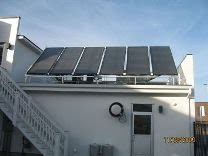
From a post on the Web site of Bubbling Spirngs Solar:
Café 27 in Steven’s Point has just finished the installation of a six-panel array of Bubbling Springs Solar’s collectors, performed by Bob’s Plumbing. Using solar thermal technology in the foodservice industry is highly economical; the sun heats or preheats the water for dishwashing and cooking, cutting down on conventional energy bills. Café 27 is setting an excellent example and we hope to see more solar thermal in the foodservice industry. Check out Café 27 at 945 Clark St. in Stevens Point, WI or call 715-544-4730.
by jboullion | Jan 19, 2010 | Uncategorized
From a news release issued by the Wisconsin Department of Workforce Development:
State Labor Secretary says UW-Platteville on track with new clean energy degree
PLATTEVILLE – Department of Workforce Development (DWD) Secretary Roberta Gassman said today Governor Doyle’s Clean Energy Jobs Act will create 15,000 jobs by 2025, including career opportunities for graduates of a new clean energy degree program at the University of Wisconsin-Platteville.
“Governor Doyle’s comprehensive clean energy package will create thousands of good, family-supporting jobs, grow our economy and help Wisconsin gain its energy independence,” Secretary Gassman said. “His plan will mean career opportunities for our workers of tomorrow, including UW-Platteville students pursuing the new bachelor’s degree in renewable energy.”
Governor Doyle’s Clean Energy Jobs Act implements recommendations of his Global Warming Task Force to address climate change and grow the state’s green economy. The comprehensive package would:
Require use of renewable energy sources for 20 percent of Wisconsin’s needs by 2020and 25 percent by 2025. This will ensure more energy dollars remain in the state. Wisconsin currently spends $16 billion per year on imported energy to heat homes and fuel cars and trucks.
Increase energy efficiency and energy conservation efforts with graduated statewide electricity savings goals, leading to a 2 percent reduction in energy use by 2015 and annual reductions thereafter.
Create jobs, more than 1,800 in the first year, many of them construction jobs, according to new industry-recognized research. Economists and policy analysts estimate the package will create 800 to 1,800 new construction jobs per year through 2025 and more than 2,000 manufacturing jobs once the energy act provisions are fully implemented.
Secretary Gassman addressed students and faculty in the new on the first day of the spring semester. She applauded the university’s decision to offer a four-year degree in renewable and sustainable energy. The decision was prompted by the popularity of a minor degree in renewable energy that the College of Engineering, Mathematics and Science offered to students in all fields of study.
by jboullion | Jan 19, 2010 | Uncategorized
From an editorial in the Milwaukee Journal Sentinel:
The Clean Energy Jobs Act will require trade-offs, but we’re confident that the cost of the measure will be far less than if we stand pat.
A bill just introduced in the state Legislature holds the promise of growing new technologies, new jobs and energy independence in Wisconsin. Its goals of reducing greenhouse gas emissions and increasing conservation efforts and renewable and alternative sources of energy are good public policy. They deserve widespread support in the Legislature and from citizens.
The bill comes with costs, and the Legislature should do what it can to mitigate those costs to businesses and families, especially the neediest. But doing nothing in the face of the climate change that science says is already taking place will be even more costly. And even if the worst projections of climate change don’t come to fruition, and even if the federal government doesn’t act on a bill of its own, it’s still important to reduce Wisconsin’s reliance on fossil fuels and increase our use of renewable energy. Public health and the environment demand no less.
Just as important in the wake of the Great Recession, the Clean Energy Jobs Act, based on the recommendations of the governor’s Global Warming Task Force, also brings opportunity. Gov. Jim Doyle asserts the bill will create more than 15,000 jobs. Maybe that’s an overestimation; maybe not. But it’s clear that jobs will be created and that the bill could put the state in position to take advantage of a new wave in the so-called green economy. Getting ahead of other states would benefit businesses as well as the families who need jobs.
The act provides a launching pad for a number of efforts that could move Wisconsin forward. It is not without flaws – and those flaws need to be addressed by legislators – but if done right, this bill deserves to be enacted this year.
A key element of the bill is a requirement that Wisconsin generate 25% of its power from renewable sources such as wind turbines, biomass plants and solar panels by 2025, up from 5% in 2008.