by jboullion | May 8, 2009 | Uncategorized
From a news release issued by Focus on Energy:
MILWAUKEE (May 5, 2009) — On April 4, 2009, Prairie Apartments, an innovative eco-friendly new construction building, opened its doors to low-income Milwaukee residents experiencing obstacles such as homelessness and mental illness. With the help of Focus on Energy, developers Heartland Housing of Chicago and Guest House of Milwaukee were able to integrate energy efficiency measures into the 24-unit complex.
“Not only does the apartment provide high-quality affordable housing for Milwaukee residents in need, it incorporates important energy efficient features,” said Carter Dedolph, Focus on Energy Program Manager. “Prairie Apartments is a shining example of our goal to help buildings throughout the state reduce their energy use, operating costs and environmental impact.”
Energy Efficient Features
To save energy and money, Focus on Energy worked with the developers to make extensive use of ENERGY STAR® qualified compact fluorescent fixtures and lighting occupancy sensors in most of the common areas. In addition, ENERGY STAR qualified appliances, programmable thermostats and windows were also used throughout.
Moreover, the building’s well-sealed envelope reduces air leakage, and works hand in hand with high efficiency cooling and heating equipment. In fact, the facility’s standards of design are so high it was built to achieve the prestigious Leadership in Energy and Environmental Design (LEED) for Homes certification. Overall, the improvements should save the building more than 4,000 therms of natural gas and about 72,500 kilowatt hours of electricity annually; not to mention $13,000 a year on energy costs.
by jboullion | May 6, 2009 | Uncategorized
Wisconsin State Journal, May 16, 2009
An eight-hour public hearing last week at the Capitol highlighted a threat to the statewide interest in developing wind power.
The hearing also demonstrated why lawmakers should quell that threat by replacing a hodgepodge of local rules for smaller wind farms with uniform state standards.
At stake is not only a clean, renewable source of energy, but also the state’s economic vitality.
Wisconsin is counting on wind power to propel the state 90 percent of the way toward meeting a goal of more than doubling the renewable energy contribution to electric needs over the next six years. Developing wind power, and other forms of renewable energy, can help resolve global warming worries, improve energy security and generate jobs.
But a barrier looms: When developers of smaller wind farms apply to local governments to build turbines on specific sites, they too often find that local officials are cowed into imposing impossible-to-meet requirements, or even moratoriums, after opponents raise alarming concerns, commonly based in misinformation.
As a result, a few people gain veto power over the state’s energy policy.
Granted, not every location is suitable for wind farms. Local concerns about public safety and health should be respected, when based on sound science. But local officials confronted by alarmed constituents are not in a good position to evaluate competing arguments.
Meanwhile, larger wind farms face no such array of local Mixmasters. They go to one agency — the state Public Service Commission. Wind farm plans face a rigorous PSC review process. But at least developers know what they are dealing with from the outset. It’s a far better system, both for encouraging wind farm development and protecting public safety and health.
Wisconsin’s hostile regulatory environment for smaller wind farms is taking a toll. The state lags far behind neighboring Iowa, Minnesota and Illinois in wind power. Part of the reason is that Wisconsin has less potential for wind power than those states. But testimony at last week’s hearing indicated that regulatory hostility is also a factor, driving some wind farms away from Wisconsin to its neighbors.
That conclusion is supported by the fact that Michigan, with a relatively small potential for wind power, has a far higher wind farm growth rate than Wisconsin.
The solution lies in the proposed legislation that was the subject of last week’s hearing. The plan calls for lawmakers to grant the PSC authority to establish, with public input, a model set of wind farm standards to guide local governments.
Local governments would be forbidden from exceeding the standards.
Any party would have a right to appeal a local decision to the PSC and then to court.
Wisconsin can protect the health and safety of residents and encourage wind farm development. The proposed wind farm siting reform is the answer.
by jboullion | May 4, 2009 | Uncategorized
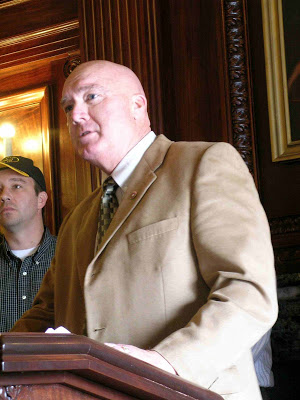
Terry McGowan of the International Union of Operating Engineers Local 139 speaks at the press conference for the introduction of a bill to set uniform siting standards for wind projects in Wisconsin.
From a news release issued by Sen. Jeff Plale, Rep. Jim Soletski, Sen. Randy Hopper, and Rep. Phil Montgomery:
MADISON – A bipartisan coalition of Wisconsin legislators announced that they are introducing legislation that calls for the creation of uniform siting standards for wind energy projects. Senate Bill 185 (SB 185), and its Assembly companion, directs the Public Service Commission (PSC), after public input, including a stakeholder committee, to establish by rule, permitting standards to be applied by local or state government to wind energy installations, regardless of size and location.
“Too many wind projects are victims of delay tactics and other obstructions,” Senator Jeff Plale, Chair of the Senate Committee on Commerce, Utilities, Energy, and Rail said. “SB 185 will enhance Wisconsin’s economy by protecting and creating “green-collar” jobs; it will attract new investment to our state and support state energy policy. I look forward to working with my colleagues to ensure that we can make Wisconsin more attractive to wind energy and achieve the resulting economic and environmental benefits.”
“A sensible wind energy policy will help Wisconsin harness the jobs and growth opportunities that green power provides,” stated Representative Jim Soletski, Chair of the Assembly Energy and Utilities Committee. “I am excited to be working with a bipartisan group of legislators from diverse regions of the state to remove the obstacles to more development of wind power in Wisconsin. By advancing this legislation, Wisconsin utilities can move toward meeting their obligation to generate clean energy and much needed jobs can be created for our workers.”
“We can’t build a 21st century energy infrastructure by digging in our heels,” Senator Randy Hopper said. “This legislation will ensure that interested parties from all over our state can take part in developing the Public Service Commission’s guidelines.”
“Wind power is job-creating power,” according to Representative Phil Montgomery. “A fair and uniform state standard for siting wind developments will create an environment of investment in our state while moving us closer to our green energy goals.”
In addition to RENEW, the following organizations issued statements of support for Senate Bill 185: CREWE, Clean Wisconsin, Citizens Utility Board, Customers First!, Renewegy, Wind Capital Group, WPPI/Municipal Electric Utilities.
by jboullion | May 4, 2009 | Uncategorized
Focus on Energy provides links to renewable energy training courses — professional development, technical colleges, and universities.
by jboullion | May 4, 2009 | Uncategorized
Focus on Energy provides links to renewable energy training courses — professional development, technical colleges, and universities.
by jboullion | May 4, 2009 | Uncategorized
From the Valley Stewardship Network:
A presentation by Ken Meter, Economist & President of the Crossroads Resource Center
Thursday, May 21st from 6:30-8:30 pm
Vernon Memorial Hospital
(new medical office building)
Community Conference Rooms A & B
Ken is the creator of “Finding Food in Farm Country” studies. He examines food systems and creates reports using hard economic data to demonstrate the importance of developing local, sustainable food systems. His reports have been adopted in 38 regions in 18 states. These reports have transformed the discussion of farm and food economics, and launched a national discussion on local foods as economic development. Ken has made over 150 presentations nationally on local food systems. He has conducted state-wide analyses in Minnesota, Iowa, California and Hawaii to document economic losses suffered in America’s farm communities. He paints a picture of local food systems that can inspire people to take action to improve their own economies. Read more about Ken’s work at www.crcworks.org/econ.html
The Southwest Wisconsin Local Farm & Food Economy Report was funded by the Valley Stewardship Network’s Food and Farm Initiative in a cooperative effort with Vernon Economic Development Association and the Crawford County UW Extension office.
We hope to see you all there!! There is no charge to attend but donations are encouraged. Local beverages and snacks will be served.