by jboullion | Jan 12, 2009 | Uncategorized
From a media release issued by Focus on Energy:
MADISON, Wis. (January 6, 2009) – Focus on Energy, Wisconsin’s energy efficiency and renewable energy initiative, announced today that New Lisbon Municipal Light and Water officially became a program member beginning January 1, 2009. The utility serves approximately 850 customers in Juneau County.
“I welcome New Lisbon Municipal Light and Water into Focus on Energy and am delighted its customers will be able to benefit from the services the program offers,” said Eric Callisto, Chairperson of the Public Service Commission of Wisconsin, the agency that manages the state’s Focus on Energy Program. “New Lisbon Municipal Light and Water’s decision to participate in Focus on Energy will result in a healthier environment for Wisconsin and will provide options for its customers to make sound energy decisions.”
New Lisbon Municipal Light and Water will participate in the Business, Residential and Renewable Energy offerings under the Focus on Energy umbrella. The benefits of participating include:
Business Programs that help manufacturers, commercial businesses, farmers, schools and local governments reduce operating costs, increase their bottom line and improve productivity and employee and customer comfort. The programs offer technical expertise, training and financial incentives to help implement innovative energy management projects.
Wisconsin ENERGY STAR Homes, Home Performance with ENERGY STAR and Apartment & Condo Efficiency Services Programs that encompass new and existing homes, multi-family construction and remodeling projects for all types of residential dwellings. These programs help homeowners and landlords integrate energy improvements into their remodeling projects, as well as deliver newly-built homes, apartments and condominiums that are comfortable, safe, durable and energy efficient.
Lighting and appliance programs that increase the availability of ENERGY STAR qualified products ranging from compact fluorescent light bulbs to heating and cooling equipment. These efforts deliver lower energy bills for residents and businesses and increased sales for retailers and contractors.
Renewable Energy Programs that help residents and businesses harness energy from sunlight, wind and organic materials.
Targeted Home Performance that reduces energy bills while increasing comfort and safety for income-qualified participants.
by jboullion | Jan 12, 2009 | Uncategorized
From an article by Rick Barrett in the Milwaukee Journal Sentinel:
The old Shell Oil terminal at the Port of Milwaukee has been sold to a New York-based biodiesel company that plans to use the terminal for distributing biodiesel and other renewable fuels in the Midwest.
The terminal, built in the 1950s, includes a 20,000 square foot warehouse, offices and a garage. It also has access to railroad service and an idled connection to a petroleum pipeline.
by jboullion | Jan 12, 2009 | Uncategorized
From a letter to the editor by Marty Anderson in the Marshfield News Herald:
In my capacity as chairman of the Sustainable Marshfield Committee, I’ve had the opportunity to present throughout central Wisconsin about sustainability principles. In each presentation, I begin by defining what sustainability is, because the word is often overused and not well defined when it is used.
Put simply, sustainability is defined as living and working in ways that do not jeopardize our current and future social, environmental and economic resources. In other words, we can’t take away from the ability of future generations to have a standard of living similar or better than our own conditions today.
In February 2007, the city of Marshfield approved a resolution to become one of the first sustainable communities in the state. In doing so, we also adopted the sustainability framework called The Natural Step, originally founded in Sweden by Dr. Karl Henrik Robèrt in 1989. The Natural Step is made up of four basic principles:
• Reduce dependence upon fossil fuels and extracted underground metals and minerals.
• Reduce dependence on chemicals and other manufactured substances that can accumulate in nature.
• Reduce dependence on activities that harm life-sustaining ecosystems.
• Meet the hierarchy of present and future human needs fairly and efficiently.
These principles are purposely general in their scope. Dr. Robèrt was trying to create a vision for a sustainable definition that everyone can agree with and support. In addition, it gives those working on implementing sustainability a litmus test to determine if what they are doing is moving their community towards sustainability.
Anderson, a former alderman and the current chairman of the Sustainable Marshfield Committee, be reached by e-mail at mande047@solarus.net.
by jboullion | Jan 9, 2009 | Uncategorized
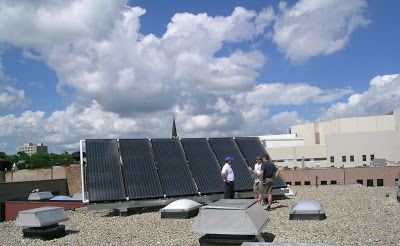
Solar installer Shawn Young (H&H Solar), RENEW’s Michael Vickerman, and the City of Madison’s Kay Schindel (left to right) inspect the solar hot water system on Station No. 1 with the downtown Madison skyline in the background.
From an article by Julian Emerson and Andrew Dowd in the Leader-Telegram:
Eau Claire city officials have outlined 58 infrastructure projects totaling $70.58 million that could be started this year if they receive money.
The proposed city projects span a range of infrastructure improvement initiatives and have not been prioritized. Besides the Hobbs remodeling, other big-ticket items on the list include a $6.8 million L.E. Phillips Memorial Public Library upgrade, $6 million to relocate the Police Department, a $5 million North Barstow Redevelopment District parking ramp and a $4 million city bus transit center.
The list includes some less costly endeavors too, such as City Hall heating, ventilation and air conditioning improvements costing $117,000 and a $23,200 rooftop solar water heating system for City Hall and fire station No. 2.
by jboullion | Jan 9, 2009 | Uncategorized
From a letter to the editor by Bobby Gifford:
In print we recently heard from a member of the Stevens Point Plan Commission regarding the pace of planning for downtown, including the mall. We need to look not at the pace of planning, but at the assumptions of planning and how they square with our new economic reality.
A key component of the mall plan is spending over $2 million on parking spaces. It appears that PDI, the paid consultants we are using in Point, are unaware of the peak oil problem, or ignore it. It seems that most planning in our region is based on the assumption that cheap oil and gas will persist far into the future.
The global peak of oil production is still here. The global economic collapse has not increased global petroleum supply. Instead, crashing petroleum prices are driving supply capacity from the market. The next upswing in crude oil and natural gas prices will be a brake on recovery.
Our recovery from global recession will be very slow. The retail sector as we know it is probably already history.
Our Plan Commission and local sustainability groups need to be on the same page. Local elected officials need to consistently consult with local sustainability activists such as Farmshed, Sustain Central Wisconsin, Eco-municipality committees, UWSP, students, and the Interfaith Council for the Earth and read all available sustainability literature.
Gifford offered these Web sites for research:
http://www.energybulletin.net
http://www.peakoil.net
http://www.theoildrum.com
http://aspo-usa.com
http://www.simmonsco-intl.com/research.aspx?Type=msspeeches
by jboullion | Jan 9, 2009 | Uncategorized
From a story on WXOW News 19, La Crosse:
While President Elect Obama won’t take the oath of office until January 20th, some local politicians already see some changes.
The Governor has been asked to work with county officials to find ways to make La Crosse more energy efficient and bring more jobs to the area.
Today County Administrator Steve O’Malley met with the Joint Committee on Sustainability.
They discussed a number of green projects for the county if Obama’s Federal Stimulus Plan passes.
They primarily focused on three solar hot water projects.
The proposed design would add solar panels to the county jail, and county nursing homes.
If the county can get federal funding, officials say we would see an immediate impact on the economy.
Steve O’Malley says, “Following what Congress and the President talked about, we think La Crosse is on the cutting edge or trying to increase the demand for alternative energy and we hope to be a part of that.”