by jboullion | Dec 19, 2008 | Uncategorized
From a media release issued by Xcel Energy:
The Public Service Commission of Wisconsin (PSCW) has created a docket to begin evaluating the company’s request to install biomass gasification technology at the Bay Front Power Plant in Ashland, Wis. This represents the first step in the regulatory review process for the innovative project that, if approved, would transform Bay Front into the largest biomass-fueled power plant in the Midwest, and one of the largest in the nation. When completed, the project will convert the plant’s remaining coal-fired unit to biomass gasification technology, allowing it to use 100 percent biomass in all three boilers. Currently, two of the three operating units at Bay Front use biomass as their primary fuel to generate electricity.
In 1979, the facility became the first investor-owned utility plant in the nation to burn waste wood to generate electricity.
This is the first time biomass gasification technology will be used to convert a coal-fired boiler at an existing base-load power plant. The project will require new biomass receiving and handling facilities, an external gasifier, modifications to the plant’s remaining coal-fired boiler and an enhanced air quality control system and is expected to cost $55-$70 million.
by jboullion | Dec 16, 2008 | Uncategorized
From an article article by Deneen Smith in the Kenosha News:
Shawn Henoch can’t wait for frigid weather and the first serious heating bills of winter.
“I’m really looking forward to January and February to see,” Henoch said. “Who is excited to get their electric bill? But I am.”
Henoch hired a company to do an energy efficiency overhaul of her 60-year-old Kenosha home this year. The work was completed in June, and she said she’s already seen a dramatic reduction in her energy bills and an improvement in the coziness-factor of her home.
The project sealed air leaks in the house, added insulation in the walls and ceiling, and replaced an old, inefficient furnace and air conditioner.
Before the overhaul, her typical winter heating bills were about $400 “and that was keeping my heat set at 67 or 68,” she said. “Now I can really keep my house at 72, and my last bill was, I think, $136.”
Learn more about an energy efficiency evaluaition at Focus on Energy.
by jboullion | Dec 12, 2008 | Uncategorized
From an article in the Osceola School District newsletter:
Over the past year, the school district of Osceola has begun to take an inventory of how many ways it’s becoming a “green friendly” environment. Prompted by a state movement for schools to gain certification as “Green and Healthy,” as well as a community interest in becoming more sustainable, the district began to formally address the initiative district-wide. All buildings have a goal of becoming certified as “Green and Healthy” by the Wisconsin Department of Public Instruction.
Schools have collected and submitted much data. Many statistics that students and staff tracked were used in earning the titles, from the amount of food waste produced to the temperature of the buildings over time. Buildings also submitted curriculum documentation of environmental education. Finally, each site completed an action and implementation plan for continuing its initiatives. These plans have become a vehicle for communicating with students and staff at each building as to their progress and next steps.
Director of Building and Grounds, Bob Schmidt, has been a solid resource for each building. “When we sat down and looked at the criteria, we realized how much work we had already done as a district to become more efficient and environmentally esponsible. It was positive to see the efforts we had made previously make this transition fairly easy. We still have steps we can take, but we’ve begun to cut our costs, energy usage, and effect on the environment already.”
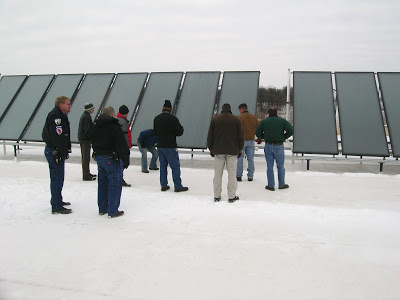
One of the most noticeable additions to the district is that of 32 flat panel solar energy collectors installed on top of the Osceola Middle School. “We researched solar options for months, traveling to other educational institutions to find out pros and cons of different systems,” stated Mr. Schmidt. “Last spring, we made a presentation to the school board about the different system options as well as grant funding available for the project. The school board has been extremely supportive and proactive in this area.” In the end, the district received grant monies from Focus on Energy in the amount of $46,960.94 to use for the project.
by jboullion | Dec 11, 2008 | Uncategorized
From an article by Jim Massey in The Country Today:
MADISON – A Canadian renewable-energy company says it plans to build biogas facilities in Wisconsin and elsewhere that would use manure and rendering industry byproducts to produce electricity.
Ontario-based StormFisher Biogas plans to build one Wisconsin project in 2009 and two or three more between 2010 and 2012, according to StormFisher Biogas development manager Chris Amey. It plans to partner on some of the projects with Sanimax, an animal byproducts company with facilities in DeForest, Abbotsford, Evansville and Green Bay.
Amey said StormFisher plans to build the facilities on farms with at least 2,000 cows. Each project would cost $15 million to $25 million and would create 12 to 20 full-time jobs.
Amey said the company is still finalizing agreements with dairy producers, so he couldn’t reveal where the farms are located. But he said the 2009 project would be in central or northwest Wisconsin.
by jboullion | Dec 10, 2008 | Uncategorized
From a media release issued by Focus on Energy:
WITHEE, Wis. — Joe’s Refrigeration, Inc., a family-owned business that designs and installs custom milking and refrigeration systems for dairy farms, has earned Focus on Energy’s Award for Excellence in Energy Efficiency for its efforts to promote energy-saving, environmentally friendly equipment.
Working in partnership with Focus on Energy, Wisconsin’s energy efficiency and renewable energy initiative, Joe’s Refrigeration helps dairy producers and processors cut energy consumption and costs by installing efficient equipment such as refrigeration heat-recovery tanks and plate coolers. The resulting savings helps farmers stay profitable and competitive as energy costs continue to rise.
“While milk prices have risen, so too have the costs of feed, fertilizer and fuel. Wisconsin’s dairy industry is important to our economy and we’re glad to help farmers stay competitive,” explained Rich Hackner, sector manager for Focus on Energy’s Agriculture and Rural Business Program.
“Joe’s Refrigeration is a great partner and we applaud their efforts to
help dairy producers make smart choices that save energy, save money and protect the environment.”
Over the past 50 years, Joe’s Refrigeration has expanded and diversified from its beginnings as a refrigeration business. Over the years, the company branched into the dairy industry, a side of the business that has doubled in the past year as more and more farmers have sought financial savings through energy efficiency.