by jboullion | Sep 27, 2010 | Uncategorized
From an article by Tom Content in the Milwaukee Journal Sentinel:
It was five years ago that renewable energy proponents dubbed this Wisconsin’s Solar Decade – the 10 years that would move solar energy from the fringe to the mainstream.
In 2010, solar remains a fraction of the state’s energy mix, but it’s growing. And with it, interest is intensifying in manufacturing products for the solar industry.
As solar advocates prepare to host industry conferences this week, the solar industry is installing larger projects, and the cost per project is shrinking.
“It’s not getting sunnier in Wisconsin, but prices are coming down and rates are going up,” said Niels Wolter, solar electric program manager at Focus on Energy, the statewide energy efficiency initiative that provides incentives for renewable energy installations.
So far this year, the typical cost of a solar-electric system installed at a business with the help of Focus on Energy incentives has fallen 13% from a year ago. The price of these same systems installed on homes has fallen by 7%.
“We’re seeing that it may cost $6,000 to $9,000 to install a solar hot water system on a home, and the payback may be around 12 to 14 years,” said Amy Heart, Milwaukee solar coach and head of Midwest Renewable Energy Association’s Milwaukee office.
A solar-electric, or photovoltaic, system may cost $15,000, but it has a payback of about 10 years, she said.
The main hurdle to broader deployment of solar remains the high upfront cost, as well as the complexity of the incentives available to bring down the cost, Wolter said.
In recent months, though, attention to solar has intensified in the area:
• Construction started this summer on the state’s first solar panel factory, Helios USA, in Milwaukee’s Menomonee Valley. Helios expects to employ 50 people by next summer.
“That’s a good sign for Wisconsin, that there are going to be some jobs here on the manufacturing side in addition to the installation side of things,” said Carl Siegrist, senior renewable energy strategist at Milwaukee utility company We Energies.
• The largest solar project to date in the state opened in Milwaukee. It’s the Milwaukee Area Technical College PV Educational Laboratory, generating more than 500 kilowatts of power, all with the aim of training students for careers in renewable energy.
• The number of businesses engaged in solar is increasing. Two years ago, seven companies were installing solar in a 20-mile radius of Milwaukee. This year, that number has more than tripled, to 24.
by jboullion | Sep 24, 2010 | Uncategorized
From a story by Heather Sawaski on WAOW-TV, Wausau:
PARK FALLS (WAOW) — Flambeau River Papers in Park Falls is going to get a little greener.
Company leaders say when the new biomass plant is complete, the mill will use all of its waste energy, making it the first mill in North America not to use any fossil fuels. That’s a far cry from where the future of the paper mill stood just over 4 years ago. That’s when CEO Butch Johnson bought it out of bankruptcy. That’s when the idea of a biomass refinery in the Northwoods started to take shape.
“We’re no smarter than the guys before us that went bankrupt,” Johnson explained. “What can we do differently with our operation so we can ensure our employees, our partners in our project that we’re going to keep going? So we looked at a green initiative from the get go.”
The $300 will convert biomass from bark and sawdust into diesel for domestic markets.
Johnson says between logging, construction, and operation, the plant will bring in hundreds of jobs.
“We buy currently about 140,000 cords of wood for this paper mill,” he said. “With the bio-refinery, we would be buying an additional 365,000 cords of wood.”
by jboullion | Sep 24, 2010 | Uncategorized
From an article by Dustin Klein in The Pointer, UW-Stevens Point:
Many students would agree that the UW-Stevens point campus is very eco-friendly. Those same students might not know that UWSP burns coal at the physical plant on the north end of campus.
Joseph Rohrer, a sophomore forestry major, felt it speaks volumes about our university.
“Obviously, I’m not happy about [burning coal]. We’re supposed to be the greenest campus in the state, so it really says something about the other campuses,” he said.
The plant is used to heat the campus’ water and buildings, which is why it needs to burn its fuel. The physical plant runs all day long, despite rumors that it only runs at night.
According to Bob Govett, a 20-year veteran of the College of Natural Resources, the State of Wisconsin and the University work out a contract on the materials they burn. It comes in three different possibilities: coal, wood pellets, or natural gas. The decision about what to burn comes down to one thing: money. The campus burns the cheapest fuel available at the time.
“The coal is purchased under state contract, paper pellets under state contract, and the gas, again, is purchased under state contract,” Govett stated.
by jboullion | Sep 24, 2010 | Uncategorized
From the Web site of City Utilities of Richland Center:
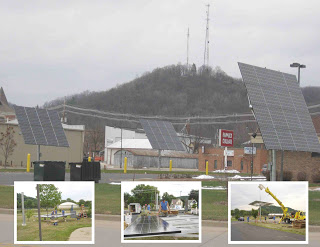
Electric customers in Richland Center are benefitting from a new application of solar power in the city. The community-owned utility recently installed an array of solar photovoltaic (PV) panels at City Hall.
City Utilities of Richland Center installed three dual axis trackers with a total output of 8.64 kilowatts, providing approximately 14,500 kilowatt-hours of emissions-free electricity each year.
“It is our objective to be a model for the use of renewable energy,” said Commission President Rod Perry. “By supporting community-wide renewable projects, City Utilities is illustrating the practical use of renewable energy and enticing customers to do the same.”
Solar PV systems collect energy from sunlight and convert it into electricity, providing renewable, emissions-free energy. These highly visible projects demonstrate the technology, while educating the community on their benefits, operation and performance.
City Utilities pursued various grant opportunities, including funding from its power supplier WPPI Energy, to help fund the purchase and installation of the solar PV systems. The project is contracted through H&H Solar Energy of Madison and became operational in September 2008.
“We’re working hard to lead by example,” said Perry. “The use of renewable energy is a simple step anyone can take to help create a cleaner energy future.”
The project
Three 2.88 kW dual-axis trackers
14,220 kWh per year
PV panels: Kyocera KD180
Installed by H & H Solar Energy Services
Output detail
by jboullion | Sep 24, 2010 | Uncategorized
From an article by Marie Rohde in The Daily Reporter:
The Milwaukee Metropolitan Sewerage District is poised to enter into a 20-year contract to buy methane gas to run the Jones Island Wastewater Treatment Plant, a move district officials say will save taxpayers tens of millions of dollars.
But the project will cost $94.7 million in infrastructure improvements.
“We will be able to purchase methane gas at 48 percent of the cost of natural gas,” said Kevin Shafer, MMSD’s executive director.
The district could begin using methane as early as January 2013, but the system would not be fully functional for several years after that.
While methane gas is increasingly used as a fuel to produce electricity, this plan is unusual in that it requires piping the gas 17 miles from the Emerald Park Landfill on the eastern edge of Muskego.
by jboullion | Sep 23, 2010 | Uncategorized
From a story on WQOW, Eau Claire:
Dunn County (WQOW) – Millions of dollars in federal aid are heading to rural Wisconsin to help our farms and businesses. Part of the goal is for them to become more energy efficient. It’s part of a program to reduce energy consumption and stir the economy.
Deborah Dillaway hopes to lead the way with her 90-foot wind turbine.
“We see people driving a car that’s fuel efficient,” Deborah says. “We see people with solar panels. As it comes more commonplace, more people will think of supplementing the use or dependence they have on fossil fuels.”
This tower does just that, sitting on Deborah’s 200-acre farm in Dunn County.
The turbine produces electricity, which is then transferred to the local energy cooperative, where it’s used by other customers on the grid. For that, Deborah gets a credit on her bill.
She’s one of the first in the area to make this investment.
“It has to start somewhere and people will see it,” Deborah says.
And with a $93,000 dollar price tag, it is an investment. But the USDA helped, giving a $19,000 grant through a program meant to reduce rural energy consumption and stimulate local economies.
Forty-five farms and businesses in Wisconsin have received similar funding, totaling nearly $3 million in aid for projects.
by jboullion | Sep 23, 2010 | Uncategorized
From a column by Gregg Hoffman on WisBusiness.com:
Contrary to stereotypes of the gloomy, cloudy Midwest, Milwaukee, and Wisconsin in general, are very conducive to effective use of solar energy, and in fact have developed into leaders in the country in that field.
That fact will be highlighted during Milwaukee Solar Week, Sept. 28-Oct. 2. Milwaukee Shines, the city of Milwaukee’s solar program, will team with the Midwest Renewable Energy Association (MREA) and other organizations and businesses to showcase renewable energy successes and opportunities during the week.
We Energies and Focus on Energy also are hosting solar events during the week. Milwaukee Shines is coordinating the week.
“The city is fortunate to be hosting two premier professional solar conferences, which will highlight all Milwaukee has to offer a growing solar market,” said Matt Howard, director of Milwaukee’s Office of Environmental Sustainability.
Professionals and the general public will both find things of interest during the week.
“Milwaukee Solar Week has something for everyone,” said Amy Heart, Milwaukee’s Solar Coach and MREA’s Milwaukee Director. “This is a perfect chance to get information on installing solar on your home, find out how to get in the solar business or establish business connections in this growing industry.”
Heart emphasized that Milwaukee and Wisconsin do get an average of 4 ½ hours of sunlight per day. “That’s more than Germany, and Germany is an energy exporter,” she added.
by jboullion | Sep 22, 2010 | Uncategorized
From a news release issued by Governor Jim Doyle:
CUBA CITY – Governor Jim Doyle today announced up to $1,506,000 in assistance to Wausaukee Composites and Grant County to support the company’s efforts to create 200 full-time jobs. The funding comes from the Community Development Block Grant for Economic Development program overseen by the Department of Commerce.
“My top priority this year has been to help move companies and communities forward and create good-paying jobs for our citizens,” said Governor Doyle. “I’m pleased that we could help Wausaukee Composites expand its business and bring these new jobs to Grant County.”
Wausaukee Composites will use the state funding to build and equip an addition to their Cuba City facility. The company has committed to creating 200 new full-time positions to manufacture wind turbine components. The total project cost is $5,023,000.
Wausaukee Composites manufactures highly engineered composite components for original equipment manufacturers in the construction equipment, agricultural equipment, mass transportation, wind energy, medical imaging, commercial site furnishings, therapeutic systems, corrosion-resistant materials handling and recreation industries. They are a subsidiary of Sintex Industries, headquartered in India, with textile and structural plastics plants on four continents.
by jboullion | Sep 21, 2010 | Uncategorized
From an article in the Stevens Point Journal:
The front design for the Central Wisconsin Children’s Museum new site at 1100 Main St. will blend in with the surrounding older buildings.
On Wednesday, the Stevens Point Historic Preservation/Design Review Commission approved the design by Arc Central, the architectural and design firm working on the renovations.
The Main Street front is part of an ongoing project to move the Children’s Museum from the CenterPoint MarketPlace to its new location in what was called “The Connection.” Because it is in the Main Street Historic District, the Main Street side of the building needed to be approved by the city commission.
Jim Lucas, project designer with Arc Central, said the idea was to “capture the flavor of downtown.”
The museum’s front also will have solar panels to collect light for the museum. The museum will sell back the excess energy to Wisconsin Public Service.
The museum will use the panels to teach children about alternative energy in a hands-on manner.
by jboullion | Sep 21, 2010 | Uncategorized
From an article on BizTimes Daily:
When the new high-speed rail network is established in the Midwest, it will create 13,000 new jobs in Wisconsin, eliminate 780,000 car trips every year and conserve 2.76 million gallons of gasoline annually, according to a new report released today by the WISPIRG Foundation.
The organization attributed the estimate of the jobs created to the Midwest High-Speed Rail Association.
Kyle Bailey, program associate with WISPIRG, said the 13,000 jobs include both private development in and around intermodal stations and rail lines, manufacturing jobs related to train and car construction, and the development, maintenance and operations of the trains and intermodal stations.
Bailey said he did not know how many of the 13,000 jobs would be with private companies or the state.
“High-speed rail is part of the solution – boosting our economy and creating jobs, modernizing our transportation system and helping to solve our nation’s oil dependency, worsening congestion and pollution,” Bailey said. “High-speed rail gets us moving in the right direction.”
Bailey noted the growing popularity of the Amtrak Hiawatha line between Chicago and Milwaukee, which saw a 63-percent increase in ridership from 2004 to 2008, when more than 766,000 passengers rode the line.
Wisconsin’s Midwest regional rail line upgrades will speed the Hiawatha service up to 110 mph, reducing trip time from Chicago to Milwaukee to about an hour, and extend it to Madison and eventually La Crosse or Eau Claire and the Twin Cities.