by jboullion | Jun 10, 2010 | Uncategorized
From the newsletter of Energy Concepts:
Walking the conservation talk, Eenergy Concepts is hosting a ride share event for riders and drivers bound for the 21st Annual Energy Fair in Custer, WI. Ample free parking is available from the meeting place at our Hudson headquarters. Participants will also receive $5 off the price of admission. Sign up on our Facebook discussion board here. Don’t do Facebook? No worries, email Kat at kat@energyconcepts.us. The greenest show on earth just got greener.
by jboullion | Jun 10, 2010 | Uncategorized
From an editorial in the Sheboygan Press:
We don’t yet know the final solution to the Deepwater Horizon oil spill in the Gulf of Mexico, so we surely don’t know the final cost of the cleanup and the restoration of the fishery and the beaches.
But what we should know by now is that offshore oil drilling will have to be more closely monitored in the future. We should also know that we have to make a deeper commitment to reducing our dependence on oil — foreign and domestic.
The Disaster in the Gulf, as the now nearly two-month-long oil spill is being called, should be the wake-up call of all wake-up calls. It should spark bold action — in the offshore drilling regulatory process and in weaning the U.S. from oil.
President George W. Bush said in 2006 that the U.S. was “addicted to oil.” Yet today, we remain as hooked on oil and gas as we were then — and, like any addiction, it can be destructive. We are seeing its effect now in the Gulf of Mexico.
Although the U.S. needs to reduce its reliance on oil, there is no way to go “cold-turkey.” Our economy relies heavily on transportation — delivery of goods and services and people getting to and from jobs.
Oil, along with coal and natural gas, is also used to generate electricity and heat our homes. Many of the consumer goods we use have a base in petroleum.
In recent years, due mainly to the slowdown in the nation’s economy, the demand for oil has slowed in the U.S. It is still growing in much of the rest of the world, particularly China.
But rather than simply returning to oil as the main source of fuel, there needs to be a plan to move the U.S. economy forward while also reducing the use of oil. We’re taking baby steps today to find alternative sources of fuel. It’s time to think giant leaps forward.
by jboullion | Jun 9, 2010 | Uncategorized
From a news release issued by the Public Service Commission:
MADISON – – Utility bills can soar with rising temperatures. To stay cool this summer while conserving energy and keeping costs down, the Public Service Commission of Wisconsin (PSC) offers these easy, low-cost steps:
Use cold water for doing laundry and air dry your clothes on clotheslines.
Wash dishes with cold water and air dry.
Turn off lights when leaving a room.
Check the weather-stripping and caulking for leaks around doors and windows.
Use a microwave oven or cook outside instead of using the stove or oven.
Minimize the amount of time your refrigerator and freezer doors are open.
Use natural lighting and compact fluorescent light bulbs. Ninety percent of the energy used by an incandescent bulb makes heat.
by jboullion | Jun 9, 2010 | Uncategorized
From a news release issued by Xcel Energy:
Test stations to be used to educate local farmers, public on woody biomass development and costs
ASHLAND, WIS. – Plantings began today on two innovative woody biomass energy plantations in the Lake Superior basin that will be testing hybrid species of poplar and black willow trees. The plantations at the Ag Experiment Station in Ashland and Morning View Farm in Port Wing were made possible by grants from the Wisconsin Department of Natural Resources and Xcel Energy. The Lake Superior Woody Biomass Initiative (LSWBI) will promote the scientific research and development of the two biomass energy plantations.
The LSWBI includes a number of research-based projects that are necessary to support sustainable biomass production and utilization in northwest Wisconsin. To be sustained, production and harvest of woody biomass must protect or enhance soil quality, surface and groundwater quality, and biodiversity. The LSWBI will:
* Evaluate advanced selections of woody biomass crops by establishing hybrid poplar and black willow germplasm clone trials. The trial will be conducted in cooperation with Bill Berguson, Natural Resources Research Institute, Duluth, Minn., who has one of the largest hybrid breeding programs in the United States.
* Optimize woody biomass production systems by establishing poplar and black willow production trials to evaluate and demonstrate management and harvest options. The trials will be used to demonstrate basic site preparation, planting and weed control management options to farmers and the public.
by jboullion | Jun 9, 2010 | Uncategorized
From an article by Kevin Murphy in the Wausau Daily Herald:
MADISON — D.C. Everest Area School District wants to be more involved in decision-making on a proposed $250 million biomass power plant planned in Rothschild.
In a letter to the Wisconsin Public Service Commission dated Monday, Milwaukee attorney William Mulligan asked that the district be granted “intervenor” status, which would allow district representatives to see all communications in the case.
In her affidavit filed with the PSC, Superintendent Kristine Gilmore said the district should be involved in the case because it is obligated to protect the health and safety of its 5,702 students, 720 teachers and staff in 11 schools.
“Rothschild Elementary School is within one half mile and D.C. Everest Junior High School is within one mile of the site of the biomass-fired cogeneration plant Wisconsin Electric Power Company proposes to build in Rothschild,” she wrote in the affidavit.
by jboullion | Jun 9, 2010 | Uncategorized
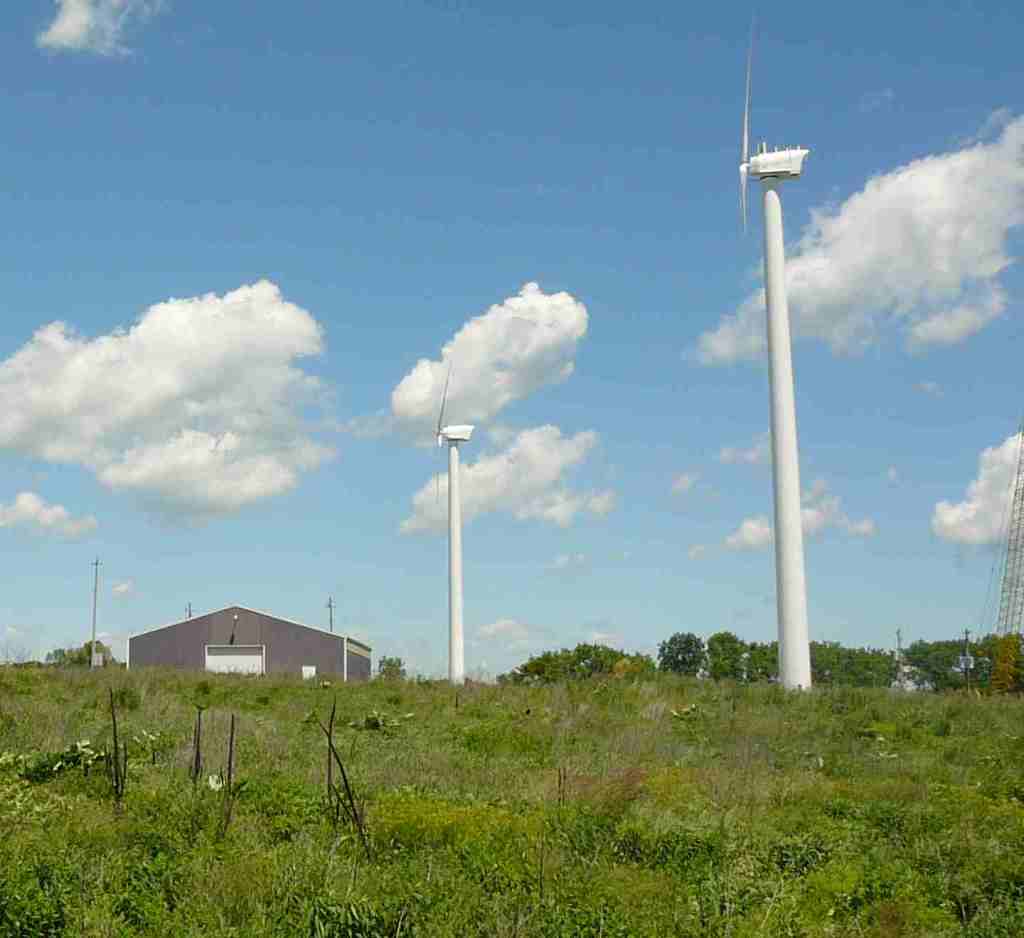
From a news release issued by RENEW Wisconsin:
With the start-up of two 100-kilowatt (kW) wind turbines, the Village of Cascade became the first Wisconsin community to power its municipal wastewater treatment plant with 100 percent locally produced wind energy.
The impetus behind Cascade’s embrace of wind power was the avoided utility expenditures associated with operating a wastewater treatment plant. In the first year of operation, Cascade stands to save $30,000. With anticipated increases in electric rates, the Village of Cascade should save more than one million dollars over the thirty-year life of the turbines.
Additional revenue will come from the sale of excess power to We Energies.
“With these two turbines, the Village of Cascade has taken a giant step toward energy independence,” said Michael Vickerman. “Its prudent investment in wind energy will enable the community to control its energy budget, saving money for current and future residents.”
Kettle View Renewable Energy, LLC, a wind system installer located in nearby Random Lake, installed and commissioned Cascade’s turbines.
“We are proud that our local efforts on this project made this the first net-zero wastewater treatment plant in Wisconsin,” said project manager Randy Faller. “It speaks volumes to the commitment by the Village of Cascade to generate clean, domestic energy while saving their community money.”
These two turbines double the number of Northwind 100s operating in Wisconsin to four, all installed in the last 12 months. The first two installed turbines serve schools in Wausau and Fort Atkinson.
Northern Power Systems, the Vermont turbine manufacturer, “couldn’t be more pleased that our technologically advanced, American-made Northwind 100 turbines are delivering real energy solutions for municipalities, schools, businesses and farms across Wisconsin,” said Mr. Brett Pingree, Vice President of Americas at Northern Power Systems.
Grants from Milwaukee-based We Energies and Focus on Energy were instrumental in supplementing Cascade’s investment in the project.
by jboullion | Jun 9, 2010 | Uncategorized
FOR IMMEDIATE RELEASE
June 9, 2010
MORE INFORMATION
Michael Vickerman
RENEW Wisconsin
Executive Director
608.255.4044
Randy Faller
Project Manager
Kettle View Renewable Energy
920.994.9433
Eve Frankel
Northern Power Systems
Marketing Communications Manager
802.461.2935
Village of Cascade Installs Two Wind Turbines at Wastewater Plant
With the start-up of two 100-kilowatt (kW) wind turbines, the Village of Cascade became the first Wisconsin community to power its municipal wastewater treatment plant with 100 percent locally produced wind energy.
The impetus behind Cascade’s embrace of wind power was the avoided utility expenditures associated with operating a wastewater treatment plant. In the first year of operation, Cascade stands to save $30,000. With anticipated increases in electric rates, the Village of Cascade should save more than one million dollars over the thirty-year life of the turbines.
Additional revenue will come from the sale of excess power to We Energies.
“With these two turbines, the Village of Cascade has taken a giant step toward energy independence,” said Michael Vickerman. “Its prudent investment in wind energy will enable the community to control its energy budget, saving money for current and future residents.”
Kettle View Renewable Energy, LLC, a wind system installer located in nearby Random Lake, installed and commissioned Cascade’s turbines.
“We are proud that our local efforts on this project made this the first net-zero wastewater treatment plant in Wisconsin,” said project manager Randy Faller. “It speaks volumes to the commitment by the Village of Cascade to generate clean, domestic energy while saving their community money.”
These two turbines double the number of Northwind 100s operating in Wisconsin to four, all installed in the last 12 months. The first two installed turbines serve schools in Wausau and Fort Atkinson.
Northern Power Systems, the Vermont turbine manufacturer, “couldn’t be more pleased that our technologically advanced, American-made Northwind 100 turbines are delivering real energy solutions for municipalities, schools, businesses and farms across Wisconsin,” said Mr. Brett Pingree, Vice President of Americas at Northern Power Systems.
Grants from Milwaukee-based We Energies and Focus on Energy were instrumental in supplementing Cascade’s investment in the project.
END
RENEW Wisconsin: (http://www.renewwisconsin.org/) is an independent, nonprofit 501(c)(3) organization that acts as a catalyst to advance a sustainable energy future through public policy and private sector initiatives.
Northern Power Systems: (http://www.northernpower.com/) Northern Power has over 30 years of experience in developing advanced, innovative wind turbines. The company’s next generation wind turbine technology is based on a vastly simplified architecture that utilizes a unique combination of permanent magnet generators and direct-drive design. This revolutionary new approach delivers higher energy capture, eliminates drive-train noise, and significantly reduces maintenance and downtime costs. Northern Power systems is a fully integrated company that designs, manufactures and sells wind turbines into the global marketplace from its headquarters in Vermont, USA.
Kettle View Renewable Energy LLC (http://www.kettleviewre.com/) provides consulting, site assessments, and installation services for wind energy systems.
by jboullion | Jun 8, 2010 | Uncategorized
From an article in the Stevens Point Journal:
Volunteer program: Midwest Renewable Energy Association’s 21st annual Energy Fair
Volunteer spotlight: The qualities that define a strong community are different to everyone. For some, a strong community means healthy, happy children. For others, it means a population of people who can read and write well. And for others, it means nurturing the environment that provides a home for us all. There are kind and dedicated volunteers throughout our county who work to build up all of these strengths and more. Ed Lemar is one of these volunteers.
Lemar has created a life in Portage County with his wife and 2-year-old daughter. Lemar is a local artist, musician and playwright who also sells artisan cheese at Wisconsin farmers markets. When Lemar is not busy with one of these endeavors, he volunteers his time to the Midwest Renewable Energy Association, especially for its annual Energy Fair.
Each year, the MREA Energy Fair transforms rural central Wisconsin into the global hot spot for renewable energy education. The nation’s longest running energy education event brings people from nearly every state in the United States and several countries around the world to learn, connect with others and ready them for action at home. With more than 23,000 attendees, the Energy Fair relies on a team of 400 dedicated volunteers throughout the week to make it possible.
From June 14 through the 21, the MREA needs volunteers to help with set up before the fair, and take down after the fair, as well as help with hospitality, sales, grounds crew, traffic control and other tasks. Volunteers are welcome each day to help at the Midwest Renewable Energy Association’s ReNew the Earth Institute in Custer.
by jboullion | Jun 7, 2010 | Uncategorized
AC_FL_RunContent( ‘codebase’, ‘http://download.macromedia.com/pub/shockwave/cabs/flash/swflash.cab#version=8,0,0,0’, ‘width’, ‘405’, ‘height’, ‘191’ , ‘src’, ‘http://storybridge.tv/sites/all/themes/storybridge/swfs/sbplay_seg02c’, ‘quality’, ‘high’, ‘pluginspage’, ‘http://www.macromedia.com/go/getflashplayer’, ‘align’, ‘middle’, ‘play’, ‘true’, ‘loop’, ‘true’, ‘scale’, ‘showall’, ‘wmode’, ‘transparent’, ‘devicefont’, ‘false’, ‘id’, ‘sbplay_seg02c’, ‘bgcolor’, ‘#000000’, ‘name’, ‘sbplay_seg02c’, ‘menu’, ‘true’, ‘allowFullScreen’, ‘true’, ‘allowScriptAccess’, ‘always’, ‘movie’, ‘http://storybridge.tv/sites/all/themes/storybridge/swfs/sbplay_seg02c’, ‘salign’, ‘tl’, ‘FlashVars’, ‘pathPrefix=http://storybridge.tv&segList=%2Ffiles%2FMakingTheTeamOpen_main.jpg%0D%0A%2Ffiles%2Fmakingtheteam_0.swf%2C8%0D%0A%2Ffiles%2Fep132main_1.swf%2C33%0D%0A%2Ffiles%2Fep132main_2.swf%2C44%0D%0A%2Ffiles%2Fep132main_3.swf%2C111%0D%0A%2Ffiles%2Fep132main_4.swf%2C66%0D%0A%2Ffiles%2Fep132main_5.swf%2C9%2Chttp%3A%2F%2Fwww.mge.com%2Fbusiness%2Fsaving&lc0=Z&lc1=X&lc2=X&lc3=X&lc4=X&autoplay=false&pingPath=http://storybridge.tv/files/ping.txt&myTitleIn=MAKING+THE+TEAM&mp4_path=/files/MakingTheTeam.mp4&selfURL=http://storybridge.tv/greenview/makingtheteam&nextNode=http://storybridge.tv/greenview/solarsystems&nextNodeTitle=SOLAR+SYSTEMS&nextNodeTease=Solar+is+hot+right+now%21++There%27s+a+lot+of+curiousity+and+for+years%2C+MGE+engineers+have+been+preparing+themselves+to+answer+those+questions.%0D%0A%0D%0AIn+an+attempt+to+learn+all+about+solar%2C+MGE+has+spent+the+last+10+years+building+solar+demonstrations+projects+in+all+shapes+and+sizes.++%0D%0A%0D%0AIn+this+story%2C+get+up+close+to+some+unique+solar+systems+and+find+out+what+engineers+have+learned+by+testing+ideas+in+the+real+world.%0D%0A%0D%0Awindow.onload%3Dfunction+%28%29+%7B+document.getElementById%28%22liHome%22%29.className+%3D+%22off%22%3B+document.getElementById%28%22liAskBob%22%29.className+%3D+%22off%22%3B+document.getElementById%28%22liGenerationGreen%22%29.className+%3D+%22off%22%3B+document.getElementById%28%22liWindEnergy%22%29.className+%3D+%22off%22%3B+document.getElementById%28%22liSolarEnergy%22%29.className+%3D+%22on%22%3B+document.getElementById%28%22liArchive%22%29.className+%3D+%22off%22%3B%7D+&nextNodeImg=http://storybridge.tv/files/ep83thumb_poster.jpg’);
by jboullion | Jun 7, 2010 | Uncategorized
AC_FL_RunContent( ‘codebase’, ‘http://download.macromedia.com/pub/shockwave/cabs/flash/swflash.cab#version=8,0,0,0’, ‘width’, ‘405’, ‘height’, ‘191’ , ‘src’, ‘http://storybridge.tv/sites/all/themes/storybridge/swfs/sbplay_seg02c’, ‘quality’, ‘high’, ‘pluginspage’, ‘http://www.macromedia.com/go/getflashplayer’, ‘align’, ‘middle’, ‘play’, ‘true’, ‘loop’, ‘true’, ‘scale’, ‘showall’, ‘wmode’, ‘transparent’, ‘devicefont’, ‘false’, ‘id’, ‘sbplay_seg02c’, ‘bgcolor’, ‘#000000’, ‘name’, ‘sbplay_seg02c’, ‘menu’, ‘true’, ‘allowFullScreen’, ‘true’, ‘allowScriptAccess’, ‘always’, ‘movie’, ‘http://storybridge.tv/sites/all/themes/storybridge/swfs/sbplay_seg02c’, ‘salign’, ‘tl’, ‘FlashVars’, ‘pathPrefix=http://storybridge.tv&segList=%2Ffiles%2FMakingTheTeamOpen_main.jpg%0D%0A%2Ffiles%2Fmakingtheteam_0.swf%2C8%0D%0A%2Ffiles%2Fep132main_1.swf%2C33%0D%0A%2Ffiles%2Fep132main_2.swf%2C44%0D%0A%2Ffiles%2Fep132main_3.swf%2C111%0D%0A%2Ffiles%2Fep132main_4.swf%2C66%0D%0A%2Ffiles%2Fep132main_5.swf%2C9%2Chttp%3A%2F%2Fwww.mge.com%2Fbusiness%2Fsaving&lc0=Z&lc1=X&lc2=X&lc3=X&lc4=X&autoplay=false&pingPath=http://storybridge.tv/files/ping.txt&myTitleIn=MAKING+THE+TEAM&mp4_path=/files/MakingTheTeam.mp4&selfURL=http://storybridge.tv/greenview/makingtheteam&nextNode=http://storybridge.tv/greenview/solarsystems&nextNodeTitle=SOLAR+SYSTEMS&nextNodeTease=Solar+is+hot+right+now%21++There%27s+a+lot+of+curiousity+and+for+years%2C+MGE+engineers+have+been+preparing+themselves+to+answer+those+questions.%0D%0A%0D%0AIn+an+attempt+to+learn+all+about+solar%2C+MGE+has+spent+the+last+10+years+building+solar+demonstrations+projects+in+all+shapes+and+sizes.++%0D%0A%0D%0AIn+this+story%2C+get+up+close+to+some+unique+solar+systems+and+find+out+what+engineers+have+learned+by+testing+ideas+in+the+real+world.%0D%0A%0D%0Awindow.onload%3Dfunction+%28%29+%7B+document.getElementById%28%22liHome%22%29.className+%3D+%22off%22%3B+document.getElementById%28%22liAskBob%22%29.className+%3D+%22off%22%3B+document.getElementById%28%22liGenerationGreen%22%29.className+%3D+%22off%22%3B+document.getElementById%28%22liWindEnergy%22%29.className+%3D+%22off%22%3B+document.getElementById%28%22liSolarEnergy%22%29.className+%3D+%22on%22%3B+document.getElementById%28%22liArchive%22%29.className+%3D+%22off%22%3B%7D+&nextNodeImg=http://storybridge.tv/files/ep83thumb_poster.jpg’);