by jboullion | May 13, 2010 | Uncategorized
From a post by Jeff Sherman, president of OnMilwaukee.com, on Milwaukee Biz Blog:
One of the many things I truly love about Milwaukee is its commitment to its past and its steady, although sometimes too slow and sure, movement through its innovative present and onward to its future.
Streetcars, no doubt, are a testament to a city’s past but also to its success. Look at any modern, successful city and nearly all have integrated transportation systems that involve roads, sidewalks, highways, rail, streetcars, bikes, busses and more.
Milwaukee’s lagged way behind in the past 30 years, but now it’s poised to move forward in the transportation game. I know some cry about the costs. Honestly, its infrastructure that we need. I live downtown and rarely use the Marquette Interchange, but I pay for it and see its need. Sidewalks, roads and highways – they don’t “make money” but they do provide quality-of-life that we must have in greater Milwaukee.
I also realize that we can battle back and forth on ridership. Projections, though, show that Milwaukee’s 3.6-mile modern streetcar line is estimated to generate daily ridership of 3,800 passengers, a level that exceeds the ridership of all 11 MCTS Freeway Flyer routes and 12 of the 29 MCTS regular routes.
All numbers aside, it’s time once and for all to put petty politics behind and improve transportation in Milwaukee.
Transportation isn’t a Republican or Democratic issue; it’s a simple, quality-of-life matter.
So, here are my 8 reasons why you should look forward to the new streetcar system in downtown Milwaukee . . .
by jboullion | May 13, 2010 | Uncategorized
From an article in the Wausau Daily Herald:
ROTHSCHILD — The massive coal-fired power plant Weston 4 must limit the visibility of pollutants leaving its main smokestack but does not need tighter controls for other emissions, an appeals court ruled today.
A three-judge panel of the District 4 Court of Appeals agreed with the Sierra Club that the state Department of Natural Resources erred when it did not require the smokestack for the plant’s main boiler to follow a federal visibility standard for pollutants on its air pollution permit.
Limiting the visibility of emissions effectively limits the amount of harmful particulate matter that becomes airborne. The DNR and the plant’s operator, Wisconsin Public Service Corp. of Green Bay, argued the visibility standard was unnecessary because emissions of particulate matter and sulfuric acid from the boiler were controlled in other ways.
The appeals court sided with the environmental group, which argued that the visibility standard was clearly required under the Clean Air Act. The rule will require continuous monitoring to ensure the pollution leaving the smokestack meets an opacity standard — that it is much closer to invisible than a thick black cloud of dust.
The court rejected the Sierra Club’s argument that the plant needs to install different technology to further reduce emissions of sulfur dioxide and nitrogen oxide. The court found the limits set by the DNR were appropriate.
The $774 million plant near Wausau opened in 2008. It is owned by WPS and Dairyland Power Cooperative of La Crosse, and they say it is one of the cleanest coal plants in the nation.
The Sierra Club says it is nonetheless one of the largest pollution sources in central Wisconsin and has fought for years to strengthen the air permit.
by jboullion | May 12, 2010 | Uncategorized
From a post by Milwaukee Alerman Robert Bauman on the Milwaukee Biz Blog:
Milwaukee County Clerk Joe Czarnezki has floated the idea of establishing a high-speed rail station in western Milwaukee County in the vicinity of the Milwaukee County Research Park. This is an excellent idea that deserves serious consideration by the state Department of Transportation and the Federal Railroad Administration (FRA).
In addition to the research park, this station would serve dense commercial development along Mayfair Road and the Milwaukee County Medical Complex. Employment in this area is second only to downtown Milwaukee. Moreover, this station would serve relatively dense suburban residential communities as well as west side Milwaukee neighborhoods.
A station on the high-speed rail line in the vicinity of Watertown Plank Road and Mayfair Road would be easily accessible via major arterial roads and within one mile of I-94 and Highway 45 interchanges and within one mile of busy Mayfair Mall. This station location would also be accessible to existing Milwaukee County Transit routes and could serve as an intermodal terminal for enhanced local transit service.
In short, this station location would generate significantly higher ridership than a stop in Brookfield.
by jboullion | May 12, 2010 | Uncategorized
From an editorial in the La Crosse Tribune:
A study by a team of business students at the University of Wisconsin-La Crosse found a great deal of enthusiasm for high-speed rail among La Crosse area business people.
Megan Louwagie, Brianna Murray, Bryant Poss and Chelsey Wagner conducted the study, sponsored by the La Crosse Area High-Speed Rail Coalition, for their Business 230 class, using 545 e-mail surveys returned by area business people.
The respondents were well aware of La Crosse’s position as a possible stop on a proposed high-speed rail line between Chicago and the Twin Cities (an average of 4.41 on a five-point scale, on which one is “not aware” and 5 is “very aware”), and 83 percent said they would use high-speed rail to travel to destinations along the proposed La Crosse route.
Business people are generally news-savvy, and their awareness of the high-speed rail issue wasn’t surprising. But the
students’ original premise was that area business people wouldn’t be all that interested in actually using a passenger rail system.
The data the students compiled proved their assumption incorrect, both for business and leisure travel.
The average respondent was quite interested in using such a system (4.33 on a five-point scale), and high-frequency departures and arrivals (six trains per day in each direction) would increase their use of passenger rail (4.72 on a five-point scale).
Fourteen percent of respondents reported they presently use Amtrak.
On average, business people rated the importance of bringing a high-speed rail route through the city to be a 4.01 on a five-point scale (again one being “not important” and five being “very important”).
by jboullion | May 12, 2010 | Uncategorized
Energy Concepts, Inc., a Hudson, WI based Renewable Energy Engineering Firm is seeking a part time summer intern.
We would like to expand and improve our social media outreach, blogs, and other electric media efforts. (facebook page, twitter, yelp, photos on flickr).
Ideal candidate has marketing and communications background, great oral and written skills and some interest or knowledge in the renewable energy field. (interest being the key).
This position also includes assisting liason staff member in our office to organize community events and support with other marketing efforts.
Please apply by Monday, May 17, 2010.
Approximately 15 hours/week, salary depends on experience, position starts immediately.
Please apply by May 17, 2010. Send resume and letter of interest to Kathy Tarr at ktarr@energyconcepts.us.
Contact Kathy at 715 808-1385 (cell) or 715 381-9977 (office)
www.energyconcepts.us
by jboullion | May 11, 2010 | Uncategorized
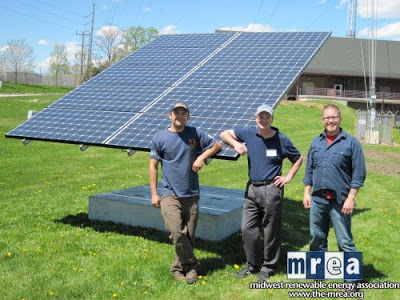
Nick Matthes and Ed Stoll of Pieper Electric (who will be installing the PV), flank Rich Hinkelman of Solar Systems Inc (who build the racking for the system). All are MREA supporters and Energy Fair exhibitors!
From a post on Tom Content’s blog on the Milwaukee Journal Sentinel site:
Leaders at Milwaukee Area Technical College kicked off the construction of the largest solar project in the state with a groundbreaking ceremony Wednesday afternoon north of Capitol Drive.
The solar project — dubbed the Photovoltaic Educational Farm — will be developed on a former landfill along the Milwaukee River, underneath the television tower for MPTV, Milwaukee Public Television.
The project will feature nearly 2,600 solar panels from four different manufacturers, in eight different configurations. It’s scheduled to be completed in August.
The aim of the project is to showcase a variety of renewable energy technologies, as well as provide training in solar field to students at MATC as well as Milwaukee’s three engineering schools, said Brad Bateman of Johnson Controls.
“This will be a testing and training platform unlike any other in the country,” he said.
The project is projected to generate enough power to make the TV transmitter for MPTV the first of any public television station in the country to be powered with renewable energy. MPTV projects energy savings of at least $70,000 in its first year of operation.
The project will employ 150 people, said Sargent.
Johnson Controls Inc. is the technical college’s partner and general contractor on the project, which includes 14 other firms — 13 of them from Wisconsin.
by jboullion | May 10, 2010 | Uncategorized
From a story on WQOW-TV, Eau Claire:
Eau Claire (WQOW) – Eau Claire rolls out a contest to get more city employees out of their cars and onto public transportation.
May is bike month. In honor of that, Eau Claire is holding a contest called Rack n’ Roll for city employees.
Wednesday morning’s commute to work was unusual for Colleen Shian. She took the bus.
“I hadn’t ridden the bus, I did once before, but I thought it would be fun to try and see how it worked,” says Colleen Shian, City of Eau Claire Risk Manager.
Shian often thought about taking the bus to work, but never made it part of her daily routine. The three week Rack n’ Roll contest gave her the extra incentive to try it out.
“The Rack n’ Roll event is a great way to tie not only sustainability, but active living, physical fitness together in a fun way to come to work using maybe your bike or bus or combination there of or carpooling,” says Ned Noel, City of Eau Claire Associate Planner.
Employees are given a ‘trekker card’ with eight activities on it. Those eight activities are:
-Participate in a City wellness program
-Walk for 20 minutes, 5 days in a row
-Use City trail system
-Bike to work
-Use bike and bus to reach a destination
-Use City bus
-Take bus to work
-Carpool
Employees have until May 20th to do five of the eight activities. If they complete them, they are entered to win prizes such as golf lessons or passes to Fairfax Pool.
by jboullion | May 10, 2010 | Uncategorized
From an article by Cara Spoto in the Stevens Point Journal:
Hoping to reduce Portage County’s carbon footprint and save a little money in the process, county leaders will start work this month on a strategic energy plan.
The Smart Energy Team, led by Portage County Executive Patty Dreier and County Board Chairman O. Philip Idsvoog, has a goal of having a plan in place by Dec. 1. Toward that end, the group has received $12,000 in capital improvement dollars, along with a $4,500 grant, which may be used to hire a consultant.
Jennifer Stewart, community development educator with the University of Wisconsin-Extension in Whiting, said the first phase of the planning process will largely consist of taking a snapshot of how much energy the county consumes and in what ways.
“What we have talked about doing at the first meeting is reviewing the scope of the committee’s charge and start identifying first steps,” Stewart said.
From there, the team will draw on the knowledge of experts and its members, including Planning and Zoning Director Jeff Schuler, Facilities Director Todd Neuenfeldt and the chairs of the finance and space and properties committee, to establish a set of goals for consumption, alternative energy use and conservation.
Options for achieving such goals could include retrofitting buildings, altering building operations, purchasing energy-efficient equipment, using alternative energy sources and educating employees.
by jboullion | May 10, 2010 | Uncategorized
From an story by on WXOW-TV, La Crosse:
Onalaska, Wisconsin (WXOW)- How would you like to save three hundred dollars on your home energy bill?
That’s how much one Onalaska man is saving after having his home weatherized for free, thanks to Couleecap.
The private, nonprofit agency will be spending between 6500 dollars and 8500 dollars to weatherize homes that meet eligibility requirements.
With the assistance, the Burkhardt’s were able to re-insulate their home, replace their water heater, and put in a new furnace for free.
In turn, he is able to save money on his energy bills.
In total, Burkhardt is now saving about three hundred dollars.
Burkhardt isn’t the only that stands to see savings.
More than a thousand other homes will also be weatherized like Burkhardt’s was under the Couleecap program.
Executive Director Grace Jones says, “It’s part of the overall energy conservation movement trying to reduce reliance on fossil fuels and non-renewable.
Which also means less dependence on foreign fuel.
Although the program is free for the recipients, the money is coming from somewhere.
Couleecap has a little more than 8.3 million dollars in its budget for the weatherization program thanks to state and federal dollars, including about 3.6 million dollars coming from the American Recovery and Reinvestment Act or stimulus package. . . .
If you think you might be eligible for the weatherization program, go to Couleecap.org.
Or call, Couleecap their in La Crosse in 608-782-4877 or 1-866-717-9490.
by jboullion | May 10, 2010 | Uncategorized
From an article by Don Behm of the Milwaukee Journal Sentinel:
The roof of Milwaukee’s Central Library sprang to life, and went to work, in Friday’s steady rain.
Thousands of sedum, a ground-covering plant, and clumps of chive and ornamental grasses – all perennials – were planted Friday in a six-inch layer of small gravel and soil spread across 30,000 square feet – nearly seven-tenths of an acre – to create a green roof atop the historic building, said Taj Schoening, business operations manager for the Milwaukee Public Library.
Its job is to mimic nature. The living roof will collect and store thousands of gallons of rainwater during a downpour, rather than allowing the clean water to drain immediately to a street sewer, Schoening said.
Each gallon of fresh water kept out of the pipes decreases the risk of sewer overflows, according to Kevin Shafer, executive director of the Milwaukee Metropolitan Sewerage District.
Combined sanitary and storm sewers on Wisconsin Ave. in front of the library quickly fill with rain in a deluge and begin spilling into the district’s deep tunnels. Pipes draining street sewers into the tunnels are closed as the underground caverns fill, causing street sewers to overflow to local rivers and Lake Michigan.
Green roofs can become saturated after hours of heavy rainfall, and additional rain would slowly begin to drain to a street sewer. But that delay in draining to a sewer buys time for the district’s system of tunnels and sewage plants to treat earlier flows.
An added benefit for taxpayers is the durability of the library’s green roof, Schoening said.
“This will double the life expectancy of our flat roof,” she said. “We won’t have to do this again for 40 years.”